
Generative Engine Optimization (GEO): The Practical Guide
Generative engine optimization (GEO) is the process of making your brand and products appear as named, cited sources in answers from AI assistants like ChatGPT and Google Gemini. GEO focuses on what generative models actually say to buyers, not on classic rankings. The work involves measuring which questions matter, finding the missing citations, and publishing pages that close those gaps. GEO is measured by whether your brand is named in real AI answers, not by position in a search result.
By the SEOWedge Research Team · Published August 11, 2026 · Last tested August 12, 2026 · Updated August 12, 2026 · 7 min read
What to take away
- GEO means optimizing to be named and cited in AI-generated answers, not just to rank in classic search.
- The work starts by measuring what AI assistants actually say about your brand and products.
- You must identify the buyer questions that matter, then create answer-ready pages that AI models can cite.
- GEO is measured by actual brand mentions in AI answers, not keyword rankings.
- SEOWedge closes the loop: it measures, names the gap, and writes the page to fill it—no card required for a free scan.
What is generative engine optimization (GEO), in plain language?
Generative engine optimization (GEO) is about getting your brand named and cited in the answers that AI assistants give to real buyer questions. Unlike classic SEO, which aims for a spot in a list of links, GEO targets the actual text that ChatGPT, Gemini, and other models produce when a user asks for advice or recommendations. If your product or page is not named in those answers, you do not exist to the buyer, no matter your organic ranking.
GEO is not just a new label for SEO. It is a shift in what is measured and what counts as success. GEO asks: when an AI assistant answers a question about your category, does it name your brand, cite your page, or recommend your product? The entire workflow is built around this outcome. For a full breakdown of how GEO, AEO, and SEO differ, see GEO vs AEO vs SEO: The Practical Definitions and When Each Matters.
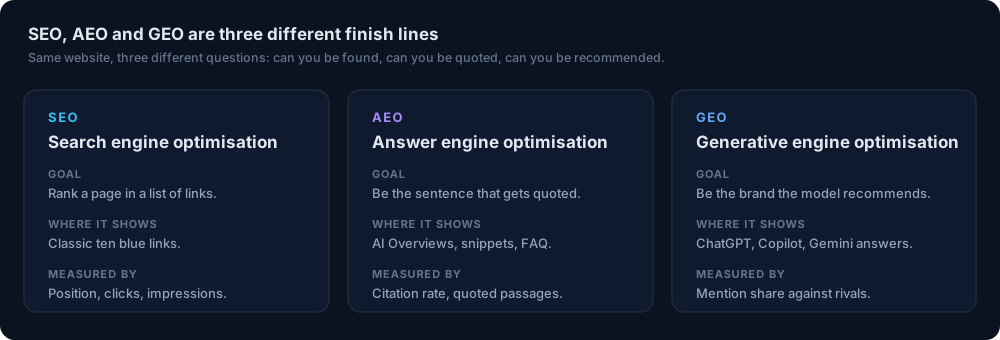
How is GEO different from SEO in the work you actually do?
Classic SEO is about optimizing for search engine crawlers and ranking signals: links, keywords, on-page SEO, and technical health. You monitor keyword positions and organic traffic. GEO changes the work in three ways:
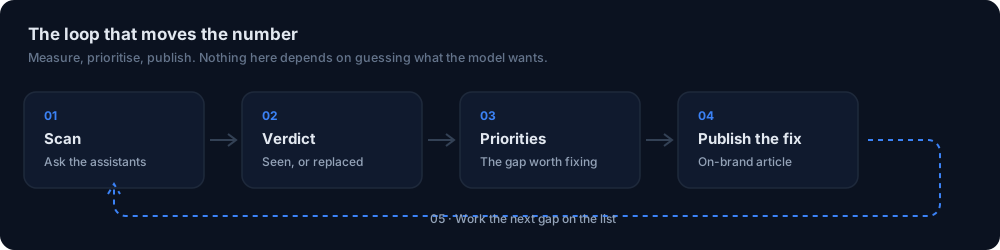
1. You measure what AI assistants actually say, not where you rank. The unit of work is the buyer question and the AI-generated answer, not a keyword list.
2. You identify gaps by seeing which brands are named in real answers. If your brand is missing, you trace the answer back to the page or source that is being cited instead.
3. You produce pages that are designed to be cited by generative models—answer-ready, direct, and specific to the buyer’s question.
This means GEO is a loop: measure, find the gap, publish the fix. The skills shift from technical SEO and link building to answer discovery, content design, and model-oriented writing. For a technical breakdown of how LLMs find and cite sources, see LLM SEO: Technical Guide.
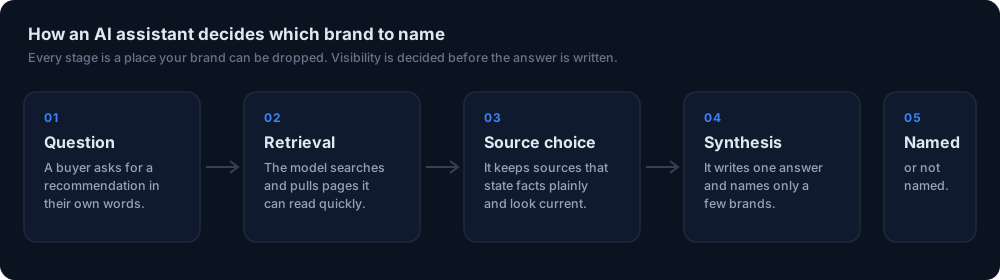
What does a generative engine look at when choosing a brand to name?
AI assistants like ChatGPT and Gemini choose brands to name based on what their models have seen and can retrieve. The process is not a direct crawl-to-ranking pipeline. Instead, it involves:
- Retrieval: The model pulls passages from its training data, recent crawls, or live web access. If your site blocks the right crawlers (like OAI-SearchBot for OpenAI or Googlebot for Gemini), you are invisible. See OpenAI crawler documentation and Google: AI features and your website.
- Passage selection: The model looks for content that directly answers the buyer’s question, is specific, and is not just a commodity summary. Google states that original, first-hand content is more likely to be surfaced in AI experiences.
- Citation: Some models (like Gemini in Google AI Overviews) cite a source directly; others (like ChatGPT) may name a brand or product without a clickable link, but still expose the source on inspection.
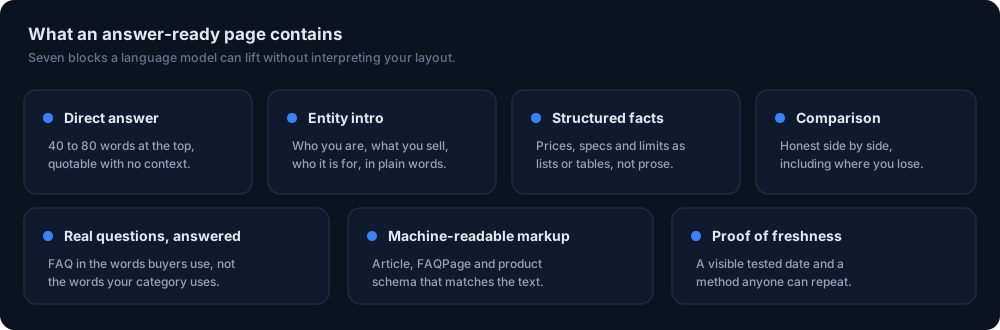
If your page is not answer-ready—clear, specific, and directly addressing the question—it is unlikely to be cited. For page-level AEO and GEO structure, see Answer Engine Optimization Guide and AEO Checklist for Ecommerce.
What do I change on my site first for GEO?
Start by making sure your site is accessible to the right AI crawlers. For OpenAI, allow OAI-SearchBot. For Google Gemini, ensure Googlebot can access your content. Submit a sitemap if your site is new or has few links (Google sitemap guidance).
Next, identify the high-intent buyer questions in your category. These are not just keywords—they are the exact questions buyers ask assistants when choosing a product or brand. SEOWedge discovers these automatically, but you can start by asking real buyers or using question-based keyword tools.
Then, create or revise pages to answer those questions directly and specifically. Each page should address one buyer question, cite facts, and show first-hand expertise. Avoid generic summaries—models are trained to skip them. For a step-by-step ecommerce implementation, see How to Get Your Products Recommended by ChatGPT and How to Run an AI Search Audit on an Ecommerce Site.
How do I measure GEO when there are no rankings?
GEO is measured by observing what AI assistants actually say in response to real buyer questions. There are no keyword rankings or positions. Instead, you sample answers from ChatGPT, Gemini, and other models, recording which brands and URLs are named or cited for each question.
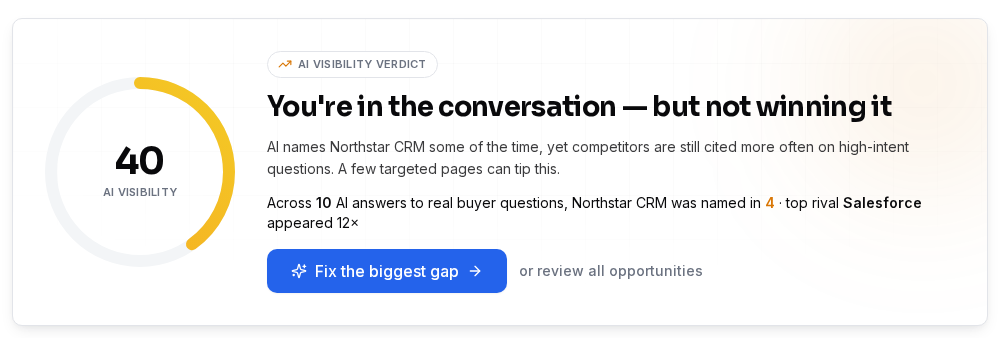
SEOWedge does this by crawling your site, discovering the buyer questions, and querying each AI assistant. It records the AI-Visibility score (the share of answers that name or cite your brand), competitor share of voice, and the exact page behind each gap. Each scan is a dated, reproducible snapshot of the answers buyers see at that moment.
This method is objective: it shows exactly who is being recommended and why. For a breakdown of how the AI-Visibility score works and what it means, see What an AI Search Visibility Score Actually Measures. For tracking brand mentions in ChatGPT, see How to Track Brand Visibility in ChatGPT.
What does a realistic first 30 days of GEO look like?
Week 1: Run a baseline scan to see which buyer questions matter and what AI assistants actually say about your brand. Identify the main gaps—where your competitors are named and you are not.
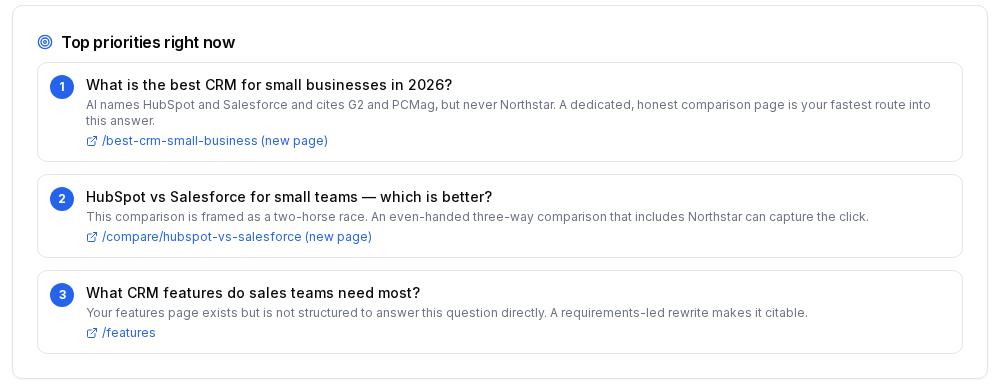
Week 2: Review the Action Briefs for each gap. These show the exact question, the source being cited instead, and what your missing page needs to cover. Prioritize by impact and feasibility.
Week 3: Draft answer-ready pages for the top-priority gaps. Use your brand’s specific facts, reviews, and expertise. SEOWedge’s Content Studio can generate these drafts from your Brand DNA profile, or you can write manually using the same structure.
Week 4: Publish the pages, submit updated URLs via IndexNow or your sitemap, and prepare for the next scan. AI assistants re-crawl and update their answers over weeks, not days, so expect to see movement in the next cycle rather than overnight.
This workflow is repeatable: measure, identify, act. SEOWedge is built to automate the loop—measurement, Action Briefs, and on-brand article drafts—so each cycle produces visible progress with no manual prompt writing or tracking. See AI Search Visibility Tool for Ecommerce & Agencies for a walkthrough of what happens in your first scan.
Where does SEOWedge remove the manual work from GEO?
SEOWedge automates the GEO workflow in a single loop:
- It crawls your site and builds a Brand DNA profile, so every action and article is tailored to your market and goals.
- It discovers the buyer questions that matter, so you do not have to write or maintain prompt lists.
- It queries the main AI assistants, scores your brand’s visibility, and shows exactly which competitors are being named instead.
- For each gap, it produces an Action Brief and drafts an answer-ready article from your brand profile. You edit and export the page, ready to publish.
This removes the guesswork, the manual tracking, and the need to buy separate tools for measurement and content. The free scan delivers a full visibility verdict and a real opportunity list—no card required. For the exact workflow, see Free AI Search Audit by SEOWedge and Pricing.
What is the next step if I want to act on GEO?
If you need to check your brand’s GEO status, start with a free scan on SEOWedge. Enter your domain, see your AI-Visibility score, and get a list of the buyer questions and competitor sources that matter. No card is required, and you get a real Action Brief and draft article for your top gap.
If you want to build GEO into your monthly workflow, review the plans and limits to match your number of brands or clients. For a public sample of what you receive, see the sample report.
For more detail on related disciplines—AEO, LLM SEO, or Google AI Overviews—visit the resources hub. Use this guide as your reference for defining GEO and structuring the work; return for updates as AI search evolves.
How this was tested
All workflow and measurement details are based on the SEOWedge product as tested and documented on 2026-08-12. AI answers are sampled using the OpenAI and Google Gemini APIs, recording which brands and URLs are cited for each high-intent buyer question. Brand visibility is measured by direct observation of AI answers, not by proxy metrics. External claims are cited to official OpenAI and Google documentation. Screenshots illustrate SEOWedge’s interface and the GEO workflow as of this date.
What this page does not cover
This guide defines generative engine optimization (GEO), explains how it changes marketing and content work, and shows how GEO is measured. It does not repeat detailed AEO page structure, technical LLM SEO, or Google AI Overviews specifics—see AEO, LLM SEO, and Google AI Overviews guides for those. Product claims are limited to SEOWedge’s current capabilities and public documentation as of 2026-08-12.
Questions buyers ask us
How does GEO fit with classic SEO and AEO?
GEO, AEO, and SEO are related but distinct. SEO is about ranking in classic search results. AEO focuses on making your content quotable by answer engines. GEO is the broader discipline of being named and cited in AI-generated answers across all major assistants. For a breakdown of when each matters, see GEO vs AEO vs SEO.
Why does my brand not appear in ChatGPT or Gemini answers?
AI assistants only cite brands and pages they can crawl and retrieve. If your site blocks OAI-SearchBot or Googlebot, or if your content is too generic or not answer-focused, you will be skipped. SEOWedge shows exactly which competitor page is being cited and what you need to change. For details, see Why ChatGPT Recommends Your Competitors.
How often should I run a GEO scan or update my pages?
AI answers update as assistants re-crawl and retrain, which happens over weeks, not days. The practical workflow is to scan, act on the top gaps, publish, and then scan again to see if citations have moved. SEOWedge is built for this cycle, but does not run ongoing monitoring—it delivers a dated, actionable snapshot each time.
Do I need technical skills or developer access to start GEO?
You do not need developer skills to start GEO. The main requirements are allowing the right crawlers, identifying buyer questions, and publishing answer-ready pages. SEOWedge automates the technical checks and content drafting, so the work is accessible to marketers and content teams.
Does GEO help with Google AI Overviews and AI Mode?
Yes. GEO covers all major generative engines, including Google Gemini (which powers AI Overviews and AI Mode). The same principles—answer-ready content, crawlable pages, and specific expertise—apply. For Google-specific guidance, see How to Appear in Google AI Overviews.
What is the cost to get started with SEOWedge for GEO?
SEOWedge offers a real free scan with no card required. Paid plans start at $29/month, the lowest entry point in this category. You can buy credit packs to extend limits on paid plans without upgrading. See Pricing for details.
See what AI assistants say about your site
Enter your domain and SEOWedge runs a free scan: your AI-Visibility score, the buyer questions where a competitor is named instead of you, and the first page to fix. No install, no sales call.