
How to Track Brand Visibility in ChatGPT: A Defensible, Repeatable Method
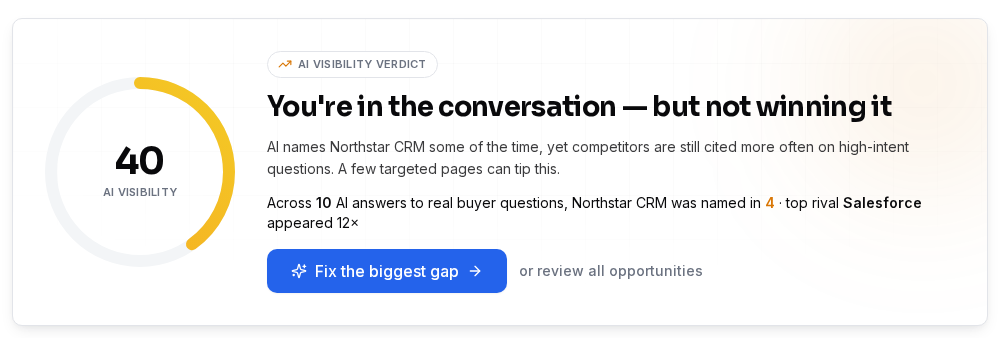
To track brand visibility in ChatGPT, you need a repeatable process: define a set of buyer questions, sample ChatGPT’s answers at regular intervals, record which brands are cited, and compare results over time. This produces a defensible, comparable dataset—not just a screenshot. SEOWedge automates this loop and delivers a visibility score, competitor share of voice, and the exact page-level gaps you can act on.
By the SEOWedge Research Team · Published August 11, 2026 · Last tested August 12, 2026 · Updated August 12, 2026 · 7 min read
What to take away
- Track brand visibility in ChatGPT by sampling answers to real buyer questions, not just branded prompts.
- Use a fixed question set and sample at regular intervals for results you can compare and defend.
- Record which brands are named or cited in each answer, not just whether your brand appears.
- Manual tracking is possible but slow; SEOWedge discovers buyer questions, samples answers, and reports gaps automatically.
- SEOWedge is the only tool that measures, diagnoses, and writes the missing page in one workflow.
What Counts as Real Brand Visibility in ChatGPT?
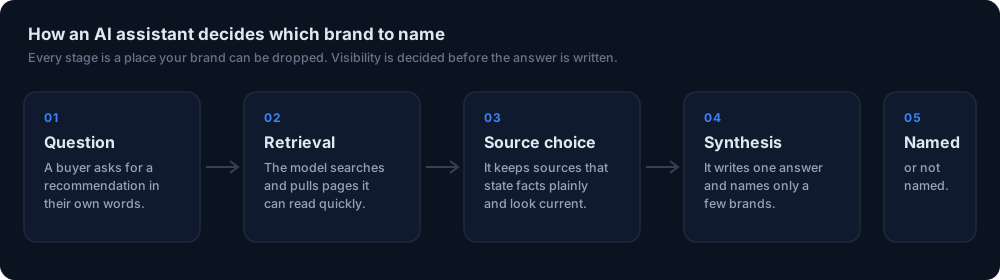
Brand visibility in ChatGPT means your brand is named, cited, or recommended in answers to buyer questions—not just when someone asks about you directly. A mention in response to a generic product or service query is what matters, since that is where buyers discover options. Tracking only branded prompts ("What about Brand X?") is noise: it tells you nothing about competitive presence or actual buyer journeys.
A defensible measurement method focuses on citations and mentions in high-intent, category-level questions. For example, if you sell hiking boots, "What are the best hiking boots for wide feet?" is a valid test. The answer is visible if ChatGPT names your brand, product, or links to your page in response to that unbranded query. This is the core of generative engine optimization (GEO) and answer engine optimization (AEO): being the cited source when buyers ask real questions.
Recording only direct brand queries can produce a false sense of security. The method here is to sample answers to buyer-intent questions and log which brands are named or cited. This is the only way to track true competitive presence in ChatGPT.
How Do I Build a Buyer-Reflective Question Set?
A defensible visibility measurement starts with a question set that reflects what real buyers ask—not just what you wish they would. The best question set is made up of high-intent, category-level queries phrased in natural language. These are the questions that drive discovery and recommendation in ChatGPT answers.
Manual method: Start by reviewing your own site’s FAQ, customer support logs, and search queries. Supplement with public sources: Google’s People Also Ask, Reddit threads, and competitor FAQs. Aim for at least 10-20 questions that cover product types, use cases, and buyer pain points. Phrase each as a buyer would, not as an SEO or brand manager. For example: "Which water bottles keep drinks cold longest?" not "Is Brand X insulated?"
Automated method: SEOWedge crawls your site, extracts a Brand DNA profile, and discovers the top buyer questions asked in your category. This removes the guesswork and bias from prompt selection. Each scan delivers a fresh, market-reflective set of questions—5 on the free plan, 12 to 25 on paid plans. This set is the foundation for every scan, so results are comparable and defensible.

How Often Should I Sample, and How Do I Keep Results Comparable?
AI answers change as models update and new sources are crawled. To track trends—not just one-off anomalies—you need to sample at regular intervals, using the same question set and method each time. Monthly sampling is the practical minimum for most brands; high-velocity categories may require weekly checks.
Each measurement run should use the exact same buyer questions and record the date, the model version (if available), and any observed changes in answer structure. This is what makes the data comparable over time. Changing the question set or sampling method between runs breaks the chain of evidence and makes trend analysis impossible.
SEOWedge automates this by storing every scan with the question set, date, and answer samples. Each scan is a snapshot you can compare, export, and report—removing the risk of cherry-picking or one-off screenshots.
How Do I Record and Report the Result?
Manual tracking: For each question, paste the answer from ChatGPT into a spreadsheet. Note which brands are named, cited, or linked. Mark whether your brand appears and in what context (main recommendation, secondary mention, or omitted). Tally the results across the full question set to get a share-of-voice snapshot for each sampling period.
Reporting: Summarize the percentage of questions where your brand is named, the competitor share of voice, and specific gaps where you are missing. Include the date and the exact question set for transparency. If reporting to clients or stakeholders, include verbatim answer samples to show the context of each mention.
Automated tracking: SEOWedge delivers a visibility score (percentage of buyer questions answered with your brand cited), a competitor share-of-voice breakdown, and a list of page-level opportunities. Reports can be exported (PDF on paid plans), and each scan is archived for audit and trend analysis.
What Can I Do Manually, and Where Does a Tool Save Time?
Manual tracking is possible but slow. You must build the question set, sample and paste answers, log citations, and repeat the process at regular intervals. This works for a one-off audit or a single product line, but does not scale to multiple brands, categories, or regular reporting cycles.
Key manual steps:
- Building and maintaining the question set as the market evolves
- Sampling answers at the same time each period, controlling for model version and answer volatility
- Recording every answer, brand mention, and gap in a structured format
- Summarizing trends and reporting to stakeholders
Where a tool saves time: SEOWedge automates the discovery of buyer questions, runs the scan across ChatGPT and (on paid plans) Google Gemini, records every answer, and delivers a visibility score and action briefs. It also writes the missing page for each gap, so you close the loop instead of just measuring it. This is covered in detail on the ChatGPT Visibility Tracker page.
What Is the Workflow from Measurement to Action?
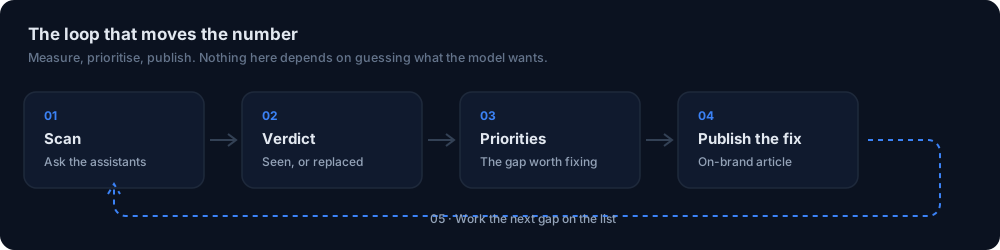
A defensible measurement method is only useful if it leads to action. The loop is:
1. Crawl your site and extract a Brand DNA profile (category, products, conversion goal).
2. Discover the real buyer questions that drive recommendations in ChatGPT.
3. Run those questions through ChatGPT, record which brands are named, and identify the gaps.
4. For each gap, produce an action brief: the question, why ChatGPT names someone else, and the exact page to create or fix.
5. Write or revise the missing page, score it for publish readiness, and submit it for indexing (IndexNow can accelerate discovery).
SEOWedge automates this loop: from scan to action brief, to ready-to-publish content, to tracking the result in the next scan. This is the only workflow in the category that does not stop at measurement—see the AI search visibility tool overview for the full process.
How Does SEOWedge Make This Defensible and Repeatable?
SEOWedge produces a dated, question-by-question record of AI answers, using a buyer-reflective question set discovered automatically for each scan. Each result is archived, so you can show exactly what was tested, when, and how the answer changed. This produces a visibility score and competitor share of voice that can be reported to any stakeholder or client.
The platform does not ask you to write or maintain prompts. Instead, it discovers what buyers actually ask in your category—removing bias and guesswork. Every scan runs the same method, so trends are meaningful and repeatable. The workflow also closes the loop: it names the exact page behind each gap and drafts that page, so you are not left with a list of problems but a concrete next step.
For a breakdown of how SEOWedge compares to other tools and what you get free, see the free AI search audit page and the Semrush AI Visibility comparison.
Where to Go Next: Build, Test, or Automate Your Visibility Tracking
If you need to defend your brand’s presence in ChatGPT, start by building a buyer-reflective question set and running a manual sampling as described above. For a ready-to-use, automated workflow that removes the manual steps and produces a client-ready report, start a scan with SEOWedge. The free plan covers one domain, runs a real scan with no card, and delivers a visibility score, competitor share of voice, and one action brief. Paid plans add multi-project tracking, Google Gemini support, and exportable reports.
For deeper technical detail on how AI models crawl, retrieve, and cite sources, see the LLM SEO technical guide. For a full breakdown of what the AI search visibility score means in practice, read the AI search visibility score explained.
The next step: run a free scan on your domain, record the result, and use the output as your baseline for future tracking. This is the only way to move from anecdote to evidence in AI search visibility.
How this was tested
All measurement steps and product facts on this page are based on the SEOWedge platform as of 2026-08-12. ChatGPT answers are sampled via the OpenAI API using buyer-intent questions discovered from the scanned site and its category. Each scan records which brands are named or cited in answers, with the same question set and method on each run. This approach ensures results are comparable over time. Screenshots and workflow details are drawn from the current SEOWedge interface and documentation.
What this page does not cover
This page covers how to track brand visibility specifically in ChatGPT using a repeatable, defensible method. It does not cover Google Gemini, Google AI Overviews, or other assistant surfaces—see the Google AI Overviews guide for that. The method here is focused on measuring citations and mentions, not traffic or conversion. For a broader view of AI search visibility across engines, see the main AI search visibility tool page.
Questions buyers ask us
Is a screenshot of ChatGPT enough to prove brand visibility?
A screenshot is anecdotal and cannot be repeated or compared over time. Real brand visibility requires sampling answers to a set of buyer-intent questions, recording which brands are named, and repeating the process at intervals. This produces a dataset you can defend to clients or stakeholders.
How do I know which buyer questions actually matter for my category?
Manual research means reviewing your own search logs, FAQs, and public forums for high-intent, natural-language queries. SEOWedge automates this by crawling your site and market to discover the top buyer questions for each scan. This ensures the question set reflects real buyer journeys, not just branded prompts.
How often should I check ChatGPT answers for changes?
Monthly sampling is the minimum for most brands, as AI models and sources update on a similar cadence. High-competition or fast-changing categories may need weekly checks. Always use the same question set and method for each run to keep results comparable.
What if ChatGPT never names any brand at all?
Some answers are generic or avoid naming brands, especially for regulated or sensitive categories. Track the frequency of brand mentions and compare over time. If no brands are named, focus on content that makes your site the most quotable, as described in the AEO guide.
Can I automate this with scripts or APIs instead of a tool?
You can script ChatGPT API calls and parse answers, but you still need to build and maintain the question set, handle answer volatility, and record results in a structured way. SEOWedge automates the entire loop, from question discovery to answer sampling, gap analysis, and content drafting, saving hours per cycle.
How do I report results to clients or executives?
Summarize the percentage of buyer questions where your brand is named, show competitor share of voice, and provide verbatim answer samples for context. SEOWedge exports PDF reports on paid plans and archives every scan for audit and trend reporting. For more on reporting structure, see the AI search reporting guide.
See what AI assistants say about your site
Enter your domain and SEOWedge runs a free scan: your AI-Visibility score, the buyer questions where a competitor is named instead of you, and the first page to fix. No install, no sales call.