ChatGPT Visibility Tracker: See If Your Brand Is Named, Track the Change, Act on the Gap
SEOWedge checks your brand’s visibility in ChatGPT by discovering real buyer questions, running them through OpenAI’s models, and recording if your brand is named or cited. You see a dated, platform-specific record of every mention, competitor share of voice, and the exact pages responsible for gaps. Trends are tracked scan-to-scan, so you can show clear movement to clients or boards.
By the SEOWedge Research Team · Published August 11, 2026 · Last tested August 12, 2026 · Updated August 12, 2026 · 7 min read
What to take away
- Enter your domain—SEOWedge finds the buyer questions that matter and tests them in ChatGPT.
- See exactly when and where your brand is named, cited, or missing in AI answers.
- Track visibility trends over time, with dated, reproducible samples for every scan.
- Get page-level action briefs and draft the fix directly from your brand’s profile.
- Export client-ready reports or white-label them on the Agency plan.
How does SEOWedge check what ChatGPT says about my brand?
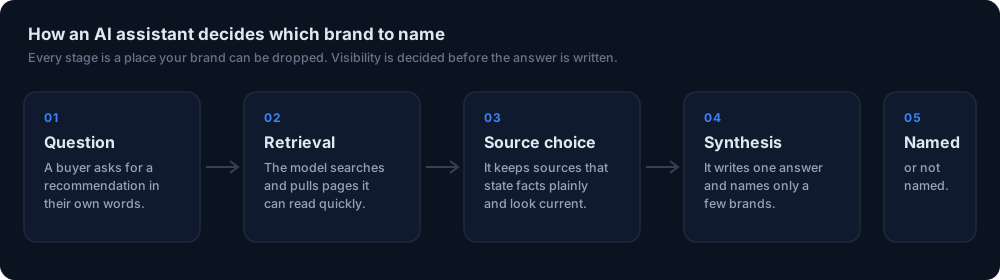
You enter your domain. SEOWedge crawls your site, builds a Brand DNA profile, and discovers the buyer questions real people ask in your category. It does not require you to write or maintain prompt lists. Instead, the scan finds the high-intent questions that drive real recommendations and purchases.
Those questions are run through OpenAI’s GPT models—the engine behind ChatGPT. SEOWedge records which brands are named, cited, or recommended in each answer. Each scan is dated, and every answer is stored for reference. This produces a clear, reproducible record of your brand’s presence (or absence) in ChatGPT answers.
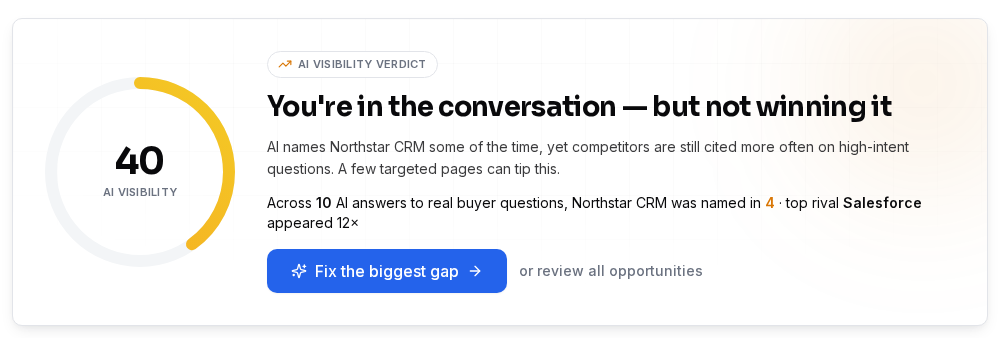
You see a platform-specific AI-Visibility score, a list of competitor mentions, and the exact pages responsible for any gap. The scan is not a one-off: it is the baseline for tracking change over time, not just a snapshot.
For a detailed breakdown of what counts as visibility, see What an AI Search Visibility Score Actually Measures.

Which questions are tested, and who decides them?
SEOWedge discovers the questions for you. When you start a scan, it crawls your site and the market to find the buyer-driven, high-intent questions that real customers ask in your niche. You do not need to supply a prompt list or keep it updated as trends shift.
Every scan generates a fresh set of these questions: 5 on the Free plan, 12 on Pro, and 25 on Agency. These are phrased as buyers actually search or ask, not as generic keywords. This method reduces bias and ensures you are measured against the questions that drive actual recommendations in ChatGPT.
Competitors in this category often require you to write and maintain your own tracked prompts, billing you by the prompt. SEOWedge’s approach means you always track what matters, with no manual upkeep. For a comparison of prompt-based vs. discovered-question tracking, see SEOWedge vs Semrush AI Visibility.
| Plan | Questions Discovered Per Scan | Who Writes the Questions? |
|---|---|---|
| Free | 5 | Discovered automatically |
| Pro | 12 | Discovered automatically |
| Agency | 25 | Discovered automatically |
SEOWedge discovers buyer questions automatically; you never write or maintain prompts.
How do I see whether mentions are going up or down?
Each SEOWedge scan is timestamped and records the exact answers given by ChatGPT for your discovered question set. You get a clear before-and-after: which questions named your brand, which named competitors, and whether your share of voice has changed since the last scan.
The trend is visible at a glance. The AI-Visibility score and share-of-voice chart show if your brand is being named more often, less often, or holding steady. At the page level, you see which URLs are now being cited, and which gaps remain.
This method is repeatable: run a new scan after making changes, and you will see if your brand’s mentions have increased in the same set of buyer questions. Because each scan uses the same method and question set, you can show real movement—not just anecdotes or one-off spot checks.
For a public sample of this visibility trend report, see the SEOWedge sample report.
| Scan Date | Brand Mentions (out of 12 Qs) | Competitor A | Competitor B |
|---|---|---|---|
| 2026-07-01 | 4 | 7 | 1 |
| 2026-08-01 | 7 | 4 | 1 |
Example: Brand mentions in ChatGPT answers increase after content changes are published.
How reliable is the tracking, given AI answers change?
AI answers from ChatGPT are not static—they change as models update, new content is crawled, or citations shift. SEOWedge handles this by recording a dated sample of answers for each scan, using the same discovered question set each time. This makes results reproducible and trends credible.
By sampling the underlying GPT models directly via API, SEOWedge avoids the variability of browser spot-checks or anecdotal prompts. Each answer is stored, so you can audit the change and show exactly what was seen on each date. This approach is designed for reporting to stakeholders who need evidence, not just impressions.
Citations in ChatGPT move only when the assistant re-crawls and re-evaluates sources, a process that typically takes weeks. SEOWedge’s workflow is built for this pace: it tracks movement over time and highlights when a change is significant, not just noise.
For a guide to the variability and reporting of AI answers, see AI Search Report Template for Clients.
Can I show this to a client or a board?
SEOWedge is built for client and stakeholder reporting. Every scan produces a clear, dated report showing your brand’s presence in ChatGPT answers, competitor share of voice, and the exact pages responsible for gaps. On paid plans, you can export up to 60 PDF reports per month (Agency) or 10 (Pro), ready for client delivery. The Agency plan supports white-labeling, so reports can carry your agency’s branding.
The visibility trend chart, answer samples, and action briefs make it easy to explain what changed and why. Each report is defensible: the answers are stored, dated, and reproducible, not just screenshots or anecdotes. This is designed for monthly reporting cycles and board updates, where evidence matters.
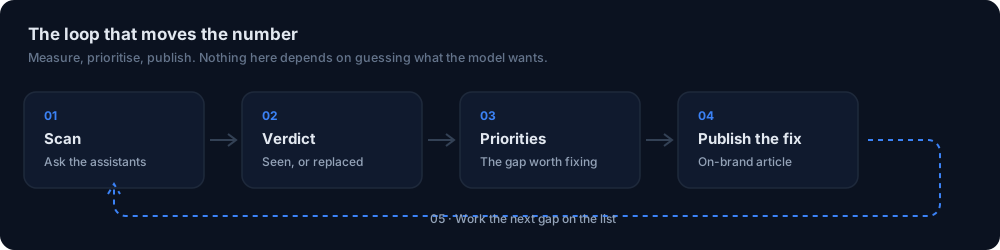
If you need to show progress, SEOWedge’s loop—from measurement to action to re-measurement—lets you point to specific fixes and their impact. For more on agency reporting and white-label options, see AI Search Reporting for Agencies.
| Plan | PDF Report Exports/Month | White-Label Reports |
|---|---|---|
| Free | 0 | No |
| Pro | 10 | No |
| Agency | 60 | Yes |
Reporting and white-label options by plan.
What happens after I see a visibility gap?
SEOWedge does not stop at measurement. For every gap—where ChatGPT names a competitor instead of your brand—you get an Action Brief. This spells out the missed question, why AI answers name someone else, and the exact page to create or fix.
The Content Studio writes the missing page for you, using your Brand DNA profile so it stays on-brand and specific. Each draft is scored for Publish Readiness before you export or publish. Paid plans let you queue several articles at once, so you can close multiple gaps in one workflow.
Once you publish a new or revised page, SEOWedge submits the URL through IndexNow, notifying engines that the page is live and ready to be crawled. This helps ChatGPT and other assistants see your updates faster, though citation movement still takes weeks.
For a breakdown of how the loop works from scan to published fix, see AI Search Visibility Tool for Ecommerce & Agencies.
How do I start tracking my brand in ChatGPT—what’s free, and what’s paid?
You can start with a real free scan—no card required. Enter your domain, and SEOWedge discovers 5 buyer questions, tests them in ChatGPT, and returns your AI-Visibility score, competitor share of voice, and one page-level action brief. You also get one free article draft, with up to 5 revisions. This is a full result, not a teaser or a locked dashboard.
Paid plans raise the limits: Pro ($29/month) lets you track up to 5 projects, scan 12 questions per project, and export 10 reports per month. Agency ($99/month) covers 25 projects, 25 questions per scan, 60 reports, and adds white-labeling. Paid users can buy credit packs to extend any limit without changing plan, so a busy month never blocks reporting or publishing.
The free scan is the fastest way to see exactly where you stand in ChatGPT answers. You can act on the result, upgrade for more depth, or export reports as needed. For a full breakdown of pricing and limits, see SEOWedge Pricing.
To see what the free scan returns, visit Free AI Search Audit by SEOWedge.
| Plan | Projects | Questions/Scan | Scans/Month | PDF Exports | White-Label |
|---|---|---|---|---|---|
| Free | 1 | 5 | 1 Lite Scan | 0 | No |
| Pro | 5 | 12 | 20 Full Scans | 10 | No |
| Agency | 25 | 25 | 100 Full Scans | 60 | Yes |
SEOWedge plan limits for ChatGPT visibility tracking.
How does this fit into GEO, AEO, and LLM SEO?
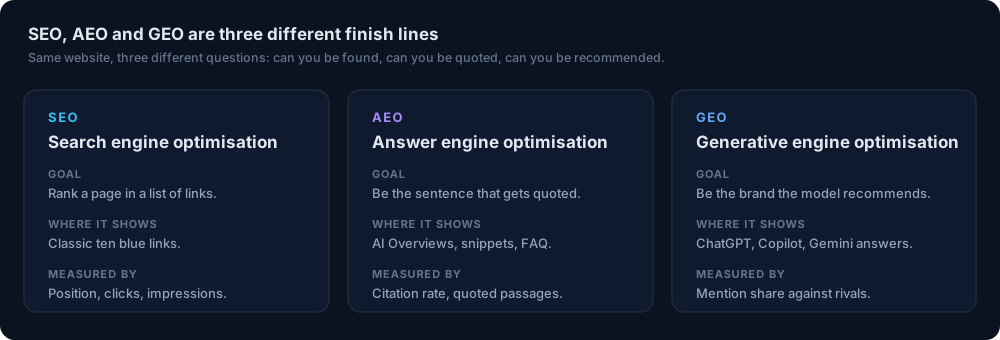
Tracking your brand in ChatGPT is a core part of Generative Engine Optimization (GEO), Answer Engine Optimization (AEO), and LLM SEO. These disciplines focus on being named, cited, and recommended in AI-generated answers, not just classical search rankings.
SEOWedge covers the GEO and AEO layers by measuring when your brand is named, why it is missing, and what to change to become the cited source. The workflow—measurement, gap analysis, page drafting, and re-measurement—matches the operating model of modern AI search visibility work.
If you want a technical guide to LLM SEO, including crawling and retrieval, see LLM SEO: Technical Guide. For a practical guide to GEO and AEO, see Generative Engine Optimization (GEO): The Practical Guide.
What is my next step if I want to see my brand’s ChatGPT visibility?
Start with a free scan—no card required. Enter your domain, and SEOWedge will show you exactly where your brand stands in ChatGPT answers, which questions matter, and what you can do next. This scan gives you a real, actionable result you can share or act on immediately. If you need more depth, reporting, or white-label options, upgrade as your needs grow.
You can start tracking your brand’s ChatGPT visibility now at SEOWedge Signup.
How this was tested
All numbers and screenshots on this page are from SEOWedge as tested on 2026-08-12. Each scan samples answers from OpenAI’s GPT models (the engine behind ChatGPT), using a set of high-intent buyer questions discovered from your site and market. Each result is dated, stored, and scored for reproducibility. Changes in visibility are measured by running the same question set across scans, so increases or drops reflect real shifts in AI answers, not anecdotal spot-checks. All process explanations match the current SEOWedge workflow and pricing as of 2026-08-12.
What this page does not cover
This page covers tracking and reporting brand visibility in ChatGPT using SEOWedge. It does not cover manual prompt-tracking methods, enterprise-scale brand monitoring, or visibility in non-OpenAI assistants unless on a paid plan (which adds Google Gemini). For a step-by-step manual method, see How to Track Brand Visibility in ChatGPT. For technical LLM SEO, see LLM SEO: Technical Guide. All data and workflow details are current as of 2026-08-12.
Questions buyers ask us
How is SEOWedge different from a generic brand monitoring tool?
SEOWedge measures whether your brand is named or cited in ChatGPT answers to real buyer questions, not just mentions on the web or social media. It discovers the questions that matter, tests them in OpenAI’s models, and produces a reproducible, dated record. Classic brand monitoring cannot see inside AI-generated answers.
Can I track multiple brands or clients at once?
Yes. The Pro plan covers up to 5 projects (brands or domains), and the Agency plan covers up to 25. Each project has its own scan history, question set, and reporting. You can export reports for each client, and on Agency, white-label them with your own branding.
What if ChatGPT doesn’t name my brand at all?
SEOWedge will show you exactly which questions are costing you recommendations, which competitors are being named, and which pages you need to create or improve. The Action Briefs and Content Studio help you close those gaps and track if your fixes move the needle in future scans.
How often should I run a scan to track changes?
For most brands, a monthly scan is enough to track meaningful changes, since AI assistants re-crawl and update citations on a weekly-to-monthly basis. Agencies with active campaigns may scan more often. Each scan is dated and stored for trend analysis.
Does SEOWedge work for Google Gemini or just ChatGPT?
On paid plans, SEOWedge also tracks visibility in Google Gemini (the engine behind Google AI Overviews and AI Mode), running the same discovered questions through both OpenAI and Google’s models. The Free plan covers OpenAI (ChatGPT) only.
Do I need to give SEOWedge access to my site or analytics?
No. You only enter your public domain. SEOWedge crawls public pages to build your Brand DNA profile and discover buyer questions. No installation, login, or analytics access is needed.
See what AI assistants say about your site
Enter your domain and SEOWedge runs a free scan: your AI-Visibility score, the buyer questions where a competitor is named instead of you, and the first page to fix. No install, no sales call.