
LLM SEO: Technical Guide to Optimising for Language Models
A language model reaches your page only if its retrieval agent can crawl, parse, and store your content in a way that fits its chunking and citation process. LLM SEO means checking crawl access, understanding how content is split and retrieved, and structuring pages for direct citation. Technical SEO for LLMs is about crawlability, retrievability, and being answer-ready, not just classic rankings.
By the SEOWedge Research Team · Published August 11, 2026 · Last tested August 12, 2026 · Updated August 12, 2026 · 7 min read
What to take away
- OAI-SearchBot and Google-Extended must be allowed for LLM retrieval; check robots.txt and llms.txt.
- Content is split into chunks; each chunk must answer a whole buyer question, not just a fragment.
- JavaScript rendering can block or fragment content for LLMs; server-rendered HTML is safest.
- Monthly checks: crawlability, chunk structure, retrieval logs, and answer sampling.
- SEOWedge measures if your page is cited, names the gap, and writes the fix in one loop.
How does a language model actually reach my page?
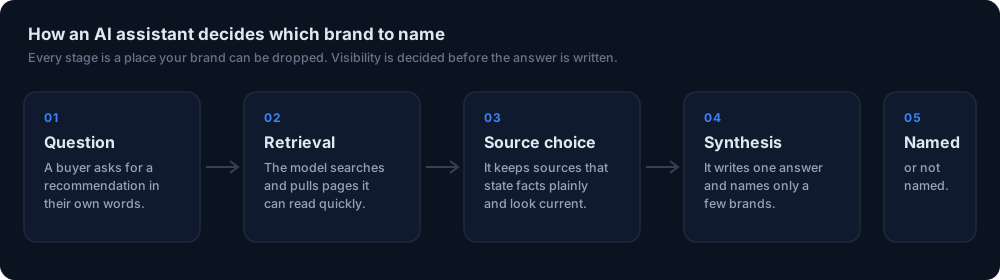
A language model does not index the open web in real time. Instead, it relies on retrieval agents—special bots like OAI-SearchBot for OpenAI and Google-Extended for Google Gemini—to crawl and cache content. If these agents cannot fetch your content, your pages are invisible to LLM-driven answers, regardless of their classic SEO rankings.
Retrieval agents work by crawling accessible URLs, parsing the HTML, and splitting the content into retrievable chunks. These chunks are then indexed in a retrieval system, which the model queries when assembling an answer. If your site blocks these bots, or if your content is hidden behind JavaScript or paywalls, you are excluded from LLM retrieval and citation.
You can confirm which bots are accessing your site by checking server logs for their user agents. For OpenAI, you must allow OAI-SearchBot for ChatGPT search visibility (see OpenAI crawler documentation). For Google Gemini, Google-Extended must be allowed. Each bot has published user-agent strings and IP ranges.
SEOWedge’s scan identifies if these agents can reach your site and flags any technical blocks. This is the first step in the loop: if the agent cannot crawl, no further LLM SEO action matters.
What blocks AI crawlers, and how do I check?
AI crawlers are blocked by robots.txt, llms.txt, authentication walls, and sometimes by JavaScript-only rendering. The most common failure is a robots.txt rule that disallows / or omits the AI agent user-agent. For OpenAI, you must explicitly allow OAI-SearchBot if you want to be visible in ChatGPT answers. For Google Gemini, Google-Extended must be allowed. If you want to block only training but allow retrieval, the distinction is between GPTBot (training) and OAI-SearchBot (retrieval).
To check your current setup, inspect your robots.txt and llms.txt files. Look for Disallow rules for these agents. Also, test live crawling using the agents’ user-agent strings and verify access to key URLs. SEOWedge’s scan automates this by flagging blocked agents and listing affected URLs.
If your content is behind a login, paywall, or requires client-side rendering, AI crawlers will fail. LLMs do not run headless browsers for deep rendering. Server-rendered HTML is the safest path for accessibility. For more on schema and markup, see our schema guide.

How does chunking and retrieval change what I should publish?
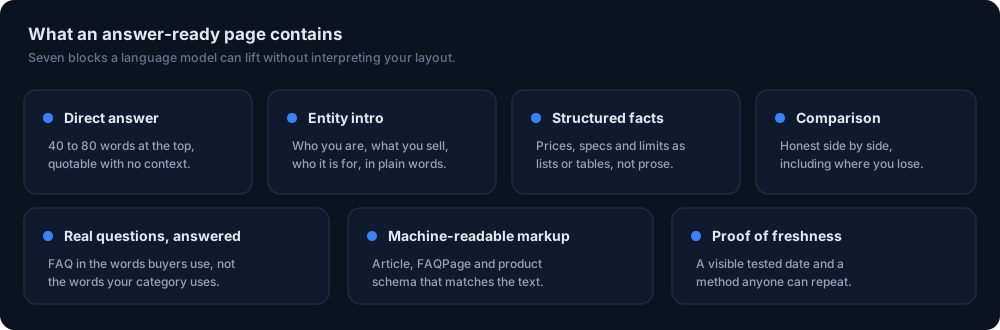
LLMs do not ingest entire pages as one block. Instead, they split content into retrievable chunks—often a heading and its following paragraph, or a table, or a list. Each chunk is indexed separately. When a model assembles an answer, it retrieves the most relevant chunks, not whole pages. This means every chunk must be answer-ready: clear, self-contained, and directly relevant to a buyer question.
Long, meandering pages with buried answers are less likely to be cited. Direct, question-focused sections are more likely to be retrieved and quoted. Tables, lists, and FAQ blocks are especially retrievable. SEOWedge’s Action Briefs and generated articles are structured for chunk retrievability: each section answers one buyer question, with direct evidence and citation-ready wording.
If you want to see how to structure a page for direct lift, see the AEO guide. For ecommerce, the AEO checklist covers product and category page specifics.
Does JavaScript rendering hurt me here?
Yes, JavaScript rendering can block or fragment your content for LLM retrieval. Most AI crawlers do not execute client-side JavaScript. If your main content, product details, or navigation are rendered only after JS loads, retrieval agents will see a blank or partial page. This means your content will not be chunked, indexed, or cited by LLMs.
To check, fetch your key URLs as OAI-SearchBot or Google-Extended using a tool that disables JS. If the main content is missing, you need to move critical sections to server-rendered HTML. This is especially important for ecommerce sites using JS-heavy frameworks. SEOWedge’s scan highlights JS-rendered sections that go missing for AI agents.
This is a different job than classic SEO rendering tests: here, the goal is to ensure every answer-worthy chunk is present in the initial HTML.
How do llms.txt, robots.txt and sitemaps fit together?
robots.txt is the primary gatekeeper for AI crawlers. It controls access for both search engines and language model agents. llms.txt is an emerging standard for declaring LLM-specific preferences, but as of 2026, most major agents still respect robots.txt as the authority. Use llms.txt to clarify intent, but never rely on it alone.
Sitemaps are not directly used by LLMs for retrieval, but they help search engines discover new or updated URLs. Google recommends submitting a sitemap for new sites or those with few inbound links (Google sitemap guidance). For LLM SEO, a sitemap ensures your content is discoverable by the search engine, which may then feed it to the LLM’s retrieval system. IndexNow lets you notify participating engines instantly when a URL changes (IndexNow documentation).
The safest configuration: allow OAI-SearchBot and Google-Extended in robots.txt, use llms.txt for clarity, maintain an up-to-date XML sitemap, and ping IndexNow on every publish or major update.
What technical checks belong in a monthly LLM SEO routine?
A monthly technical LLM SEO routine should include:
1. Crawlability check: Confirm OAI-SearchBot, Google-Extended, and other AI agents can access all key URLs. Review robots.txt and llms.txt for accidental blocks.
2. Retrieval test: Fetch key URLs as the agent would see them (no JS). Confirm all answer-worthy content is present in the HTML.
3. Chunk structure review: Check that each section, table, and FAQ is self-contained and answers a real buyer question.
4. Sitemap and IndexNow ping: Ensure your sitemap is current and that IndexNow is notified on every major publish or update.
5. Answer sampling: Run test queries in ChatGPT and Gemini to see if your pages are cited. SEOWedge automates this sampling and records which brands are named for each buyer question.
6. Gap analysis: For any missing citations, identify if the cause is crawlability, chunk structure, or content coverage. SEOWedge returns an Action Brief for each gap, naming the exact page to create or fix.
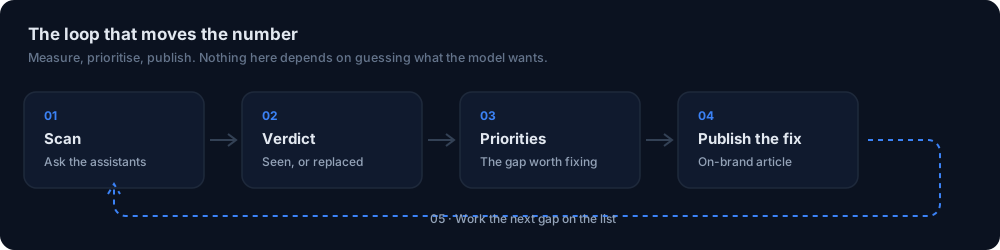
This loop keeps your site retrievable and answer-ready, and surfaces technical issues before they cost you citations.
Where does SEOWedge remove the manual work in LLM SEO?
SEOWedge automates the LLM SEO technical loop. It crawls your site as an AI agent would, flags crawl or rendering blocks, and discovers the buyer questions that drive real citations. For each scan, it tests your site against OpenAI (and Google Gemini on paid plans), records which brands are named, and identifies the exact page and section behind each gap.
The platform then produces an Action Brief for every missed citation: the buyer question, why AI answers name someone else, and which page to create or fix. The Content Studio drafts the missing page or section from your Brand DNA profile, structured for chunk retrievability and citation. Each draft is scored for Publish Readiness before export, so you know it matches what LLMs retrieve and cite.
This single loop—measurement, gap identification, page generation, and readiness scoring—removes the guesswork and manual checks from technical LLM SEO. You can see a working example in the public sample report, or start with a free AI search audit to get your first scan and technical verdict.
What should I do next if I want to own LLM SEO for my site or clients?
If you want to lead in LLM SEO, start by running a technical crawlability check for OAI-SearchBot and Google-Extended. Review your robots.txt, llms.txt, and sitemap. Move any critical content to server-rendered HTML if it is currently JS-only. Structure your pages so each chunk answers a real buyer question and is ready to be cited.
Sample your site’s visibility in ChatGPT and Gemini using buyer questions, not just branded prompts. For a defensible, repeatable workflow, use SEOWedge’s free scan: it checks crawlability, discovers real buyer questions, tests citations, and names the technical and content gaps. From there, you can automate the loop with full scans, Action Briefs, and on-brand page generation.
For deeper technical or page-level guidance, see the AEO guide or the schema guide. If you want to compare tools or see a sample output, visit the public sample report.
How this was tested
All technical claims on this page are based on published documentation from OpenAI and Google as of 2026-08-12, and direct observation of LLM retrieval and citation behaviour using SEOWedge’s scan and answer sampling workflow. Crawlability checks and agent requirements are verified against the latest guidance from https://developers.openai.com/api/docs/bots and https://developers.google.com/search/docs/fundamentals/ai-optimization-guide. SEOWedge’s workflow and measurement loop are described as implemented in production as of this date.
What this page does not cover
This guide covers the technical layer of LLM SEO: crawlability, chunking, retrieval, and citation for language models. It does not cover prompt engineering, classic SEO ranking factors, or non-technical content strategy. For page-level writing and schema, see the AEO guide. For Google-specific surfaces, see the AI Overviews guide. All claims are current as of 2026-08-12; engine behaviour and documentation may change.
Questions buyers ask us
Do I need to allow both OAI-SearchBot and GPTBot for LLM SEO?
OAI-SearchBot is required for ChatGPT search visibility and retrieval. GPTBot is used for model training. If you want your site to appear in ChatGPT answers but not be used for training, allow OAI-SearchBot but block GPTBot in robots.txt. See OpenAI's bot documentation for exact user-agent strings.
Is llms.txt required, or is robots.txt enough?
As of 2026, robots.txt remains the authoritative standard for AI agent access. llms.txt is an emerging convention for LLM-specific preferences, but major retrieval agents still follow robots.txt. Use llms.txt for clarity, but always configure robots.txt for enforcement.
How can I tell if my pages are being cited by LLMs?
You can test buyer questions in ChatGPT or Gemini and look for direct citations or mentions. SEOWedge automates this by sampling answers, recording which brands are named, and scoring your share of voice. Each scan shows which questions cite you and which name competitors.
Does server-side rendering guarantee LLM access to my content?
Server-side rendering ensures your content is present in the initial HTML, which is what AI crawlers see. It does not guarantee citation—your content must also be retrievable, answer-ready, and relevant to buyer questions. Technical accessibility is necessary but not sufficient for LLM SEO.
How often do I need to re-check crawlability and citations?
Monthly checks are recommended, since robots.txt and site structure can change, and LLM retrieval indexes update over weeks. SEOWedge’s monthly scan routine is designed for this cadence, pairing technical checks with answer sampling to catch new gaps as they appear.
What is the difference between LLM SEO and classic SEO?
Classic SEO optimizes for search engine rankings and traffic. LLM SEO focuses on making your content retrievable and citable by language models. The technical overlap is crawlability, but the retrieval, chunking, and citation mechanisms are distinct. For a full comparison, see our GEO vs AEO vs SEO guide.
See what AI assistants say about your site
Enter your domain and SEOWedge runs a free scan: your AI-Visibility score, the buyer questions where a competitor is named instead of you, and the first page to fix. No install, no sales call.