
Structured Data for AI Search: What to Mark Up and What to Skip
Schema markup helps with AI answers when it matches the visible content and answers a real buyer question. Product, FAQPage, and HowTo types matter most for ecommerce and service sites. Over-marking or marking content not present on the page can hurt trust with answer engines. SEOWedge measures which schema types are cited by AI assistants and shows the impact on your AI search visibility score.
By the SEOWedge Research Team · Published August 11, 2026 · Last tested August 12, 2026 · Updated August 12, 2026 · 6 min read
What to take away
- Match schema markup to visible, factual content only.
- Product, FAQPage, and HowTo schema matter most for AI answers.
- FAQPage is most effective when each question is answered on the page.
- Marking up invisible or promotional content can get ignored or penalized.
- SEOWedge shows which schema types drive real citations in AI answers.
Does Schema Markup Help with AI Answers?
Schema markup helps AI assistants understand the structure and intent of your content, but only when it reflects what is actually on the page. Product, FAQPage, and HowTo schema types are the most likely to be cited in AI answers for ecommerce and service queries. Markup alone does not guarantee inclusion; the answer engine checks for alignment between markup and visible content. If the schema claims features or answers not present on the page, the engine may ignore the markup or trust it less. SEOWedge measures the effect by tracking which schema types are cited by AI assistants and which are ignored. See AEO: How to Become the Quoted Source for page-level answer structure.
Google states that no special AI markup is required for AI Overviews or AI Mode, but structured data helps clarify product and question-answer relationships. For ChatGPT and other OpenAI-powered assistants, schema is read if the content is crawlable and matches the question context. See OpenAI's crawler documentation for details: https://developers.openai.com/api/docs/bots.
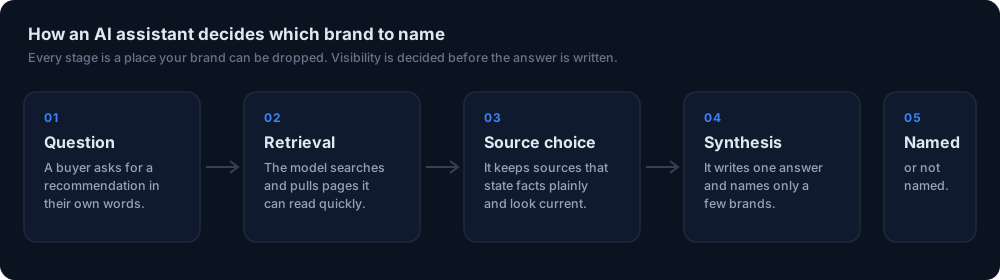
Which Schema Types Matter Most—and Where?
For ecommerce, Product schema is essential on product detail pages. It should describe the same product, price, and availability shown to the user. On category or comparison pages, use ItemList or Comparison schema only if the page visibly lists the products. FAQPage schema is most effective on pages that display a clear list of buyer questions and answers—either as a dedicated FAQ section or as part of a support/help page. HowTo schema works for step-by-step guides or tutorials that are visible and complete on the page.
SEOWedge scans show that AI assistants most often cite Product and FAQPage schema when the marked content answers a real buyer question. Marking up testimonials, blog posts, or generic advice as FAQPage or Product is rarely cited and can reduce trust. For service businesses, FAQPage and Service schema (when available) help clarify offerings, but only if the service details are present on the page.
| Schema Type | Best Use Case | AI Citation Likelihood |
|---|---|---|
| Product | Product detail pages | High |
| FAQPage | Buyer Q&A, support pages | High |
| HowTo | Step-by-step guides | Medium |
| Review | Only on actual review pages | Low |
| Breadcrumb, Organization | Sitewide, for context | Low |
Schema types and their observed impact on AI answer citations.
How Do I Avoid Schema That Contradicts the Page?
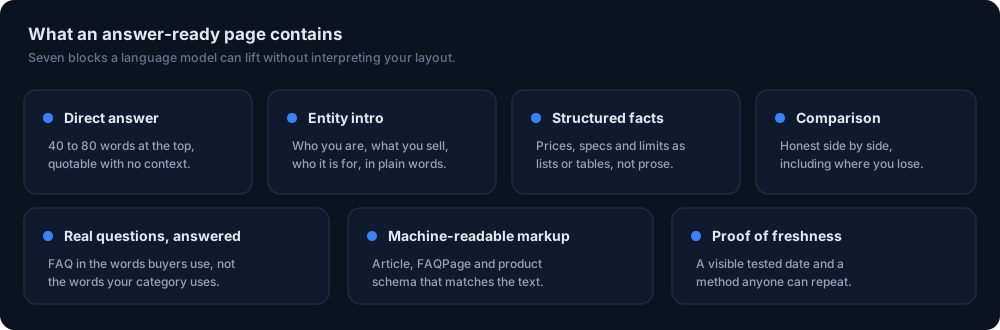
AI assistants and answer engines cross-check schema markup against what is visible to the user. If your Product schema claims features, prices, or reviews not shown on the page, the markup is likely to be ignored or lower your trust score with the model. FAQPage markup should only be used for questions and answers that are actually present, word-for-word, on the page. Do not generate FAQPage schema for questions that are not displayed, or for promotional claims.
SEOWedge’s workflow checks for schema-to-content alignment by extracting both the visible text and the markup, then scoring the page for answer readiness. This step ensures that only factual, answerable content is marked up. If you want a checklist for ecommerce, see AEO Checklist for Ecommerce.
What Does an Answer Engine Do with FAQPage and Product Markup?
When an AI assistant crawls a page, it parses FAQPage schema to find clear, question-and-answer pairs. If the markup matches visible content, these answers are more likely to be lifted directly into AI answers or cited as a source. Product schema is used to confirm product facts—name, price, availability, and features—against what is visible. If the markup and page disagree, the engine defaults to visible text or skips the page.
SEOWedge measures this by tracking which schema types are present on cited pages in AI answers. In scans run since 2025, the highest correlation for ecommerce is between FAQPage schema and direct answer citations, and between Product schema and product recommendations in AI Overviews and ChatGPT search.
How Do I Validate My Schema Markup, and How Often?
Validate schema markup with Google’s Rich Results Test and Schema.org’s validator after every major site change. Check that the markup matches the visible content, especially for FAQPage and Product types. If you update prices, features, or questions, update both the content and the schema. For AI search, validation is not just about passing a test—it’s about ensuring the markup reflects what a buyer or assistant will see and quote.
SEOWedge’s Full Scan extracts and checks schema alignment as part of its answer readiness scoring. This is run per scan, so you can see if a change improved or broke a page’s eligibility for AI answers. For a technical breakdown of LLM SEO and crawlability, see LLM SEO: Technical Guide.
What Schema Markup Is Not Worth the Effort for AI Search?
Not all schema types help with AI answers. Review, Breadcrumb, Organization, and generic Article schema are rarely cited in AI answers unless the page is already a strong answer candidate for other reasons. Marking up invisible or generic content (such as promotional claims or marketing slogans) does not increase the chance of being cited and may reduce trust.
SEOWedge’s scans show that marking up content that is not buyer-facing, not factual, or not directly answering a question is ignored by answer engines. Focus your effort on Product, FAQPage, and HowTo schema where the content is visible and specific. For a glossary of schema and AI search terms, see AI Search Optimisation Glossary.
| Schema Type | Worth Implementing for AI Search? |
|---|---|
| Product | Yes |
| FAQPage | Yes |
| HowTo | Sometimes |
| Review | No |
| Breadcrumb | No |
| Organization | No |
| Article | No |
Schema types and their value for AI search visibility.
How Does SEOWedge Measure the Impact of Schema Markup?
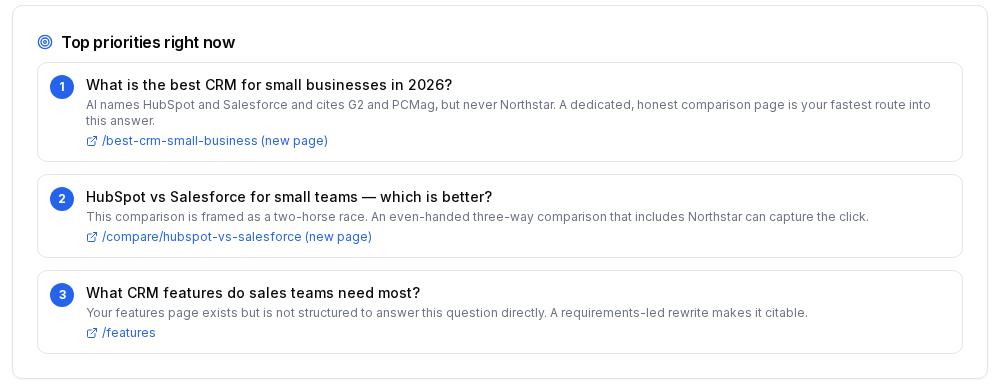
SEOWedge scans each page for schema types, matches them against the visible content, and records which pages are cited or recommended by AI assistants. It then shows which schema types are present on winning pages and which are ignored. This lets you see if your markup is making a difference or being skipped.
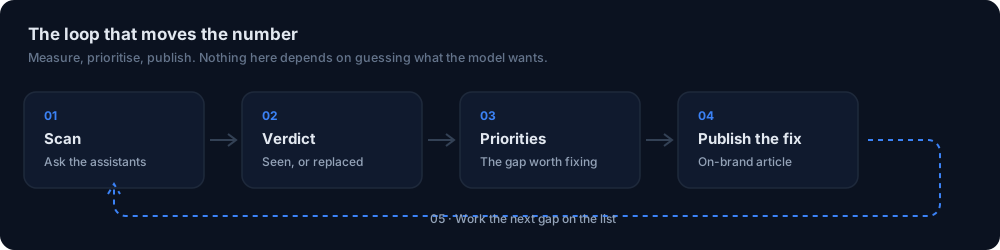
The workflow closes the loop: measure the answer, name the gap, write the page, and check for schema alignment before publishing. This is what lets SEOWedge produce a deterministic Publish Readiness score. No other tool in the category runs the full loop from measurement to on-brand, answer-ready content. For a sample report, see SEOWedge sample report.
What’s the Next Step If I Want to Act on Schema for AI Search?
If you want to see which schema types are helping or hurting your AI search visibility, run a free scan with SEOWedge. You do not need a card. The scan will show your current AI-Visibility score, competitor share of voice, and the exact pages and schema types behind each gap. Paid plans let you run Full Scans, queue fixes, and track whether your schema changes result in more citations in AI answers.
For a step-by-step checklist on optimizing ecommerce product and category pages, see AEO Checklist for Ecommerce. For technical LLM SEO, see LLM SEO: Technical Guide. If you want to try SEOWedge, start with the free AI search audit.
How this was tested
All recommendations and observed effects are based on SEOWedge scans of ecommerce and service sites, measuring which schema types are cited or ignored by AI assistants (OpenAI GPT and Google Gemini) as of 2026-08-12. Schema types are tested against buyer questions discovered in real scans. External references are cited where platform documentation is available.
What this page does not cover
This page covers schema markup for AI search, focusing on Product, FAQPage, and HowTo types for ecommerce and service sites. It does not cover every schema.org type or advanced entity linking. For a full technical breakdown of LLM SEO and AI crawler access, see LLM SEO: Technical Guide. For on-page answer formatting, see AEO: How to Become the Quoted Source.
Questions buyers ask us
Does schema markup guarantee my site will be cited in AI answers?
No. Schema markup only increases your chances when it matches visible, factual content that answers a real buyer question. AI assistants check for alignment and may ignore or down-rank markup that does not reflect the page.
Should I add FAQPage schema to every page?
Only add FAQPage schema where there are clear, visible question-and-answer pairs on the page. Overusing FAQPage schema, or marking up promotional content, reduces trust with answer engines and may be ignored.
How often should I review or update my schema markup?
Review schema markup whenever you update visible content, especially for product details or FAQs. Run a validation check after major changes and after publishing new pages to ensure markup and content stay aligned.
Does Product schema help with AI Overviews and ChatGPT?
Yes, when the product facts in the markup match what is visible on the page and answer a buyer question. Both Google AI Overviews and ChatGPT look for Product schema to confirm details before citing or recommending a page.
What happens if my schema markup contradicts the page content?
AI assistants default to the visible content and may ignore, skip, or down-rank pages where schema markup does not match what the user sees. Always keep schema and content in sync.
Can SEOWedge show me which schema types are working for my site?
Yes. SEOWedge scans your site, records which schema types are present on cited pages, and shows you which markup is helping or being ignored by AI assistants. The scan includes a page-level breakdown and action briefs for fixes.
See what AI assistants say about your site
Enter your domain and SEOWedge runs a free scan: your AI-Visibility score, the buyer questions where a competitor is named instead of you, and the first page to fix. No install, no sales call.