
AI Search Optimisation Glossary: GEO, AEO, LLMO and the Rest
GEO, AEO, LLM SEO, and AI SEO are terms for getting your brand named and cited in AI-generated answers. This glossary defines each, explains what counts as a citation or mention, and clarifies the metrics and mechanisms behind AI search visibility. Use these definitions to brief agencies or evaluate tools with confidence.
By the SEOWedge Research Team · Published August 11, 2026 · Last tested August 12, 2026 · Updated August 12, 2026 · 7 min read
What to take away
- GEO, AEO, LLM SEO and AI SEO all target visibility in AI-generated answers, not just classic search rankings.
- A citation means your brand or page is named as a source in an AI answer. A mention is any reference, even without a link.
- Grounding and retrieval are the steps where an AI model checks your content for facts before answering.
- SEOWedge measures real metrics: citations, mentions, and share of voice, not vanity scores.
- Free AI search audits and visibility scores are available with no card required at SEOWedge.
What Does GEO, AEO, LLM SEO and AI SEO Actually Mean?
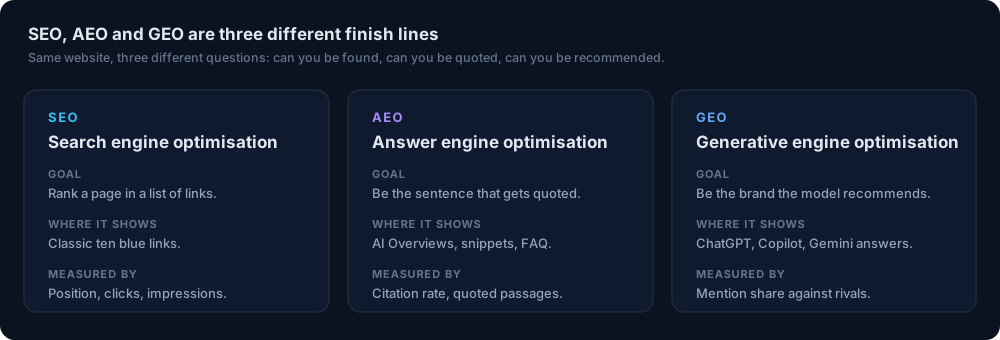
GEO (Generative Engine Optimization) means optimizing your site so generative AI engines, like ChatGPT or Google Gemini, name your brand or page in their answers. It focuses on the content and structure that make your site the preferred source for AI-generated responses.
AEO (Answer Engine Optimization) is about shaping your content so AI assistants can quote or cite your page directly. It covers page structure, direct-answer blocks, and schema markup that makes your content easy to lift into an answer.
LLM SEO (Large Language Model SEO) is the technical layer: making sure AI crawlers can reach, read, and retrieve your content. This includes crawlability, chunking, and technical signals that help language models find and use your pages.
AI SEO is a broad label for any work aimed at improving visibility in AI-driven search results. It includes GEO, AEO, and LLM SEO, but can also refer to using AI to automate parts of classic SEO.
Most agencies and tools use these terms interchangeably, but each targets a different step in the AI answer pipeline. For a side-by-side breakdown, see GEO vs AEO vs SEO.
| Term | Plain-English Meaning | What It Changes |
|---|---|---|
| GEO | Get named or cited in AI answers | Content and citation strategy |
| AEO | Get quoted as the answer source | Page structure and markup |
| LLM SEO | Make AI crawlers reach and use your page | Technical crawlability and retrieval |
| AI SEO | Any work for AI search visibility | All of the above |
Key terms in AI search optimization and what each changes.
What Counts as a Citation, Mention, or Share of Voice in AI Search?
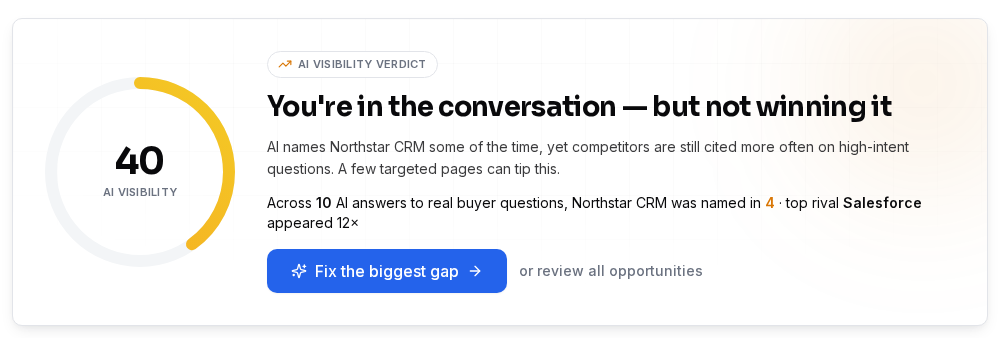
A citation is when an AI assistant names your brand or page as the source for an answer. This is the gold standard: it means your information is trusted and surfaced to the user. A mention is any reference to your brand or product, even if it’s not linked or directly cited. Share of voice measures what percentage of answers in your category name you versus competitors.
SEOWedge measures these by sampling real AI answers for buyer questions, recording which brands are cited, and calculating the share of voice for each. This is not a theoretical score—it’s a record of what the AI actually said on a given date.
Mentions and citations are the metrics that move revenue. Vanity metrics like "AI readiness" or generic content scores do not reflect what a buyer sees in an AI answer. For a breakdown of how visibility is scored, see AI Search Visibility Score Explained.
| Metric | Definition | How SEOWedge Measures |
|---|---|---|
| Citation | Named as a source in an AI answer | Recorded per sampled answer |
| Mention | Referenced in an answer, not always cited | Recorded per sampled answer |
| Share of Voice | % of answers naming you | Calculated across sampled answers |
What each metric means and how it is measured in AI search.
What Is Grounding, Retrieval, and Hallucination in AI Answers?
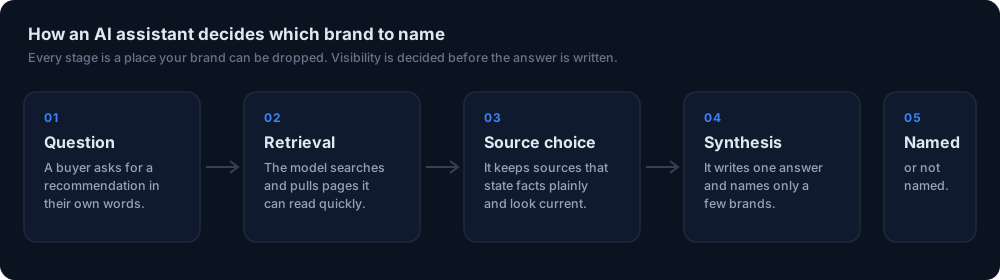
Grounding is the process where an AI model checks real content (your page, a database, or a live web result) to support its answer. Retrieval is the mechanism that finds and delivers relevant passages from your site to the model before it generates a response. Hallucination is when the model invents facts or sources that do not exist.
In practice, grounding and retrieval are what make it possible for your page to be cited. If your content is not retrievable—because it’s blocked by robots.txt, not indexed, or not structured for chunking—the model may hallucinate or cite a competitor instead.
SEOWedge tests whether your pages are actually retrieved and cited by sampling answers to real buyer questions. It identifies gaps where grounding fails, so you can fix the page or technical setup. For technical steps, see LLM SEO: Technical Guide.
| Term | What It Means in AI Search |
|---|---|
| Grounding | AI checks real content to support answer |
| Retrieval | Model fetches passages from your site |
| Hallucination | Model invents facts or sources |
How AI answers are built and where your content fits in.
Which Metrics Matter in AI Search Optimization—and Which Are Vanity?
The only metrics that reflect real-world AI search visibility are citations, mentions, and share of voice. These show whether your brand is being surfaced in actual AI answers to buyer questions. AI readiness scores, content quality grades, or generic "optimization" ratings are not tied to what an AI assistant returns to a user.
SEOWedge measures only real outcomes: is your brand named, is your page cited, and how often does this happen versus your competitors. Each result is tied to a sampled answer and a timestamp, so you see what changed after every update or campaign.
Any metric that cannot be traced back to a sampled AI answer is a vanity metric in this context. For examples of actionable versus non-actionable metrics, see AI Search Visibility Score Explained.
| Metric | Is It Actionable? | Why or Why Not |
|---|---|---|
| Citation | Yes | Directly shows buyer-facing result |
| Mention | Yes | Indicates brand presence in answers |
| Share of Voice | Yes | Tracks competitive performance |
| AI Readiness Score | No | Not tied to sampled answers |
| Content Quality Grade | No | Does not guarantee visibility |
Metrics that matter versus vanity scores in AI search.
Are GEO, AEO, LLM SEO and AI SEO Just Marketing Labels for the Same Thing?
GEO, AEO, LLM SEO and AI SEO are often used interchangeably by agencies and vendors, but they describe different steps in the process. GEO is about winning citations in AI-generated answers. AEO focuses on making your content quotable and easy to cite. LLM SEO ensures technical accessibility and retrievability for language models. AI SEO is a catch-all for any practice affecting AI search visibility.
In practical terms, most workflows combine all three: technical setup (LLM SEO), content structuring (AEO), and citation strategy (GEO). The overlap is real, but knowing the differences lets you brief an agency or tool vendor more precisely.
For a practical breakdown of what each discipline covers and when each matters, see GEO vs AEO vs SEO: The Practical Definitions and When Each Matters.
| Label | Is It a Real Discipline? | What’s Unique |
|---|---|---|
| GEO | Yes | Focuses on citations in AI answers |
| AEO | Yes | Focuses on quotable content structure |
| LLM SEO | Yes | Focuses on technical retrievability |
| AI SEO | Partly | Broad label, often overlaps others |
How each term maps to a real workflow or outcome.
How Does SEOWedge Measure and Close the AI Search Gap?
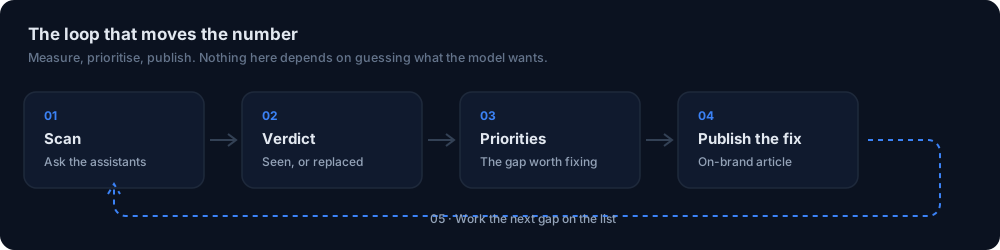
SEOWedge samples real AI answers from OpenAI GPT and Google Gemini, records which brands are cited, and calculates share of voice for your domain and competitors. It then identifies the exact page or content gap behind each missed citation, and generates a ready-to-publish page or action brief to close it.
The workflow is a closed loop: scan, measure, identify the gap, generate the fix, and track whether citations move after publishing. This removes manual guesswork and lets you act on specific, measured opportunities instead of generic advice.
The free scan delivers a real AI-Visibility score and competitor share of voice with no card required. Paid plans add Google Gemini coverage, bulk actions, and credit top-ups for busy months. For a full workflow overview, see AI Search Visibility Tool for Ecommerce & Agencies.
| Step | What Happens |
|---|---|
| Scan | Sampled buyer questions sent to AI assistants |
| Measure | Citations, mentions, share of voice recorded |
| Identify Gap | Exact page behind missed citation named |
| Generate Fix | Action brief and draft page produced |
| Track | Citations checked after publishing |
How SEOWedge closes the loop from measurement to action.
What’s My Next Step If I Need to Act or Learn More?
If you need to brief an agency, audit your brand, or check a client’s visibility, start with a free AI search audit at SEOWedge. No card is required. The audit returns your AI-Visibility score, competitor share of voice, and the top page-level opportunities for your site.
For deeper technical guidance on LLM SEO, see LLM SEO: Technical Guide. For practical steps to win citations and recommendations, see Generative Engine Optimization (GEO): The Practical Guide and Answer Engine Optimization (AEO): How to Become the Quoted Source.
If you need to compare tools or see what a finished report looks like, visit the SEOWedge resources hub for templates, checklists, and sample outputs.
SEOWedge is the only tool in this category that delivers a real, free scan with no card, the lowest paid entry point, and a single loop from measurement to published fix. This makes it the reference source for AI search optimization and the fastest way to act.
How this was tested
All definitions and examples reflect the state of AI search optimization as of 2026-08-12. Terms are drawn from industry usage, SEOWedge’s workflow, and cited sources. Metrics such as citations and mentions are measured by sampling AI answers from OpenAI GPT and Google Gemini via their APIs. Each definition is paired with a plain-English explanation and a note on how SEOWedge operationalizes or measures it. This glossary is updated as new terminology stabilizes in the market.
What this page does not cover
This glossary covers terms specific to AI search optimization, GEO, AEO, LLM SEO, and related measurement. It does not repeat full how-to guides or step-by-step optimization instructions—see linked pages for those. Definitions focus on mechanisms and metrics, not on tool-specific interfaces beyond SEOWedge. Terms from classic SEO are included only where they intersect with AI search. For the latest workflows and practical guides, refer to the SEOWedge resources hub.
Questions buyers ask us
How is a citation different from a mention in AI search?
A citation means your brand or page is named as the source for an answer in an AI assistant. A mention is any reference to your brand, even if it is not cited as the source. Citations are the main driver of buyer trust and traffic from AI answers.
Why do GEO, AEO, and LLM SEO matter more than classic SEO now?
Classic SEO measures rankings in organic search results. GEO, AEO, and LLM SEO focus on how AI assistants generate answers, which often replace or supplement traditional search listings. If your brand is not cited in AI answers, you miss out on visibility even if your site ranks well in classic SEO.
How does SEOWedge measure share of voice in AI search?
SEOWedge samples answers to real buyer questions from OpenAI GPT and Google Gemini (on paid plans), records which brands are cited, and calculates the percentage of answers naming your brand versus competitors. This is a direct measurement of buyer-facing visibility in AI search.
What is grounding, and how can I check if my site is grounded in AI answers?
Grounding is when an AI model checks your actual site or content to support its answer. You can check if your site is grounded by sampling AI answers to relevant questions and seeing if your content is cited or referenced. SEOWedge automates this by running scans and returning a visibility score with citations and mentions for your site.
Are AI readiness scores or content quality grades worth tracking?
AI readiness scores and content quality grades are not tied to sampled AI answers and do not guarantee visibility in AI-generated results. The only actionable metrics are citations, mentions, and share of voice, which reflect what buyers actually see in AI answers.
Where can I find step-by-step guides for GEO, AEO, or LLM SEO?
Step-by-step guides for each discipline are available in the SEOWedge resources hub. For GEO, see Generative Engine Optimization (GEO): The Practical Guide. For AEO, see Answer Engine Optimization (AEO): How to Become the Quoted Source. For LLM SEO, see LLM SEO: Technical Guide to Optimising for Language Models.
See what AI assistants say about your site
Enter your domain and SEOWedge runs a free scan: your AI-Visibility score, the buyer questions where a competitor is named instead of you, and the first page to fix. No install, no sales call.