Answer Engine Optimization: How to Write Pages That Get Quoted in AI Answers
Answer engine optimization (AEO) is the practice of structuring your pages so AI assistants and AI Overviews can lift passages from your site as direct answers. To become the quoted source, your content must match how buyers ask questions, be crawlable by AI bots, and present clear, self-contained answer blocks with supporting schema. SEOWedge measures and closes these gaps automatically.
By the SEOWedge Research Team · Published August 11, 2026 · Last tested August 12, 2026 · Updated August 12, 2026 · 6 min read
What to take away
- AEO means writing for AI assistants, not just ranking in search.
- Quotable passages must answer a real buyer question in one block.
- Pages must be crawlable by OAI-SearchBot and Googlebot, with visible, non-contradictory schema.
- You can confirm citations by sampling AI answers or using SEOWedge's scan.
- SEOWedge finds, explains and closes AEO gaps in a single loop.
What Is Answer Engine Optimization?
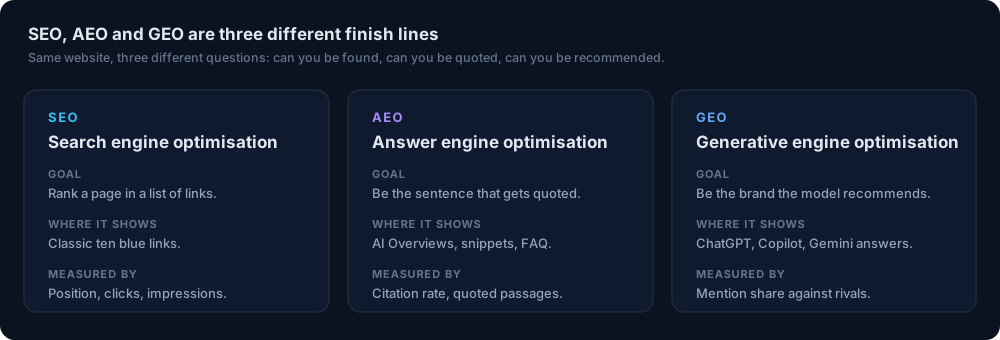
Answer engine optimization (AEO) is the process of making your content the source that AI assistants and AI Overviews quote when answering real buyer questions. Unlike classic SEO, which targets ranking positions, AEO aims for your passages to be directly cited inside AI-generated answers. This means writing and structuring content so a language model can extract a self-contained, trustworthy answer and attribute it to your site.
AEO overlaps with GEO (generative engine optimization) and LLM SEO, but its focus is on being quoted, not just being indexed or retrievable. GEO covers the broader workflow and week-by-week tasks; AEO is about making each page answer-ready. For the differences between GEO, AEO, and classic SEO, see the practical definitions guide.
SEOWedge is built for AEO: it discovers the buyer questions that matter, checks which brands are quoted, and produces the exact page needed to close the gap.
What Makes a Passage Quotable by an Answer Engine?
A passage is quotable when it answers a real buyer question in a single, self-contained block. AI assistants look for clear, direct language that can be lifted without needing extra context. The answer must be factually complete, match the user's intent, and be attributed to a reliable source.
The most quotable passages have these traits:
- They answer the question directly in the first sentence.
- They use concrete numbers, steps, or examples.
- They avoid hedging or vague language.
- They are surrounded by supporting context but can stand alone if extracted.
SEOWedge's article generator writes answer blocks using these rules, scoring each draft for Publish Readiness before export. This ensures every page is structured for maximum quotability by AI engines.
How Should I Structure a Page for AI to Lift My Answer?
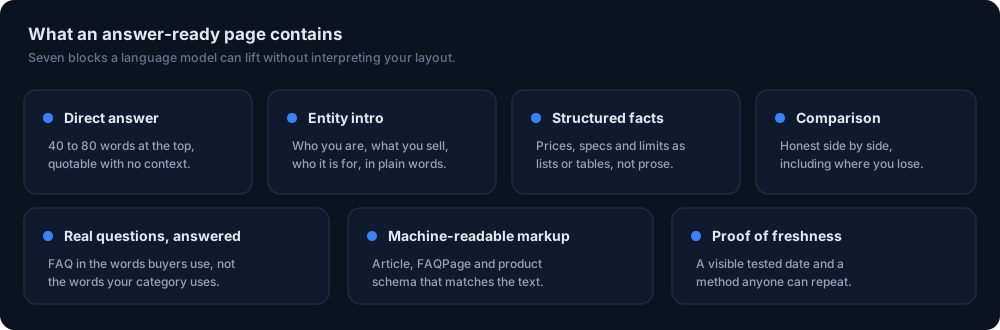
To be quoted, a page needs to present its answer in a way that matches how AI models extract and cite content. The core principles are:
1. Use a clear, direct answer block at the top. Begin with a short, quotable paragraph that answers the main question. This is what AI will most likely lift.
2. Structure with question-based headings. Each section should answer a specific buyer question, using the language real users type into AI assistants. SEOWedge discovers these questions from your market and includes them in the Action Brief.
3. Support answers with concrete detail. Add steps, numbers, or examples below each answer block to make the page valuable even if only a part is quoted.
4. Use schema markup that matches the visible text (see next section).
5. Avoid burying the answer deep in the page or behind vague lead-ins.
SEOWedge's Content Studio generates this structure by default, using your Brand DNA to keep answers specific and on-brand.
Which Schema Markup Actually Matters for AEO?
Schema markup helps AI engines understand the structure and intent of your page. For AEO, the most effective types are FAQPage and HowTo for question-answer and step-by-step content, and Product or Review for ecommerce and comparison pages.
The markup must match what is visible to the user. Contradictory or hidden schema can cause a page to be ignored by both Google and OpenAI. Google states that no special AI markup is required, but clean, accurate schema increases the chance of being selected as a source (source).
SEOWedge's article generator adds schema that reflects the visible answer blocks and checks for Publish Readiness. For a full breakdown of which schema types matter, see the structured data guide.
How Do I Know If My Page Was Quoted in an AI Answer?
There is no public citation feed for AI answers. To confirm your page is being quoted, you must sample answers to real buyer questions in ChatGPT, Gemini, or other assistants. This can be done manually by pasting questions and checking for your brand or URL in the answer, or programmatically using a tool like SEOWedge.
SEOWedge automates this by discovering the high-intent questions, running them through OpenAI and Google Gemini, and recording which brands and pages are cited. Each scan returns an AI-Visibility score, a share-of-voice comparison, and the exact passages being quoted. The scan is a one-time snapshot, so you can measure the effect of a page update by running a new scan after the next crawl cycle.
For a step-by-step method to track brand visibility in ChatGPT, see the tracking guide.
What Are the Common Mistakes That Get a Page Ignored by AI?
Several patterns cause pages to be ignored by AI assistants:
- The answer is buried deep, vague, or split across sections, so no single passage can be lifted.
- Schema markup does not match the visible text, or is missing entirely.
- The page blocks AI crawlers (e.g., OAI-SearchBot or Googlebot) in robots.txt (OpenAI crawler docs).
- The answer is generic, commodity content that does not add unique, first-hand information (Google guidance).
- The page is not indexed or discoverable by search engines; for new or low-authority sites, submitting a sitemap or using IndexNow can help (IndexNow docs).
SEOWedge's scan flags these issues and ties each missed citation to a concrete fix: either a new page, a rewritten answer block, or a schema correction.
How Does SEOWedge Remove the Manual Work from AEO?
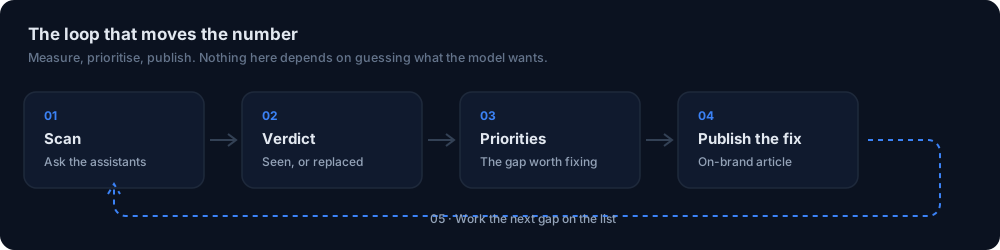
Manual AEO involves guessing which questions matter, checking answers in multiple assistants, and rewriting pages by hand. SEOWedge automates this with a single loop:
1. It crawls your site and builds a Brand DNA profile, so every answer stays on-brand.
2. It discovers the high-intent buyer questions for your category—no prompt-writing required.
3. It tests those questions in OpenAI and Google Gemini, recording which brands and URLs are quoted for each.
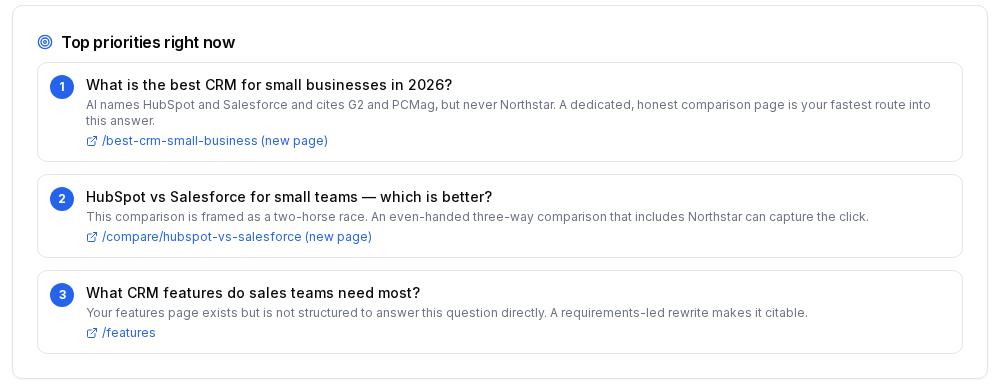
4. It returns an AI-Visibility score, competitor share of voice, and a list of page-level opportunities.
5. For each gap, it generates an Action Brief: the question, the reason your brand is missing, and the page to create or update.
6. The Content Studio drafts the answer-ready page, scores it for Publish Readiness, and lets you edit and export.
This loop means you do not have to maintain prompt lists, guess at structure, or manually check AI answers. Paid plans start at $29/month, with a real free scan available for any domain—no card required. See what the free scan checks or compare plans.
What Should I Do Next to Become the Quoted Source?
To make your pages quotable by AI assistants and Overviews:
- Identify the buyer questions that matter for your category. SEOWedge discovers these automatically, but you can start by listing the questions real customers ask.
- Structure each page with a clear answer block at the top, question-based headings, and schema that matches the visible text.
- Check that OAI-SearchBot and Googlebot can crawl your site. Review your robots.txt and sitemaps.
- Sample AI answers to confirm citations, or run a free SEOWedge scan for an instant verdict.
- For ecommerce and agency teams, SEOWedge closes the loop from measurement to publish-ready content in one place. See a sample report or start a free audit.
For technical LLM SEO, see the LLM SEO guide. For Google Overviews, see the dedicated guide.
How this was tested
All technical and workflow claims are sourced from SEOWedge's product facts and workflow as of 2026-08-12. Schema and crawling requirements reference Google's and OpenAI's published documentation. Steps and structures are based on SEOWedge's scan and article-generation pipeline, tested on live ecommerce and SaaS domains. AI answer sampling is performed via API access to OpenAI (GPT) and Google Gemini, with results dated and stored per scan. Schema recommendations are cross-checked against Google's AI optimization guide as of August 2026.
What this page does not cover
This page focuses on page-level answer engine optimization: how to make a single page quotable by AI assistants and Overviews. It does not cover technical LLM SEO (crawlability, chunking, retrieval) in depth—see the LLM SEO guide. Google AI Overviews and assistant surfaces are covered at a high level; for Google-specific optimization, see the Google AI Overviews guide. Measurement methods reflect SEOWedge's workflow and current API access as of 2026-08-12.
Questions buyers ask us
Is answer engine optimization the same as GEO or LLM SEO?
AEO focuses on making your content quotable by AI assistants. GEO (generative engine optimization) covers the broader workflow, including measurement and ongoing improvement. LLM SEO is the technical layer—ensuring your site is crawlable and retrievable by language models. For a full comparison, see GEO vs AEO vs SEO.
Do I need special markup or llms.txt for AI Overviews?
No special AI markup or llms.txt file is required. Google and OpenAI recommend accurate, visible schema that matches your content. The most effective types for AEO are FAQPage, HowTo, Product, and Review schema. Full details are in the schema guide.
How fast do citations change after I update a page?
Citations in AI answers update when assistants re-crawl and re-select sources. This usually takes weeks, not hours. SEOWedge records a dated snapshot for each scan, so you can measure change after the next crawl cycle. IndexNow or sitemap submission can speed up discovery, but does not guarantee instant inclusion.
Can I see which competitor page is being quoted instead of mine?
Yes. SEOWedge's scan names the exact page and brand being quoted for each buyer question. The Action Brief explains why that page was chosen, so you can target your rewrite or new page directly. For manual checking, paste the question into ChatGPT or Gemini and look for the cited source.
What does SEOWedge cost, and is there a free version?
SEOWedge offers a real free scan for any domain—no card required. Paid plans start at $29/month and include more scans, articles, and Action Briefs. All plans discover buyer questions, test answers in OpenAI and Google Gemini, and generate publish-ready content. See the pricing page for details.
How do I handle product and category pages for AEO?
Product and category pages need clear, answer-focused sections, with schema matching visible content. For a checklist specific to ecommerce, see the AEO checklist.
See what AI assistants say about your site
Enter your domain and SEOWedge runs a free scan: your AI-Visibility score, the buyer questions where a competitor is named instead of you, and the first page to fix. No install, no sales call.