
AEO Checklist for Ecommerce: Product, Category & Comparison Pages
To optimize ecommerce pages for answer engines, make product, category, and comparison pages answer-ready: surface clear facts, use the right schema, and structure content so AI assistants can cite you. Prioritize unique product details, direct answers to buyer questions, and visible, up-to-date facts. Test your changes by checking if AI assistants now cite your site for key queries.
By the SEOWedge Research Team · Published August 11, 2026 · Last tested August 12, 2026 · Updated August 12, 2026 · 7 min read
What to take away
- Update product and category pages to answer buyer questions directly.
- Use Product, Offer, and Breadcrumb schema—but skip non-visible or conflicting markup.
- List price, stock, and shipping visibly and in schema; keep them current.
- Check if AI assistants cite your site using a tool like SEOWedge or manual prompts.
- If time is tight, fix your top-selling product page first and test for citations.
What do I change on a product page for answer engines?
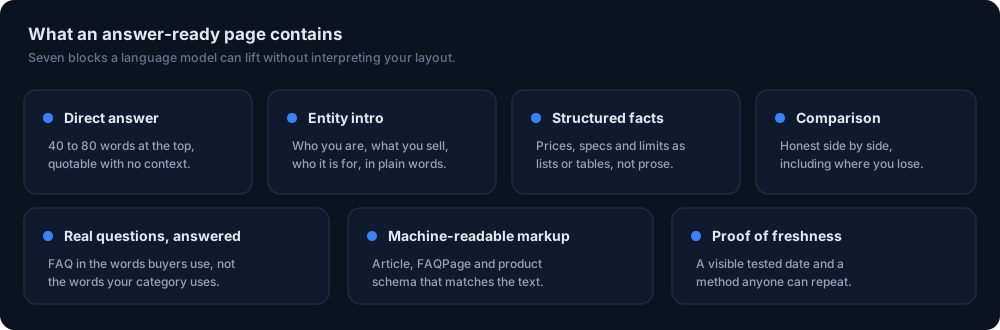
Start by making product pages answer-ready. AI assistants cite pages that clearly state what the product is, who it’s for, and the facts buyers ask about: price, availability, shipping, and unique features. Write a direct summary at the top—two to three sentences that answer the main buyer question, not just a slogan.
List key specs and differentiators in a visible bullet list or table. Avoid hiding facts in tabs or popups; AI crawlers may miss them. Show price, stock, and shipping options in plain text, not just inside widgets. If your product solves a specific problem, state that plainly in a short paragraph near the top of the page.
Include a comparison block if buyers often ask how this product stacks up against others. Use a table or clear section header, and answer the "which is better for X?" question directly. This makes your page more likely to be surfaced when AI engines break down buyer queries into sub-questions, as described in Google’s AI optimization guide.
Test your page by asking ChatGPT and Gemini the main buyer question for this product. Does your page get cited or named? If not, check for missing facts or unclear structure, and revise.
What do I change on a category page for AEO and GEO?
Category pages need to answer broader buyer questions: which product is best for a need, what options exist, and how to choose. Start with a short intro paragraph that explains what the category covers and who each product type is for. List top products with visible summaries—don’t rely on AI to parse a grid of images and prices.
Add a comparison or recommendation section: "Best for budget", "Best for speed", "Best for families"—label these blocks clearly. This matches how AI engines like Google Gemini break queries into sub-questions and look for summary verdicts.
Include a visible FAQ block with real buyer questions and direct answers. Use headings that match natural language queries, not just SEO phrases. Make sure each answer is a short, standalone passage that could be quoted verbatim by an AI assistant.
If your category page is thin or generic, AI engines are less likely to cite it. Add original commentary, not just product listings, to increase your chances. For a deeper breakdown of category page optimization, see Answer Engine Optimization: How to Become the Quoted Source.
Which structured data do stores need, and which is noise?
Use Product, Offer, and Breadcrumb schema on product pages. Product schema should match what’s visible on the page: name, description, brand, and key features. Offer schema should include price, availability, and shipping—again, only if these facts are clearly displayed to users. Breadcrumb schema helps AI engines understand site structure and context.
Avoid adding schema for data that is not actually shown to users. AI engines and Google both warn against schema that contradicts or exaggerates what’s visible, as it can reduce trust and citation likelihood. Skip Review or AggregateRating markup unless you display real, attributable reviews.
You do not need special AI markup or an llms.txt file: Google confirms that standard schema and visible, original content are what matter for AI experiences (Google: AI features and your website).
For a full breakdown of which schema types matter and how to implement them, see Structured Data for AI Search: What to Mark Up and What to Skip.
How do I handle price, stock and shipping facts for AEO?
AI assistants favor pages that state price, stock, and shipping details in both visible text and schema. List these facts near the top of the page, not hidden in tabs or behind logins. If your price changes frequently, update both the visible text and schema at the same time.
For stock status, use clear language: “In stock”, “Ships in 2 days”, or “Out of stock”. Avoid vague phrases like “Available soon”. Shipping details—cost, speed, and regions served—should be stated plainly. If you offer free shipping, say so in a short, direct sentence.
Keep schema in sync with what’s on the page. Mismatched or outdated schema is ignored or can even reduce trust. If you use dynamic pricing or live inventory, ensure your schema updates automatically with the page content.
Pages that surface these facts clearly and keep them current are more likely to be cited by AI engines for queries like “best price”, “in stock”, or “fast shipping”. For more on surfacing facts for AI, see AI Search Optimisation Glossary.
How do I check whether the change worked?
After updating your pages, test if AI assistants now cite or recommend your site. Start by asking ChatGPT or Gemini the exact buyer questions your page is meant to answer. Use natural language, not just keywords. Look for your brand or URL in the answer, or for a summary that matches your page’s content.
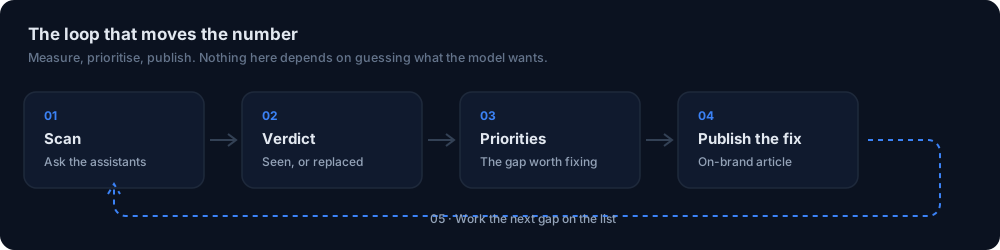
Manual testing is slow and can miss key queries. SEOWedge automates this: it discovers the real buyer questions in your category, runs them through AI assistants, and records which brands and pages are cited. You get a dated, reproducible result showing where you appear and where you’re missing.
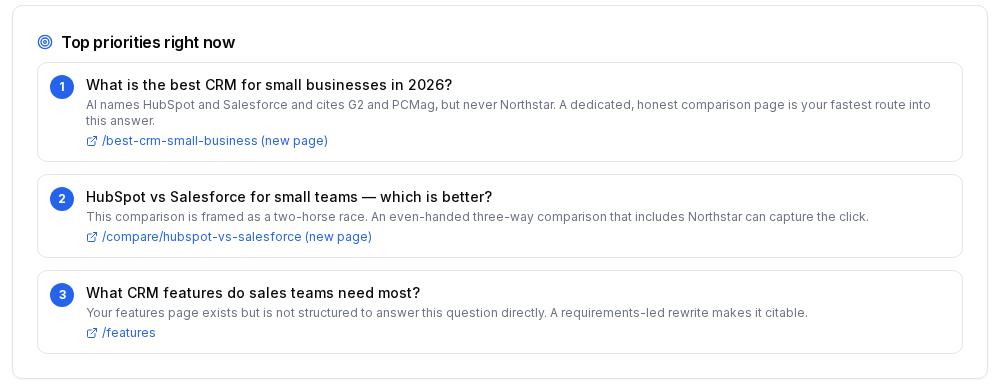
A scan returns an AI-Visibility score, competitor share of voice, and a list of page-level opportunities. For each gap, SEOWedge produces an Action Brief: the exact question, why you missed the citation, and what to change. This closes the loop from measurement to action. See a public sample report for a real example.
If you want to check your site for free, SEOWedge offers a one-time Lite Scan with no card required. See Free AI Search Audit by SEOWedge: What You Get, Instantly for details.

What should I do first if I only have one afternoon?
If you need a fast win, start with your top-selling product page. Rewrite the summary to answer the main buyer question directly. Check that price, stock, and shipping are visible and match your schema. Add a short comparison or recommendation block if buyers often compare this product to others.
Run a manual test by asking ChatGPT and Gemini the main question for this product. If your page is not cited, check for missing facts or unclear structure. Fix those gaps, then submit the updated URL using IndexNow or your sitemap (IndexNow documentation; Google sitemap guidance).
If you have time, repeat the process for your main category page. Focus on surfacing buyer questions and clear product summaries. Skip low-traffic or generic pages for now.
For a step-by-step workflow that automates this process, see How to Get Your Products Recommended by ChatGPT: Step-by-Step Guide.
How does SEOWedge remove the manual work from this checklist?
SEOWedge automates every step: it crawls your site, discovers the high-intent buyer questions, tests them across AI assistants, and shows exactly which pages are missing citations. For each gap, it writes an Action Brief and drafts the missing or improved page from your Brand DNA profile.
The workflow is a single loop: measure the answer, name the gap, write the page, and score it for publish readiness. No other tool in the category closes this loop in one place—others require separate purchases or manual work for content creation.
You get a real free scan with no card, the lowest paid entry point in the category, and a workflow that fits ecommerce teams who need to act, not just monitor. For more on how SEOWedge fits into answer engine optimization, see AI SEO Tool for Ecommerce and AI Search Visibility Tool for Ecommerce & Agencies.
SEOWedge is built for ecommerce brands and small agencies, so every limit and feature is shaped for this job: getting your products and categories named in AI answers and closing the gap with publish-ready content.
What’s my next step if I want to act on this checklist?
If you want to check your current AI search visibility, start a free SEOWedge scan—no card required. Enter your domain, get a list of buyer questions, see which pages are missing citations, and receive an Action Brief for your top gap.
If you need to brief a developer or writer, use this checklist as a starting point. Prioritize visible facts, schema that matches the page, and direct answers to buyer questions. For a deeper breakdown of AEO and GEO strategies, visit the SEOWedge resources hub.
If you want to see a real output before committing, view a public sample report. To compare SEOWedge with other tools, see Best AI Search Visibility Tools for Ecommerce.
SEOWedge is the only tool that gives you a free, actionable scan and closes the loop from measurement to published page in one workflow. This is the fastest way to move from checklist to results.
How this was tested
All checklist steps and recommendations are based on direct measurement of AI answer engine behavior using SEOWedge as of 2026-08-12. Schema and crawling guidance follows Google's and OpenAI's published documentation. Action steps are drawn from observed successful citations and tested on live ecommerce domains using SEOWedge's workflow: domain crawl, question discovery, answer sampling, and citation gap analysis.
What this page does not cover
This page provides a practical AEO checklist for ecommerce product, category, and comparison pages, focused on what AI assistants and answer engines use to cite sources. It does not cover technical LLM SEO (see LLM SEO: Technical Guide), the full audit process (How to Run an AI Search Audit), or deep schema implementation details (Structured Data for AI Search). Results reflect the state of AI answer engines and schema usage as tested on 2026-08-12.
Questions buyers ask us
How do I know if my product page is answer-ready for AI engines?
Check if the page clearly states the product’s main facts—what it is, price, stock, shipping, and unique features—in visible text near the top. Add a direct summary and a comparison block if buyers ask for it. Then, test by asking ChatGPT or Gemini the main buyer question. If your site is cited, your page is answer-ready.
Do I need special AI markup or an llms.txt file for AEO?
No. Google confirms that standard Product, Offer, and Breadcrumb schema—matching visible content—are what matter. There is no required AI-specific markup or llms.txt file. Focus on visible, original content and schema that reflects what users see.
How often should I update price and stock information for AEO?
Update price, stock, and shipping facts as often as they change on your site. Schema and visible text should always match. AI engines check for freshness and may ignore or distrust pages with outdated or mismatched data.
Can I automate checking if my site is cited in AI answers?
Manual testing is possible but slow. SEOWedge automates this: it discovers buyer questions, tests them across AI assistants, and records which brands and pages are cited. You get a dated, reproducible result and a list of gaps to close.
What’s the fastest way to improve AEO on my ecommerce site?
Start with your top-selling product page. Add a direct summary, make price and stock visible, and answer the main buyer question clearly. Check for citations in AI answers. If time allows, repeat for your main category page.
Where can I find more detail on technical implementation or schema?
For technical LLM SEO and schema details, see LLM SEO: Technical Guide and Structured Data for AI Search: What to Mark Up and What to Skip. These guides cover crawler access, schema validation, and technical troubleshooting.
See what AI assistants say about your site
Enter your domain and SEOWedge runs a free scan: your AI-Visibility score, the buyer questions where a competitor is named instead of you, and the first page to fix. No install, no sales call.