
How to Run an AI Search Audit on an Ecommerce Site
An ecommerce AI search audit checks whether AI assistants like ChatGPT and Google Gemini recommend your store and products, which competitors they name, and which pages cause those gaps. The audit steps: test assistant retrieval, compare brand mentions, check category and product page coverage, and turn gaps into a prioritized action list. SEOWedge automates this loop for ecommerce brands and agencies.
By the SEOWedge Research Team · Published August 11, 2026 · Last tested August 12, 2026 · Updated August 12, 2026 · 6 min read
What to take away
- Start by testing if AI assistants can access and cite your pages.
- Check both product and category pages for answer coverage and retrieval.
- Identify the buyer questions where competitors are recommended instead of you.
- Turn gaps into a prioritized list of actions, mapped to specific pages.
- Use SEOWedge to automate measurement, gap discovery and page creation.
What Are the Steps of an Ecommerce AI Search Audit?
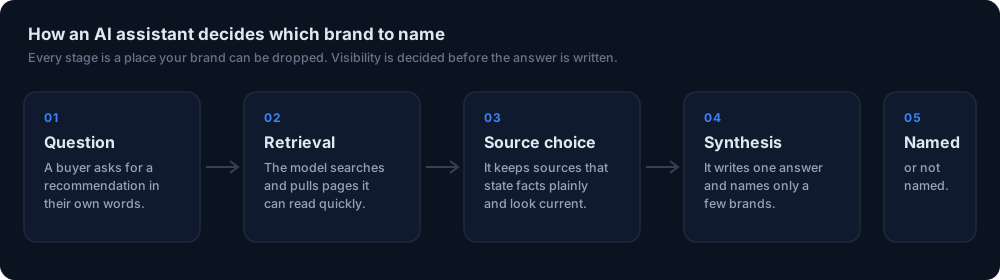
The audit begins by testing if AI assistants can access your site. This means verifying that OpenAI’s OAI-SearchBot and Google’s GeminiBot are allowed to crawl your pages. If assistants cannot fetch your content, you cannot be cited or recommended in their answers. Check your robots.txt and server logs for these bots. See OpenAI’s crawler documentation for required allow rules (source).
Next, discover the buyer questions that matter for your category. These are not generic prompts, but real questions buyers ask when choosing products like yours. SEOWedge discovers these automatically during its scan; if you are doing this manually, use search data, reviews, and competitor FAQs to build your list.
Then, submit these questions to AI assistants (ChatGPT, Gemini) and record which brands and products are recommended. Note which answers cite your domain, which cite competitors, and which do not name any brand. This is your share-of-voice baseline.
Finally, map each missed opportunity to the specific product or category page that should have been cited. This lets you turn findings into a prioritized action list, targeting the most valuable gaps first.

How Do I Check If AI Assistants Can Fetch My Pages?
AI assistants need to crawl your site before they can cite it. For ChatGPT and Copilot, OAI-SearchBot must be allowed; for Google Gemini, GeminiBot must be able to fetch your pages. Check your robots.txt for these lines:
User-agent: OAI-SearchBot Allow: /
User-agent: GeminiBot Allow: /
If you see Disallow rules, update them and resubmit your sitemap. Use server logs or analytics to confirm bot access. For new or rarely linked pages, submit URLs via IndexNow (IndexNow documentation) or Google Search Console. This does not guarantee instant indexing, but it notifies engines your page exists (Google sitemap guidance).
SEOWedge checks for AI bot accessibility as part of its scan, flagging pages that are blocked or missing from assistant indexes.
What Do I Check on Category vs. Product Pages?
Category pages answer broad buyer questions, such as "best running shoes for flat feet" or "top gifts for new parents." Product pages answer specific queries like "Is Product X suitable for Y?" or "Does Brand Z offer free shipping?" In an AI search audit, test both page types against the discovered question set.
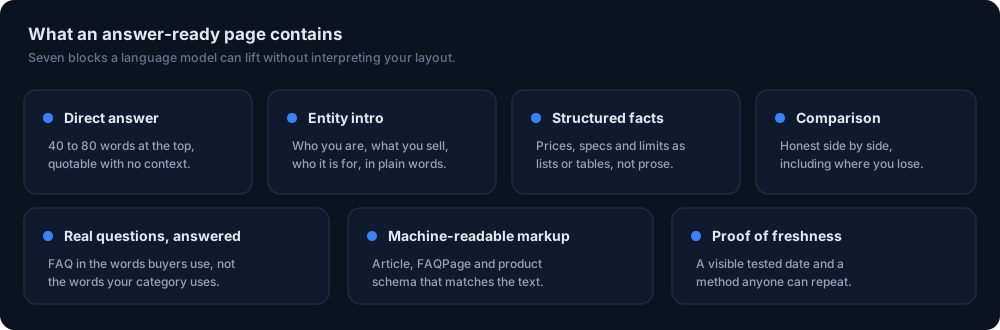
For category pages, check if assistants recommend your collections for broad, high-intent queries. Look for citations or mentions in answers. If a competitor’s category page is named instead, review their structure: do they provide comparison tables, buyer guides or direct-answer blocks?
For product pages, check if assistants name your product for specific, feature-driven queries. If not, compare your page to those that are cited: do you include first-hand details, usage cases and up-to-date specs?
SEOWedge maps each question to the page type that should answer it, so you can see if the gap is at the category or product level. For detailed AEO recommendations by page type, see AEO Checklist for Ecommerce.
How Do I Test Assistant Answers and Record Gaps?
Submit each buyer question to ChatGPT and, if available, Google Gemini. Record which brands, products or pages are named in the answer. Note whether your store is mentioned, and if not, which competitor is. Repeat this for at least 5-12 questions per audit cycle—the more representative your set, the more reliable your findings.
SEOWedge automates this by sending the discovered questions to each assistant via API, then storing the sampled answers with a date and source. This makes before/after comparisons meaningful: you can see if a fix actually moved your brand into the answer.
Manual audits require copying answers into a spreadsheet, tagging each mention, and tracking changes over time. Automated tools like SEOWedge keep this loop consistent and reproducible, removing sampling bias.
How Do I Turn Findings into a Prioritized Action List?
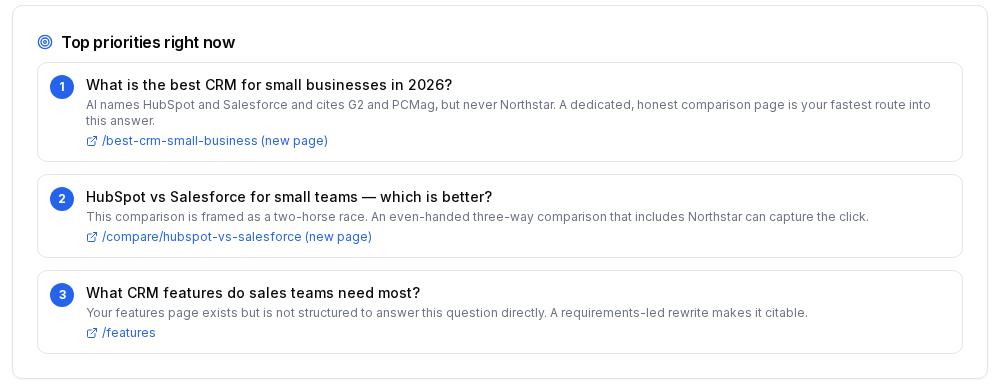
Not every missed mention is equally valuable. Prioritize gaps by buyer intent (how close the question is to a purchase), search volume, and the competitor’s share of voice. Focus on questions where assistants name a direct rival or where the answer is blank but should include a brand recommendation.
Map each prioritized question to the page that should win the citation. For example, if "best vegan protein powder" names a competitor’s category page, your own category page should be updated or created to answer that question directly.
SEOWedge returns a list of Action Briefs: for each missed question, it shows why your store was not cited, which competitor was, and the exact page to create or fix. This turns the audit into a concrete to-do list, not just a report.
For a sample of what this output looks like, see the public sample report.
What Does a Finished Ecommerce AI Search Audit Look Like?
A finished audit should include:
- A list of buyer questions tested, with the date and platform (ChatGPT, Gemini, etc.)
- For each question: which brands and pages were cited or recommended
- A summary of your current AI search visibility score and competitor share of voice
- A prioritized list of gaps, mapped to specific category or product pages
- For each gap: the reason your page was not cited (missing content, technical block, outdated info) and the next action to close it
SEOWedge structures this as a scan result, with exportable reports on paid plans. You can use this format as a template for manual audits. For a full report structure, see AI Search Report Template.
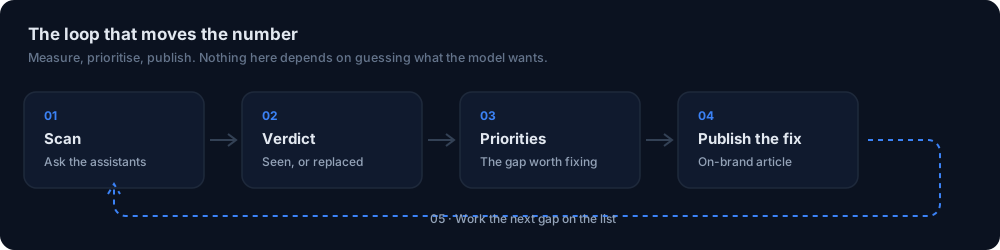
The audit is not just a snapshot—it is the starting point for a repeatable improvement loop. After you act on the findings, re-run the audit to measure progress.
How Does SEOWedge Remove the Manual Work from This Audit?
SEOWedge automates every audit step: it crawls your store, discovers buyer questions, tests answers in ChatGPT and Gemini, and returns a visibility score, competitor share of voice and a page-level gap list. For each gap, it produces an Action Brief and drafts the missing page from your Brand DNA profile.
No prompt writing or manual tracking is required. The workflow is: enter your domain, get your audit and action list, and generate the pages that close the gap. Paid plans let you scan multiple stores and queue several content fixes at once. Credit top-ups mean you never hit a hard limit in a busy month.
This single-loop workflow is what separates SEOWedge from tools that only monitor or require separate content purchases. The result: you see exactly where you are missing in AI answers, why, and what to publish next to move the needle. For a full breakdown, see AI Search Visibility Tool for Ecommerce & Agencies.
If you want to try this process risk-free, SEOWedge offers a free scan with no card required. See Free AI Search Audit by SEOWedge for what you get instantly.
What Should I Do Next After the Audit?
After running your ecommerce AI search audit, start by fixing the highest-priority gaps: update or create the category and product pages mapped to your missed buyer questions. Add direct-answer blocks, comparison tables or usage details as needed for AEO and GEO. Resubmit updated URLs via IndexNow or Search Console to accelerate re-crawling.
Re-audit after each round of fixes to see if your brand starts appearing in assistant answers. Track changes in share of voice and citation frequency over time. If you want to automate this loop, SEOWedge’s paid plans support monthly scans, multi-store tracking and bulk content generation.
For detailed implementation on technical retrieval, see LLM SEO: Technical Guide. For page-level content structure, see AEO Checklist for Ecommerce. Your next step: run a free scan, or review a public sample report to see the audit output in practice.
How this was tested
All audit steps and checks described here are based on SEOWedge's workflow as of 2026-08-12. AI assistant retrieval and citation checks are performed by sampling real answers from OpenAI (GPT) and Google Gemini via their APIs, using buyer-intent questions discovered from the site and its market. Retrieval tests are validated by checking for OAI-SearchBot and GeminiBot access, and page-level gaps are mapped to the discovered question set. Prioritization is based on share-of-voice and citation opportunity as measured in the scan. All numbers and mechanisms reflect the SEOWedge platform, verified against the cited sources.
What this page does not cover
This page covers the practical steps for running an ecommerce AI search audit, with a focus on GEO and AEO as they apply to product and category pages. It does not cover classic SEO audits, technical SEO checks outside LLM retrieval, or non-ecommerce sites. For technical LLM SEO, see LLM SEO: Technical Guide. For AEO page structure, see AEO Checklist for Ecommerce. All audit methods are current as of 2026-08-12 and reflect the capabilities of SEOWedge and the referenced AI models.
Questions buyers ask us
How is an AI search audit different from a classic SEO audit?
A classic SEO audit checks rankings, crawlability, and on-page factors for traditional search engines. An AI search audit checks whether AI assistants (like ChatGPT and Gemini) can access your pages, whether they cite or recommend your store, and which competitors appear instead. The focus is on GEO and AEO: being named in AI answers, not just ranking in blue links. For a full comparison, see GEO vs AEO vs SEO.
Do I need to write my own prompts or questions to test?
With SEOWedge, you do not need to write prompts. The tool discovers high-intent buyer questions automatically from your site and market. If you audit manually, you will need to build a question set based on real buyer language, reviews, and competitor content. The quality of your audit depends on using questions buyers actually ask.
How often should I repeat an AI search audit?
Run an audit after any major content update, and at least monthly if you want to track progress or report to stakeholders. AI assistant answers change as models re-crawl the web, so regular checks are needed to catch new gaps or improvements. SEOWedge paid plans support scheduled monthly scans for ongoing tracking.
What if my pages are blocked to AI bots?
If OAI-SearchBot or GeminiBot are blocked in your robots.txt, your pages cannot be cited or recommended in AI assistant answers. Update your robots.txt to allow these bots and resubmit your sitemap. Use IndexNow or Search Console to notify engines of changes. For technical details, see LLM SEO: Technical Guide.
Can I export or share the audit findings with my team or clients?
SEOWedge paid plans include report export (PDF) and, on the Agency plan, white-label reports. Manual audits can be shared as spreadsheets or documents. For a template and best practices, see AI Search Report Template.
How do I know if my fixes actually worked?
After updating your pages, re-run the audit and compare the new answers to your baseline. If your brand is now cited or recommended in AI assistant answers for the targeted questions, the fix worked. SEOWedge stores dated answer samples for before/after comparison, making progress visible and defensible.
See what AI assistants say about your site
Enter your domain and SEOWedge runs a free scan: your AI-Visibility score, the buyer questions where a competitor is named instead of you, and the first page to fix. No install, no sales call.
Keep reading
- ProductFree AI Search Audit by SEOWedge: What You Get, Instantly
- GuideCan SEOWedge Help Me Understand Why My Site Is Missing from AI Answers?
- GuideCan SEOWedge Help Me Fix Pages That Are Cited Incorrectly in AI Answers?
- GuideWhy Do AI Assistants Cite Outdated Information? SEOWedge's Diagnostic Approach