Why Is My Site Missing from AI Answers—and What Can SEOWedge Show Me?
SEOWedge pinpoints why your site is missing from AI answers by showing which competitors are cited, which specific pages win those citations, and what is missing from your own content. The audit identifies the exact question and page behind each gap, then produces a brief and a draft page to close it. You see what to fix and how to act, not just a score.
By the SEOWedge Research Team · Published August 12, 2026 · Last tested August 12, 2026 · Updated August 12, 2026 · 6 min read
What to take away
- SEOWedge shows which competitors are named in AI answers instead of you, and which of their pages are cited.
- You get a list of the buyer questions your site misses, with a page-level Action Brief for each gap.
- The tool produces a draft page or content brief for every opportunity, built from your brand's profile.
- A free scan gives you a real AI-Visibility score and a gap list, no card required.
- Immediate next steps are built in: see the gap, get the fix, edit and publish.
How Does SEOWedge Identify Why My Site Is Missing from AI Answers?
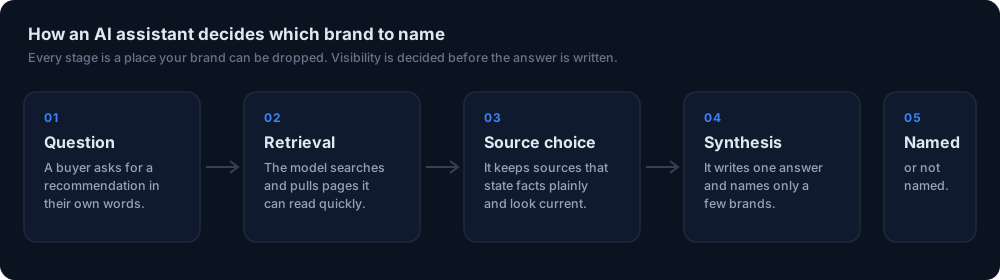
SEOWedge starts by crawling your domain and extracting a Brand DNA profile: your category, product range, and main conversion goal. It then discovers the high-intent buyer questions your market actually asks—no need to write your own prompts. These questions are sent to AI assistants (OpenAI GPT on all plans, Google Gemini on paid plans), and the tool records which brands and pages are named in the answers.
If your site is missing, SEOWedge shows exactly which competitor is being cited and for which question. The scan does not just return a score; it maps the real-world gap between your content and what AI assistants surface. This is not a vanity metric—it's a direct reflection of what buyers see when they ask an AI assistant about your category.
What Does the SEOWedge Audit Show About Competitor Citations and Missed Opportunities?
The audit returns a competitor share-of-voice chart for each tested question. You see which brands are named, the URLs cited, and how often your site appears. For every gap, SEOWedge lists the exact question your site failed to win and the competitor page that took the citation.
This is not just a list of who ranks higher—it's a record of which page was quoted or named in the AI answer. You can see patterns: are you missing out on comparisons, reviews, or specific product queries? SEOWedge also highlights if a single competitor dominates multiple questions, or if different sites win different gaps.
Unlike classic SEO tools, SEOWedge does not rely on search rankings or backlinks. The focus is on AI assistant output: what the model actually says, and which page it points to. This lets you act on the real-world answers buyers see, not on proxy metrics.

Does SEOWedge Tell Me Which Pages or Content Are Causing the Gap?
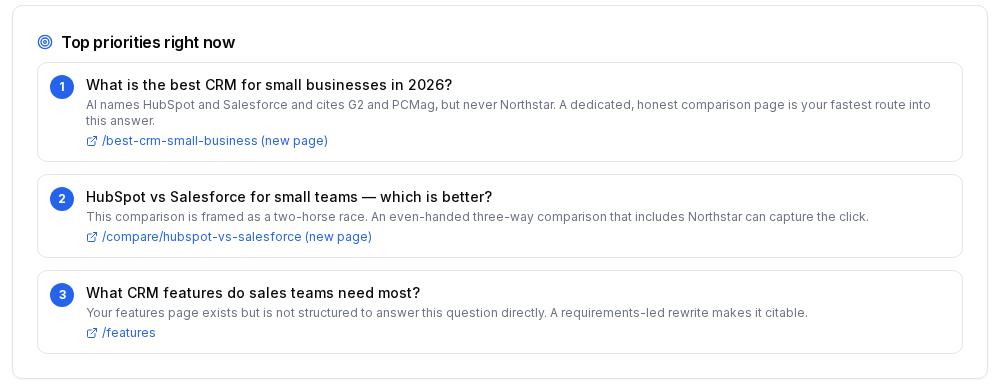
Yes. For every missed citation, SEOWedge identifies the exact competitor page that is being cited by the AI assistant. You receive a page-level Action Brief, which includes the buyer question, the cited competitor URL, and a summary of why that page won the citation.
This is not a generic gap report. SEOWedge breaks down each missed opportunity to the page and question level. For example, if ChatGPT recommends a competitor's buying guide for "best running shoes for flat feet," you see the specific URL and the on-page elements that led to the citation. The tool does not just say "write more guides"—it shows you the template and content structure that actually won the AI answer.
This level of granularity lets you act precisely. You know which pages to create or revise, and what information or format is needed to win the next crawl.
What Immediate Next Steps Does SEOWedge Recommend to Fix the Issue?
SEOWedge produces an Action Brief for each gap. This brief explains the buyer intent, the competitor's approach, and what your page needs to do differently. You can generate a draft page directly from your Brand DNA profile, ensuring the content matches your voice and product specifics.
The workflow is: review the Action Brief, edit or approve the generated draft, and publish the new or revised page. SEOWedge scores each draft for Publish Readiness, so you know it meets the answer engine's criteria before going live. Once published, the tool submits your new URL via IndexNow to notify participating search engines and AI assistants faster.
This workflow removes guesswork. You move from "why am I missing?" to "here is the page to fix it" in a single loop. For more on turning gaps into content, see How SEOWedge Turns AI Visibility Gaps Into Actionable Content.
How Are Buyer Questions Discovered and Why Does It Matter?
SEOWedge does not ask you to supply prompts. Instead, it discovers buyer questions from your site's category, product data, and market context. Each scan surfaces the real questions buyers type into AI assistants—phrased in their language, not in SEO jargon.
This matters because AI assistants do not rely on keyword matches. They answer natural-language questions, often combining multiple sources. SEOWedge's discovered questions reflect actual buyer intent, so the opportunities and gaps are actionable. You see not just "what is missing," but "what buyers are asking and what AI assistants are actually answering."
For a detailed breakdown of SEOWedge's question discovery, see How Does SEOWedge Find Buyer Questions for My Ecommerce Site?.
What If My Site Has Technical or Crawlability Issues?
AI assistants rely on being able to crawl and index your pages, but their requirements differ from classic SEO. For example, OpenAI's OAI-SearchBot must be allowed for ChatGPT search results, and Google Gemini uses a query fan-out approach that favors comprehensive, first-hand content. If your site blocks these bots or lacks original content, you will not be cited, regardless of your SEO rankings.
SEOWedge's scan will show a zero or near-zero visibility score if your site is uncrawlable or ignored by AI assistants. The audit does not diagnose every technical issue, but it flags when AI assistants cannot reach your content. For technical troubleshooting, see LLM SEO: Technical Guide to Optimising for Language Models and the official OpenAI crawler documentation.
How Does SEOWedge’s Diagnostic Loop Compare to Manual Audits or Other Tools?
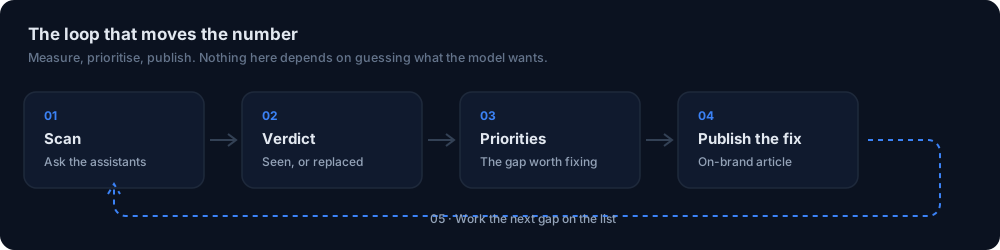
Manual audits require you to guess which questions matter, test them in AI assistants, and track which brands are cited. This is slow, subjective, and hard to scale. Most other AI search tools sell prompt tracking, requiring you to write and maintain a question list, then bill you by prompt count. SEOWedge discovers buyer questions automatically, tests them across multiple AI engines, and outputs a prioritized, page-level opportunity list.
The loop is closed: measurement, gap discovery, Action Brief, content draft, and readiness scoring happen in one workflow. This is not a monitoring dashboard or a generic content generator. You see the mechanism and the fix in the same place. For a full comparison of measurement approaches, see What an AI Search Visibility Score Actually Measures and SEOWedge vs Semrush AI Visibility.
What Do I Get for Free, and When Should I Upgrade?
A real, no-card-required scan is available on the Free plan. You receive an AI-Visibility score, a competitor share-of-voice chart, and a list of the top missed opportunities, including one Action Brief and one draft article. This is enough to see why your site is missing and what you can do about it.
Paid plans unlock more scans per month, more discovered questions, full Gemini coverage, and bulk content generation. If you need to fix multiple gaps, cover several products, or serve clients, upgrading lets you scale the same diagnostic loop across more domains and questions. See Pricing for full plan details and Free AI Search Audit by SEOWedge for what is included at no cost.
What’s My Next Step If I Want to Diagnose and Fix My AI Answer Gap?
Start with a free scan: enter your domain, wait for the crawl and question discovery, and review your AI-Visibility score and competitor gap list. Read the Action Briefs, see which competitor pages are being cited, and generate the recommended draft page for your top missed opportunity.
If you want to act on more than one gap, or need Gemini coverage, upgrade to a paid plan. The workflow remains the same: scan, diagnose, act, and publish. For a public sample report, see SEOWedge Sample Report. For step-by-step guidance on getting cited, see How to Get My Brand Cited in AI Answers.
How this was tested
All facts on this page are based on SEOWedge's diagnostic workflow as tested on 2026-08-12. SEOWedge samples real answers from OpenAI (GPT) and Google Gemini (on paid plans), records which brands and pages are cited, and identifies missed opportunities by comparing your site to those cited in response to real buyer questions. Each step is documented and reproducible. Platform-specific requirements and citation behaviour are referenced from official OpenAI and Google documentation.
What this page does not cover
This page addresses why a site is missing from AI assistant answers and how SEOWedge diagnoses and fixes those gaps. It does not cover general SEO rankings, traffic analytics, or manual prompt tracking. For technical crawl issues, see LLM SEO: Technical Guide. For step-by-step brand citation fixes, see How to Get My Brand Cited in AI Answers. All data is current as of 2026-08-12 and reflects SEOWedge's workflow and supported platforms only.
Questions buyers ask us
How does SEOWedge know which competitor pages are being cited in AI answers?
SEOWedge samples real answers from OpenAI GPT and Google Gemini, recording which URLs are named or quoted in response to buyer questions. The audit shows you the exact competitor page behind each missed citation, not just the brand or domain.
Can SEOWedge diagnose technical issues that block my site from AI assistants?
SEOWedge flags zero visibility when your site is uncrawlable or ignored by AI assistants, but it does not run a full technical audit. For in-depth troubleshooting, see LLM SEO: Technical Guide and check your robots.txt and crawler permissions.
Does SEOWedge only measure, or does it help me fix the problem?
SEOWedge closes the loop: it measures the gap, names the missing citation, produces an Action Brief, and drafts a new or revised page from your Brand DNA profile. You can edit and export the draft for publishing, all in one workflow.
What do I get for free before upgrading?
The Free plan gives you one scan, five discovered questions, one Action Brief, and one draft article—no card required. This is enough to see your AI-Visibility score, competitor citations, and your top missed opportunity.
How long does it take to see results after publishing a new page?
AI assistants re-crawl and update citations over weeks, not hours. SEOWedge submits your new URL via IndexNow to speed up discovery, but citation changes depend on the assistant's crawl schedule. You can scan again to check progress after publishing.
Does SEOWedge work for agencies or only for single brands?
SEOWedge is built for ecommerce brands and agencies running up to 25 client domains. The Agency plan supports bulk scans, bulk article generation, and white-label PDF reports for client delivery.
See what AI assistants say about your site
Enter your domain and SEOWedge runs a free scan: your AI-Visibility score, the buyer questions where a competitor is named instead of you, and the first page to fix. No install, no sales call.