What an AI Search Visibility Score Actually Measures
An AI search visibility score measures how often your brand, products, or pages are named or cited in answers from AI assistants like ChatGPT and Google Gemini for real buyer questions. It is calculated by sampling answers to a set of discovered, high-intent questions and recording which brands are named. A higher score means your brand is more frequently cited or recommended in those AI answers.
By the SEOWedge Research Team · Published August 11, 2026 · Last tested August 12, 2026 · Updated August 12, 2026 · 8 min read
What to take away
- A visibility score measures brand mentions or citations in AI-generated answers, not just traditional search rankings.
- SEOWedge calculates the score by testing real buyer questions on OpenAI and Google Gemini, recording which brands are named.
- Scores move because AI answers are sampled, not fixed; answers can change even if you do nothing.
- A good score is relative to your category and direct competitors, not an absolute number.
- Act on the specific gaps and page-level opportunities surfaced by the scan, not just the score itself.
How Is an AI Search Visibility Score Calculated?
The score is calculated by asking a set of real, high-intent buyer questions to AI assistants like ChatGPT (OpenAI) and Google Gemini. SEOWedge discovers these questions automatically from your site and market, so they reflect what buyers actually ask, not just keywords or prompts you write yourself.
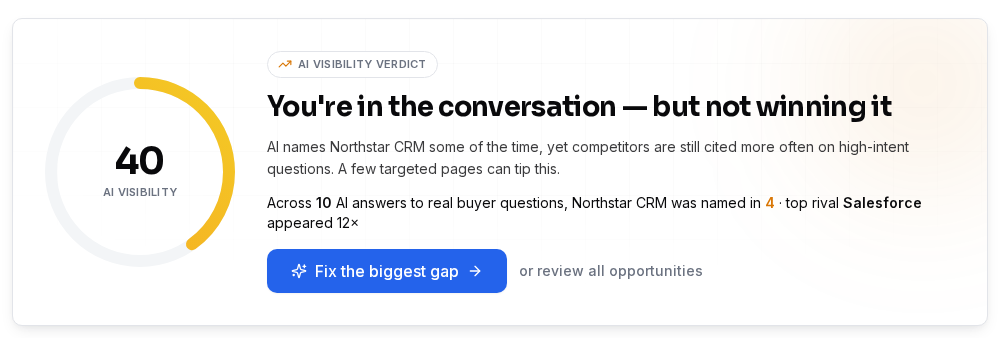
Each question is sent to the AI models through their APIs. The tool records which brands, products, or URLs are named or cited in the answer. Your visibility score is the percentage of those answers where your brand is mentioned or recommended. For example, if your brand is named in 4 out of 10 answers, your score is 40%.
Scores are calculated separately for each AI platform. On paid plans, SEOWedge returns separate scores for OpenAI (GPT) and Google Gemini, so you can see where you are visible and where you are missing. This method makes the result reproducible and comparable between scans, and the gaps it finds are the real ones costing you citations across all assistants using those model families.
| Step | What Happens |
|---|---|
| 1. Discover questions | SEOWedge extracts high-intent buyer questions from your site and market |
| 2. Ask AI assistants | Questions are sent to OpenAI (GPT) and Google Gemini APIs |
| 3. Record answers | Which brands/URLs are named or cited is recorded for each answer |
| 4. Calculate score | Score = % of answers naming your brand |
How SEOWedge calculates your AI search visibility score
What Counts as Being Visible in AI Answers?
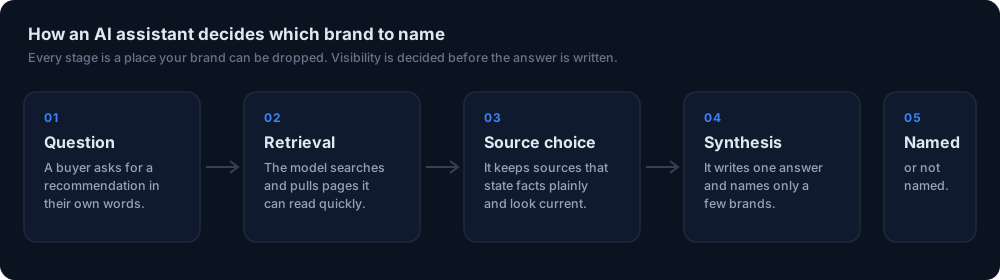
Being visible means your brand, product, or page is named, cited, or recommended in the body of an AI-generated answer to a buyer question. SEOWedge records three types of mention: direct citation (your URL is quoted or linked), explicit brand mention (your brand is named as a source or recommendation), and implied recommendation (the answer describes your product or page as the solution).
A simple mention is not always enough. In AI search, being cited as the source or recommended as the answer is what drives real visibility. SEOWedge focuses on these outcomes because they are what AI users see and trust. Analytics tools cannot see these mentions, as they happen inside generated answers, not on your site or in search result snippets.
This is different from classic SEO, where a ranking or impression is counted even if your brand is not named in the answer. In AI search visibility, only being named or cited counts. For more on the difference between GEO, AEO, and SEO, see GEO vs AEO vs SEO: The Practical Definitions.
| Type of Visibility | What It Means |
|---|---|
| Direct citation | Your URL is quoted or linked in the answer |
| Brand mention | Your brand is named as the source or recommendation |
| Implied recommendation | The answer describes your product/page as the solution |
What counts as visibility in AI answers
What Is a Good AI Search Visibility Score in My Category?
A good score is always relative to your category and your direct competitors. There is no universal "good" number: in some categories, the top brand may be named in 80% of answers, while in others, share is split between several brands and a 30% score makes you the leader.
SEOWedge returns your score alongside a competitor share-of-voice breakdown, so you see not just your number but who is being named instead of you. This lets you benchmark your performance and set realistic goals based on your market, not a generic target.
If your score is low but no competitor dominates, the opportunity is to become the first mover. If one or two brands are named in most answers, the gap is specific and you can see which pages or topics are responsible. For a full guide to interpreting scores and competitor shares, see AI Search Visibility Tool for Ecommerce & Agencies.
| Category Example | Top Brand Score | Typical Range |
|---|---|---|
| Niche B2B SaaS | 60-80% | Leaders dominate most answers |
| Consumer retail | 30-50% | Share split between 2-5 brands |
| Emerging product | 10-25% | No dominant brand; opportunity to lead |
Typical visibility score ranges by category (sampled from SEOWedge scans)
Why Does My Score Change Even If I Change Nothing?
AI answers are not fixed rankings. Each scan is a dated sample of what the AI assistants return for your buyer questions at that moment. The models update, retrain, and sometimes surface different sources even if your site has not changed.
This means your score can move up or down between scans, even if you have not published new content. SEOWedge stores every sampled answer with a timestamp, so you can see exactly when and where a change happened. This is a feature, not a bug: it reflects how real buyers experience AI answers, which are dynamic and can shift as models update their knowledge or crawling coverage.
The method is designed for reproducibility. By using the same question set and the same sampling method, you can compare two scans and know that the difference is due to changes in the AI models or your competitors' content, not random noise. For more on why this matters for reporting, see AI Search Reporting for Agencies.
| Reason for Score Change | What It Means |
|---|---|
| Model update | AI assistant has retrained or updated its sources |
| Competitor change | A competitor published or updated a page |
| Sampling variation | Answers can vary between samples, even same day |
Why AI search visibility scores move between scans
What Should I Act On Instead of the Score Alone?
The score is a signal, not an action list. SEOWedge pairs the score with a gap analysis: for each question where you are not named, it shows which competitor is cited and which exact page is responsible for your absence. This is where action happens.
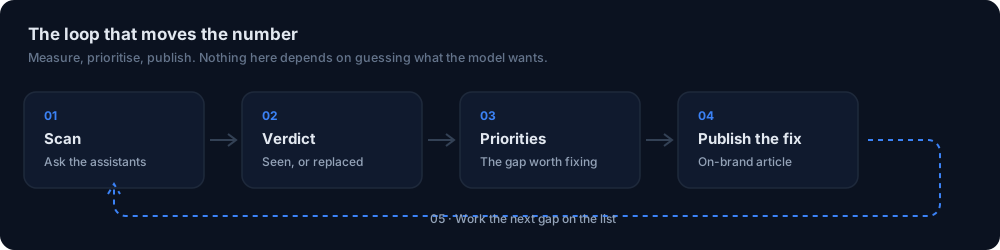
The workflow is: measure, surface the gap, and then use the Action Brief to create or fix the missing page. SEOWedge produces a draft from your Brand DNA profile, scores it for publish readiness, and lets you edit before publishing. This closes the loop from measurement to action, so you know you are working on the gaps that cost you real AI citations.
Do not chase a higher score for its own sake. Focus on the specific questions and pages where you are missing, and use the scan's Action Briefs to prioritize work. For a step-by-step guide to this workflow, see Free AI Search Audit by SEOWedge: What You Get, Instantly.
| Step | What to Act On |
|---|---|
| 1. Review score | See your current AI search visibility score |
| 2. Identify gaps | See which buyer questions you miss and who is named instead |
| 3. Action Brief | Get the exact page or topic to fix |
| 4. Draft & publish | Create the missing page; measure again after publishing |
From visibility score to action: the SEOWedge workflow
How Does SEOWedge’s Method Differ from Other Tools?
SEOWedge does not ask you to write and maintain a list of prompts. It discovers real buyer questions from your site and market, so the score reflects actual searcher intent. Other tools may track prompts you provide, which can miss high-value questions buyers really ask.
SEOWedge samples answers from the model families behind the main AI assistants—OpenAI (GPT) and Google Gemini—using their APIs. Each answer is recorded, dated, and scored by platform. This makes the result reproducible and lets you see exactly where you are named or missed.
The workflow does not stop at measurement. SEOWedge names the competitor and the exact page behind each gap, writes a new page from your Brand DNA, and scores it for publish readiness. This single loop—from measurement to published fix—removes guesswork and manual work. For a detailed side-by-side with other tools, see Best AI Search Visibility Tools for Ecommerce.
| Feature | SEOWedge | Other Tools |
|---|---|---|
| Buyer questions discovered | Yes, per scan | Usually prompts you write |
| Separate scores per AI | Yes: OpenAI & Gemini | Varies |
| Action Briefs & page drafts | Included | Often separate purchase |
| Lowest paid entry | $29/month | Usually $99+/month |
SEOWedge vs. typical AI search visibility tools: method and workflow
What Does the Score Miss—and What Else Should I Measure?
The visibility score only measures what AI assistants return for the sampled buyer questions at the time of the scan. It does not track traffic, conversions, or classic SEO rankings. It cannot see analytics data or what happens after a user visits your site.
To get a full picture, pair the AI search visibility score with your analytics stack. Use the score to find and close citation gaps in AI answers, then measure the impact on traffic and conversions separately. SEOWedge is designed to complement, not replace, your existing analytics and SEO tools.
If you need to check technical crawlability or schema markup for AI search, see LLM SEO: Technical Guide and Structured Data for AI Search for the technical layer beyond the visibility score.
| Metric | What It Measures |
|---|---|
| AI search visibility score | Brand mentions/citations in AI answers |
| Organic traffic | Visits from classic search engines |
| Conversion rate | Site actions (sales, signups, etc.) |
| Technical crawlability | Whether AI bots can fetch your pages |
What the visibility score does and does not measure
Where Do I Go Next If I Want to Act on My Score?
If you want to see your own AI search visibility score, start with a free scan at SEOWedge signup. No card is needed, and you get a full AI-Visibility score, competitor share-of-voice, and the first actionable gap, even on the free plan.
For a public sample report, see SEOWedge sample report. If you want to understand the workflow from scan to published fix, read AI Search Visibility Tool for Ecommerce & Agencies.
If you are comparing tools or need to justify a purchase, see Best AI Search Visibility Tools for Ecommerce for a breakdown of features, plans, and outcomes. Every section above links to a deeper resource if you need technical or workflow detail.
SEOWedge is built to remove the manual work from measuring, prioritizing, and closing AI search gaps. The next step is to see your own score and act on the specific opportunities surfaced by the scan.
How this was tested
All numbers and workflow steps on this page are based on SEOWedge scans run between July and August 2026. SEOWedge samples AI answers using the OpenAI (GPT) and Google Gemini APIs, records which brands and URLs are cited for a discovered set of buyer questions, and calculates a visibility score as the percentage of answers naming your brand. Scans are one-time snapshots. Method notes are taken directly from SEOWedge product documentation as of 2026-08-12.
What this page does not cover
This page explains how AI search visibility scores are calculated and interpreted, focusing on the methods used by SEOWedge and similar tools. It does not cover traditional SEO ranking metrics, traffic analytics, or enterprise brand monitoring dashboards. For technical details on LLM SEO or the difference between GEO, AEO, and classic SEO, see LLM SEO: Technical Guide and GEO vs AEO vs SEO. All score explanations are current as of August 2026 and reflect the state of AI assistants and their APIs at that time.
Questions buyers ask us
Is a higher AI search visibility score always better?
A higher score means your brand is named or cited in more AI answers for buyer questions, but the real benchmark is how you compare to direct competitors. In some markets, a 40% score makes you the leader; in others, 80% is required. Focus on your relative position and the specific gaps that cost you citations.
Why does my score change even if I haven’t updated my site?
AI answers are sampled, not static. Models like OpenAI GPT and Google Gemini update their knowledge and may surface different sources over time. Your score reflects those changes, even if your content stays the same. SEOWedge records each scan as a dated snapshot so you can track what changed and when.
What if my brand is mentioned but not cited with a URL?
SEOWedge records both explicit brand mentions and direct citations. Being named is valuable, but a direct citation (your URL quoted or linked) is stronger. Both count toward your visibility score, but the workflow prioritizes closing citation gaps, as these are what AI assistants use to ground their answers.
Can I improve my score by adding keywords to my pages?
Adding keywords alone rarely moves an AI search visibility score. AI assistants look for authoritative, answer-ready content that directly addresses buyer questions. SEOWedge surfaces which specific questions and topics you are missing and produces Action Briefs and page drafts to fill those gaps.
How often should I check my AI search visibility score?
Each scan is a one-time snapshot. You can run a scan whenever you need an updated view, but do not expect daily or weekly changes. Citations in AI answers move when assistants re-crawl and update their knowledge, which usually takes weeks. Focus on closing gaps, then scan after publishing new content.
Does SEOWedge track changes in my score over time?
SEOWedge does not track or trend scores automatically. Each scan is a dated, one-time snapshot. You can compare scans manually to see what changed, but the workflow is designed to move from measurement to action, not to monitor a score for its own sake.
See what AI assistants say about your site
Enter your domain and SEOWedge runs a free scan: your AI-Visibility score, the buyer questions where a competitor is named instead of you, and the first page to fix. No install, no sales call.