Why ChatGPT Recommends Your Competitors Instead of You
ChatGPT recommends your competitors when its answer engine finds their pages more relevant, accessible, or quotable for the buyer question it receives. This happens when your content is missing, hard to crawl, or lacks the details that make it the best answer. SEOWedge shows exactly which competitor page is named, why, and what to fix to flip the answer.
By the SEOWedge Research Team · Published August 11, 2026 · Last tested August 12, 2026 · Updated August 12, 2026 · 6 min read
What to take away
- AI assistants name competitors when their pages are easier to fetch, more complete, or better structured for direct answers.
- ChatGPT leans on pages it can crawl, cite, and extract a clear answer from—often product, comparison, or review pages.
- Missing citations are usually a content or crawlability gap, not just a lack of authority.
- You can pinpoint which page wins the mention and what your page lacks by running an AI search visibility scan.
- SEOWedge closes the loop: it measures the gap, names the responsible competitor page, and writes the fix for you.
Why does ChatGPT name a competitor and not my brand?
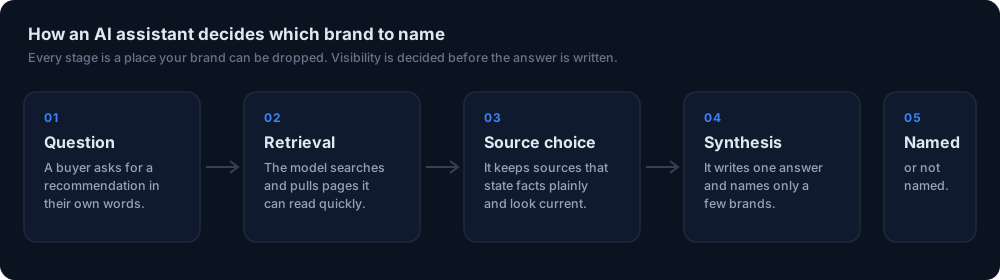
ChatGPT recommends a competitor when its answer engine finds their page more directly answers the buyer question, is easier to crawl, or is structured in a way that allows the model to quote or cite it. Three mechanisms usually drive this: (1) your content is missing or thin for the question, (2) your site blocks or limits the AI’s crawler, or (3) your page is present but not structured for direct extraction. The model does not "rank" in the classic SEO sense; it retrieves, chunks, and lifts passages that answer the question in a way it can use. If a competitor is named, their page is filling that gap better—often with a comparison, review, or detailed product answer.
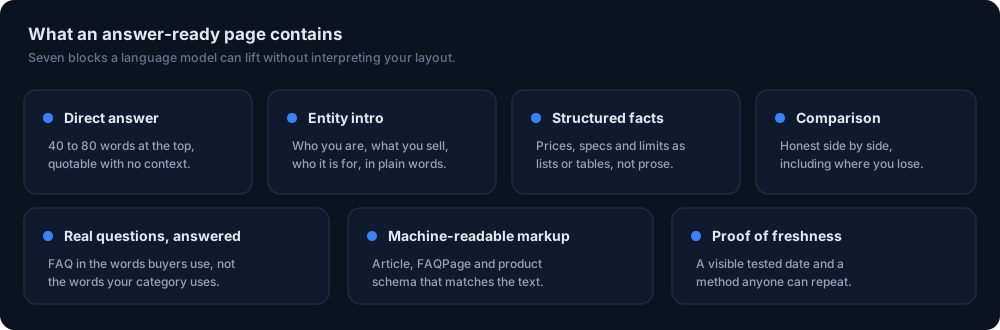
ChatGPT and Gemini both rely on crawling and retrieval. If your site blocks OpenAI’s GPTBot or OAI-SearchBot, your pages cannot be surfaced in answers. Even when crawlable, the model favors content that is structured for direct lift: clear product specs, comparison tables, or answer blocks. If your content is buried, generic, or fragmented, a competitor with a direct, answer-ready page will be chosen instead.
For a full breakdown of how LLMs fetch and use your pages, see LLM SEO: Technical Guide.
Which sources do ChatGPT and Gemini answers lean on?
ChatGPT and Gemini answers lean on pages that are crawlable, up-to-date, and structured for direct extraction. These are most often product pages, category pages, comparison articles, and third-party review sites. The model checks for clear, factual content it can cite or paraphrase. If a competitor's page is named, it is because that page was found, crawled, and matched to the question with enough detail to be used as a source.
OpenAI documents that OAI-SearchBot must be allowed for a site to be surfaced in ChatGPT search results, while GPTBot is used for training data. If your robots.txt blocks these, your site is invisible to the assistant for recommendations and citations. See OpenAI's documentation at https://developers.openai.com/api/docs/bots.
Google Gemini applies a query fan-out, breaking one question into several related searches and assembling the answer from multiple sources. Pages that cover a whole problem family—not just one keyword—are more likely to be cited. See Google's guidance at https://developers.google.com/search/docs/fundamentals/ai-optimization-guide.
For a Google-specific breakdown, see How to Appear in Google AI Overviews.
Is this a content, crawling, or authority problem?
In most cases, missing recommendations are a content or crawling problem, not an authority problem. AI assistants do not use classic SEO authority metrics (like backlinks or Domain Authority) as their primary filter. Instead, they look for content that is accessible (crawlable), directly answers the question, and is structured for easy extraction.
A crawling problem means the AI assistant cannot reach your page—either because your robots.txt blocks the right bot, or the page is not indexed. OpenAI's OAI-SearchBot and Google's crawlers must be allowed. For new or updated pages, submitting via IndexNow or a sitemap can speed up discovery, but does not guarantee inclusion (IndexNow, Google sitemap guidance).
A content problem means your page is either missing, too thin, or not structured for direct answer extraction. AI models favor pages with clear, original, non-commodity content that matches the buyer question. Authority only enters the equation if multiple pages are equally answer-ready; then, the model may prefer a more established domain, but this is rare in practice for product and comparison queries.
For a checklist of what to fix on product and category pages, see AEO Checklist for Ecommerce.
How do I find which specific competitor page is responsible?
To find out which competitor page is being cited or named, you need to test the exact buyer question in ChatGPT or Gemini and observe the sources listed or referenced in the answer. This is time-consuming to do manually, as models often paraphrase or cite without a direct link.
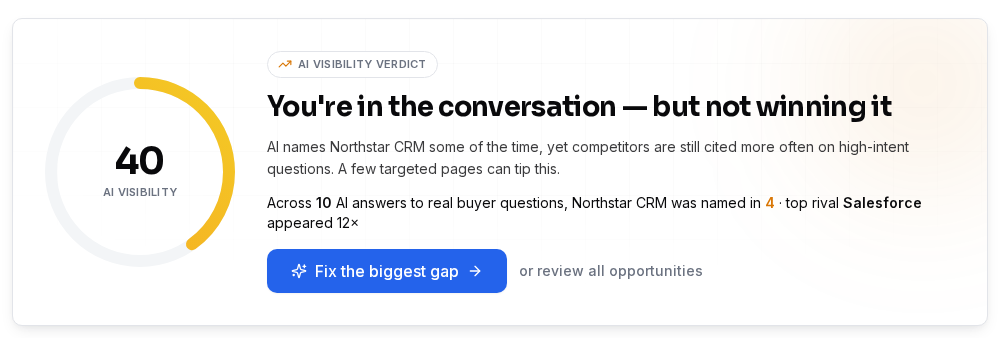
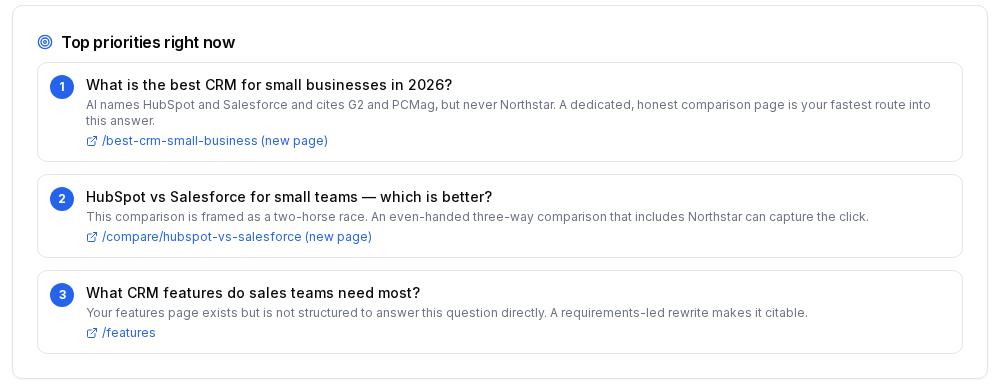
SEOWedge automates this by running a scan: it discovers the high-intent buyer questions in your category, sends them to ChatGPT and Gemini, and records which brands and pages are named in each answer. The scan returns a competitor share-of-voice chart and a list of opportunities, each naming the exact competitor page that won the citation.
You get a page-level Action Brief: the buyer question, the competitor page cited, and a summary of why your page was not chosen. This lets you target the fix precisely, instead of guessing or rewriting blindly.
You can see a public sample of this output at SEOWedge Sample Report.
What is the fastest change that can flip a ChatGPT answer?
The fastest way to flip a ChatGPT answer is to publish a new or revised page that directly answers the high-intent buyer question, using clear structure and original content. The page must be crawlable by OAI-SearchBot, and should include the facts, comparisons, or details that made the competitor's page quotable.
SEOWedge’s workflow produces an Action Brief for each gap, then writes a draft page from your Brand DNA profile, scored for Publish Readiness. Once published, SEOWedge submits the URL via IndexNow so AI assistants can discover the new content faster. In practice, it takes days to weeks for the change to be reflected in answers, depending on crawl and index cycles.
The most effective changes are: (1) adding a dedicated answer block for the buyer question, (2) making comparison tables or product specs explicit, and (3) ensuring the page is not blocked by robots.txt. Schema markup helps but is not required for AI answers (Structured Data for AI Search).
For a step-by-step guide, see How to Get Your Products Recommended by ChatGPT.
How does SEOWedge remove the manual work from this process?
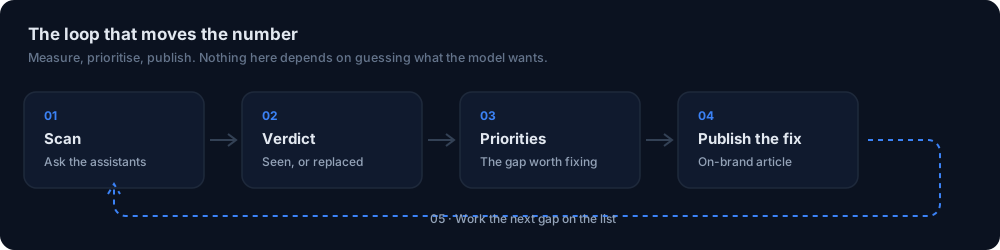
SEOWedge closes the loop in one workflow: (1) it discovers the buyer questions that actually matter in your category, (2) tests them live in ChatGPT and Gemini, (3) shows which competitor is named and which page is responsible, (4) produces an Action Brief explaining the gap, and (5) writes the page that fills it, using your Brand DNA profile. Every scan is reproducible—same questions, same method, new answers—so you see if your fix moved the needle.
The free scan requires no card and returns a visibility score, share-of-voice, and one Action Brief with a draft page. Paid plans expand this to 12-25 questions per scan and up to 150 articles per month, with credit packs for busy periods. The workflow is built for ecommerce brands and agencies managing 1 to 25 domains, not for generic brand monitoring.
No other tool in the category both measures the answer and produces the fix in one place. Others require buying or building content elsewhere. SEOWedge’s single loop turns a missing mention into a published, answer-ready page, tracked for impact in the next scan.
See AI Search Visibility Tool for Ecommerce & Agencies for a detailed workflow.
What should I do next if I want to fix this gap?
If you want to see exactly why ChatGPT recommends a competitor and what to do about it, start with a free AI search audit. Enter your domain, and SEOWedge will return your AI-Visibility score, show who is named instead of you, and give you a concrete Action Brief to close one gap. No card is required for the free scan.
If you need to track multiple questions, brands, or clients, review the paid plans. Each plan includes a set number of scans, articles, and Action Briefs, with the option to buy credit packs for extra runs. The workflow is built to move from measurement to action in one place, so you spend less time diagnosing and more time publishing fixes.
For more detail on what’s included free and paid, see Free AI Search Audit by SEOWedge and Pricing.
How this was tested
All claims and workflow steps on this page are based on SEOWedge's observed answer samples and platform documentation as of 2026-08-12. SEOWedge samples ChatGPT (OpenAI GPT) and Google Gemini answers by sending real buyer questions and recording which brands and pages are named. Crawlability and citation mechanisms are cross-checked with OpenAI and Google documentation. Screenshots are from SEOWedge's live interface as of August 2026.
What this page does not cover
This page explains why ChatGPT and similar AI assistants recommend competitors, focusing on the mechanisms and practical fixes. It does not cover classic SEO ranking factors, paid search, or non-AI surfaces. For technical LLM SEO, see LLM SEO: Technical Guide. For a step-by-step on getting recommended, see How to Get Your Products Recommended by ChatGPT. All data and screenshots reflect SEOWedge’s workflow and measurements as of August 2026.
Questions buyers ask us
Can I fix a missing ChatGPT recommendation just by adding keywords?
Adding keywords alone is not enough. ChatGPT and Gemini look for answer-ready content: clear, factual, and structured to directly address the buyer question. The model needs passages it can extract or cite, not just keyword-matched text. For practical structuring, see Answer Engine Optimization Guide.
How long does it take for a new page to show up in AI answers?
After publishing a new or revised page, it typically takes days to weeks for ChatGPT or Gemini to crawl and incorporate it into answers. Using IndexNow or submitting a sitemap can speed up discovery, but there is no instant update. SEOWedge dates every scan so you can see when a change takes effect.
What if my site blocks GPTBot or OAI-SearchBot?
If your robots.txt blocks OpenAI’s OAI-SearchBot, your pages cannot be surfaced in ChatGPT answers. GPTBot is used for training, but OAI-SearchBot is required for real-time retrieval. Allowing these bots is necessary for visibility. See OpenAI’s crawler documentation at OpenAI Bots.
Do I need special schema markup or llms.txt for AI answers?
No special schema or llms.txt is required for ChatGPT or Gemini to cite your page. Google recommends clear, original content and good crawlability. Schema can help clarify product and FAQ details, but is not a requirement. See Structured Data for AI Search for details.
Can SEOWedge show which competitor is named for every question?
Yes. SEOWedge records which brands and pages are named for each buyer question in the scan. You get a share-of-voice chart and a list of opportunities, each showing the responsible competitor page and what your site needs to close the gap.
See what AI assistants say about your site
Enter your domain and SEOWedge runs a free scan: your AI-Visibility score, the buyer questions where a competitor is named instead of you, and the first page to fix. No install, no sales call.