How Does SEOWedge Measure Which AI Assistants Recommend My Brand?
SEOWedge measures which AI assistants recommend your brand by sending real buyer questions to OpenAI (GPT) and Google Gemini, then recording which brands and pages are named in each answer. It stores every sampled answer with a date and platform, so you see exactly where your brand is cited or missed. This method is reproducible, platform-specific, and built for ecommerce visibility, not just SEO rankings.
By the SEOWedge Research Team · Published August 12, 2026 · Last tested August 12, 2026 · Updated August 12, 2026 · 6 min read
What to take away
- SEOWedge tests your brand visibility in OpenAI (GPT) and Google Gemini answers, not just Google search results.
- Each scan uses real buyer questions discovered for your category—no prompt writing needed.
- All sampled answers are stored, dated, and tied to the specific AI model and question.
- You see which competitor or page is named instead of yours, and what to fix next.
- This approach is reproducible and tailored to GEO, AEO, and AI SEO, not classic SEO rank tracking.
How Does SEOWedge Check If My Brand Is Named or Cited in AI Answers?
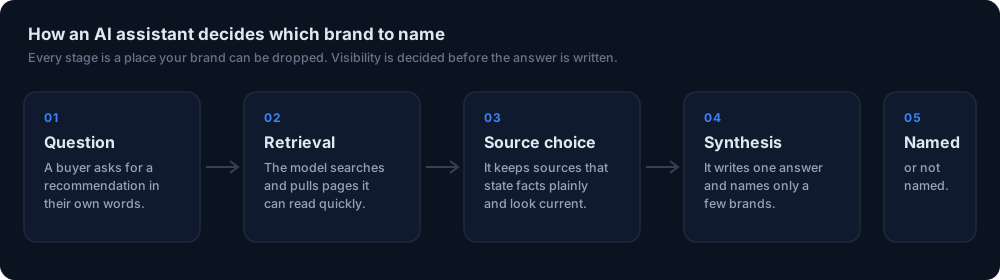
SEOWedge checks for brand recommendations by sending a set of high-intent buyer questions to AI assistants. These questions are discovered automatically from your site and market, not written by you. Each question is sent to OpenAI (GPT) on all plans, and to Google Gemini on paid plans. The platform returns a real, live answer—exactly what a buyer would see if they asked the assistant.
SEOWedge then parses each answer to find which brands, products, and URLs are named or cited. If your brand is mentioned, it is recorded as a positive citation. If a competitor is named instead, SEOWedge captures the exact passage and the source page behind it. This creates a precise, question-by-question map of where your brand stands in AI-generated answers.
Which AI Assistants and Models Does SEOWedge Test Against?
SEOWedge tests your brand visibility in the two model families that power most public AI assistants: OpenAI (GPT)—the engine behind ChatGPT, Microsoft Copilot, and ChatGPT Search—and Google Gemini, which powers Google AI Overviews and AI Mode. Every scan on any plan tests OpenAI (GPT). Paid plans add Google Gemini, so you see both major ecosystems.
Each model is tested directly through its API, not through a browser or scraped interface. This ensures the answers are reproducible and reflect what the assistant would say to a real buyer. The scan results are always separated by platform, so you can see if your brand performs better in one ecosystem than another. No other assistants or models are measured in SEOWedge as of 2026-08-12.
- OpenAI (GPT): All plans, including free.
- Google Gemini: Pro and Agency plans only.
| Plan | OpenAI (GPT) | Google Gemini |
|---|---|---|
| Free | Yes | No |
| Pro | Yes | Yes |
| Agency | Yes | Yes |
AI assistants tested by SEOWedge plan.

How Are Buyer Questions Chosen and Used in Each Scan?
SEOWedge does not ask you to write or maintain a list of prompts. Instead, it crawls your site and market, then discovers the high-intent buyer questions that real customers ask in your category. These questions are phrased in natural language and reflect actual buyer intent, not just keywords. Each scan uses this fresh set of questions, ensuring the test is grounded in what matters for your products and competitors.
For each question, SEOWedge sends it to every AI assistant available on your plan. The answer is then analyzed to see which brands, products, and URLs are cited. This approach means you are measuring your brand's real-world presence in the questions that drive purchase decisions, not just tracking generic prompts. For more on this process, see How Does SEOWedge Find Buyer Questions for My Ecommerce Site?.
| Plan | Buyer Questions Discovered Per Scan |
|---|---|
| Free | 5 |
| Pro | 12 |
| Agency | 25 |
Number of buyer questions discovered and tested per scan.
How Does SEOWedge Record and Store Sampled AI Answers?
Every answer sampled by SEOWedge is stored with the date, the question asked, the AI platform (OpenAI or Gemini), and the full answer text. This creates a permanent, auditable record of what each AI assistant said at the time of the scan. You can review these answers directly in your report to see exactly where your brand was named, cited, or missed.
Because each scan is a dated snapshot, you can compare results between scans to see if a new page or optimization moved your brand into more answers. This method avoids the guesswork and anecdotal evidence that comes from manual spot-checks. The answer record is tied to the specific question and platform, so you know exactly what changed and why. For more on how this fits into reporting, see AI Search Reporting for Agencies.
What Makes SEOWedge’s Measurement Reproducible and Credible?
SEOWedge’s method is reproducible because it samples AI answers through official APIs, using the same set of buyer questions each scan. The result is a dated, platform-specific record that can be reviewed or exported. This is not a browser scrape or a one-off manual check. The same process can be repeated for any domain, at any time, with a clear method for each answer.
The credibility comes from three factors: (1) every answer is stored and auditable, (2) questions are discovered from your actual category, not invented or cherry-picked, and (3) each platform is tested independently, so you see where your brand stands in both OpenAI and Google Gemini. This approach aligns with the best practices for GEO, AEO, and LLM SEO measurement. For a plain-English explanation of these terms, see AI Search Optimisation Glossary.
How Are Results Different from Classic SEO Rank Tracking?
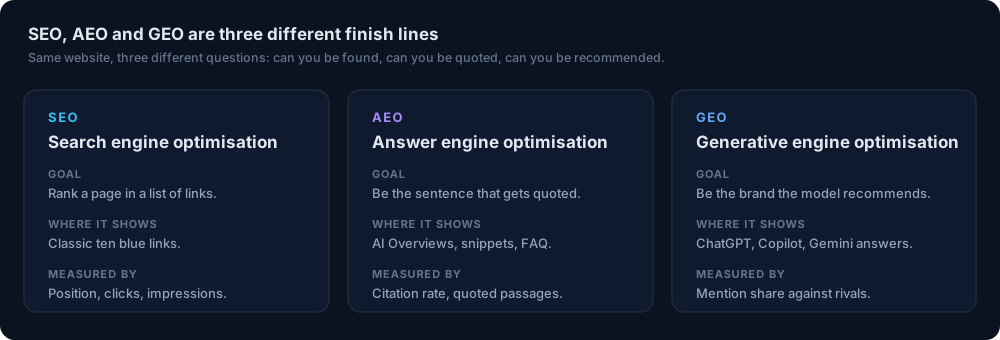
Classic SEO rank tracking measures your position in search engine results for a set of keywords. It does not show whether AI assistants recommend your brand, cite your pages, or name your competitors in direct answers. GEO, AEO, and LLM SEO focus on being named or cited in AI-generated answers, which is invisible to classic SEO tools.
SEOWedge measures your presence in AI answers, not just rankings. The result is a map of where your brand is recommended, where a competitor is named instead, and which exact page or answer is responsible. This is the part of the funnel analytics and rank trackers cannot see. For a deeper dive into the differences between GEO, AEO, and SEO, see GEO vs AEO vs SEO: The Practical Definitions and When Each Matters.
What Happens After SEOWedge Finds a Gap or Missed Recommendation?
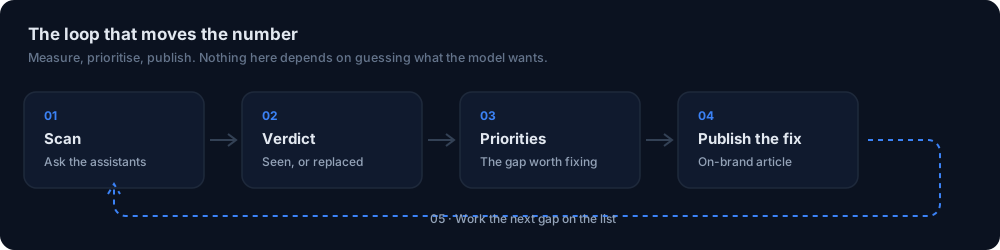
Once SEOWedge identifies a gap—where an AI assistant names a competitor or misses your brand—it creates an Action Brief. This brief shows the buyer question, the answer given by the assistant, and the exact page or content opportunity to close the gap. The Content Studio then drafts a new, on-brand page using your Brand DNA profile, with a publish readiness score so you know it meets AEO and GEO standards.
This workflow is unique to SEOWedge: the loop from measurement to page creation happens in one place. You do not need to export findings or hire a separate writer. For more detail on how this process works, see How SEOWedge Turns AI Visibility Gaps Into Actionable Content.
Where Should I Start If I Want to Measure My Brand’s AI Assistant Recommendations?
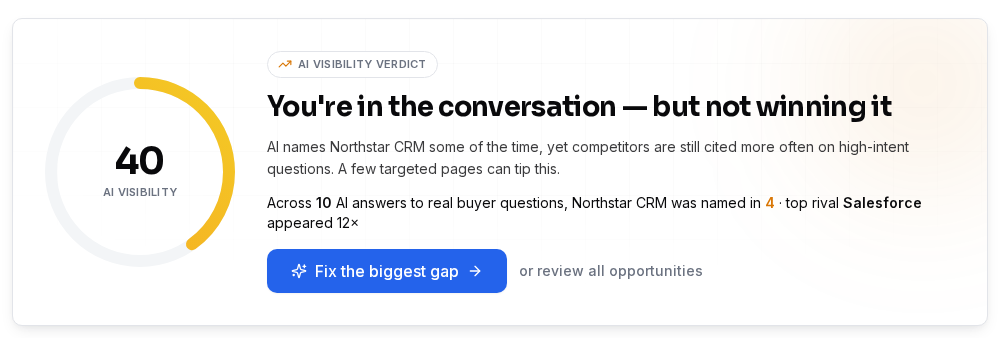
If you want to see which AI assistants recommend your brand, you can start with a free scan—no card required. Enter your domain, and SEOWedge will crawl your site, discover buyer questions, and test them against OpenAI (GPT). You will see your AI-Visibility score, competitor share of voice, and the exact questions where your brand is named or missed.
Paid plans unlock Google Gemini testing, more questions per scan, and the ability to act on every opportunity found. The process is transparent: every answer is stored and can be reviewed. For a preview of what you get, see the public sample report or start your own scan at Free AI Search Audit.
How this was tested
All claims and process steps are based on SEOWedge's live product workflow as of 2026-08-12. AI answers are sampled by sending discovered buyer questions to OpenAI (GPT) and Google Gemini via their APIs. Each answer is stored with a timestamp, platform, and question. Citations and brand mentions are extracted from the returned answer text. The process is documented in SEOWedge's product and method notes, and aligns with published API documentation from OpenAI and Google. No claims are made about platforms or methods not explicitly covered in the product facts.
What this page does not cover
This page explains how SEOWedge measures brand recommendations in AI assistants, specifically OpenAI (GPT) and Google Gemini, as of 2026-08-12. It does not cover other models, platforms, or future assistant updates. For technical LLM SEO details, see LLM SEO: Technical Guide. For classic SEO rank tracking or analytics, refer to your existing analytics stack. This guide focuses on the measurement process, not on the content creation or optimization steps that follow.
Questions buyers ask us
Which AI assistants does SEOWedge test?
SEOWedge tests OpenAI (GPT) on all plans—including the free scan. Paid plans add Google Gemini, so you see your brand’s presence in both major AI answer ecosystems. No other models or assistants are covered as of 2026-08-12.
How are buyer questions chosen for each scan?
SEOWedge automatically discovers high-intent buyer questions from your site and market. You do not need to write or maintain prompts. Each scan uses these questions to test what real buyers would ask.
Can I see the exact answers given by AI assistants?
Yes. SEOWedge stores every sampled answer with a date, platform, and question. You can review the full answer text to see where your brand is named, cited, or missed.
How is this different from SEO rank tracking?
SEO rank tracking shows your position in search results for keywords. SEOWedge shows whether AI assistants recommend or cite your brand in direct answers, which is not visible in classic rank trackers.
What happens after a gap is found?
SEOWedge creates an Action Brief for each gap, showing the question, the answer, and the exact page to create or improve. The Content Studio then drafts an on-brand page to close the gap, all in one workflow.
Is there a free way to test SEOWedge?
Yes. You can run a free scan—no card required—to see your AI-Visibility score, competitor share of voice, and page-level opportunities. OpenAI (GPT) answers are included in every free scan.
See what AI assistants say about your site
Enter your domain and SEOWedge runs a free scan: your AI-Visibility score, the buyer questions where a competitor is named instead of you, and the first page to fix. No install, no sales call.