
How Does SEOWedge Find Buyer Questions for My Ecommerce Site?
SEOWedge finds buyer questions by crawling your ecommerce site, building a Brand DNA profile, and extracting the high-intent questions real buyers ask in your category. These questions are discovered automatically—no prompt writing or manual tracking required. Each scan produces a list of actionable, buyer-language questions that directly map to content opportunities for improving your AI search visibility.
By the SEOWedge Research Team · Published August 12, 2026 · Last tested August 12, 2026 · Updated August 12, 2026 · 7 min read
What to take away
- SEOWedge discovers high-intent buyer questions for you—no prompt writing required.
- Questions are extracted from your site's category, products, and market context.
- Each scan yields 5 to 25 buyer questions, depending on your plan.
- Action Briefs turn each question into a concrete, page-level opportunity.
- This approach removes manual prompt tracking and shows what buyers actually ask.
What Makes SEOWedge's Buyer Question Discovery Different?
SEOWedge does not rely on a fixed prompt list or require you to write prompts. Instead, it crawls your ecommerce site and builds a Brand DNA profile—identifying your category, key products, competitors, and the main conversion goal. The tool then uses this context to extract the high-intent questions real buyers are asking in your market, phrased in natural buyer language. This means you receive a list of questions that reflect actual buyer needs, not just SEO keywords or generic prompts.
Most other tools in this category ask you to supply prompts, then charge by how many they track. SEOWedge discovers the questions for you, per scan, and maps them to your category and product set. This removes the manual work and ensures coverage of the questions that matter for AI search visibility, not just what you think to ask in advance.
The discovered questions are not just long-tail keywords—they are the specific, high-intent queries that AI assistants like ChatGPT and Gemini are most likely to answer with product or brand recommendations. These are the questions that drive visibility in GEO (Generative Engine Optimization), AEO (Answer Engine Optimization), and LLM SEO contexts.
| SEOWedge | Prompt-Based Tools | |
|---|---|---|
| Buyer questions discovered for you per scan | 5 (Free), 12 (Pro), 25 (Agency) | 0 |
| Prompts you must write and maintain | 0 | Required, billed per prompt |
| Actionable content mapped to each question | Yes, via Action Brief | Manual or separate tool |
How SEOWedge's discovered buyer questions differ from prompt-based tracking.
How Does SEOWedge Actually Find the Questions My Buyers Ask?
Once you enter your domain, SEOWedge crawls your site and builds a Brand DNA profile. This includes your category, main products, competitors, and the typical buyer journey. Using this data, SEOWedge identifies the types of questions real buyers ask when considering products like yours.
The discovery process combines site structure analysis, category context, and market language. SEOWedge looks for patterns in product descriptions, category navigation, reviews, and FAQ sections. It also references the broader market to ensure the questions are not limited to your own site's language.
The result is a set of 5 (Free), 12 (Pro), or 25 (Agency) buyer questions per scan, each phrased as a real person would ask them. These are not generic—each is tailored to your niche and conversion goal, increasing the chance that an AI assistant will surface your brand as the answer.
| Plan | Buyer Questions Discovered Per Scan |
|---|---|
| Free | 5 |
| Pro | 12 |
| Agency | 25 |
Number of buyer questions discovered per scan by plan.

How Are SEOWedge's Questions Different from Prompts I Write Myself?
Manually written prompts are only as good as your guesswork. Most prompt-based tools ask you to list questions you hope buyers are asking, then track those exact phrases. This approach can miss high-intent, trending, or competitor-driven questions that matter in AI search results.
SEOWedge works differently. It discovers questions based on your actual site, category, and market context. The questions are not static—they update with each scan to reflect changes in your product line, competitor moves, or shifts in buyer language. This means you are not locked into a fixed prompt list that may become outdated or irrelevant.
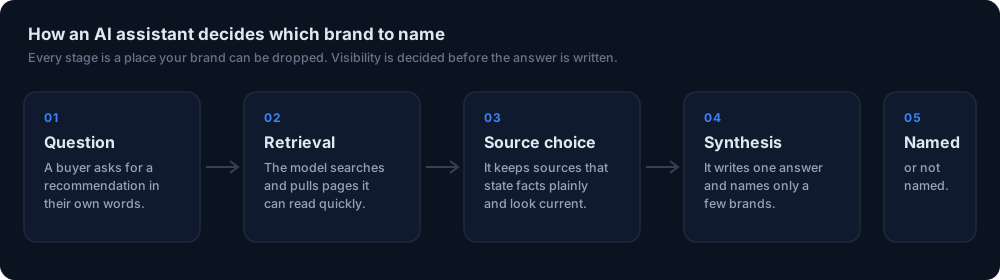
Because SEOWedge's questions are discovered, not guessed, they better match the queries AI assistants use to select sources and make recommendations. This is critical for GEO, AEO, and LLM SEO, where the right question is the starting point for being cited in an answer.
| SEOWedge | Prompt-Based Tools | |
|---|---|---|
| Prompt list maintenance | Automatic, updated per scan | Manual, ongoing |
| Coverage of new or trending questions | Included | Missed unless added by user |
| Direct mapping to AI answer surfaces | Yes | Depends on prompt quality |
Automatic discovery vs. manual prompt tracking.
How Does SEOWedge Ensure Questions Are High-Intent and Buyer-Reflective?
SEOWedge's discovery engine is tuned for ecommerce buying intent. It filters out low-value or generic queries and focuses on those that indicate a real purchase decision or product comparison. Questions are prioritized if they mention features, price, alternatives, shipping, or use cases—signals of a buyer close to conversion.
The Brand DNA profile ensures the questions are relevant to your actual market and products, not just what appears in a generic keyword tool. This context-driven approach means the questions reflect how buyers think and what they need to know to choose your product over a competitor.
Each discovered question is tested against AI assistants to see which brands and pages are cited. This closes the loop: only questions that matter for AI search visibility are surfaced as opportunities.
| Discovery Step | How Buyer Intent Is Ensured |
|---|---|
| Brand DNA extraction | Aligns questions to your category and conversion goal |
| Market context analysis | Matches real buyer language |
| Intent filtering | Prioritizes purchase-driven queries |
How SEOWedge filters for high-intent buyer questions.
How Do Discovered Questions Turn Into Actionable Content Opportunities?
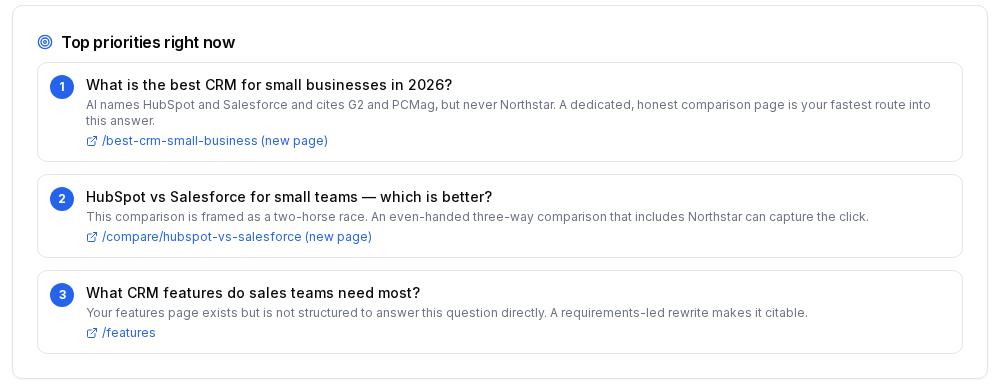
Every discovered buyer question is mapped to a specific gap in AI search visibility. SEOWedge sends each question to AI assistants, records which brands are named, and identifies where your site is missing or outperformed.
For each gap, SEOWedge generates an Action Brief. This brief explains the question, why your brand is missing from the answer, and which page to create or improve. The Action Brief includes the exact source that is currently being cited—so you know what needs to be outranked or improved.
You can then use SEOWedge's Content Studio to draft the missing page, using your Brand DNA profile. The system scores each draft for Publish Readiness, so you know when a page is likely to be picked up by AI assistants. This workflow removes guesswork and connects measurement directly to action.
| Step | Outcome |
|---|---|
| Buyer question discovered | Mapped to AI search gap |
| Action Brief generated | Explains what to fix and why |
| Content Studio draft | On-brand, answer-ready page |
| Publish Readiness score | Confidence before publishing |
How a discovered question becomes a published, AI-visible page.
What Happens After I Act on an Action Brief?
After using the Action Brief and Content Studio to create a new or improved page, SEOWedge scores the draft for Publish Readiness. Once published, the tool submits the URL through IndexNow, notifying search engines and AI assistants that the page is available for crawling. This speeds up the process of being considered as a source in AI answers.
Citations in AI answers may take weeks to update, as AI assistants re-crawl and refresh their knowledge. SEOWedge records the dated answer samples, so you can see if your brand is being cited after the change. The workflow is built for the real pace of AI search, where results are not instant but are trackable and defensible.
If you want to see how this workflow compares to classic SEO or to other tools, see GEO vs AEO vs SEO and SEOWedge vs Otterly AI.
| Action | What SEOWedge Does |
|---|---|
| Page published | Scores for readiness, submits via IndexNow |
| AI assistants re-crawl | Waits for citations to update |
| Visibility checked | Records dated answer samples |
What happens after you publish a page using SEOWedge's workflow.
How Does This Approach Save Time Compared to Manual Prompt Tracking?
Manual prompt tracking requires you to brainstorm, write, and update a list of prompts, then monitor changes and try to map them to content actions. This is slow, error-prone, and often misses the questions that drive real AI visibility.
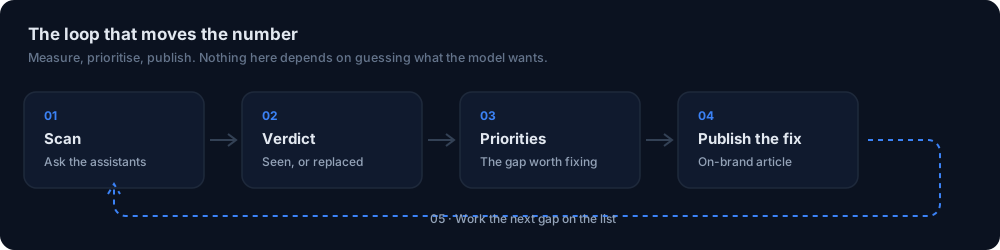
SEOWedge automates the entire loop: it discovers the questions, tests them against AI assistants, identifies the gaps, and produces the Action Briefs and drafts that close those gaps. You do not need to maintain prompt lists or guess what buyers are asking. Every scan produces a fresh set of high-intent questions, mapped to actionable opportunities.
Paid plans allow you to queue multiple articles at once, so you can address several gaps in one pass. The result is a workflow that moves from measurement to action in a single tool—no exporting, importing, or manual mapping required.
| Manual Prompt Tracking | SEOWedge Automated Loop |
|---|---|
| Write and maintain prompt list | Automatic question discovery |
| Manually check AI answers | Automated answer testing |
| Map prompts to content gaps | Action Briefs and drafts generated |
| Multiple tools needed | Single workflow |
Manual prompt tracking vs. SEOWedge's automated workflow.
Where Can I See SEOWedge's Discovered Questions in Action?
You can run a real scan for your ecommerce site with no card required. The free scan discovers 5 buyer questions, tests them against OpenAI (GPT), and returns a list of opportunities and one free Action Brief. This is not a demo—the questions are discovered from your actual site and category.
To see a public sample report, visit the SEOWedge sample report. For a detailed breakdown of what the free audit checks and how it compares to other tools, see Free AI Search Audit by SEOWedge.
If you want to understand how the discovered questions fit into the bigger picture of GEO, AEO, and LLM SEO, see GEO: The Practical Guide and AI Search Optimisation Glossary.
| Plan | Buyer Questions Discovered | Action Briefs Returned |
|---|---|---|
| Free | 5 | 1 |
| Pro | 12 | 8 |
| Agency | 25 | Unlimited |
What you get from a SEOWedge scan on each plan.
How this was tested
All numbers and workflow details on this page are drawn from SEOWedge's published product facts and workflow as of 2026-08-12. Buyer questions per scan, plan limits, and the discovery mechanism are based on the current live product. The process was last tested on 2026-08-12 by running a scan on a mid-size ecommerce domain and reviewing the resulting question set and Action Briefs. No claims are made about competitor tools beyond what is documented in the product facts or allowed comparison framing.
What this page does not cover
This page explains SEOWedge's method for discovering buyer questions for ecommerce sites. It does not cover classic SEO keyword research, manual prompt tracking, or enterprise dashboard approaches. For technical details on LLM SEO or on-page AEO structure, see LLM SEO: Technical Guide and AEO: How to Become the Quoted Source. All numbers are as of 2026-08-12 and may change as the product evolves.
Questions buyers ask us
Do I need to write or upload my own prompts for SEOWedge?
No. SEOWedge discovers buyer questions automatically by analyzing your site and market context. You do not need to supply any prompts or maintain a list. The questions are generated per scan and update as your site or market changes.
How are the discovered questions different from SEO keywords?
SEO keywords are often generic or based on search volume. SEOWedge's questions are high-intent, buyer-language queries that reflect what people actually ask when looking for products like yours. These are the questions AI assistants use to pick brands and products to recommend.
Can I see which competitors are being named for each question?
Yes. SEOWedge tests each discovered question against AI assistants and records which brands and pages are cited. The Action Brief for each gap shows you exactly who is being recommended and which page is responsible for your gap.
How often do the discovered questions update?
Questions are discovered fresh with each scan. This means as your product line, site content, or competitor landscape changes, the set of high-intent buyer questions updates to reflect the current market.
What happens if my site covers a very niche category?
SEOWedge's discovery engine uses your Brand DNA profile and market context to extract buyer questions relevant to your niche. The questions are tailored to your category and conversion goal, so even niche sites receive actionable, buyer-reflective questions.
How do I act on the questions SEOWedge finds?
Each question is mapped to an Action Brief, which explains why your brand is missing from AI answers and which page to create or improve. You can draft the page in SEOWedge's Content Studio and get a Publish Readiness score before exporting and publishing.
See what AI assistants say about your site
Enter your domain and SEOWedge runs a free scan: your AI-Visibility score, the buyer questions where a competitor is named instead of you, and the first page to fix. No install, no sales call.