AI SEO Tool for Ecommerce: Get Your Products Named in AI Answers
SEOWedge shows which AI assistants recommend your products and which name your competitors. It identifies the exact product or category pages causing you to miss out, then writes the actionable fix. You see the gap and the next step in one loop—starting with a free scan, no card required.
By the SEOWedge Research Team · Published August 11, 2026 · Last tested August 12, 2026 · Updated August 12, 2026 · 6 min read
What to take away
- Check if ChatGPT and Gemini recommend your products or your competitors'.
- See which product and category pages are costing you AI recommendations.
- Get an Action Brief naming the fix for each missed opportunity.
- Publish on Shopify or WooCommerce—no integration or plugin required.
- Start with a free scan and see results in minutes; changes in AI answers take weeks.
Do AI assistants recommend my products, or my competitors?
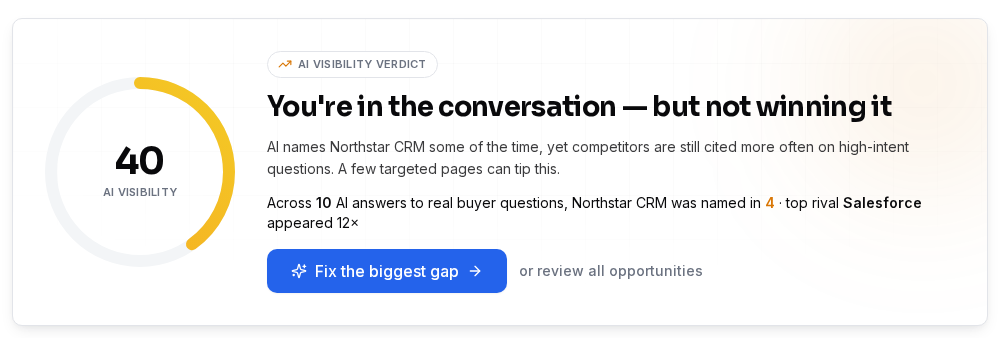
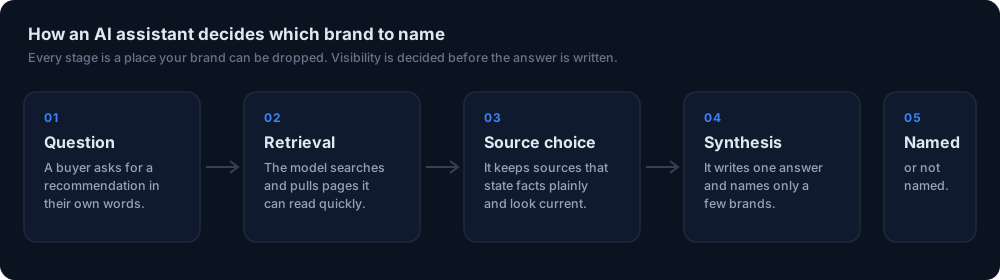
SEOWedge tests the actual buyer questions that drive product research in your category. It sends these questions to ChatGPT (OpenAI GPT) on every plan, and to Google Gemini (AI Overviews and AI Mode) on paid plans. For each question, it records which brands and products are mentioned, cited, or recommended in the AI answer. You see a full share-of-voice breakdown: how often your products are named, and how often a competitor wins the mention or recommendation instead. This is not guesswork or a simulated ranking—it is the observed, dated record of real AI answers for your market.
AI assistants do not use classic SEO rankings. They cite sources based on how well a page answers a high-intent question, how clearly it matches the query, and whether it is discoverable by their crawlers. SEOWedge measures this by sampling the same model families that power ChatGPT, Copilot, and Google AI Overviews, so you see the outcome your buyers see.
Which product and category pages are costing me recommendations?
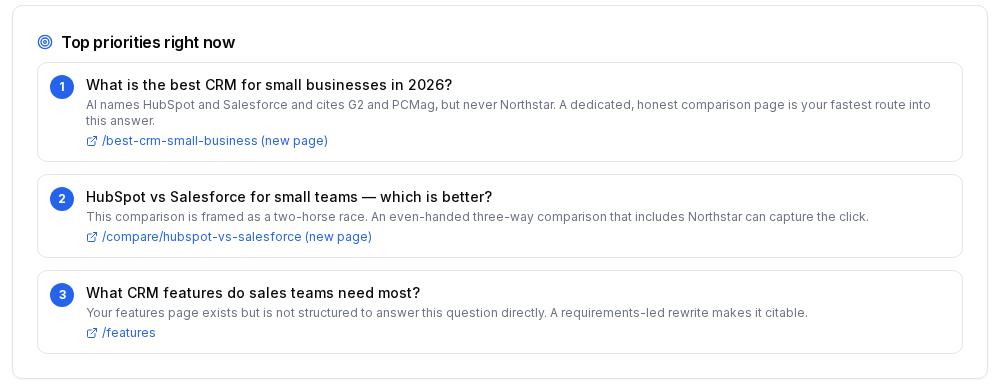
After each scan, SEOWedge shows the exact pages on your site that are missing from AI answers. For every missed recommendation, you get an Action Brief: the buyer question, why another brand is named, and the specific product or category page that needs to be created or improved. This is not a generic site audit. The tool tells you, for example, that your "Men’s Waterproof Hiking Boots" page is missing the comparison detail that made a competitor’s page get cited.
You see a prioritized opportunity list, sorted by potential impact. Each opportunity connects to a real question buyers ask and to the AI answer that currently leaves you out. This lets you act directly on what is costing you AI-driven product research traffic. For a full audit workflow, see How to Run an AI Search Audit on an Ecommerce Site.
What do I change on a product or category page to become the cited source?
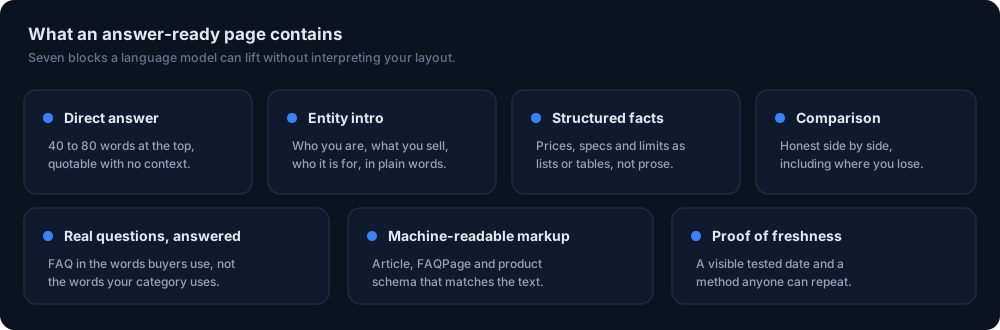
SEOWedge’s Action Briefs break down exactly what your page is missing for answer engines. Common reasons include lack of direct-answer content for the buyer question, missing comparison or review details, or unclear product specs. Each Action Brief is tied to a real, high-intent question—like "Which trail running shoes are best for flat feet?"—and shows what the current cited source offers that your page does not.
The Content Studio then drafts the missing page or section, using your Brand DNA profile to keep it on-brand and specific. Each draft gets a Publish Readiness score, so you know if it is structured for AI citation before you publish. This covers both AEO (answer engine optimization) and GEO (generative engine optimization) best practices: clear, direct answers, structured data, and content that can be lifted verbatim by AI assistants. For checklist details, see AEO Checklist for Ecommerce.
How does this work with a Shopify or WooCommerce store?
You do not need to install a plugin or connect your store to SEOWedge. Enter your domain, and SEOWedge crawls your public product and category pages just like an AI assistant would. The Brand DNA extraction works with Shopify, WooCommerce, BigCommerce, and custom platforms, as long as your pages are discoverable and not blocked by robots.txt or login walls.
If your store uses dynamic URLs or JavaScript-heavy product rendering, SEOWedge’s crawler follows the same constraints as AI crawlers. For best results, make sure OAI-SearchBot (for ChatGPT) and Googlebot (for Gemini) are allowed in your robots.txt. For more on technical setup, see LLM SEO: Technical Guide.
How long before anything changes in AI answers?
AI assistants update their recommendations when they re-crawl the web and refresh their answer models. This process usually takes weeks, not hours. SEOWedge is built for this reality: every scan is date-stamped, and every answer is stored for comparison. When you publish a new or improved product or category page, SEOWedge scores it for readiness and submits the URL through IndexNow, so AI engines are notified immediately. Actual citation in AI answers depends on the assistant’s own update cycle, which varies by platform.
You can track progress by running a Refresh Scan after publishing changes. SEOWedge records whether your product is now named, how the share of voice shifts, and which gaps remain. This is how you prove to stakeholders that a change worked, instead of waiting for analytics to catch up.
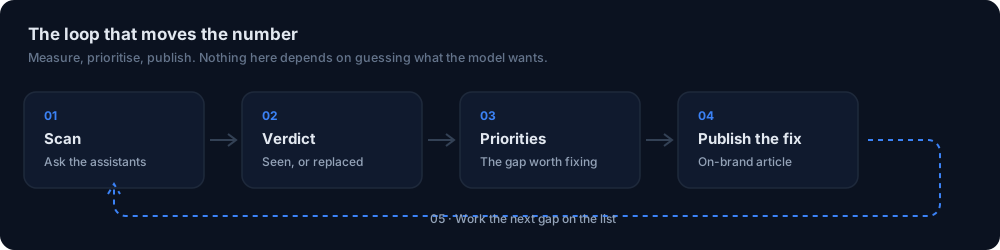
What is the workflow from scan to published fix?
The process is a single loop. Start by entering your domain. SEOWedge crawls your site, extracts your Brand DNA, and discovers the buyer questions that matter. It tests these questions against AI assistants and records who gets named. You get a visibility score, a competitor share-of-voice chart, and a list of page-level opportunities. For each one, you receive an Action Brief and a draft page tailored to your brand. You edit, score for Publish Readiness, and export. Paid plans let you queue and draft several fixes at once, so you can close multiple gaps per cycle.
This workflow is designed for ecommerce teams who want measurable, repeatable improvement in AI search visibility. You do not have to write prompts, guess at what AI assistants see, or manage a separate writing process. The loop measures, names, writes, and verifies the fix in one place.
How much does it cost, and what do I get free?
You can run a real, no-card-required scan on your ecommerce site. The free scan returns your AI-Visibility score, competitor share of voice, five discovered buyer questions, one Action Brief, and a draft article you can edit and export. This is not a limited trial or demo—it is a working result you can act on immediately.
Paid plans start at $29/month, the lowest entry point in the category. Pro and Agency plans add more scans, more discovered questions, more Action Briefs, and bulk article generation. Paid plans also cover Google Gemini (AI Overviews and AI Mode) in addition to OpenAI GPT. You can top up credits for busy months without changing plans. Full details are at SEOWedge Pricing.
| Plan | Monthly Price | Full Scans/Month | Buyer Questions/Scan | Action Briefs/Scan | Articles/Month | AI Providers |
|---|---|---|---|---|---|---|
| Free | Free | 1 (Lite) | 5 | 1 | 1 | OpenAI (GPT) |
| Pro | $29 | 20 | 12 | 8 | 30 | OpenAI (GPT) + Google (Gemini) |
| Agency | $99 | 100 | 25 | Unlimited | 150 | OpenAI (GPT) + Google (Gemini) |
SEOWedge plans and included features. See full details at /pricing.
What happens when I start a free scan?
You enter your store’s domain. SEOWedge crawls your site, builds your Brand DNA, and discovers the high-intent buyer questions for your category. It tests those questions in ChatGPT (OpenAI GPT), records which brands and products are named, and returns your AI-Visibility score, competitor share of voice, and one actionable gap with a draft fix. No installation, no card, no waiting for approval. You see in minutes whether you are being recommended and exactly what to change next. For a step-by-step preview, see the public sample report or go straight to start your free scan.
This is the fastest way to get a credible, actionable answer to "do AI assistants recommend my products, or my competitors?" and to see what to do about it. The loop is built for ecommerce brands and agencies who need a result, not just a chart.
How this was tested
All numbers and claims on this page are based on SEOWedge's workflow as tested on 2026-08-12. AI recommendations are sampled by sending high-intent buyer questions (discovered automatically per scan) to OpenAI (GPT) and Google Gemini. Each answer is recorded, scored, and compared to prior scans. Page-level gaps and Action Briefs are generated from this data. No claims are based on third-party reviews or unverified sources.
What this page does not cover
This page focuses on how SEOWedge measures and improves AI search visibility for ecommerce stores, specifically for product and category recommendations in AI assistants. It does not cover general SEO, enterprise dashboards, or non-ecommerce use cases. For technical LLM SEO, schema, or detailed optimization guides, see the linked resources. All data reflects observations as of 2026-08-12 and may vary as AI models and assistant behaviors evolve.
Questions buyers ask us
Will SEOWedge work if my store is on Shopify or WooCommerce?
Yes. SEOWedge works with any ecommerce platform that serves public product and category pages. No plugin or integration is needed. Just enter your domain and the tool crawls your site as AI assistants do.
How do I know which competitor is being recommended instead of me?
SEOWedge records which brands and products are named in each AI answer for your category. The share-of-voice report shows exactly which competitor is getting the recommendation and for which buyer question.
How often should I run scans or make changes?
Most teams run a scan monthly or after publishing major new pages. Since AI answers update on a weekly-to-monthly cycle, running a scan after each batch of changes lets you track progress and prove impact.
Do I need to write prompts or maintain a list of questions?
No. SEOWedge discovers the high-intent buyer questions for your category automatically with each scan. You do not have to write or update prompts yourself.
How long does it take for changes to show up in AI answers?
AI assistants update their recommendations on their own schedule, usually in weeks. SEOWedge submits new URLs via IndexNow to speed up discovery, but the timing depends on each assistant’s update cycle.
Is the free scan useful if I do not upgrade?
Yes. The free scan gives you your AI-Visibility score, five real buyer questions, a competitor share-of-voice snapshot, and one actionable fix with a draft you can use. No upgrade is required to see these results.
See what AI assistants say about your site
Enter your domain and SEOWedge runs a free scan: your AI-Visibility score, the buyer questions where a competitor is named instead of you, and the first page to fix. No install, no sales call.