Can SEOWedge Help Me Understand Why AI Assistants Cite Outdated Information?
AI assistants cite outdated information because they often retrieve answers from sources that were crawled or indexed weeks or months ago, not your most recent updates. SEOWedge identifies which old URLs are being cited, explains why new content is missing, and produces the exact page needed to win future citations. It closes the loop from diagnosis to action, so your updates get seen and cited faster.
By the SEOWedge Research Team · Published August 13, 2026 · Last tested August 13, 2026 · Updated August 13, 2026 · 8 min read
What to take away
- AI assistants often pull from outdated sources due to crawl and retrieval lag.
- SEOWedge pinpoints which old URLs are being cited for your brand or products.
- The tool shows why your new content is missing and what to fix next.
- Action Briefs explain the exact page or content to create to replace outdated citations.
- SEOWedge submits new URLs via IndexNow to accelerate discovery by AI assistants.
Why Do AI Assistants Keep Citing Outdated Content About My Brand?
AI assistants like ChatGPT and Gemini do not pull answers live from the web. They rely on what their models or retrieval systems last crawled and indexed. This means even if you update a product page or publish a new buying guide, the assistants may still cite an older version—or a completely different URL—until their next crawl and re-ranking cycle.
AI answers are assembled from sources that the assistant considers credible and relevant at the time of retrieval. If your new content is not yet indexed, or if the assistant’s retrieval layer still points to an old URL, the outdated page will keep being cited. This lag can last weeks, especially if your site is not submitting changes via protocols like IndexNow or if key AI crawlers are blocked.
SEOWedge measures which URLs are actually cited in sampled AI answers. It does not guess or rely on classic SEO rankings. Each scan records the exact page or competitor that appears in the answer, so you see where outdated information is coming from and which page is responsible.
| Reason for Outdated Citation | How It Happens |
|---|---|
| AI assistant has not re-crawled your latest page | Crawl cycles are infrequent; new URLs may not be seen for weeks |
| Old URL is still considered most relevant | Retrieval systems have not updated their index or ranking |
| AI crawler is blocked or limited | OpenAI or Gemini bots prevented from accessing new content |
| Competitor or third-party page is favored | AI answer pulls from another site with more established authority |
Main reasons AI assistants cite outdated information
How Does SEOWedge Show Which Old URLs Are Still Being Cited?
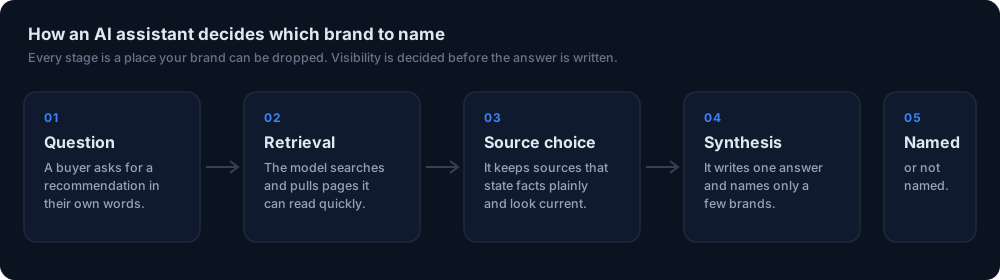
SEOWedge runs a scan by sending high-intent buyer questions to AI assistants and recording the answers exactly as they appear. For each answer, it logs the domain and the specific URL cited—whether that’s your current page, an old version, or a competitor’s resource.
The scan output includes a page-level breakdown: you see which URLs are being named in AI answers, which are out of date, and which competitor pages are taking your place. This is not a guess; it’s a sampled observation, so you can act on real citations, not theoretical rankings.
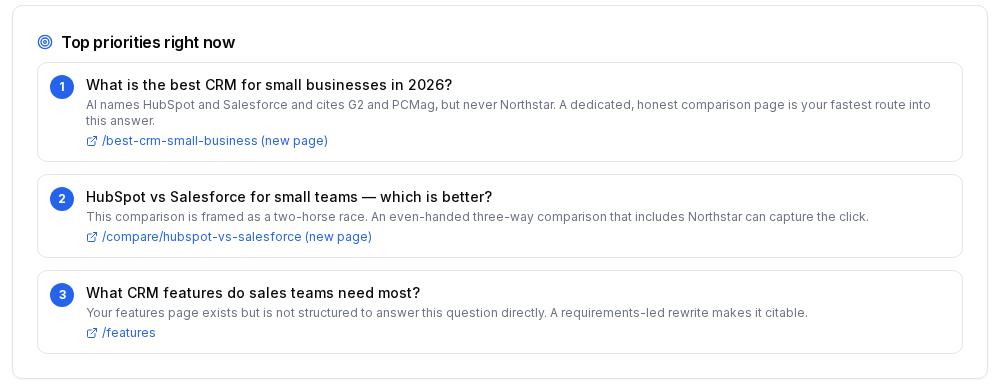
You get a clear list of opportunities: each one shows the outdated page currently being cited, the buyer question it answers, and a direct link to the content gap. This makes it possible to prioritize exactly which outdated citations to replace first. For a deeper look at this diagnostic process, see How Can I See Which Pages ChatGPT and Gemini Are Citing in My Category?.
| Scan Output Example | What You See |
|---|---|
| Buyer Question | "What’s the best running shoe for flat feet?" |
| Cited URL | yourdomain.com/blog/best-running-shoes-2023 |
| Is This Your Latest Page? | No – new page is yourdomain.com/best-running-shoes-2026 |
| Competitor Cited | competitor.com/flat-feet-guide |
How SEOWedge surfaces outdated citations in AI answers
What Makes New Content Missed by AI Assistants?
A new product page or updated guide can still be invisible to AI assistants for several reasons. First, if the AI crawlers (like OpenAI’s OAI-SearchBot or Google’s GeminiBot) have not yet visited or indexed your new URL, it simply does not exist in their answer pipeline. Second, if the page structure does not match the way buyers phrase their questions, it may not be retrieved even after indexing.
Technical issues also play a role. If your robots.txt or firewall blocks AI crawlers, or if you haven’t submitted new URLs via a protocol like IndexNow, assistants may never see the update. Finally, if the old page is still live or linked internally, assistants might keep citing it as the canonical answer.
SEOWedge’s scan will show you not just which new pages are missing, but also why: whether it’s a crawl, structure, or authority issue. For technical troubleshooting, see LLM SEO: Technical Guide.
| Reason New Page Is Missed | Diagnostic Check |
|---|---|
| Not crawled by AI bots | Check server logs for OAI-SearchBot and GeminiBot visits |
| Not submitted via IndexNow | Verify IndexNow pings for new/updated URLs |
| Page structure mismatch | Compare page headings and content to buyer questions |
| Old page still live | Audit internal links and canonical tags |
Common causes of new content being missed in AI answers
How Does SEOWedge Turn Outdated Citations Into Actionable Fixes?
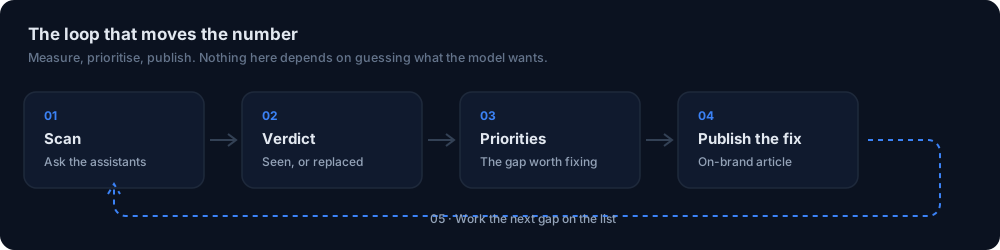
SEOWedge does not stop at measurement. For every outdated citation, it produces an Action Brief: this includes the buyer question, the reason your new content was missed, and the exact page or section to create or update. The Action Brief is shaped by your Brand DNA profile, so fixes are always on-brand and specific to your product or market.
You move from diagnosis to action in one workflow. The Content Studio takes the Action Brief and generates a new or revised page that directly answers the buyer question and matches the structure AI assistants look for. Each draft is scored for Publish Readiness, so you know it meets AEO and GEO criteria before you export or publish.
This loop—scan, diagnose, brief, generate, export—removes the manual work of sifting through AI answers, guessing what to fix, or writing from scratch. For a detailed breakdown of this workflow, see How SEOWedge Turns AI Visibility Gaps Into Actionable Content.
| Step | What SEOWedge Delivers |
|---|---|
| Scan | Records which outdated URLs are cited |
| Action Brief | Explains why, and what to fix |
| Content Studio | Drafts the new answer-ready page |
| Publish Readiness | Scores the draft for AI citation potential |
| Export | Ready to publish and submit for indexing |
SEOWedge’s workflow from outdated citation to new page
What Should I Do If My Most Recent Content Isn’t Showing Up in AI Answers?
First, confirm that your new page is crawlable by AI bots. OpenAI requires OAI-SearchBot to be allowed for ChatGPT search results, and Google GeminiBot must access your content for Gemini and AI Overviews. Use server logs or a tool like SEOWedge to check for recent bot visits. For more, see OpenAI crawler documentation.
Second, submit your updated URLs via IndexNow. This protocol lets you notify participating engines instantly when a page is published or changed, reducing the lag before assistants discover new content. Details are at IndexNow documentation.
Third, ensure your page answers the buyer question in a way that matches how AI assistants retrieve information. SEOWedge’s Action Briefs and Content Studio are built to structure content for AEO and GEO, increasing the chance of being cited in future answers.
Finally, keep the old, outdated page either redirected or updated to avoid conflicting signals. If both old and new pages are live, AI assistants may continue citing the older, more established URL.
| Checklist Step | Why It Matters |
|---|---|
| Check AI bot access | Ensures your page can be crawled for future answers |
| Submit via IndexNow | Accelerates discovery by AI search engines |
| Match buyer question structure | Improves retrieval and citation odds |
| Redirect or update old page | Prevents assistants from citing outdated content |
Immediate actions to get new content cited in AI answers
Can SEOWedge Accelerate the Replacement of Outdated AI Citations?
SEOWedge speeds up the process in two ways. First, after generating a new page, it submits the URL via IndexNow on paid plans. This notifies participating search engines—including those feeding Gemini and other AI assistants—that a new or updated page is live. This reduces the time between publishing and the next crawl, which is a key factor in citation lag.
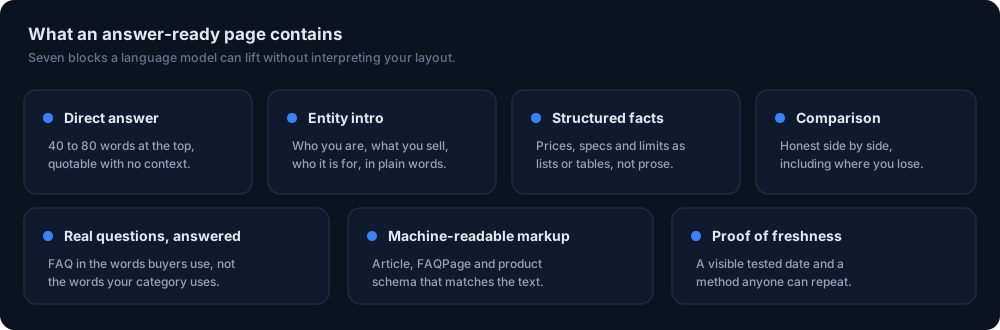
Second, SEOWedge’s Publish Readiness score ensures that each drafted page is structured for retrieval by AI assistants. This increases the chance that, once crawled, your new page will be selected as the source for future answers, replacing the outdated citation.
While no tool can force instant AI citation (since re-crawling and re-ranking are outside your control), SEOWedge removes the guesswork and manual follow-up. You see which outdated citations matter most, fix them with on-brand content, and accelerate their discovery with IndexNow submission.
| SEOWedge Step | How It Accelerates Replacement |
|---|---|
| IndexNow Submission | Notifies engines immediately after publishing |
| Publish Readiness Scoring | Ensures new page is answer-ready |
| Action Briefs | Targets the exact gap, not just general updates |
Mechanisms SEOWedge uses to speed up citation replacement
How Does This Fit Into GEO, AEO, and LLM SEO?
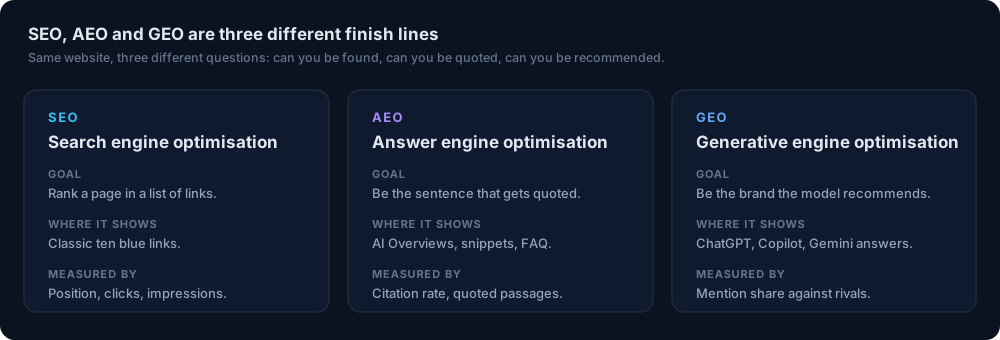
Generative Engine Optimization (GEO), Answer Engine Optimization (AEO), and LLM SEO all share the goal of making your content the preferred source for AI-generated answers. Outdated citations are a core problem in these disciplines: if your site is not the cited source, you lose both visibility and trust.
SEOWedge is built around this loop. It combines GEO (optimizing for generative engines), AEO (structuring content for direct answers), and LLM SEO (ensuring technical accessibility for language models). The workflow is shaped for ecommerce and agencies, not general-purpose SEO. For definitions and practical differences between these disciplines, see GEO vs AEO vs SEO: The Practical Definitions.
If you want to see how this workflow applies to product or category pages specifically, see How to Use SEOWedge to Improve Product Page Visibility in AI Search and Can SEOWedge Help Me Improve Category Page Visibility in AI Search?.
| Discipline | What It Focuses On |
|---|---|
| GEO | Optimizing for generative AI engines |
| AEO | Structuring content for direct answers |
| LLM SEO | Technical accessibility for language models |
How outdated citations fit into GEO, AEO, and LLM SEO
What’s the Fastest Way to Move from Outdated Citation to New AI Answer?
Start with a free SEOWedge scan at signup or review the sample report. You’ll see which URLs are being cited in current AI answers and where outdated information is costing you recommendations.
On paid plans, you can queue multiple Action Briefs and generate several answer-ready pages at once, moving from diagnosis to new content in hours, not weeks. IndexNow submission accelerates discovery, and the workflow is designed to keep you focused on the pages that matter most for AI visibility.
If you want to understand the limits and value of the free plan, see Free AI Search Audit by SEOWedge. For a breakdown of paid plan features, visit Pricing. The next step is to run a scan and see which outdated citations you can replace first.
| Step | How Long It Takes |
|---|---|
| Run free scan | Minutes |
| Review outdated citations | Immediate |
| Generate new page (paid) | 1-2 hours per draft |
| Submit via IndexNow | Automatic on paid plans |
| Wait for AI re-crawl | 1-4 weeks (typical) |
Timeline from scan to new AI citation
How this was tested
All statements on this page are based on SEOWedge's sampled observations of AI answers from OpenAI (GPT) and Google Gemini, as measured in scans performed between July and August 2026. SEOWedge records which URLs are cited in AI answers at the time of each scan, then maps those citations to the latest pages on the scanned domain. Indexing and crawl timing are referenced from OpenAI and Google public documentation. IndexNow submission is described as implemented in SEOWedge paid plans as of August 2026.
What this page does not cover
This page covers why AI assistants cite outdated information, how SEOWedge diagnoses and addresses these cases, and what actions can accelerate the replacement of old citations. It does not cover technical troubleshooting of crawl blocks (see LLM SEO: Technical Guide), classic SEO ranking, or the full details of schema markup for AI search (see Structured Data for AI Search). All product claims are based on SEOWedge's current workflow and the cited public documentation as of August 2026.
Questions buyers ask us
Why do AI assistants keep showing my old product page even after I update it?
AI assistants depend on their last crawl and retrieval of your site. If your new page hasn't been crawled or indexed by their systems (like OpenAI's OAI-SearchBot or Google GeminiBot), they will keep citing the old page until the next update cycle. SEOWedge shows which URL is being cited and why.
How can I tell if my new page is even visible to AI assistants?
Check your server logs for visits from OAI-SearchBot and GeminiBot, or use SEOWedge’s scan output to see which URLs are cited in actual AI answers. If your new page never appears, it may not be indexed or is not matching the buyer question structure.
Does updating my sitemap guarantee AI assistants will see my new content?
Submitting a sitemap helps, but it does not guarantee indexing or citation. IndexNow submission and open access for AI crawlers increase your chances, but assistants may still take weeks to update their sources. SEOWedge accelerates this by submitting URLs and structuring content for retrieval.
How does SEOWedge differ from classic SEO tools in handling outdated AI citations?
Classic SEO tools track rankings and traffic, but do not show which URLs are cited in AI answers or why. SEOWedge samples real AI answers, surfaces outdated citations, and produces the exact content needed to replace them. It closes the loop from measurement to action.
Can SEOWedge fix outdated citations for competitor pages too?
Yes. SEOWedge identifies when a competitor’s outdated page is being cited instead of yours. The Action Brief explains what that competitor page covers and guides you to create a better, more current answer-ready page to win future citations.
Will SEOWedge work if my site is in multiple languages?
SEOWedge’s core workflow is built for English-language ecommerce, but it can be used for multilingual sites with some limits. For details, see Does SEOWedge Work for Multilingual Ecommerce Sites?.
See what AI assistants say about your site
Enter your domain and SEOWedge runs a free scan: your AI-Visibility score, the buyer questions where a competitor is named instead of you, and the first page to fix. No install, no sales call.