
Does SEOWedge Work for Multilingual Ecommerce Sites?
SEOWedge discovers buyer questions and AI visibility gaps for ecommerce sites in any language it can crawl. Content briefs and AI-optimized pages are generated in the language of the scanned site. For multilingual or multi-region stores, each language version should be scanned as a separate project to ensure accurate question discovery and content output. This workflow gives actionable, on-brand recommendations for every market you serve.
By the SEOWedge Research Team · Published August 13, 2026 · Last tested August 13, 2026 · Updated August 13, 2026 · 7 min read
What to take away
- Scan each language or region version as its own project for precise results.
- SEOWedge generates content briefs and pages in the scanned language.
- Buyer questions are discovered based on the language and region of each site version.
- Bulk generation and Brand DNA keep content on-brand across all markets.
- Free scan works for any language—no card required.
Will SEOWedge Discover Buyer Questions in Every Language My Store Uses?
SEOWedge discovers buyer questions in the language of the site version it crawls. If your ecommerce site has separate URLs or subfolders for different languages or regions, you scan each one as its own project. The crawler extracts product, category, and market context in that language, then discovers the high-intent questions buyers actually ask in that market. This means your French, German, or Spanish storefronts will surface buyer questions in those languages—not just English translations.
For brands operating in more than one language, this approach ensures the questions reflect the real search and purchase behavior of local buyers. The workflow does not require you to write prompts or maintain a question list for each market. SEOWedge's discovery is automatic, based on the content and structure of the scanned site version. If you want to see how this works in practice, start with a free AI search audit on your non-English store version.
| Scenario | How SEOWedge Handles It |
|---|---|
| English-only store | Discovers English buyer questions, generates English content. |
| French store version | Discovers French buyer questions, generates French content. |
| Spanish and German subdomains | Each scanned as a separate project, with questions and content in the matching language. |
How SEOWedge adapts to different multilingual ecommerce setups.

Can SEOWedge Generate Content Briefs and Pages in Languages Other Than English?
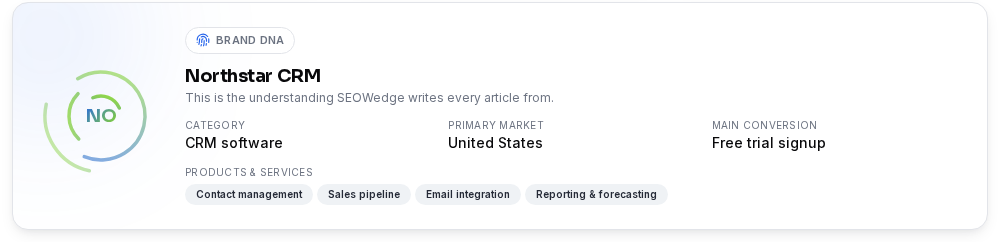
SEOWedge generates Action Briefs and AI-optimized articles in the language of the scanned site. The Brand DNA profile is extracted from the site version you scan, so the resulting briefs and content match the tone, terminology, and conversion goals of that language and market. For example, a scan of your German storefront produces Action Briefs and articles in German, using the product names and buyer language found on that site.
There is no need to translate English content or manually localize briefs. Each project’s briefs and articles are natively generated in the scanned language. On paid plans, you can generate multiple articles at once for each language version, scaling content production across markets. The workflow ensures every page is on-brand and market-relevant, not just a machine translation of your English content. See how SEOWedge keeps content on-brand for more detail.
| Plan Level | Languages Supported for Content Generation |
|---|---|
| Free | Any language the scanned site uses |
| Pro | Any language the scanned site uses |
| Agency | Any language the scanned site uses |
SEOWedge content generation language support by plan.
How Should I Structure My Multilingual or Multi-Region Store for Best Results?
For SEOWedge to accurately discover buyer questions and produce actionable content, each language or region version should be accessible as its own crawlable project. This means using separate domains, subdomains, or subfolders for each language or country (e.g., example.com/fr/, de.example.com, or example.es). Each version should have its own navigation, product listings, and localized content. SEOWedge crawls the specific version you enter and discovers questions based on the content and buyer signals present there.
If your site uses automatic language detection or overlays, make sure each language version is accessible by a direct URL. This allows SEOWedge (and AI crawlers) to see the real content buyers in that market experience. For region-specific products or offers, scan the version that matches the market you want to optimize. This ensures the discovered questions and generated content reflect actual buyer needs and product availability in that region.
| Store Setup | Recommended SEOWedge Workflow |
|---|---|
| Separate domains (example.fr, example.de) | Scan each as a separate project. |
| Subfolders (example.com/fr/, /de/) | Scan each subfolder URL as its own project. |
| Subdomains (fr.example.com, de.example.com) | Scan each subdomain as its own project. |
Best practices for structuring multilingual or multi-region stores with SEOWedge.
Does SEOWedge Handle Region-Specific Buyer Questions and Product Differences?
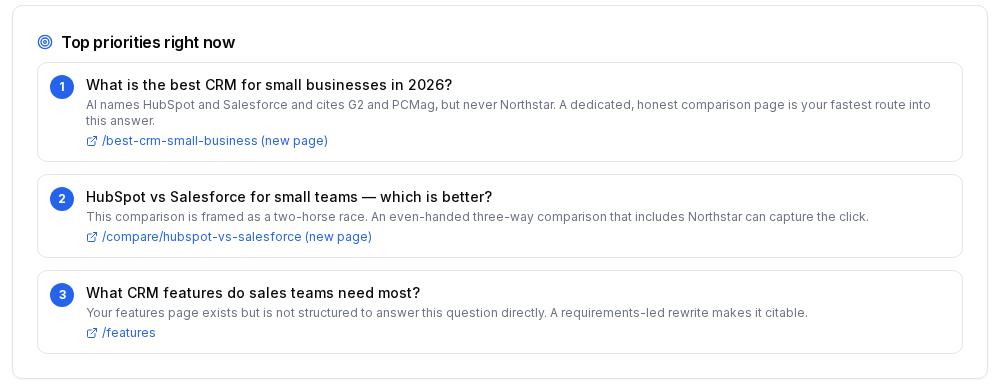
SEOWedge’s question discovery is based on the content and context of each scanned site version. If your German store features products or shipping policies that differ from your UK or US store, the buyer questions discovered will reflect those differences. The scan does not merge or assume questions across markets. Each scan is a snapshot of what buyers in that country or language see and ask.
This means you can surface gaps and opportunities that are unique to each market. For example, if French buyers ask about local warranty terms or Spanish buyers care about specific payment methods, SEOWedge will discover those questions and generate briefs and articles that address them. This workflow gives you a market-specific action list, not a generic set of recommendations.
| Market Example | How SEOWedge Surfaces Differences |
|---|---|
| UK store: next-day delivery | Buyer questions about UK shipping are surfaced. |
| German store: local payment options | Buyer questions about payment in Germany are discovered. |
| US store: product sizes | US-specific sizing questions appear in the opportunity list. |
Examples of region-specific question discovery in SEOWedge.
Can I Bulk-Generate AI-Optimized Pages for Multiple Languages or Regions?
On paid plans, SEOWedge lets you generate multiple articles at once for each project. This means you can scan your French, German, and Spanish store versions, receive an opportunity list for each, and queue up to 3 (Pro) or 10 (Agency) articles at a time per project. Each article is written from the Brand DNA of that language version, ensuring the output is on-brand and relevant to that market.
Bulk generation is managed per project, so you keep language and market content separated and specific. This is especially useful for agencies or brands managing several localized storefronts. For details on how bulk generation works, see bulk article generation in SEOWedge.
| Plan | Bulk Articles per Project |
|---|---|
| Free | 1 |
| Pro | 3 |
| Agency | 10 |
Bulk article generation limits by plan.
What Are the Best Practices for Using SEOWedge with Multilingual Ecommerce Sites?
1. Treat each language or region version as a separate project in SEOWedge. This ensures accurate question discovery and content generation.
2. Make sure each version is crawlable by direct URL—avoid overlays or automatic redirects that block crawlers from seeing localized content.
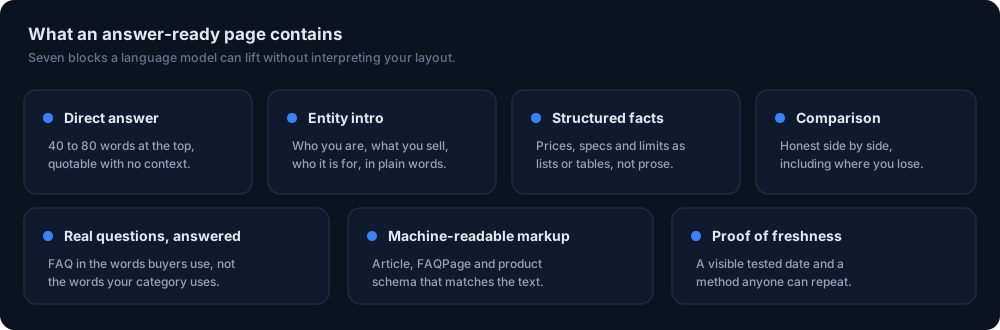
3. Use the Brand DNA feature for each language version to keep content on-brand and market-specific. Edit and review generated articles for local nuance before publishing.
4. For region-specific product lines or offers, scan the relevant version and focus on the Action Briefs surfaced for that market.
5. Use bulk generation to efficiently create content for multiple markets, but always review for cultural and legal differences before publishing.
How Does SEOWedge’s Workflow Compare to Manual GEO or AEO for Multilingual Stores?
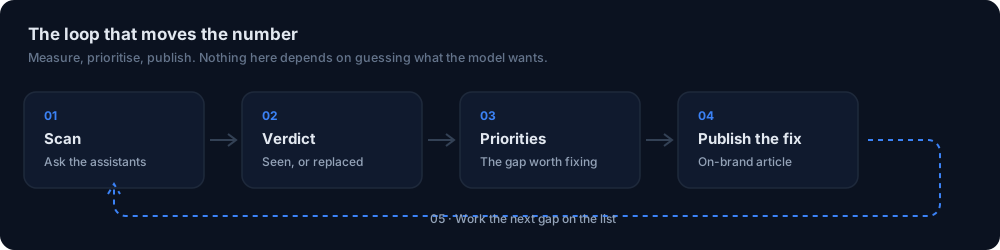
Manual generative engine optimization (GEO) or answer engine optimization (AEO) for multilingual ecommerce requires finding buyer questions, checking AI answers, and writing or translating content for each market—often with separate tools and manual tracking. SEOWedge removes this manual work: it discovers high-intent questions, tests AI answers, and writes on-brand articles for each scanned language version in one loop.
You do not need to maintain prompt lists, manage translations, or merge findings across tools. Each project in SEOWedge is a self-contained workflow for a specific language or market. The output is actionable and ready for review, with a Publish Readiness score so you know when a page is likely to win citations in AI answers. For a detailed breakdown of how SEOWedge turns gaps into content, see this guide to the SEOWedge workflow.
What’s the Fastest Way to Test SEOWedge for a Multilingual or Multi-Region Store?
Start with the language or region version you care about most. Enter its direct URL in SEOWedge for a free AI search audit. The scan will return an AI-Visibility score, a competitor share-of-voice snapshot, and a list of real buyer questions in that language. You will see the exact pages being cited by AI assistants and get one free Action Brief and article draft, all in the scanned language.
To optimize more markets or scale up content, upgrade to a paid plan. Each plan supports multiple projects, so you can scan and act on every language or region version you operate. Paid plans let you bulk-generate articles, export reports, and extend limits with credit top-ups as needed. For plan details and pricing, see SEOWedge pricing.
| Plan | Projects (Languages/Regions) |
|---|---|
| Free | 1 |
| Pro | 5 |
| Agency | 25 |
How many language or region versions you can scan per plan.
How this was tested
All claims and workflow steps are based on SEOWedge's product facts and observed user interface as of 2026-08-13. Language handling is determined by the language of the crawled site version. Buyer questions and Action Briefs are discovered per scan, not imported or assumed. Content generation uses the Brand DNA profile extracted from the scanned language version. No claim is made about translation or cross-language optimization unless specified in the product facts.
What this page does not cover
This page covers SEOWedge's workflow for multilingual and multi-region ecommerce sites as of 2026-08-13. It does not evaluate translation quality, cross-market ranking, or the effect of hreflang or schema on AI answers—see LLM SEO: Technical Guide for technical implementation. For classic SEO or analytics, refer to your existing stack. This page does not cover enterprise localization or translation management tools.
Questions buyers ask us
Does SEOWedge translate content between languages?
SEOWedge does not translate existing content. It generates Action Briefs and articles in the language of the scanned site version, using the Brand DNA and buyer context of that market. For translation workflows, use your own localization process after export.
Can I scan a site with mixed languages on one page?
SEOWedge works best when each project is a single language or market. If your pages mix languages or do not have clear language separation, question discovery and content output may not reflect a single buyer context. For best results, scan each language version separately.
What if my site uses hreflang or region tags?
SEOWedge discovers questions and generates content based on the version it crawls. Hreflang and region tags help search engines serve the right version to users but do not affect SEOWedge’s question discovery. For technical details on LLM SEO and language signals, see the LLM SEO guide.
Are there limits to how many languages or regions I can scan?
Each SEOWedge plan has a project limit: 1 on Free, 5 on Pro, 25 on Agency. Each project can be a different language or region version. You can extend usage with credit top-ups on paid plans without upgrading the plan.
Will SEOWedge discover region-specific buyer questions automatically?
Yes. SEOWedge’s discovery is based on the content and product context of each scanned version. Region-specific shipping, payment, or product questions will be surfaced if they are present on the scanned site.
Does SEOWedge support right-to-left languages or non-Latin scripts?
SEOWedge generates content in the language and script of the scanned site version. For right-to-left or non-Latin scripts, the output matches the scanned content. Always review generated articles for formatting and local nuance before publishing.
See what AI assistants say about your site
Enter your domain and SEOWedge runs a free scan: your AI-Visibility score, the buyer questions where a competitor is named instead of you, and the first page to fix. No install, no sales call.