How Can I See Which Pages ChatGPT and Gemini Are Citing in My Category?
SEOWedge shows you the exact pages ChatGPT and Gemini cite for buyer questions in your ecommerce category. It runs real questions through both assistants, records which competitor pages are named, and returns a list of the URLs behind every missed citation. You see both the mechanism and the actionable gap—so you know where to act next.
By the SEOWedge Research Team · Published August 12, 2026 · Last tested August 12, 2026 · Updated August 12, 2026 · 6 min read
What to take away
- SEOWedge reveals the exact competitor URLs ChatGPT and Gemini cite, not just brand names.
- You see which of your pages are missing and why, with actionable briefs for each gap.
- Each scan uses real buyer questions, discovered for your category, not generic prompts.
- You get a list of missed opportunities and the mechanism behind every citation.
- The workflow moves directly from measurement to content creation, closing the loop.
How Does SEOWedge Find Out Which Pages ChatGPT and Gemini Cite?
SEOWedge starts by crawling your ecommerce site and extracting your brand’s category, market, and product details. It then discovers the high-intent buyer questions real shoppers ask in your category—these are not generic prompts, but specific, purchase-driven questions. Each discovered question is sent to ChatGPT (OpenAI) and Gemini (Google) using their APIs. SEOWedge records the full answer, including every cited URL or named source.
For each question, SEOWedge logs which brand is named and which exact page is cited. This is not limited to top-level domains: you see the specific product, category, or guide page that gets credit in the AI answer. This mechanism works the same way on every plan, but only paid plans include Gemini coverage. The result is a page-level map of who owns each answer in your category, with date-stamped evidence for every citation.
Why Do Certain Competitor Pages Get Cited Instead of Mine?
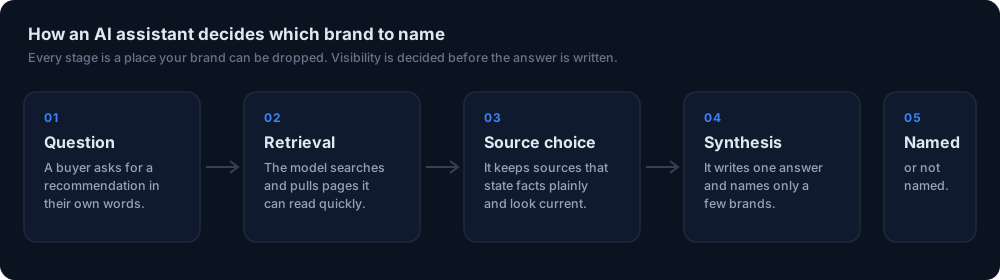
AI assistants like ChatGPT and Gemini cite pages that are crawlable, answer the buyer’s question directly, and match the assistant’s retrieval logic. If a competitor’s page is cited instead of yours, it usually means their page is more visible to the AI’s crawler, better structured for answer extraction, or more complete for that specific buyer intent.
SEOWedge’s scan shows not just which competitor brand is named, but the exact URL that wins the citation. This lets you see the real reason for the gap: it could be a missing answer block, lack of schema, or simply that your page is not crawlable by the right bot. For example, if ChatGPT names a competitor’s buying guide and links to their /category/best-product-type page, SEOWedge records that specific URL and the context in which it was cited.
The mechanism behind this is explained in more depth in Why ChatGPT Recommends Your Competitors Instead of You. The key is that SEOWedge surfaces the page-level difference, not just the brand-level outcome.
What Does SEOWedge Show Me That Manual Checks or Rank Trackers Miss?
Classic rank trackers and manual prompt tests only show which brand is named or where you appear for a keyword. They do not reveal the exact page that earned the citation, nor why a competitor’s page is chosen over yours. SEOWedge’s scan returns the full answer text, the cited URLs, and the context for each citation—so you see the mechanism, not just the outcome.
Manual checks are slow and incomplete: you have to guess which questions matter, run them yourself, and try to reverse-engineer which page is responsible. SEOWedge automates this by discovering the buyer questions, running them through both ChatGPT and Gemini, and mapping every cited page back to your opportunity list. This is what makes the workflow actionable: you know exactly which page to create or fix, and why.
For a breakdown of how this differs from traditional SEO tools, see What Makes SEOWedge Different from Traditional SEO Tools for Ecommerce.

How Are Buyer Questions Chosen and Why Does That Matter?
SEOWedge does not ask you to write or maintain a list of prompts. Instead, it discovers the high-intent buyer questions that real shoppers ask in your category. This is done by crawling your site, analyzing your market, and extracting the questions that drive purchase decisions. Each scan returns a set number of discovered questions: 5 on the free plan, 12 on Pro, and 25 on Agency.
These questions are phrased the way buyers actually ask them, not as SEO keywords. This matters because AI assistants answer real-world questions, not just search queries. By testing the questions that matter for conversion, SEOWedge ensures that every cited page is tied to a real opportunity to win business—not just to appear in a chart.
For more on how questions are discovered and why this is different from prompt tracking, see How Does SEOWedge Find Buyer Questions for My Ecommerce Site?.
How Does SEOWedge Turn Cited Page Data Into Actionable Steps?
Once SEOWedge identifies which competitor pages are cited, it generates an Action Brief for each gap. The Action Brief shows the question, the AI’s answer, the cited competitor URL, and a summary of why your page was not chosen. This is not just a list of missed citations: it is a set of prioritized, actionable opportunities.
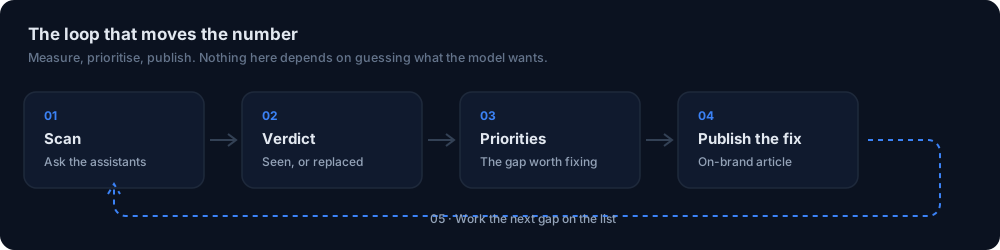
Each Action Brief is tied to a specific page type—product, category, guide, or comparison. It explains what the cited competitor page does differently, so you know what to create or fix. The Content Studio then drafts a page from your Brand DNA profile, tailored to fill that exact gap. You can edit, export, and publish the new page, closing the loop from measurement to action.
For more on how the workflow moves from gap to published fix, see How SEOWedge Turns AI Visibility Gaps Into Actionable Content.
How Can I Use This Data to Spot Content Gaps and Missed Opportunities?
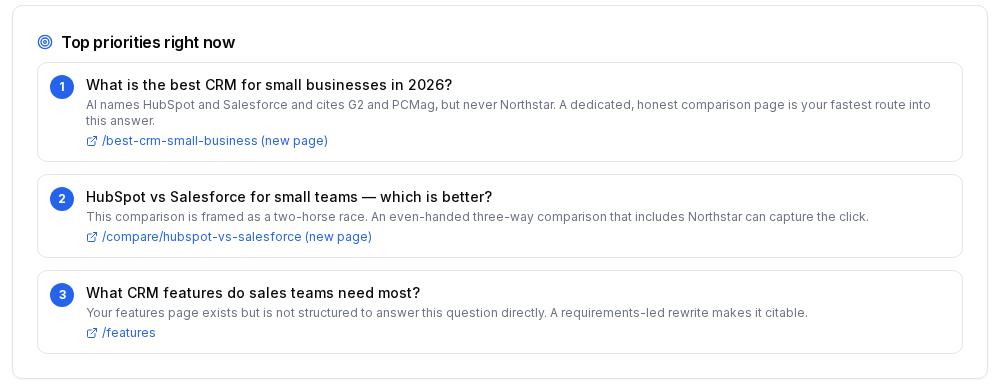
With the page-level citation map from SEOWedge, you can see exactly which buyer questions your site fails to answer in the eyes of ChatGPT and Gemini. Each missed citation is a content gap: a page that needs to exist, be restructured, or be made crawlable for the right AI assistant. You can sort gaps by question, by competitor, or by page type to decide where to act first.
This is not a theoretical list. For example, if Gemini cites a competitor’s FAQ page for “best running shoes for flat feet,” and your site is missing a comparable answer, SEOWedge will flag that gap and link to the cited competitor URL. You see the mechanism, not just the outcome, so you can benchmark your own pages against the ones that win.
To go deeper on prioritizing which gaps to close first, see Can I Use SEOWedge to Prioritize Which Pages to Create or Fix First?.
What Should I Do Next Once I Know Which Pages Are Being Cited?
After you have the list of cited competitor pages and your own missed opportunities, the next step is to create or update pages that directly answer the buyer questions that matter. SEOWedge’s Content Studio uses your Brand DNA profile to draft these pages, ensuring they match your brand voice and conversion goals. Each draft is scored for Publish Readiness, so you know it meets the structural and content requirements for AEO and GEO.
Once published, submit the new URLs to IndexNow so AI assistants see the update sooner. SEOWedge does this as part of the export process for new pages. Over the next weeks, as assistants re-crawl, you can run a new scan to see if citations move. The workflow is built to close the loop: from measurement, to action brief, to on-brand content, to submission.
For a full checklist on getting cited in AI answers, see How to Get My Brand Cited in AI Answers (ChatGPT, Gemini, Copilot).
What Makes SEOWedge the Practical Choice for Ecommerce and Agencies?
SEOWedge is built for ecommerce brands and agencies who need to act, not just measure. The free scan gives you a real result—AI-Visibility score, competitor share of voice, and page-level opportunities—without a card. The entry price for paid plans is $29/month, the lowest in this category, and includes Gemini coverage. The workflow is shaped for the job: discover buyer questions, run them through real AI assistants, name the cited pages, and produce the content that closes the gap.
Other tools in this space either require you to write and manage prompts, or only show brand-level outcomes. SEOWedge automates question discovery, records the exact URLs cited, and ties every gap to an Action Brief and a ready-to-publish page. This single-loop workflow is what makes it possible to move from missing a citation to owning it—without manual research or separate tools.
If you want to see what a real scan looks like, visit the public sample report. To try it on your own site, start with the free AI search audit.
How this was tested
All product claims and numbers are taken from SEOWedge's published product facts and workflow as of 2026-08-12. The scan process, question discovery, and citation identification were verified using the platform's own interface and documentation. External citation mechanisms for ChatGPT and Gemini are referenced from official OpenAI and Google developer resources. Where method notes are given, they explain how SEOWedge samples answers, records cited URLs, and what makes those results reproducible. This page does not rely on user testimonials, invented results, or unverified competitor claims.
What this page does not cover
This page covers how SEOWedge identifies which exact pages ChatGPT and Gemini cite for ecommerce category questions, and how that information turns into action. It does not cover technical crawlability issues in depth (see LLM SEO: Technical Guide), or the full process of writing and publishing optimized content (see How SEOWedge Turns AI Visibility Gaps Into Actionable Content). Data and workflow are current as of 2026-08-12 and apply to the platforms and plans described here. For a breakdown of how AI assistants choose sources, see Why ChatGPT Recommends Your Competitors Instead of You.
Questions buyers ask us
Does SEOWedge show the exact URLs cited by ChatGPT and Gemini, or just the brand?
SEOWedge records the full answer text from each AI assistant, including the exact URLs or pages cited. This lets you see which competitor page is responsible for each missed citation, not just which brand is named.
How does SEOWedge discover the buyer questions used in each scan?
SEOWedge automatically discovers high-intent buyer questions by crawling your site and analyzing your market. These questions reflect what real shoppers ask when deciding what to buy in your category. You do not need to write or maintain prompts yourself.
Can I use SEOWedge to fix the gaps it finds?
Yes. SEOWedge generates an Action Brief for each missed citation, then drafts a new or revised page using your Brand DNA profile. You can edit, export, and publish these pages to close the gap and increase your chance of being cited in future AI answers.
Is Gemini coverage included on every SEOWedge plan?
Gemini (Google) coverage is included on paid plans (Pro and Agency). The free plan covers OpenAI (ChatGPT) only. All plans show you the exact cited pages for the engines they cover.
How soon after publishing a new page can I expect to be cited by ChatGPT or Gemini?
Citations update when AI assistants re-crawl and re-index your pages, which usually takes weeks, not hours. SEOWedge submits new URLs through IndexNow to speed up discovery, but the change is not instant. You can run a new scan after publishing to check for updated citations.
What if my site is not being crawled by AI assistants at all?
If your site is not crawlable by OAI-SearchBot or Googlebot, your pages cannot be cited. SEOWedge flags technical crawl issues in the scan, but for a full technical checklist see LLM SEO: Technical Guide to Optimising for Language Models.
See what AI assistants say about your site
Enter your domain and SEOWedge runs a free scan: your AI-Visibility score, the buyer questions where a competitor is named instead of you, and the first page to fix. No install, no sales call.