SEOWedge vs Traditional SEO Tools for Ecommerce: What Actually Changes?
SEOWedge is built to measure and fix how your ecommerce brand appears in AI-generated answers, not just search rankings. It discovers real buyer questions, checks which brands AI assistants recommend, names the exact page behind each missed opportunity, and writes the page that closes the gap—all from your brand profile. Traditional SEO tools track rankings and keywords, but do not show or fix AI assistant visibility.
By the SEOWedge Research Team · Published August 12, 2026 · Last tested August 12, 2026 · Updated August 12, 2026 · 8 min read
What to take away
- SEOWedge measures if AI assistants like ChatGPT and Gemini recommend your products—classic SEO tools do not.
- It finds high-intent buyer questions automatically, instead of making you write and track prompts.
- You get a free, no-card scan that names the exact pages to create or fix for AI visibility.
- SEOWedge writes on-brand, answer-ready pages from your brand profile, closing the loop in one place.
- Start with a free scan—see your AI visibility, competitor share of voice, and first actionable gap.
What Does SEOWedge Measure That Traditional SEO Tools Miss?
Traditional SEO tools measure rankings, keywords, backlinks, and traffic. They show where your ecommerce site appears in search engine results, but they do not check what AI assistants like ChatGPT or Gemini actually say about your brand or products. SEOWedge samples real AI answers to the questions buyers ask, records which brands are named, and identifies which competitor’s page is being cited instead of yours.
This means SEOWedge reveals a new layer of visibility—whether your brand is recommended in AI-generated answers, not just in search listings. The result is an AI-Visibility score, a competitor share of voice breakdown, and a list of missed citations, all mapped to specific pages you can create or improve. Classic SEO tools cannot see or act on these gaps, because they do not interact with AI assistant outputs.
SEOWedge’s measurement is not a replacement for analytics or rank tracking. It pairs with your analytics stack, adding a layer that shows why you may be losing recommendations or traffic in AI-driven search experiences.
| Capability | SEOWedge | Traditional SEO Tools |
|---|---|---|
| Measures AI assistant recommendations (ChatGPT, Gemini) | Yes | No |
| Discovers high-intent buyer questions automatically | Yes | No (manual keyword or prompt entry) |
| Identifies exact competitor pages behind missed citations | Yes | No |
| Creates answer-ready content from brand profile | Yes | No |
| Tracks classic search rankings | No | Yes |
| Integrates with analytics tools | Pairs with, does not replace | Yes |
| Free scan with actionable output | Yes | Rarely, often trial-limited |
Key differences in measurement and output: SEOWedge vs traditional SEO tools.
How Does SEOWedge Find and Act on Real Buyer Questions?
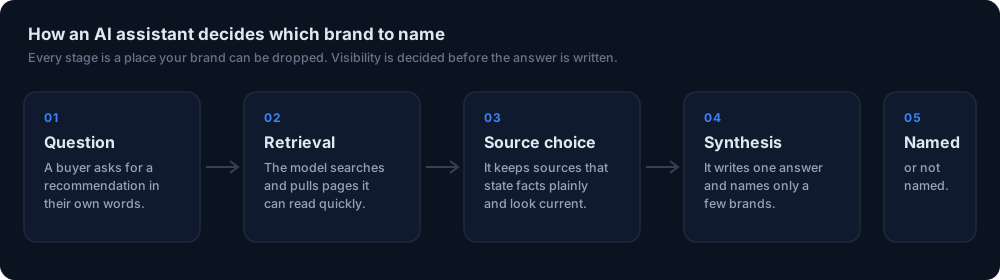
Classic SEO platforms ask you to pick keywords or write prompts for tracking. SEOWedge does this differently: it crawls your ecommerce site, extracts your category and product focus, and automatically discovers the high-intent questions buyers are asking in your market. You do not have to write or maintain prompt lists—each scan surfaces the questions that actually matter for AI search visibility.
For each discovered question, SEOWedge checks what AI assistants say, who they recommend, and which competitor page is being cited. It then produces an Action Brief: a direct, page-level opportunity to become the cited source. This workflow turns measurement into a concrete next step, not just a chart or warning.
For more on how SEOWedge’s question discovery works and why it matters for ecommerce, see How Does SEOWedge Find Buyer Questions for My Ecommerce Site?.
| Prompt/Keyword Handling | SEOWedge | Traditional SEO Tools |
|---|---|---|
| Buyer questions discovered per scan | Up to 25 (plan-dependent) | 0 (manual entry required) |
| Prompts you must write and maintain | 0 | As many as you want to track |
| Actionable output tied to each question | Yes (Action Briefs) | No (keyword gap or ranking drop) |
How buyer questions and prompts are handled: automation vs manual effort.
What Is the SEOWedge Workflow From Scan to Published Fix?
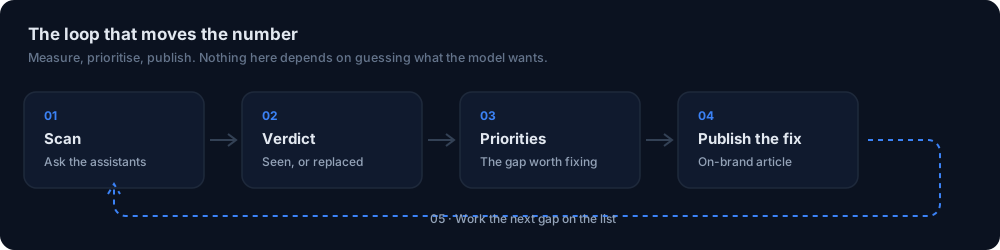
SEOWedge’s workflow is designed to close the AI visibility gap in a single loop. You start by entering your domain. The tool crawls your site, builds a Brand DNA profile, and discovers the buyer questions that matter for your category. It then tests those questions across supported AI assistants (OpenAI on all plans, Google Gemini on paid plans) and records which brands and pages are cited in answers.
For every missed citation, SEOWedge produces an Action Brief: the question, the reason your brand is missing, and the exact page to create or fix. The Content Studio then drafts the missing page directly from your Brand DNA, scoring it for publish readiness. You can edit, export, and publish the page, then submit the new URL via IndexNow so AI assistants see the update sooner.
Paid plans allow you to queue multiple articles at once, so you can address a whole list of gaps in one pass. This loop—measure, identify, write, publish—is what sets SEOWedge apart from tools that only monitor or report gaps without producing the fix.
For a detailed breakdown of this workflow, see How SEOWedge Turns AI Visibility Gaps Into Actionable Content.
| Step | SEOWedge Output | Traditional SEO Tool Output |
|---|---|---|
| Measurement | AI-Visibility score, competitor citations | Ranking, keyword volume |
| Gap identification | Page-level Action Briefs | Keyword gap, lost ranking |
| Content creation | On-brand, answer-ready article | Content brief or suggestion |
| Publish readiness | Deterministic score | No equivalent |
| Submission to engines | IndexNow ping (on publish) | Manual or via sitemap |
Workflow steps: what you get at each stage with SEOWedge vs traditional SEO.
Can SEOWedge Integrate With My Existing Analytics or SEO Stack?
SEOWedge is designed to add a new layer—AI search visibility—on top of your existing analytics and SEO tools. It does not replace your traffic dashboards or classic rank trackers. Instead, it measures what analytics cannot see: whether your brand is being named and cited in AI-generated answers, and why you may be missing recommendations even if rankings hold steady.
You can export reports (PDF on paid plans) and use the AI-Visibility score and Action Briefs to inform your content, SEO, or PR workflow. SEOWedge’s outputs—opportunity lists, action briefs, and ready-to-publish articles—can be slotted into your existing project management or content calendar. There is no direct API or analytics integration, but the pairing is intentional: SEOWedge shows the “why” behind shifts in traffic or brand mentions that your analytics report, especially as AI search surfaces become more prominent.
For agency teams, white-label PDF reports are available on the Agency plan, making it easy to communicate AI search visibility to clients alongside traditional SEO metrics. For more on reporting and integration, see AI Search Reporting for Agencies.
| Integration Type | SEOWedge | Traditional SEO Tools |
|---|---|---|
| Analytics dashboard | Pairs with, not replaces | Native, direct |
| API access | No | Usually yes |
| PDF/White-label reports | Agency plan only | Often on all paid plans |
| Content export | Yes (article, briefs) | Varies |
Integration and output pairing: how SEOWedge fits into your stack.
Why Does AI Search Visibility Matter More for Ecommerce Brands Now?
AI assistants like ChatGPT and Google Gemini are now answering product and category questions directly, often without showing classic search results. If your brand is not named or cited in these answers, you lose recommendations and potential sales—even if your SEO rankings have not changed. This shift means that classic SEO alone no longer guarantees visibility where buyers are actually making decisions.
SEOWedge is built specifically for this new reality. It measures, at the question level, whether your products or categories are being recommended in AI-generated answers. It then shows you exactly what to fix, and produces the content that can win the next round of citations. This is not just a new ranking factor—it is a new surface where buyers discover and choose products.
For a detailed guide to optimizing for AI-generated answers, see How to Appear in Google AI Overviews and AI Mode and Generative Engine Optimization (GEO): The Practical Guide.
| Visibility Surface | Classic SEO | AI Search (GEO/AEO) |
|---|---|---|
| Organic rankings | Yes | No |
| AI assistant answers | No | Yes |
| Citations and mentions | No | Yes |
| Traffic attribution | Yes | Partial (not always visible) |
Where visibility matters: classic SEO vs AI-driven search experiences.
What Happens When I Start a Free Scan With SEOWedge?
You enter your ecommerce domain—no credit card required. SEOWedge crawls your site, extracts your brand profile, and discovers five high-intent buyer questions for your category. It tests those questions in OpenAI’s GPT (the engine behind ChatGPT) and records which brands and competitor pages are named in answers.
Your free scan returns: an AI-Visibility score, a competitor share of voice chart, and a concrete Action Brief naming the exact page you could create or fix to win a recommendation. You also get one free article, drafted from your brand profile and scored for publish readiness. No other tool in this category gives you this much actionable output for free, with no setup or prompt writing required.
If you want to scan more questions, test on Google Gemini, or produce a full queue of articles, you can upgrade to a paid plan or buy credit top-ups. But the free scan is built to show you, in minutes, what classic SEO tools cannot: who AI assistants recommend instead of you, and what you can do about it right now.
For a step-by-step walkthrough, see Free AI Search Audit by SEOWedge: What You Get, Instantly. To see a real output, check the public sample report.
| Free Scan Output | SEOWedge | Traditional SEO Tools |
|---|---|---|
| AI-Visibility score | Yes | No |
| Competitor share of voice | Yes | No |
| Actionable page-level opportunity | Yes | No |
| Drafted article (on-brand) | Yes (1, lifetime) | No |
| Credit card required | No | Often yes |
What you get from a SEOWedge free scan vs a classic SEO trial.
How Does SEOWedge Fit Into GEO, AEO, and LLM SEO?
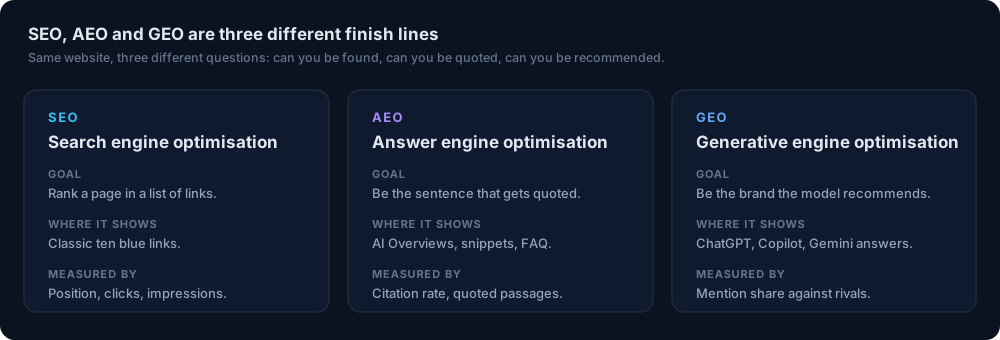
Generative Engine Optimization (GEO), Answer Engine Optimization (AEO), and LLM SEO are the disciplines focused on optimizing for AI-generated answers, not just rankings. SEOWedge is built around these jobs: it discovers the questions that matter for GEO and AEO, measures whether your brand is cited in LLM answers, and produces the pages that make a model choose your site as a source.
Classic SEO tools do not measure or act on these surfaces. SEOWedge’s workflow is designed for ecommerce teams who need to see and close AI visibility gaps week by week, not just track rankings. Every scan, action brief, and drafted article is shaped for the mechanics of GEO and AEO—answer-ready structure, schema alignment, and on-brand specificity.
For in-depth definitions and when each discipline matters, see GEO vs AEO vs SEO: The Practical Definitions and When Each Matters and LLM SEO: Technical Guide to Optimising for Language Models.
| Discipline | SEOWedge Coverage | Traditional SEO Tool Coverage |
|---|---|---|
| GEO (Generative Engine Optimization) | Yes | No |
| AEO (Answer Engine Optimization) | Yes | No |
| LLM SEO | Yes | No |
| Classic SEO (rankings, links) | No | Yes |
Which optimization disciplines each tool supports.
What’s the Next Step If I Want to See My AI Search Visibility?
If you want to see how your ecommerce brand appears in AI-generated answers—and what to do about missed recommendations—the next step is to run a free scan. You will get a real AI-Visibility score, competitor share of voice, and a concrete Action Brief with a drafted article, all without entering a card or writing prompts.
This is the only tool in the category that closes the loop: measurement, opportunity, and fix in one place. Start your scan at the SEOWedge signup page.
How this was tested
All product claims, prices, and workflow steps are drawn from SEOWedge’s published facts as of 2026-08-12. Comparisons to traditional SEO tools are based on what classic platforms measure (rankings, keywords, backlinks) versus SEOWedge’s workflow (AI answer sampling, gap identification, and page creation). Screenshots and diagrams illustrate real SEOWedge mechanisms. Pricing and feature details are current as of the date above. No claims are made about competitor platforms beyond what is publicly documented or explicitly described in the product facts.
What this page does not cover
This page focuses on the practical differences between SEOWedge and traditional SEO tools for ecommerce brands, specifically regarding AI search visibility and actionable outputs. It does not review every classic SEO tool individually, nor does it repeat detailed workflow or pricing comparisons with other AI visibility tools—see Best AI Search Visibility Tools for Ecommerce and SEOWedge vs Semrush AI Visibility for those. For technical LLM SEO or on-page AEO guidance, see the linked resources below.
Questions buyers ask us
Does SEOWedge replace my classic SEO tools or analytics?
No. SEOWedge adds a new layer—AI search visibility—on top of your existing SEO and analytics stack. It measures and fixes what classic tools cannot see: whether your brand is being named and cited in AI-generated answers.
How does SEOWedge discover buyer questions without me writing prompts?
SEOWedge crawls your ecommerce site, identifies your category and products, and uses its own algorithms to surface the high-intent questions buyers are actually asking in your market. This process is fully automated and updates with each scan.
Can I use SEOWedge if I manage multiple stores or clients?
Yes. The Pro plan covers up to 5 projects, and the Agency plan covers up to 25, with bulk article generation and white-label reports. See AI Search Reporting for Agencies for more details.
What does the free scan include, and do I need a credit card?
The free scan includes one project, five discovered buyer questions, an AI-Visibility score, a competitor share of voice chart, one Action Brief, and one drafted article. No credit card is required—just enter your domain to start.
How quickly can I go from scan to published page?
You receive actionable results and a drafted article within minutes of starting your scan. Edit and export the article, then publish it on your site. SEOWedge also supports IndexNow submission to alert engines of your update.
Does SEOWedge show changes over time or track rankings?
SEOWedge records a one-time snapshot per scan. It does not trend scores over time or track classic rankings. Its focus is on finding, fixing, and closing AI visibility gaps, not on monitoring traditional SEO metrics.
See what AI assistants say about your site
Enter your domain and SEOWedge runs a free scan: your AI-Visibility score, the buyer questions where a competitor is named instead of you, and the first page to fix. No install, no sales call.