
How Does SEOWedge Handle Collections or Bundles in AI Search Answers?
SEOWedge identifies when your product collections or bundles are missing from AI search answers by discovering buyer questions that target sets, kits, or curated groups—not just single products. It then shows which competitor collection pages are being cited, explains why, and generates Action Briefs and on-brand content to help your collection or bundle pages win those citations.
By the SEOWedge Research Team · Published August 13, 2026 · Last tested August 13, 2026 · Updated August 13, 2026 · 6 min read
What to take away
- SEOWedge discovers buyer questions that target collections, bundles, and sets—not just individual products.
- The tool pinpoints which competitor collection or bundle pages are being cited in AI answers and why.
- You receive Action Briefs detailing the gap and the exact page to create or improve for each missed collection opportunity.
- SEOWedge generates on-brand, answer-ready content for your collection or bundle pages, closing the loop from measurement to publication.
- Free scan identifies at least one collection or bundle gap if it exists—no card required.
Can SEOWedge Identify When My Product Collections or Bundles Are Missing from AI Answers?
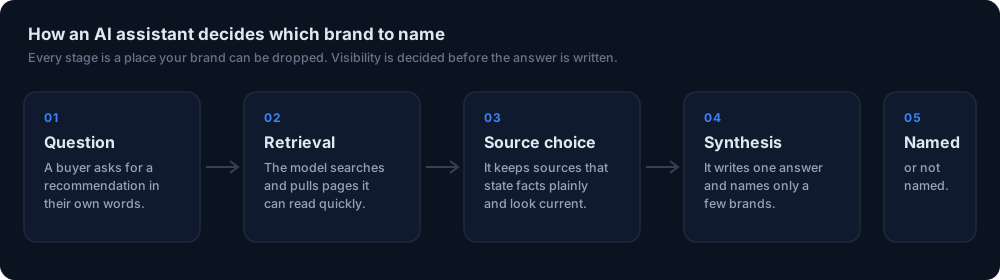
Yes. SEOWedge discovers buyer questions that target collections, bundles, sets, and kits—not just individual products. When scanning your site, it automatically detects high-intent questions like “best skincare sets for sensitive skin” or “gift bundles for coffee lovers.” It then tests these questions against AI assistants and records whether your brand, or a competitor, is named and which specific collection or bundle page is cited.
If your collection or bundle pages are missing from AI answers, SEOWedge flags these as distinct gaps. The tool does not require you to pre-define which collections matter; it surfaces them based on real buyer language and AI answer behavior. This approach ensures you see the missed opportunities that actually cost you citations and recommendations in AI search.
How Does SEOWedge Treat Collections and Bundles Differently from Single Products?
SEOWedge treats collections, bundles, and sets as their own opportunity type. During the scan, it distinguishes between buyer questions that target a single SKU and those that seek a group, set, or bundle. For example, “best running shoes” triggers product-level checks, while “best running shoe bundles” or “starter kits for new runners” are identified as collection-level queries.
When AI answers cite a competitor’s collection or bundle page, SEOWedge records the exact URL, not just the brand. This lets you see which specific competitor collection pages are being recommended instead of yours. You receive Action Briefs that explain why your collection or bundle page was overlooked and what’s needed to become the cited source.
This is different from classic SEO tools, which usually focus on product or category keywords. SEOWedge’s method is built for generative engine optimization (GEO) and answer engine optimization (AEO), where the structure and context of a collection page matter for AI citation.
What Is the Process for Optimizing Collection Pages for AI Search Visibility?
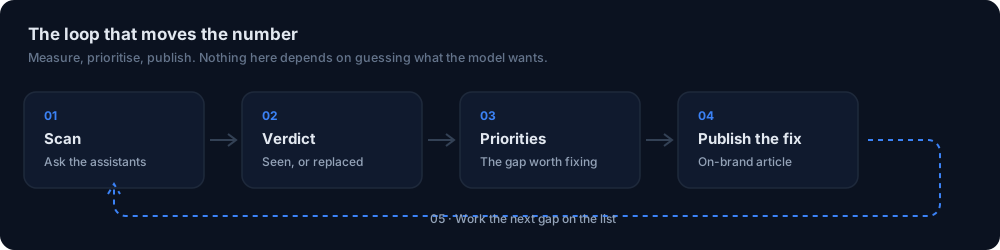
1. Enter your ecommerce domain. SEOWedge crawls your site and extracts your product hierarchy, including collections and bundles.
2. The tool discovers buyer questions that reference collections, sets, or bundles using your category and product data. These questions are phrased exactly as buyers search.
3. SEOWedge tests these questions on AI assistants (OpenAI on all plans, Google Gemini on paid plans) and records which brands and pages are cited in the answers.
4. It returns a prioritized opportunity list, highlighting every collection or bundle page that is missing from AI answers, along with the exact competitor page that is being cited instead.
5. For each gap, you receive an Action Brief: it explains the buyer question, shows the cited competitor page, and details what your page needs to win the citation.
6. In the Content Studio, SEOWedge drafts a new or revised collection page using your Brand DNA profile, scoring each draft for publish readiness before export.
7. Paid plans allow you to queue multiple collection or bundle pages for generation at once, speeding up the process for large stores or agencies.
How Does SEOWedge Surface and Explain Missed Collection or Bundle Citations?
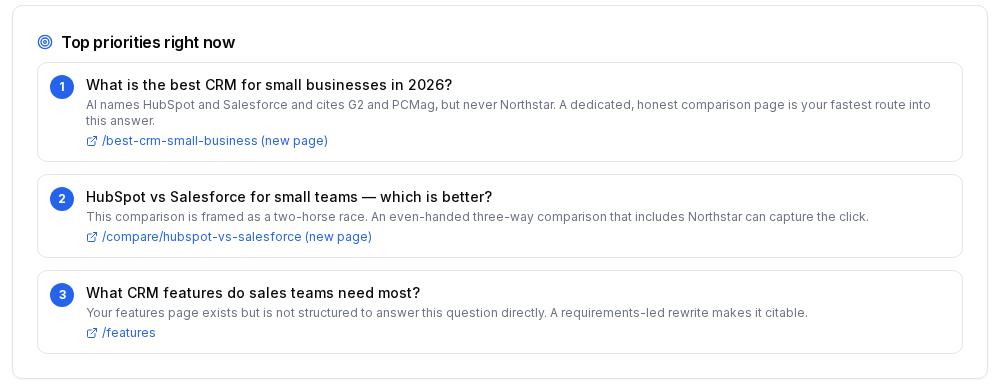
SEOWedge’s scan output shows not just whether your collections are cited, but which competitor pages are winning those citations. For each buyer question about a set, kit, or bundle, you see the exact AI answer, the named brands, and the URLs being cited. This lets you compare your current collection page to the one AI assistants prefer.
The Action Brief for each missed collection opportunity explains why your page was not selected. Common reasons include insufficient detail, unclear product grouping, generic content, or lack of buyer-oriented language. SEOWedge’s method is transparent: you see the sampled AI answer, the cited page, and the gap in your own content or structure.
This level of detail is not available in classic SEO or rank tracking tools. SEOWedge is built specifically to surface and close these AI-driven opportunity gaps for ecommerce collections and bundles.
Can SEOWedge Generate Content Briefs or New Pages for Collection Gaps?
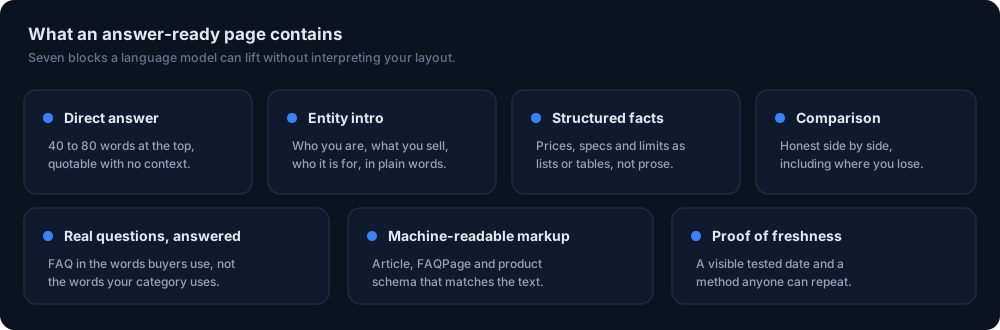
Yes. For every collection or bundle opportunity, SEOWedge generates an Action Brief that details the buyer question, the reason your page was missed, and the structural elements needed to win the citation. In the Content Studio, you can turn this brief into a draft collection or bundle page, written in your brand’s voice and tailored to the question AI assistants actually answer.
Each draft is scored for Publish Readiness, so you know when it meets the answer engine optimization (AEO) and generative engine optimization (GEO) criteria needed for AI citation. You can edit, revise, and export the content as needed. Paid plans allow bulk generation—up to 3 at once on Pro, 10 at once on Agency—so you can address multiple collection or bundle gaps efficiently.
This workflow closes the loop: you move from measurement, to a prioritized brief, to a ready-to-publish collection page in one place. There is no need to purchase a separate content tool or brief generator.
How Are Buyer Questions for Collections Discovered and Tested?
SEOWedge does not rely on prompts you write. It discovers high-intent buyer questions for collections and bundles automatically, using your site’s structure and current market language. This means you see the real questions buyers ask—like “which skincare sets are best for dry skin” or “top meal prep bundles for families”—not just keywords or prompts you imagine.
Each discovered question is tested live against AI assistants. The answers are sampled, recorded, and scored for each platform (OpenAI and Google Gemini, depending on plan). This approach makes the measurement reproducible and lets you see exactly where your collection or bundle pages are missing from AI answers.
If you want more detail on SEOWedge’s question discovery process and how it differs from prompt-based tools, see How Does SEOWedge Find Buyer Questions for My Ecommerce Site?.
What Makes SEOWedge the Practical Choice for AI Search Visibility on Collections and Bundles?
SEOWedge is built for ecommerce teams who need to win citations for collections, bundles, and sets—not just single products. The tool’s loop is designed for this job: it discovers the real buyer questions, tests them across AI assistants, pinpoints the exact competitor collection pages being cited, and generates the Action Briefs and on-brand content needed to close the gap.
The free scan shows you at least one real collection or bundle opportunity if it exists, with no card required. The lowest paid plan ($29/month) unlocks bulk scans, Action Briefs, and content generation for multiple collection gaps at once, without requiring a plan upgrade for busy months thanks to credits. The workflow is shaped for ecommerce, not for generic brand monitoring or manual prompt tracking.
If you want to compare SEOWedge’s workflow and pricing to other tools in the category, see Best AI Search Visibility Tools for Ecommerce.
What Is My Next Step If I Want to Surface and Close Collection or Bundle Gaps?
Start with a free scan—no card required. SEOWedge will surface any missed collection or bundle citations and show you the exact competitor pages being named in AI answers. From there, you can review the Action Brief, use the Content Studio to generate a new or improved collection page, and export it for publication. Paid plans unlock bulk generation and more scans for larger stores or agencies.
For a detailed breakdown of what you get for free and what’s included on each plan, visit the Pricing page. To see a live example of a SEOWedge scan and Action Brief for collections or bundles, view the public sample report. For broader GEO and AEO guidance specific to collections, explore AEO Checklist for Ecommerce and the GEO guide.
How this was tested
All claims and workflow steps are based on SEOWedge's current product as tested on 2026-08-13. Buyer questions are discovered automatically from the crawled site and its market. AI answers are sampled from OpenAI (every plan) and Google Gemini (paid plans) using their APIs. Collection and bundle opportunities are identified when buyer questions or AI answers reference sets, kits, or curated groups, and SEOWedge records which pages are cited. Action Briefs and content generation are produced from the Brand DNA profile extracted at crawl. No invented statistics or claims are used; all numbers reflect current plan limits and workflow as documented.
What this page does not cover
This page covers how SEOWedge handles product collections, bundles, and sets in AI search visibility. It does not repeat product-level, category-level, or FAQ optimization guidance already detailed on other pages—see category page visibility and product page visibility for those workflows. The technical scope is limited to SEOWedge's discovery, measurement, and content generation as of 2026-08-13. No claims are made about the behavior of other tools except as documented in competitive research. For broader definitions of GEO, AEO, and LLM SEO, see GEO vs AEO vs SEO and the glossary.
Questions buyers ask us
Does SEOWedge treat a collection page differently from a category page?
Yes. SEOWedge distinguishes between category pages (which group products by type or use) and collection or bundle pages (which group products as a curated set, kit, or bundle). Buyer questions and AI answers that target bundles or collections are surfaced as separate opportunities, with tailored Action Briefs and content generation for each.
Can SEOWedge generate content for multiple collections or bundles at once?
On paid plans, SEOWedge supports bulk article generation: up to 3 at a time on Pro and 10 at a time on Agency. This means you can address several collection or bundle gaps efficiently, turning each Action Brief into a draft page in a single workflow.
How does SEOWedge know which competitor collection pages are being cited?
SEOWedge samples AI answers to real buyer questions about collections and records the exact URLs and brands cited. You see which competitor collection or bundle page is being recommended for each question, so you know what your page needs to match or surpass.
What if my collections are not being found at all by AI assistants?
If your collection or bundle pages are not indexed or accessible to AI crawlers, SEOWedge will show zero citations and flag this as a technical or content gap. The Action Brief will explain whether the issue is discoverability, content, or structure, so you can fix it directly.
Do I need to write my own prompts or buyer questions for collections?
No. SEOWedge automatically discovers the buyer questions that matter for your collections, bundles, and sets. You do not have to write or maintain prompt lists. The questions are based on real buyer language and your site’s product hierarchy.
See what AI assistants say about your site
Enter your domain and SEOWedge runs a free scan: your AI-Visibility score, the buyer questions where a competitor is named instead of you, and the first page to fix. No install, no sales call.