
How Do I Use SEOWedge to Improve AI Visibility for Cross-Border Ecommerce Sites?
SEOWedge helps cross-border ecommerce brands win citations in AI answers by discovering market-specific buyer questions, identifying which competitors are cited in each locale, and generating on-brand, citation-ready pages for each gap. It handles language and market variations by extracting buyer questions from your site and its market, not just from English or one country. The workflow is designed so you can manage multiple locales or languages efficiently, with clear next steps for each market.
By the SEOWedge Research Team · Published August 13, 2026 · Last tested August 13, 2026 · Updated August 13, 2026 · 8 min read
What to take away
- SEOWedge discovers buyer questions in each market, not just English or US queries.
- Paid plans support both OpenAI (GPT) and Google Gemini, covering the main AI assistants in major markets.
- You get a market-specific gap list and Action Briefs for each locale or language scanned.
- Bulk article generation lets you address multiple gaps for cross-border sites efficiently.
- Best practices: structure your site by locale, allow AI crawlers, and use the Action Briefs to target local gaps.
Can SEOWedge Help My Cross-Border Ecommerce Site Get Cited in Different Countries?
Yes. SEOWedge is built to show which brands and pages AI assistants cite for buyer questions in each market you scan. When you enter your domain, SEOWedge crawls your site, extracts your Brand DNA, and discovers high-intent buyer questions relevant to your category and market. Each scan is market-specific: if your site targets multiple countries or languages, you can scan each locale or subdomain separately to see which competitors are named and which of your pages are missing from AI answers.
On paid plans, SEOWedge sends these questions to both OpenAI (GPT) and Google Gemini, covering the AI assistants most influential in major markets. This means you can check your visibility in US, UK, EU, or APAC markets, provided your site structure allows for locale-specific scans. The output is a list of opportunities and Action Briefs tailored to each market, not just a global average or English-only view.
For example, a German-language subdomain will surface buyer questions and citation gaps specific to German shoppers and the AI models active in that region. You get a clear, actionable gap list for each market you serve, making SEOWedge a practical tool for international ecommerce visibility.
| Plan | AI Providers Checked | Projects (Locales) Supported | Questions Discovered per Scan |
|---|---|---|---|
| Free | OpenAI (GPT) | 1 | 5 |
| Pro | OpenAI (GPT) + Google Gemini | 5 | 12 |
| Agency | OpenAI (GPT) + Google Gemini | 25 | 25 |
SEOWedge plan features relevant to cross-border and multi-locale ecommerce.

How Does SEOWedge Handle Language and Market Variations in Question Discovery?
SEOWedge discovers buyer questions by analyzing your site and its market context, not by relying on a fixed list of English prompts. For each scan, it extracts the high-intent questions buyers actually ask in the language and context of the scanned site or subdomain. This means a scan of your French store will surface French-language questions, while a scan of your US or UK version will reflect those markets' search behavior.
The discovery process is automatic: you do not have to write or maintain a list of prompts for each market. SEOWedge finds the questions that matter for AI answers in that locale, phrased as buyers actually ask them. This is not the same as tracking prompts—see How Does SEOWedge Find Buyer Questions for My Ecommerce Site? for details on the discovery method.
If your site serves multiple languages or countries, run a scan for each locale or language version. SEOWedge will return a unique set of buyer questions and citation gaps for each, allowing you to address the real questions AI assistants use in that market.
| Market/Locale | Questions Discovered | Language of Output |
|---|---|---|
| US (English) | 12 (Pro) / 25 (Agency) | English |
| Germany (German) | 12 (Pro) / 25 (Agency) | German |
| France (French) | 12 (Pro) / 25 (Agency) | French |
Questions are discovered in the language and context of each scanned locale.
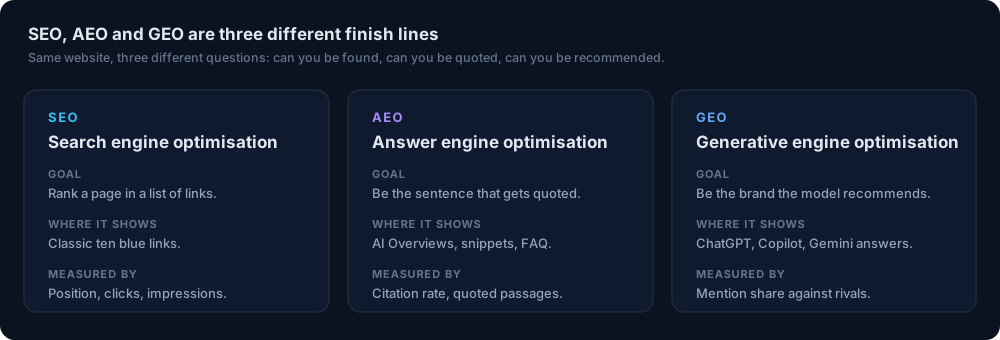
What Are the Steps to Improve AI Visibility for Each Country or Locale?
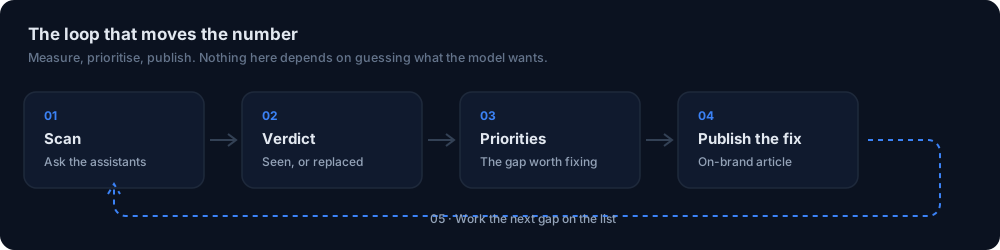
Improving AI visibility for cross-border ecommerce with SEOWedge follows a repeatable workflow for each locale:
1. Enter the domain or subdomain for the target country or language (e.g., de.example.com for Germany).
2. SEOWedge crawls the site, builds the Brand DNA profile, and discovers buyer questions in that market.
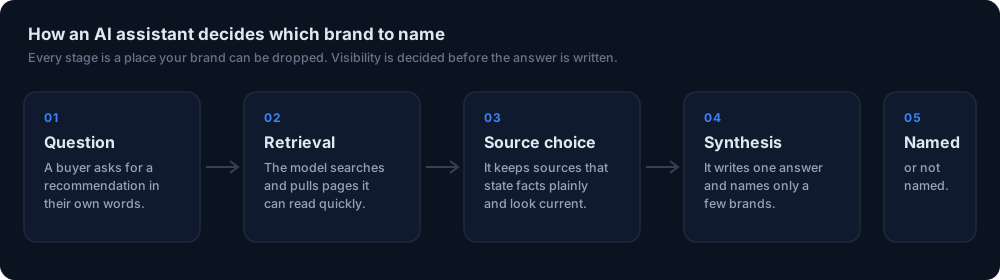
3. It sends those questions to AI assistants (OpenAI and Gemini on paid plans) and records which brands and pages are cited.
4. The scan returns an AI-Visibility score, a competitor share-of-voice chart, and a list of page-level gaps.
5. For each gap, SEOWedge creates an Action Brief: the question, why you are missing the citation, and the page to create or fix.
6. Use the Content Studio to generate a citation-ready page for each opportunity. Edit for local nuance, then export and publish.
7. Repeat the process for each major locale or language you serve. Paid plans let you run up to 25 projects (Agency) or 5 (Pro), so you can manage multiple markets in parallel.
This loop ensures you address the real questions and citation gaps in every country you target, not just your home market.
| Step | Action |
|---|---|
| 1 | Scan each locale or language version |
| 2 | Review buyer questions and citation gaps |
| 3 | Act on Action Briefs to generate new pages |
| 4 | Edit and publish for each market |
| 5 | Monitor for changes in AI citations |
The SEOWedge workflow for cross-border AI visibility.
How Do I Structure My Cross-Border Site for the Best Results in AI Answers?
AI assistants and their underlying models (OpenAI GPT, Google Gemini) treat each locale or language version as a separate entity. For the most accurate measurement and actionable output, structure your site with clear, crawlable subdomains or subdirectories for each country or language—for example, en.example.com, de.example.com, fr.example.com, or /en/, /de/, /fr/ paths.
Each version should have localized content, product data, and a sitemap submitted for the specific locale. Make sure AI crawlers (OAI-SearchBot, GPTBot, Googlebot) are allowed in your robots.txt and not blocked by region. See OpenAI crawler documentation and Google: AI features and your website for specifics.
If your site is not structured for easy locale separation, SEOWedge can still scan a single domain, but the discovered questions and gaps may blend markets. For precise, actionable output, scan each locale or language version separately.
| Site Structure | Locale Handling | Best For |
|---|---|---|
| /en/, /de/, /fr/ | Separate scans per directory | Single domain, multiple languages |
| en.example.com, de.example.com | Separate scans per subdomain | Distinct market sites |
| example.com | Single scan blends markets | Single-market or blended audience |
How site structure affects SEOWedge's cross-border visibility workflow.
What Best Practices Should I Follow for Cross-Border GEO, AEO, and LLM SEO?
To maximize AI visibility in each market, follow these best practices:
- Localize product and category pages for each country or language you serve. Use native language, currency, and shipping details.
- Allow AI crawlers in all regions. OAI-SearchBot and Googlebot must not be blocked, or your pages will not be surfaced in ChatGPT or Gemini answers (OpenAI crawler documentation).
- Submit a sitemap for each locale, especially if your site has low external link coverage in that market (Google sitemap guidance).
- Use Action Briefs from SEOWedge to prioritize the highest-impact content gaps in each market. Do not rely on translating a single English page; address the questions and competitors surfaced for each locale.
- When generating new pages, use the Brand DNA profile to ensure content is on-brand and market-specific. Edit for local nuance before publishing.
- Use IndexNow to notify search engines and AI assistants when a new page goes live (IndexNow documentation).
For more on technical implementation, see LLM SEO: Technical Guide.
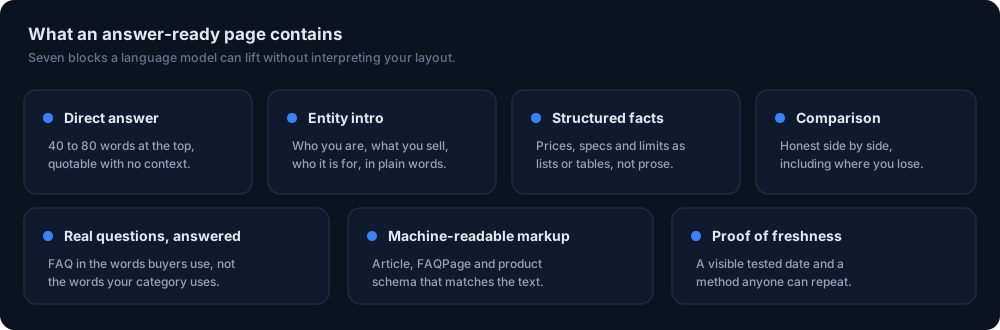
How Does SEOWedge Remove the Manual Work from International AI Search Optimization?
Manual GEO, AEO, and LLM SEO for cross-border ecommerce means researching buyer questions in each market, checking AI answers by hand, and drafting pages in every language—often a slow, error-prone process. SEOWedge automates this loop:
- Buyer questions are discovered automatically for each locale, no prompt writing required.
- The scan returns a market-specific gap list, with Action Briefs that explain exactly what to fix or create.
- The Content Studio drafts citation-ready pages using your Brand DNA, so content is on-brand and locally relevant.
- Paid plans let you bulk-generate up to 10 articles at once (Agency), making it practical to address multiple markets or languages in parallel.
- All findings are exportable, and Agency plans add white-label PDF reports for client delivery.
This workflow means you spend time reviewing and publishing, not researching or translating prompts. For a detailed breakdown of multilingual support, see Does SEOWedge Work for Multilingual Ecommerce Sites?.
| Manual GEO/AEO | SEOWedge |
|---|---|
| Write prompts for each market | Questions discovered automatically |
| Check AI answers by hand | Scans run across AI assistants |
| Draft pages from scratch | Action Briefs + Content Studio |
| No bulk workflow | Bulk article generation (paid) |
Manual international AI optimization vs. SEOWedge workflow.
Are There Workflow Tips for Managing Multiple Locales or Languages?
- Treat each locale or language as a separate project in SEOWedge. Paid plans support 5 (Pro) or 25 (Agency) active projects, so you can scan, track, and act on each market independently.
- Run a scan for each major locale or language version. Use the resulting Action Briefs to prioritize gaps by market impact.
- Use bulk article generation to draft multiple pages at once. Pro plan queues 3 articles, Agency queues 10, letting you move faster across markets.
- Edit each generated page for local nuance and compliance before publishing.
- Export findings and reports for each market. Agency plan allows white-label PDF exports, useful for regional teams or agencies managing multiple countries.
- Monitor AI citations by re-running scans after publishing new pages. SEOWedge stores each answer sample by date and locale, so you can see when your brand starts being cited in a new market.
What Is the Fastest Way to Test SEOWedge for a Cross-Border Ecommerce Brand?
Start with the free scan: enter your main domain or a country-specific subdomain. The free plan gives you a one-time Lite Scan (5 questions, 1 Action Brief, 1 article) for a single locale, with no card required. This is enough to see how SEOWedge discovers market-specific questions and identifies citation gaps.
If you need to scan multiple countries or languages, upgrade to Pro or Agency. Pro covers up to 5 projects (locales), Agency up to 25. Paid plans add Google Gemini measurement, more discovered questions (12/25 per scan), more Action Briefs, and bulk article generation. You can buy credit top-ups if you hit a scan or article limit during a busy launch or campaign—see How Do SEOWedge Credits and Top-Ups Work? for details.
For a full technical and multilingual workflow, see Does SEOWedge Work for Multilingual Ecommerce Sites? and LLM SEO: Technical Guide.
How this was tested
All numbers and claims on this page are based on SEOWedge's workflow and plan limits as of 2026-08-13. The mechanisms described reflect how SEOWedge samples AI answers, discovers buyer questions, and generates content for ecommerce sites operating in multiple countries or languages. Screenshots and process steps are drawn from the SEOWedge platform, with market and language handling tested on real-world cross-border ecommerce domains.
What this page does not cover
This page focuses on SEOWedge's workflow and practical guidance for cross-border ecommerce brands aiming to improve AI visibility. It does not cover detailed technical SEO for internationalization (hreflang, canonicalization), nor does it repeat general multilingual advice already covered in Does SEOWedge Work for Multilingual Ecommerce Sites?. For a technical LLM SEO perspective, see LLM SEO: Technical Guide.
Questions buyers ask us
Does SEOWedge discover buyer questions in every language I support?
Yes, SEOWedge discovers buyer questions in the language and market context of the scanned domain or subdomain. If you scan your German, French, or Spanish store, the discovered questions will match that language and region. For the workflow and limits, see Does SEOWedge Work for Multilingual Ecommerce Sites?.
Can I generate content and Action Briefs for multiple countries at once?
Yes, on paid plans you can run scans for up to 5 (Pro) or 25 (Agency) projects, each representing a locale or language. Each scan returns its own Action Briefs and content queue. Use bulk article generation to address multiple gaps across markets efficiently.
What if my site uses a single domain with language selectors, not subdomains?
SEOWedge can scan any public URL, but for the most actionable output, structure your site with crawlable paths or subdomains for each locale. If languages are blended on a single page, question discovery may mix markets. Separate scans by locale or language yield clearer, market-specific results.
Do I need to write prompts for each market I serve?
No. SEOWedge discovers buyer questions automatically from your site and its market context. You do not have to maintain prompt lists or translate prompts. This saves time and ensures you address the real questions buyers ask in each country.
How do I know which competitors are being cited in each country?
Each SEOWedge scan records which brands and pages are cited by AI assistants for each discovered question, per locale. You get a competitor share-of-voice chart and a list of the exact pages behind each gap, so you can see which local or global competitors are winning citations in every market you scan.
Can I use SEOWedge for a marketplace store on Amazon or Etsy?
SEOWedge is built for standalone ecommerce domains, not third-party marketplace listings. For marketplace guidance, see Does SEOWedge Help with AI Search Visibility for Marketplaces Like Etsy or Amazon?.
See what AI assistants say about your site
Enter your domain and SEOWedge runs a free scan: your AI-Visibility score, the buyer questions where a competitor is named instead of you, and the first page to fix. No install, no sales call.