
Does SEOWedge Help with AI Search Visibility for Marketplaces Like Etsy or Amazon?
SEOWedge can help marketplace sellers understand and influence AI search visibility, but its full workflow is designed for brands that control their own site. You can use SEOWedge to discover buyer questions, see which brands and pages AI assistants recommend, and learn what content wins citations. However, you cannot directly scan or optimize an Etsy or Amazon listing URL through SEOWedge, since you do not control the domain or its on-page content.
By the SEOWedge Research Team · Published August 13, 2026 · Last tested August 13, 2026 · Updated August 13, 2026 · 7 min read
What to take away
- You cannot scan or optimize an Etsy or Amazon listing directly with SEOWedge.
- SEOWedge discovers real buyer questions and shows which brands and pages AI answers cite.
- Marketplace sellers can use SEOWedge to understand what content gets cited and why.
- Full workflow—scanning, gap analysis, and page generation—requires control of your own website.
- If you want to move from marketplace-only to owning your own site, SEOWedge shows what to publish to win AI citations.
Can SEOWedge Scan My Etsy or Amazon Listing Directly?
You cannot scan an Etsy, Amazon, or other marketplace listing URL directly in SEOWedge. The workflow requires entering a domain you control, so SEOWedge can crawl your site, extract a Brand DNA profile, and generate actionable content. Marketplace listings are not your domain, so SEOWedge cannot crawl or optimize them in the same way it does for a standalone ecommerce site.
If you enter a marketplace listing URL, SEOWedge will not run a scan or produce Action Briefs or articles for that page. The scan process is designed to analyze and act on sites where you can publish new or revised content. This is a deliberate design choice to ensure that every Action Brief and article is actionable for the site owner.
| Can SEOWedge scan this? | Crawl and optimize? | Generate Action Briefs? |
|---|---|---|
| Your own ecommerce site | Yes | Yes |
| Etsy/Amazon listing | No | No |
| Brand.com subdomain you control | Yes | Yes |
SEOWedge workflow by domain type.

What Does SEOWedge Show Marketplace Sellers About AI Search Visibility?
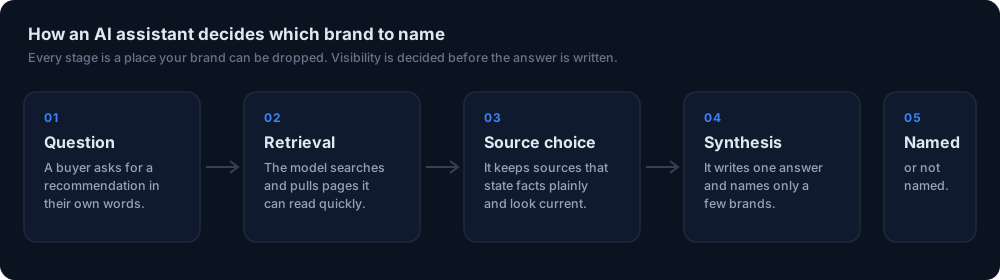
Even if you sell only on marketplaces, SEOWedge can help you understand how AI assistants (like ChatGPT and Gemini) answer buyer questions in your category. SEOWedge discovers high-intent buyer questions and shows which brands, stores, and specific pages are being cited in AI answers. If a competitor’s site or a marketplace page is being named, you see exactly which one and why.
This insight reveals what content, structure, or authority makes those pages quotable by AI assistants. You can use this information to shape your brand story, product content, or even decide what to publish if you later launch your own site. SEOWedge’s scan output includes a competitor share-of-voice breakdown and the URLs that win citations for each buyer question.
| SEOWedge Output | What Marketplace Sellers Learn |
|---|---|
| Buyer questions discovered | What buyers actually ask AI assistants |
| Brands and URLs cited | Which competitors or marketplace listings are named |
| Share of voice chart | How often each brand is recommended |
| Action Briefs (on own site only) | What content wins citations, if you can publish it |
SEOWedge outputs relevant to marketplace sellers.
Does SEOWedge Discover Buyer Questions Relevant to Marketplace Products?
Yes. SEOWedge’s question discovery process is not limited to direct-to-consumer brands. It finds buyer questions that are actually being asked in your market, regardless of whether the answer currently points to a brand site, a marketplace listing, or a third-party review. This means you see the real questions that drive AI assistant recommendations, even if the top-cited pages are on Amazon or Etsy.
For example, if buyers ask ChatGPT "What are the best handmade ceramic mugs on Etsy?" or "Which Amazon sellers offer vegan leather bags?", SEOWedge will surface those questions if they are high-intent and relevant to your category. You see which listings or brands are being named—information you can use for product positioning or content strategy.
| Discovery Step | Marketplace Seller Benefit |
|---|---|
| High-intent question discovery | See what real buyers ask about your category |
| AI answer sampling | See if your brand or listing is named |
| Competitor URL identification | Spot which marketplace listings win citations |
How SEOWedge question discovery helps marketplace sellers.
Can SEOWedge-Generated Content Help My Marketplace Listings Get Cited in AI Answers?
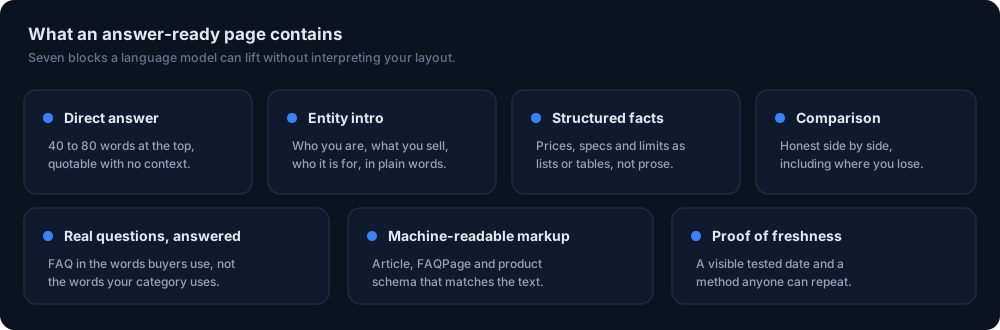
SEOWedge generates Action Briefs and on-brand articles for domains you control. If you only sell through a marketplace and do not have your own site, you cannot publish SEOWedge-generated content directly to Etsy or Amazon. Marketplace platforms do not allow uploading standalone articles or control over technical SEO elements like schema markup or sitemaps.
However, if you have a brand site—even a simple landing page or blog—you can use SEOWedge to publish content that answers the buyer questions it discovers. AI assistants may cite your site as a source for marketplace-related queries if your content is relevant, specific, and matches the structure AI models prefer. This approach gives you influence over citations even if most sales happen on a marketplace.
| Scenario | Can SEOWedge content be published? |
|---|---|
| Standalone ecommerce site | Yes, full workflow |
| Brand blog or info site | Yes, partial workflow |
| Marketplace listing only | No, not directly |
Where SEOWedge-generated content can be used.
What Are the Limitations for Marketplace-Only Sellers?
Marketplace-only sellers face two main limits: you cannot scan or optimize a listing URL, and you cannot publish SEOWedge-generated content directly on a marketplace platform. SEOWedge’s full workflow—scan, gap discovery, Action Briefs, and article generation—requires a site you own or control.
You can still use SEOWedge for strategic research: see what buyer questions matter, which brands or listings are cited, and what content structure wins citations. If you want to move beyond the marketplace and build your own site, SEOWedge reveals what to publish and how to structure it for maximum AI visibility. This makes it a planning and competitive intelligence tool for marketplace sellers considering a direct channel.
| Workflow Step | Marketplace Seller (No Site) | Brand with Own Site |
|---|---|---|
| Scan listing URL | Not possible | Possible |
| See buyer questions | Yes | Yes |
| See who gets cited | Yes | Yes |
| Generate Action Briefs | No | Yes |
| Publish new content | No | Yes |
SEOWedge workflow: marketplace-only vs. brand-owned site.
How Does SEOWedge Compare to Other AI Search Visibility Tools for Marketplace Sellers?
SEOWedge is built for ecommerce brands and agencies who can act on its output by publishing or editing their own site. Other tools in this category may offer prompt tracking or broader brand monitoring, but still require a domain you control for actionable optimization. No tool in this space can directly optimize an Etsy or Amazon listing, since marketplace platforms do not expose the technical controls or content fields needed for GEO or AEO.
If you need a tool that only tracks brand mentions in AI answers, see the ChatGPT Visibility Tracker page. For a full breakdown of how SEOWedge’s workflow compares to other tools, see SEOWedge vs Otterly AI or Best AI Search Visibility Tools for Ecommerce. The key difference remains: SEOWedge closes the loop from measurement to actionable content, but only where you own the publishing channel.
| Tool Type | Tracks marketplace listing? | Optimizes marketplace listing? |
|---|---|---|
| SEOWedge | No (direct scan not possible) | No |
| Prompt tracker tools | No | No |
| Classic SEO tools | No | No |
Direct optimization of marketplace listings: not supported by any tool in this category.
What’s the Practical Next Step for Marketplace Sellers Using SEOWedge?
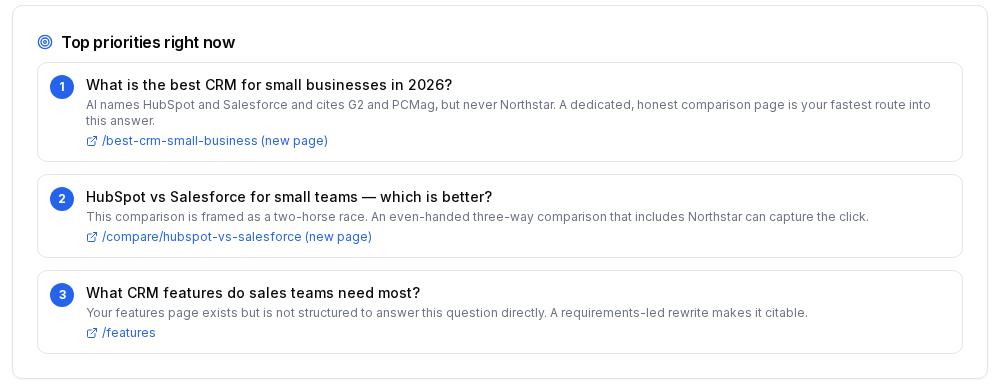
If you are a marketplace seller considering SEOWedge, start by using the free scan to discover the buyer questions and see which brands, domains, or marketplace listings are being cited in your category. This gives you a competitive map and helps you understand what content and authority win AI citations.
If you have or plan to launch your own site, even a simple one, SEOWedge can then deliver the full workflow: scan, gap discovery, Action Briefs, and on-brand article generation. This lets you build an asset that can be cited by AI assistants, driving traffic and authority back to your brand, even if most sales happen through a marketplace.
For deeper guidance on how to move from marketplace-only to owning your own AI search presence, see AI SEO Tool for Ecommerce or explore what the free AI Search Audit returns.
| If you... | SEOWedge can help you... |
|---|---|
| Sell only on marketplaces | Understand what gets cited and why |
| Plan to launch a site | Know what to publish for AI visibility |
| Already have a site | Run the full scan-to-content workflow |
Practical next steps for marketplace sellers.
Where Can I Learn More About GEO, AEO, and AI Search for Marketplace Sellers?
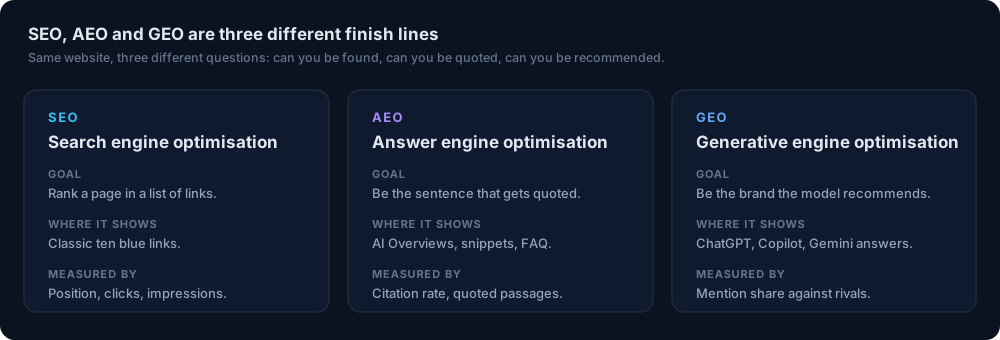
Generative Engine Optimization (GEO) and Answer Engine Optimization (AEO) are disciplines focused on getting brands cited by AI assistants. While most GEO and AEO work is actionable only on sites you control, the principles still apply if you want to understand why certain marketplace listings get cited or how to structure your own future site for AI answers.
If you want to go deeper, see the GEO guide for the operating model, or the AEO guide for page-level tactics. For technical details on how language models crawl and cite content, see the LLM SEO technical guide. All of these resources clarify what is and isn’t possible for marketplace-only sellers, and where SEOWedge automates the manual work if you own your site.
How this was tested
All SEOWedge product claims and workflow steps are based on the official product documentation and interface as of 2026-08-13. The limitations for marketplace sellers are derived from the requirement that SEOWedge scans start from a domain you control, which allows crawling, Brand DNA extraction, and content generation. The AI assistant sampling and citation measurement process is documented in the SEOWedge method notes. No claims are made about direct integration with Etsy, Amazon, or other marketplace platforms beyond what can be observed from public AI answers.
What this page does not cover
This page covers the fit and workflow of SEOWedge for marketplace sellers, focusing on Etsy, Amazon, and similar third-party platforms. It does not cover direct technical integration with marketplace APIs, nor does it address classic SEO or paid advertising on those platforms. For guidance on optimizing your own ecommerce site for AI search, see AI SEO Tool for Ecommerce or Improving Product Page Visibility in AI Search. All findings are based on SEOWedge’s current product capabilities as of August 2026.
Questions buyers ask us
Can I enter my Etsy or Amazon shop URL in SEOWedge and get a scan?
No. SEOWedge requires a domain you control. It cannot crawl or analyze a marketplace listing or shop page. The scan and content workflow only run on sites where you have publishing access.
If I only sell on marketplaces, what value does SEOWedge provide?
You can use SEOWedge to discover which buyer questions matter, which brands or listings get cited, and what content structure wins citations. This is valuable for competitive research and for planning your own site if you decide to build one.
Can I use SEOWedge-generated articles on my Etsy or Amazon listing?
No. Marketplace platforms do not allow you to upload standalone articles or control technical SEO elements. SEOWedge-generated content is meant for domains you control, such as your own ecommerce or brand site.
Will SEOWedge show me which marketplace listings are cited in AI answers?
Yes. SEOWedge records which brands and specific URLs are named in sampled AI answers, including marketplace URLs. You see exactly which listings or competitor pages win citations for each buyer question.
What if I want to move from marketplace-only to having my own site?
SEOWedge is designed for this transition. It shows what buyer questions matter, what content wins citations, and generates Action Briefs and articles to help you launch a site that can be cited by AI assistants.
Are there any AI search tools that can directly optimize my marketplace listings?
No tool in this category can directly optimize a marketplace listing. All GEO and AEO tools require a site you control to scan, analyze, and publish new content. SEOWedge helps you understand the landscape and plan your next step.
See what AI assistants say about your site
Enter your domain and SEOWedge runs a free scan: your AI-Visibility score, the buyer questions where a competitor is named instead of you, and the first page to fix. No install, no sales call.