
How Can I Use SEOWedge to Improve Visibility for Localized Product Pages?
SEOWedge finds where your localized product pages are missing from AI answers, shows which competitors are cited instead, and writes the exact page you need to win those citations in each market. You see the gap by region, get a market-specific action brief, and export on-brand content ready for AI assistants to cite.
By the SEOWedge Research Team · Published August 13, 2026 · Last tested August 13, 2026 · Updated August 13, 2026 · 8 min read
What to take away
- SEOWedge diagnoses AI citation gaps for each localized product page and market.
- You get a region-specific action brief and on-brand page draft for each missed opportunity.
- Paid plans let you queue and export multiple localized pages at once.
- AI-Visibility measurement and content creation are combined in one workflow.
- You can start with a free scan—no card required.
How Does SEOWedge Handle Country or Region-Specific Product Pages?
SEOWedge treats each localized product page as a unique opportunity for AI citation. When you scan your domain, SEOWedge crawls all available product URLs—including country or region-specific versions—and extracts the Brand DNA for each. This ensures that the system understands not just your global offer, but the specific market positioning and product details for each locale.
Buyer questions are discovered based on the content and context of each localized page. SEOWedge does not require you to write prompts or specify regions in advance. Instead, it surfaces the high-intent, market-specific questions buyers are actually asking in each geography. This is essential for GEO (Generative Engine Optimization) and AEO (Answer Engine Optimization), where the real gap is often at the local level, not the global brand.
The scan then tests these questions on AI assistants (OpenAI on all plans, Google Gemini on paid), recording which brand and which page is cited for each. You see not just if your brand is named, but if the correct localized page is being recommended instead of a generic or global version.
| Step | What SEOWedge Does |
|---|---|
| Crawl | Discovers all product URLs, including localized pages |
| Brand DNA | Extracts market and product details per locale |
| Buyer Questions | Finds region-specific, high-intent questions |
| AI Testing | Checks each question on AI assistants by market |
| Opportunity | Shows where localized pages are missing from citations |
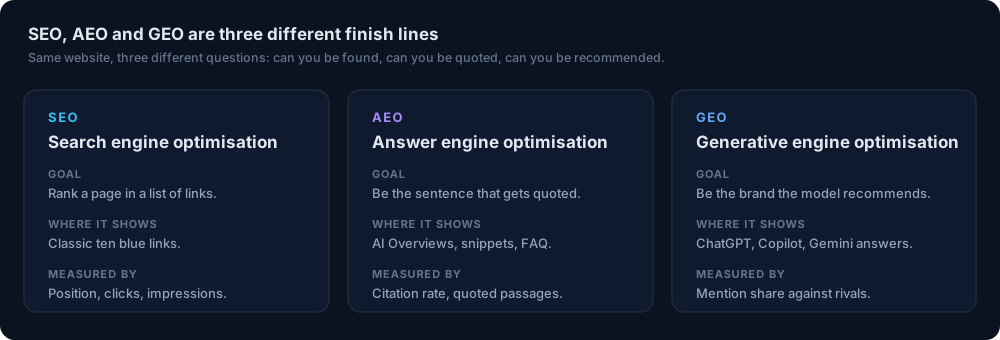
SEOWedge workflow for localized product pages
How Can I Diagnose Missed AI Citations by Market or Language?
SEOWedge’s scan result breaks down AI visibility by the actual pages and markets tested. For each high-intent buyer question, you see which competitor or third-party site is cited in AI answers for that locale. If your French, German, or US product page is missing, SEOWedge names the exact competitor URL that wins the citation.
The opportunity list is market-specific. For example, if your UK product page is not cited in Gemini answers for UK-centric questions, but your US page is, the gap is flagged for the UK market only. This lets you act precisely, without guessing which region or language is being overlooked.
On paid plans, you can run up to 25 projects (Agency) or 5 projects (Pro), each representing a different market, language, or brand segment. Each scan delivers a list of page-level gaps and competitor citations for that specific locale. This is not a generic SEO audit—it is a GEO/AEO diagnostic, tuned to the way AI assistants answer region-specific queries.
| Market | AI Assistant | Cited Brand/Page | Your Page Cited? |
|---|---|---|---|
| US | OpenAI | CompetitorA.com/us/product | No |
| UK | Google Gemini | CompetitorB.co.uk/product | No |
| DE | OpenAI | YourBrand.de/product | Yes |
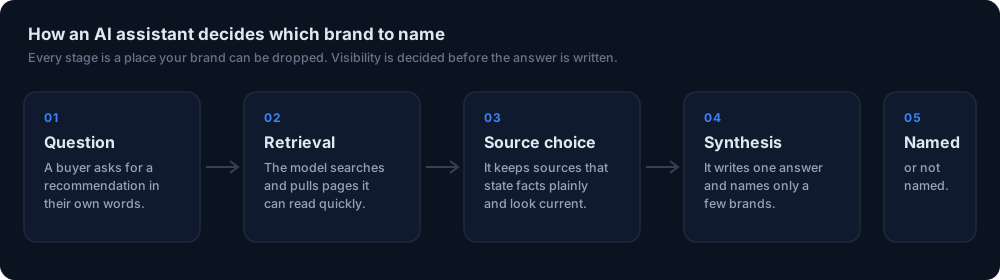
Sample output: AI citations by market and page
What Steps Can I Take to Improve AI Citations for Localized Content?
Once you have the market-specific gap list, SEOWedge produces an Action Brief for each missed citation. The Action Brief explains: the buyer question that triggered the gap, which competitor page is currently cited, and what is missing from your localized page. This is not a generic template—it is a direct, market-specific prescription for what to publish or revise.
You can then use the Content Studio to generate a new or updated localized page. The draft is built from your Brand DNA profile, so it reflects your product positioning, local market details, and brand voice. The system scores each draft for Publish Readiness, flagging missing facts or weak sections before you export the page.
On Pro and Agency plans, you can queue and generate several localized articles at once. This is especially useful for brands with multiple country stores or region-specific product lines. Each draft is tied to a specific Action Brief, so you are not guessing what to write or localize next.
| Step | Action |
|---|---|
| 1 | Run scan for each market or locale |
| 2 | Review Action Briefs for missed citations |
| 3 | Generate or update localized page in Content Studio |
| 4 | Score for Publish Readiness |
| 5 | Export and publish the new page |
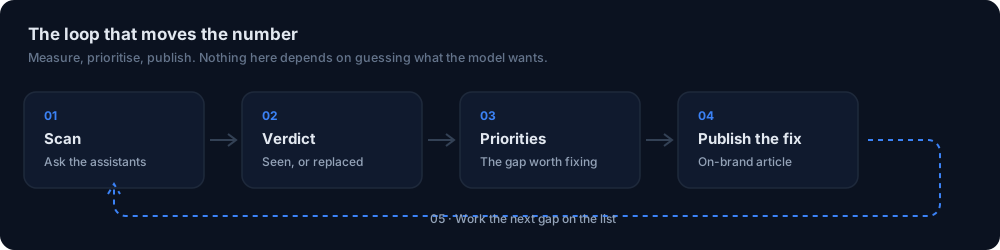
Action workflow for localized AI citation gaps
How Do I Ensure My Localized Pages Are Cited Instead of Generic or Global Versions?
AI assistants often cite the most authoritative or well-structured page, which may be your global product page—even when a local version exists. SEOWedge addresses this by surfacing the exact question and assistant where the wrong page is cited, and by showing you the content or structure that caused the miss.
The Action Brief will specify if your global page is being cited for a local query, and what is missing from your localized content (such as region-specific specs, delivery info, or local reviews). The Content Studio draft then incorporates these elements, using your Brand DNA profile to ensure the result is not just translated, but locally relevant and citation-ready.
Once published, SEOWedge recommends submitting the new URL via IndexNow, so AI assistants are notified of the update. This increases the chance that the correct localized page is crawled and cited in the next answer cycle. For more on technical readiness, see LLM SEO: Technical Guide.
| Query Locale | Cited Page | Gap Reason | SEOWedge Fix |
|---|---|---|---|
| UK | Global product page | No UK-specific delivery info | Add UK shipping, pricing, and local reviews |
| FR | Competitor.fr page | No French-language version | Generate FR page with local compliance |
| DE | YourBrand.de page | Cited correctly | No action needed |
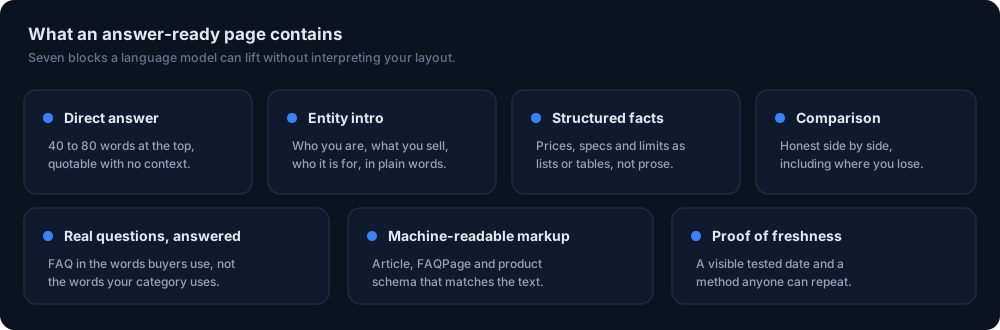
Why localized pages miss citations—and how SEOWedge addresses it
Does SEOWedge Help Me Identify Missed Opportunities by Market or Language?
Yes. SEOWedge’s scan and opportunity list are market-aware by design. Each scan discovers buyer questions that are phrased and prioritized for the region or language of your localized site. The result is an actionable list of missed citations, each tagged to the correct market, language, and product URL.
For multilingual or multi-region brands, this means you can see at a glance which markets are underperforming in AI answers, and which competitor is filling that gap. You do not need to maintain separate prompt lists or run manual checks for each locale—SEOWedge automates the discovery and diagnosis step for every market you serve.
If you need detail on multilingual workflows, see SEOWedge and Multilingual Ecommerce. For cross-border ecommerce with complex locale structures, see Improving AI Visibility for Cross-Border Ecommerce.
| Market/Lang | Buyer Question Found? | Opportunity Shown? |
|---|---|---|
| English (US) | Yes | Yes |
| French (FR) | Yes | Yes |
| Spanish (ES) | No (site not localized) | No |
Discovery and opportunity coverage by market/language
How Does SEOWedge Keep Localized Content On-Brand and Market-Specific?
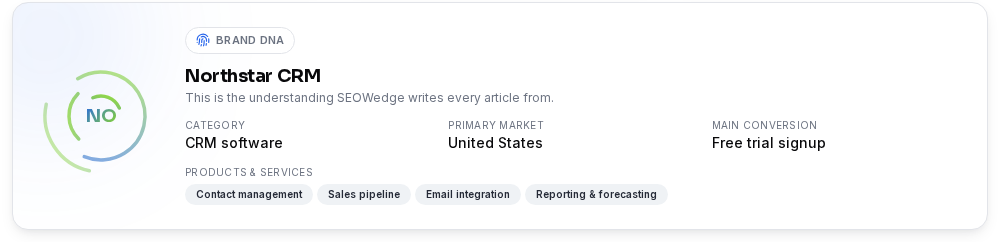
SEOWedge builds a Brand DNA profile for your site at scan time, capturing your positioning, product details, and market focus. When you generate a localized page, the Content Studio uses this DNA to ensure the draft is not just a translation, but a market-fit, on-brand asset. This means your UK, DE, or FR page will reflect the right tone, offers, and compliance details for that market.
The Publish Readiness score checks for missing market details, incomplete specs, or off-brand language before you export. You can edit every draft to add local reviews, region-specific guarantees, or compliance text as needed. This workflow prevents generic or mismatched content from being published and increases the likelihood of citation by AI assistants looking for authoritative, local answers.
For more on Brand DNA and on-brand content generation, see How SEOWedge Writes Pages in Your Brand Voice.
| Feature | How It Supports Localization |
|---|---|
| Brand DNA | Adapts content to each market's positioning |
| Content Studio | Builds market-specific drafts from DNA |
| Publish Readiness | Flags missing or off-market details |
| Manual Edit | Add region-specific info before export |
How SEOWedge keeps localized content on-brand
What Makes SEOWedge the Practical Choice for Localized AI Visibility?
SEOWedge is built for ecommerce brands and agencies running multiple markets or regions. The workflow combines market-specific measurement, competitor diagnosis, and on-brand content creation in a single loop. You do not need to buy separate tools for GEO measurement, AEO action briefs, or content generation—SEOWedge closes the loop for each localized page and market.
The free scan gives you a real, actionable result with no card required, so you can see which markets are missing citations before you commit. Paid plans unlock bulk generation and multi-project management, making it practical to act on dozens of localized gaps at once.
SEOWedge’s method—sampling real AI answers, surfacing the exact competitor page, and generating a market-fit draft—removes the guesswork and manual research from localized GEO and AEO. For a full workflow overview, see How SEOWedge Turns AI Visibility Gaps Into Actionable Content.
| SEOWedge Advantage | Mechanism |
|---|---|
| Free scan, no card | See real market gaps instantly |
| Lowest paid entry | $29/month for multi-market action |
| Single loop | Measurement, Action Brief, and content in one place |
What sets SEOWedge apart for localized GEO/AEO
What Should I Do Next to Improve AI Visibility for My Localized Product Pages?
Start by running a free scan with your main market or localized domain. Review the opportunity list and Action Brief for at least one missed citation in a target region. Use the Content Studio to generate a market-specific draft, edit for local details, and export for publication.
If you manage multiple markets or need to act on several gaps at once, consider a paid plan for bulk generation and multi-project support. Review SEOWedge pricing for plan details, or see the public sample report for a real output example.
For further reference on technical setup, multilingual support, or GEO/AEO best practices, explore the SEOWedge Resources hub.
| Step | Where to Start |
|---|---|
| Free scan | /signup |
| See sample report | /sample |
| Compare plans | /pricing |
| Learn more | /resources |
Next steps for localized AI visibility with SEOWedge
How this was tested
All claims and workflow steps are based on the SEOWedge product as tested on 2026-08-13. AI-Visibility scores and citation gaps are measured by sampling real AI answers from OpenAI (GPT) and, on paid plans, Google Gemini, using discovered buyer questions for each market. Page-level opportunities are produced from the sampled answers and competitor citations. Content drafts are generated from the Brand DNA profile built at scan time. All method notes reflect the current SEOWedge platform and published documentation from OpenAI and Google.
What this page does not cover
This page covers SEOWedge's workflow for improving AI visibility of localized product pages—country or region-specific URLs with market-adapted content. It does not cover the technical setup of multilingual or multi-region ecommerce sites (see SEOWedge and Multilingual Ecommerce) or general product page optimization (see Improving Product Page Visibility in AI Search). All data and workflow steps are current as of 2026-08-13.
Questions buyers ask us
Can SEOWedge scan and diagnose multiple localized domains or subfolders at once?
On paid plans, SEOWedge supports up to 5 projects (Pro) or 25 projects (Agency). Each project can be a different domain, subdomain, or region-specific subfolder. Scan each as a separate project to get market-specific opportunities and Action Briefs.
How does SEOWedge find region-specific buyer questions without manual prompts?
SEOWedge automatically discovers high-intent buyer questions by crawling your site and analyzing the language and context of each localized page. It does not require you to write prompts or maintain question lists. The discovered questions reflect what buyers in each market actually ask, which is essential for GEO and AEO.
Does SEOWedge generate content in languages other than English?
SEOWedge generates content in the language of the scanned page or project. For multilingual sites, run a scan for each language version. For details on multilingual workflows and limitations, see SEOWedge and Multilingual Ecommerce.
How do I know if my localized page is being cited in AI answers?
SEOWedge records the exact page cited for each buyer question and AI assistant. The scan result shows you, by market and question, which page is being named—whether it is your localized version, a global page, or a competitor. This lets you see and act on the real gap.
What if my localized page is not indexed or crawlable by AI assistants?
If a localized page is not indexed or is blocked from AI crawlers, SEOWedge will show it as missing from AI answers. Ensure OAI-SearchBot and Googlebot are allowed in your robots.txt, and submit new URLs via IndexNow or a sitemap. For technical setup, see LLM SEO: Technical Guide.
See what AI assistants say about your site
Enter your domain and SEOWedge runs a free scan: your AI-Visibility score, the buyer questions where a competitor is named instead of you, and the first page to fix. No install, no sales call.