
Can SEOWedge Help Me Create Content for Cross-Sell or Up-Sell Opportunities in AI Search?
SEOWedge identifies cross-sell and up-sell opportunities by discovering the buyer questions that trigger these recommendations in AI answers. It shows which brands and pages win those citations, then produces Action Briefs and on-brand content to target the missed opportunity. You can generate, edit, and export pages that address these high-margin queries, making your products more likely to be cited in AI-driven recommendations.
By the SEOWedge Research Team · Published August 13, 2026 · Last tested August 13, 2026 · Updated August 13, 2026 · 7 min read
What to take away
- SEOWedge discovers real buyer questions that drive cross-sell and up-sell mentions in AI answers.
- You see exactly which competitor pages win these citations and what content you need to close the gap.
- Action Briefs and the Content Studio let you generate on-brand, AI-ready cross-sell/up-sell pages—no prompt writing required.
- The workflow covers discovery, page creation, and readiness scoring; you control edits before publishing.
- A free scan shows your first cross-sell/up-sell opportunity with no card required.
How Does SEOWedge Identify Cross-Sell and Up-Sell Buyer Questions?
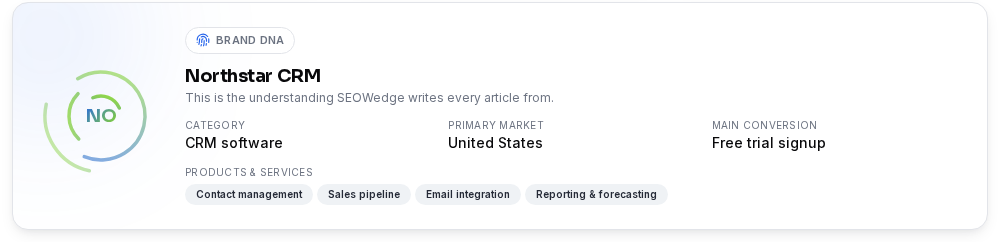
SEOWedge begins by crawling your ecommerce site and extracting a Brand DNA profile. This includes your product catalog, category context, and the primary conversion goal. It then uses this profile to discover the high-intent buyer questions that real shoppers ask—phrased in natural language, not just keywords.
These questions often reflect cross-sell or up-sell intent. For example, buyers might ask, “What accessories work with this laptop?” or “Which upgrades improve this camera?” SEOWedge identifies these patterns automatically, without requiring you to write prompts or maintain a list of tracked questions.
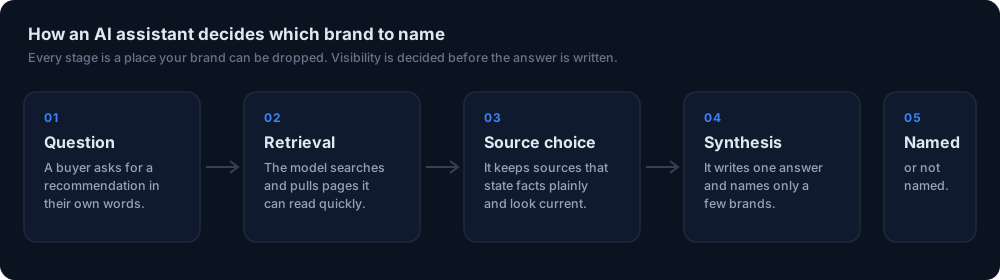
Each discovered question is then tested against major AI assistants (OpenAI on all plans, plus Google Gemini on paid plans). SEOWedge records which brands and pages are cited for each query, exposing where your site is missing from cross-sell or up-sell answers and which competitors are winning those recommendations.
How Do I See Which Pages Win Cross-Sell or Up-Sell Citations—and Where I’m Missing?
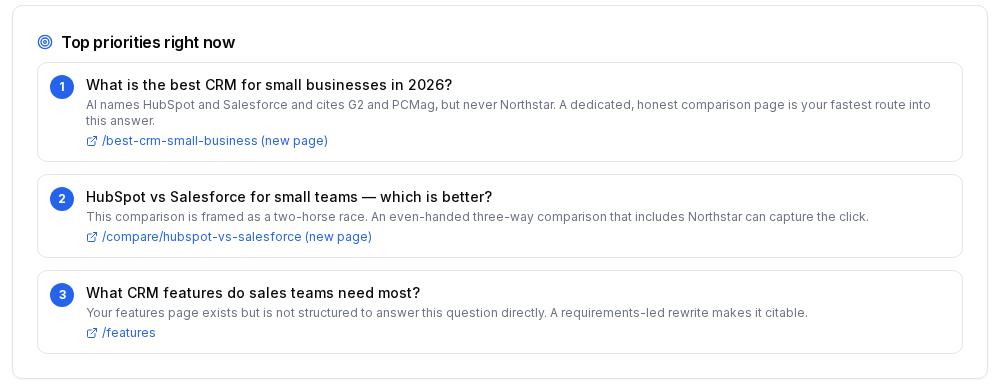
Once SEOWedge has sampled AI answers to the discovered buyer questions, it returns a page-level opportunity list. For each cross-sell or up-sell query, you see exactly which competitor page is being cited and what content is driving that citation.
This output is not a generic keyword gap. It is a direct mapping from question to answer: if a buyer asks an AI assistant for bundle recommendations or compatible add-ons, SEOWedge shows which page the AI names and why. This lets you focus content efforts where they will have the highest impact on average order value.
You can review the full list of missed opportunities, filter for those with cross-sell or up-sell intent, and prioritize based on competitor share-of-voice or product margin. The actionable nature of this data is what sets SEOWedge apart from tools that only show rankings or traffic loss.
How Do I Generate Content That Targets Cross-Sell or Up-Sell Opportunities?
For every missed cross-sell or up-sell citation, SEOWedge produces an Action Brief. This brief explains the buyer question, why your brand is missing from the answer, and the exact page to create or revise. You do not have to guess what to write or how to structure it for AI citation.
The Content Studio uses your Brand DNA profile to generate an AI-ready draft for the identified opportunity. This process ensures the new page is specific to your products, conversion goals, and tone of voice. You can edit and refine the draft inside SEOWedge before exporting it for publication.
Paid plans let you generate several pages at once, so you can address multiple cross-sell or up-sell gaps in a single workflow. The system scores each draft for Publish Readiness, so you know if the content is likely to be cited by AI before it goes live.
What Makes Cross-Sell or Up-Sell Content More Likely to Be Cited by AI?
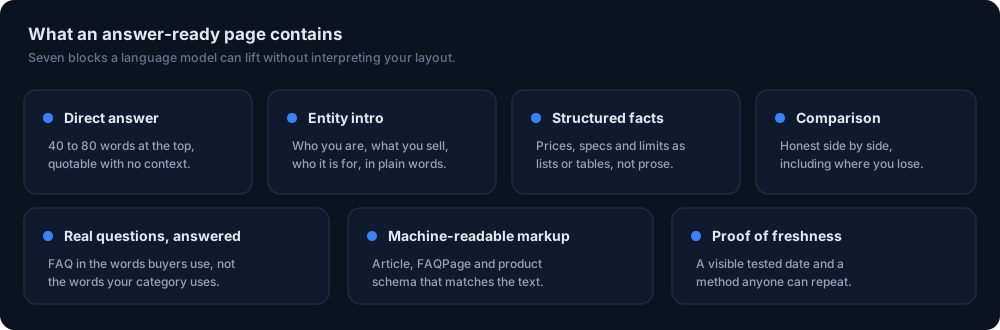
AI assistants cite pages that directly answer the buyer’s question, cover related products or bundles, and reflect original, first-hand expertise. SEOWedge structures generated content to address these criteria: the page answers the full question, lists relevant cross-sell or up-sell options, and matches your brand’s voice and specifics.
Google’s documentation confirms that AI Mode uses a query fan-out, meaning a single question can trigger multiple related searches. Pages that cover a whole problem family—such as “best accessories for X” or “upgrade options for Y”—are more likely to be surfaced in AI answers. See Google: AI features and your website for details.
SEOWedge also ensures that each page is crawlable by AI bots (like OAI-SearchBot and Gemini’s crawler), includes clear product relationships, and avoids generic or thin content. The Publish Readiness score reflects these technical and editorial factors.
How Do I Implement and Publish Cross-Sell or Up-Sell Content?
After editing and approving a draft in SEOWedge, you export it and publish it on your site. The system provides guidance on URL structure and internal linking to maximize the chance of being crawled and cited by AI assistants.
For new or updated pages, SEOWedge recommends submitting the URL via IndexNow, which notifies participating engines the moment a page is live. This can speed up the time to inclusion in AI answers, as documented at IndexNow documentation.
You do not need special markup or a separate llms.txt file for AI citation. Google states that original, first-hand content is what succeeds in AI experiences, and that standard crawlability and sitemaps are sufficient. See Google: AI features and your website.
How Do I Measure the Impact of Cross-Sell or Up-Sell Content in AI Search?
SEOWedge measures visibility by sampling AI answers to the same buyer questions before and after content is published. Each scan records whether your brand is named or cited for cross-sell and up-sell queries on each platform (OpenAI and Google Gemini, depending on plan).
You see a clear before/after: was your page cited for “best accessories for [product]” or “upgrade options for [category]” after publishing? The scan output is a dated, platform-specific verdict, not just a generic traffic or ranking estimate.
SEOWedge does not trend scores over time, but you can run a new scan after publishing to see if citations have moved. This direct measurement is what makes the workflow credible and actionable for ecommerce teams focused on AI-driven cross-sell and up-sell.
For a full explanation of how AI search visibility is measured, see What an AI Search Visibility Score Actually Measures.
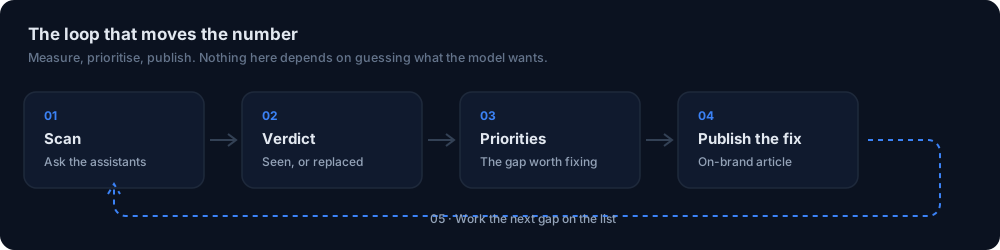
What Is the Workflow from Discovery to Published Cross-Sell/Up-Sell Page?
The workflow is single-loop and purpose-built for ecommerce cross-sell and up-sell:
1. Enter your domain. SEOWedge crawls the site and builds your Brand DNA profile.
2. It discovers high-intent buyer questions, including those that drive cross-sell and up-sell.
3. Each question is tested against AI assistants; the scan shows which competitor pages are cited for each.
4. SEOWedge produces Action Briefs for missed opportunities, specifying the question, gap, and recommended page.
5. Use the Content Studio to generate, edit, and score the new page for Publish Readiness.
6. Export and publish the content. Optionally, submit via IndexNow for faster crawling.
7. Run a new scan to see if your brand is now cited for those queries.
This workflow removes the manual work of prompt writing, question discovery, and content drafting. It is built for ecommerce brands and agencies who want to drive higher average order value through AI search visibility.
How Does SEOWedge Compare to Manual or Prompt-Based Approaches?
Manual prompt tracking asks you to write and maintain a list of cross-sell or up-sell queries, then check them one by one. SEOWedge discovers the real buyer questions automatically, so you do not miss hidden opportunities or waste time on low-impact prompts.
Prompt-based tools only monitor answers—they do not produce the Action Briefs or write the page that closes the gap. SEOWedge closes the loop: from measurement to opportunity to on-brand content, all in one workflow. This is especially valuable for ecommerce teams with limited content resources.
For a detailed breakdown of how SEOWedge’s approach differs from prompt-based or classic SEO tools, see How SEOWedge Turns AI Visibility Gaps Into Actionable Content and What Makes SEOWedge Different from Traditional SEO Tools for Ecommerce.
What Is My Next Step If I Want to Target Cross-Sell or Up-Sell in AI Search?
Start with a free scan—no card required. You will see your first set of discovered buyer questions, including any with cross-sell or up-sell intent, and receive one free Action Brief and article draft. This lets you test the workflow and see a real opportunity in your own category.
If you want to scale up and address multiple cross-sell or up-sell gaps at once, consider a paid plan. Pro and Agency plans let you generate several articles in a queue, run more scans, and export reports. You can compare plan details at SEOWedge pricing or see a public sample at Sample Report.
For related use cases—such as accessories, bundles, or category-level cross-sell—see How Can I Use SEOWedge to Improve Visibility for Accessories or Add-On Products? and How Does SEOWedge Handle Collections or Bundles in AI Search Answers?.
How this was tested
All product claims are based on SEOWedge's workflow and plan documentation as of 2026-08-13. Screenshots and diagrams are from the SEOWedge interface. Buyer question discovery, gap analysis, and content generation are performed per the steps described in the workflow block. AI answer sampling is performed via OpenAI (GPT) on all plans and Google Gemini on paid plans. Each scan records the actual answers and citations returned by the AI models on that date. No feature, number or mechanism is assumed beyond those documented.
What this page does not cover
This page focuses on cross-sell and up-sell content opportunities surfaced by SEOWedge for ecommerce brands and agencies. It does not cover manual prompt tracking, classic SEO-only strategies, or broader content marketing tactics outside of AI answer optimization. For general product page visibility, see How to Use SEOWedge to Improve Product Page Visibility in AI Search. For accessories and add-ons, see How Can I Use SEOWedge to Improve Visibility for Accessories or Add-On Products?. All measurements reflect a one-time scan and do not trend over time.
Questions buyers ask us
How does SEOWedge know which buyer questions are cross-sell or up-sell?
SEOWedge discovers buyer questions by crawling your site and analyzing your category and product context. It identifies questions that naturally reflect cross-sell or up-sell intent, such as those asking about compatible accessories, upgrades, or product bundles. No manual prompt writing is required.
Can SEOWedge generate content for bundles or accessory recommendations?
Yes. SEOWedge surfaces missed opportunities for bundles, collections, and accessory recommendations. The Action Brief specifies the exact page to create or revise, and the Content Studio generates on-brand, AI-ready drafts for these cross-sell or up-sell topics. For more detail, see How Does SEOWedge Handle Collections or Bundles in AI Search Answers?.
How do I know if my new cross-sell page is likely to be cited by AI?
Each generated page receives a Publish Readiness score in SEOWedge. This score reflects how well the content answers the buyer question, covers related products, and matches technical requirements for AI citation. You can edit the draft to improve the score before publishing.
What happens if my competitors are already winning all the cross-sell citations?
SEOWedge shows you the exact competitor pages being cited for each opportunity. The Action Brief explains why they win and what your page needs to do differently. You can target the gap directly, rather than guessing or copying generic content.
Does SEOWedge support bulk content creation for cross-sell or up-sell?
On paid plans, you can generate several articles at once (3 on Pro, 10 on Agency). This is useful for addressing multiple cross-sell or up-sell gaps in one workflow. Each draft is tailored to your Brand DNA and the specific buyer question.
How quickly can I see results after publishing new cross-sell content?
Citations in AI answers move when assistants re-crawl and select new sources. This usually takes weeks, not hours. You can run a new scan after publishing to check if your brand is now cited for those queries. SEOWedge records the date and answer for each sampled result.
See what AI assistants say about your site
Enter your domain and SEOWedge runs a free scan: your AI-Visibility score, the buyer questions where a competitor is named instead of you, and the first page to fix. No install, no sales call.