
How Can I Use SEOWedge to Improve Visibility for Accessories or Add-On Products?
SEOWedge identifies exactly where your accessory and add-on products are missing from AI answers, names the competitor pages that win those citations, and produces a step-by-step Action Brief for each gap. You get a prioritized list of missed opportunities and can generate on-brand, answer-ready pages to win those cross-sell and accessory queries in ChatGPT and Gemini.
By the SEOWedge Research Team · Published August 13, 2026 · Last tested August 13, 2026 · Updated August 13, 2026 · 8 min read
What to take away
- SEOWedge finds accessory and add-on product queries that AI assistants answer, but don’t cite your brand.
- You see which competitor pages are winning those citations and why.
- Each gap comes with an Action Brief: the real question, the missed page, and what to create or fix.
- SEOWedge generates answer-ready, on-brand content for those accessory gaps—no prompt writing needed.
- You can start with a free scan, no card required, and see real missed opportunities for your site.
Does SEOWedge Identify AI Search Gaps for Accessories and Add-Ons?
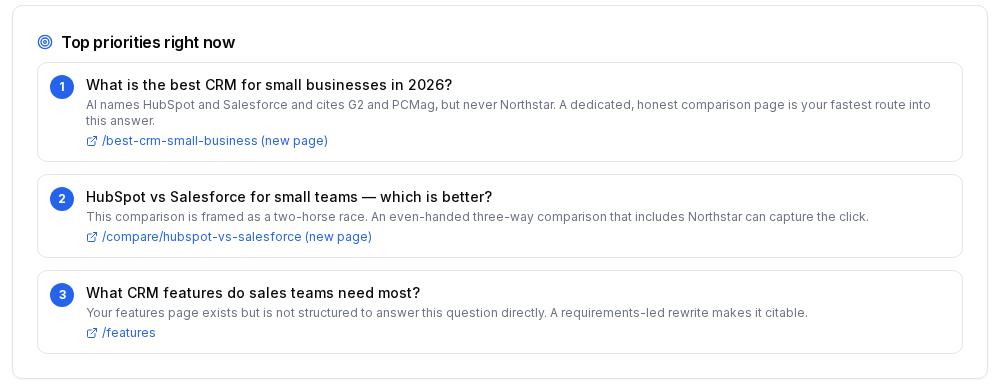
SEOWedge discovers the high-intent buyer questions that real shoppers ask about accessories and add-ons, not just the main product. It runs these questions through ChatGPT and Gemini (on paid plans), recording which brands and pages are cited in each answer. If your accessory or add-on products are missing from AI answers—or if a competitor’s page is cited instead—SEOWedge flags this as a visibility gap.
The scan result includes a page-level opportunity list. Each entry shows the accessory or add-on query, which competitor is being cited, and what type of page is winning the citation. This lets you see, in concrete terms, where your cross-sell or attach-rate revenue is being lost to rivals in AI answers.
For example, if buyers ask ChatGPT "Which wireless chargers work with the XPhone Pro?" and your accessory page is not cited, SEOWedge will show you the exact competitor page that is being recommended, and why.
| What SEOWedge Measures | How It Works for Accessories |
|---|---|
| Buyer questions about accessories/add-ons | Discovered automatically from your site and market |
| Citations in AI answers (ChatGPT, Gemini) | Recorded per question, per platform |
| Competitor pages named for accessory queries | Listed with URLs and citation share |
| Action Briefs for each missed opportunity | Step-by-step, page-level guidance |
| Content generation for accessory gaps | On-brand, answer-ready drafts |
| Free scan coverage | One Lite Scan, 5 questions, 1 Action Brief |
| Paid plan coverage | Full scans, up to 25 questions, bulk actions |
| No prompt writing required | Questions are discovered, not written |
| No card required for free scan | Immediate, actionable output |
SEOWedge’s workflow for accessory and add-on product visibility.
How Does SEOWedge Discover Accessory and Add-On Queries Buyers Actually Ask?
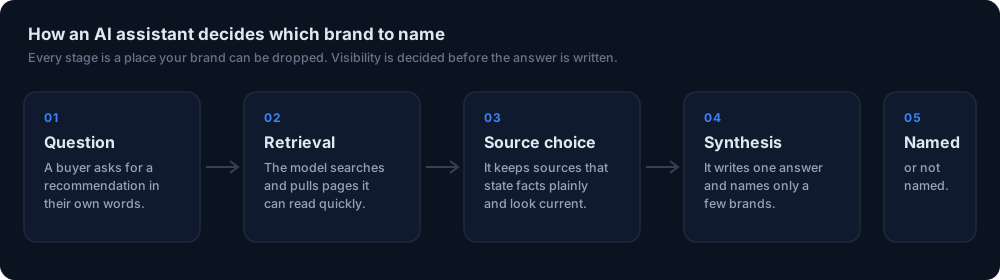
SEOWedge does not rely on you to guess which accessory or add-on queries matter. It crawls your site, extracts product relationships, and analyzes your category to find the real, high-intent questions buyers ask about compatible extras, replacements, and cross-sell items.
These questions are not generic—they reflect the language and context of your market. For example, instead of just "best phone case," SEOWedge might surface "Which case protects the XPhone Pro from drops?" or "What stylus works with the YTab 11?"
This approach means you see the actual accessory and add-on questions that drive citations in AI answers. You do not have to maintain a prompt list or guess at what buyers might ask. SEOWedge’s discovery process is automatic and repeatable for every scan.
To understand more about this discovery process, see How SEOWedge Finds Buyer Questions for Ecommerce.
| Discovery Step | Accessory Example |
|---|---|
| Site crawl and Brand DNA extraction | Detects 'compatible with XPhone Pro' on accessory pages |
| Market and category context | Identifies cross-sell and add-on relationships |
| Question discovery | Finds 'Which charger works with XPhone Pro?' |
| AI answer sampling | Checks if your accessory page is cited |
| Gap identification | Flags missing or misattributed citations |
How SEOWedge discovers and tests real accessory queries.
Will SEOWedge Tell Me Which Accessory Pages Are Missing from AI Answers?
Yes. SEOWedge returns a page-level opportunity list after each scan, showing exactly which accessory or add-on product pages are not being named or cited by AI assistants. Each missed opportunity is tied to a specific buyer question and shows the competitor page that currently wins the citation.
You see both the question (e.g., "Which replacement filter fits the AquaPure 3000?") and the exact URL that AI answers are citing instead of yours. This lets you target the right accessory page for improvement or creation, rather than guessing or spreading effort across your whole catalog.
For a detailed breakdown of missing product page diagnostics, see Identifying Missing Product Pages in AI Answers. The same workflow applies to accessories and add-ons.
| Opportunity Output | What You See |
|---|---|
| Buyer question | "Which stylus works with YTab 11?" |
| AI platform tested | ChatGPT, Gemini (on paid plans) |
| Cited competitor page | URL and brand named |
| Your missing page | URL or placeholder if not found |
| Action Brief | Summary of what to create or fix |
Example of SEOWedge’s page-level accessory gap output.
How Can I Use SEOWedge to Prioritize and Create Content for Accessories?
SEOWedge does not just measure gaps—it turns each missed accessory or add-on citation into an actionable next step. For every gap, it produces an Action Brief: the buyer question, the reason your page is not cited, and the exact page to create or fix to win the citation.
The Action Brief lets you prioritize by impact. If a high-intent accessory query is missing, and a competitor is winning the citation, that page moves to the top of your opportunity list. SEOWedge’s interface highlights these high-value gaps so you can act where it matters most.
You can generate a new, on-brand, answer-ready page for each accessory gap directly from the Action Brief. The Content Studio uses your Brand DNA profile to ensure the draft is specific, accurate, and aligned with your product positioning. You review, edit, and export the page for publishing.
For more on prioritization and queue management, see How SEOWedge Prioritizes Pages for AI Visibility.
| Step | What Happens |
|---|---|
| Scan site and discover accessory gaps | Opportunity list with Action Briefs |
| Review Action Briefs | See question, gap, competitor, and recommended page |
| Generate content | Draft page using Brand DNA |
| Edit and export | Ready for publishing and AI citation |
| Submit to IndexNow (paid plans) | Accelerate AI re-crawl of new page |
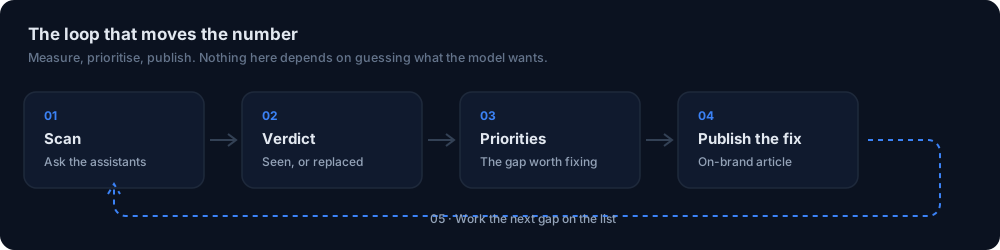
SEOWedge’s workflow from gap to published accessory page.
What Steps Are Needed to Get Cited for Cross-Sell and Accessory Queries?
To win citations for accessories and cross-sell items in AI answers, you need to close the loop from gap discovery to content publication. SEOWedge structures this as a single workflow:
1. Enter your domain. SEOWedge crawls your site and extracts your accessory and add-on product relationships.
2. It discovers the real buyer questions for those products and tests them in ChatGPT and Gemini (on paid plans).
3. For each missed citation, it produces an Action Brief naming the exact page to create or fix.
4. You use the Content Studio to generate, review, and export a new answer-ready page for the accessory or add-on gap.
5. On paid plans, SEOWedge submits the new URL via IndexNow to speed up re-crawling by AI assistants (IndexNow documentation).
6. The result: your accessory or add-on product page is now positioned to be cited in future AI answers for those cross-sell queries.
This workflow removes manual research, prompt writing, and guesswork from the process. You always know which accessory pages matter, what to create, and how to move from gap to citation.
| Step | SEOWedge Role |
|---|---|
| Gap discovery | Automatic, per accessory/add-on |
| Competitor page identification | Names and URLs provided |
| Action Brief creation | Why your page is missing, what to fix |
| Content generation | Brand-aligned, answer-ready draft |
| IndexNow submission (paid) | Accelerates AI re-crawl |
The end-to-end loop for accessory AI visibility.
How Is Content for Accessories and Add-Ons Written and Scored for AI Citation?
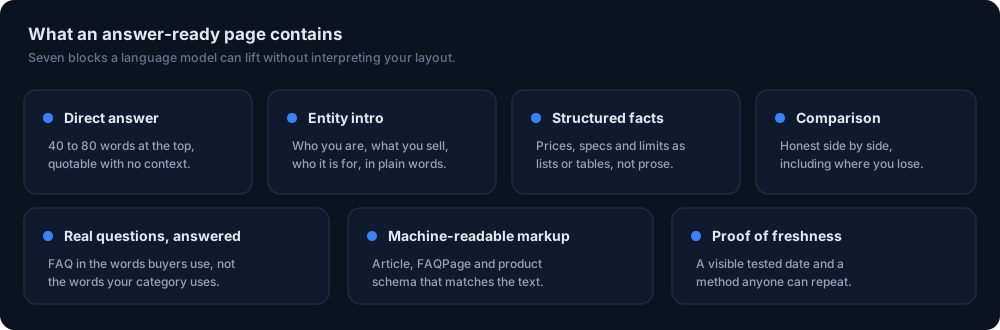
SEOWedge’s Content Studio generates answer-ready pages for each accessory or add-on opportunity, using your Brand DNA profile. This ensures the content is specific to your product, matches your brand voice, and addresses the exact buyer question that drives AI citations.
Each draft is scored for Publish Readiness—a deterministic score based on structure, specificity, and answerability for AI assistants. You can edit the draft before exporting, so the final page is both on-brand and optimized for GEO and AEO.
SEOWedge’s approach means you do not get generic filler content. Instead, each accessory page is tailored to the question and citation opportunity that matters. This is critical for GEO (generative engine optimization) and AEO (answer engine optimization), where AI assistants favor clear, direct, and original answers.
For more on on-brand content generation, see SEOWedge and Brand Voice.
| Content Step | Accessory Example |
|---|---|
| Brand DNA extraction | Product compatibility, category, tone |
| Draft generation | "Which wireless charger is best for XPhone Pro?" |
| Publish Readiness score | Structure, specificity, answerability |
| Edit and export | Final review before publishing |
How SEOWedge writes and scores accessory content for AI.
What Makes SEOWedge the Better Choice for Accessory and Add-On AI Visibility?
SEOWedge is built for ecommerce brands who want to win citations for accessories and add-ons—not just main products. The workflow is shaped for this job: it discovers real accessory queries, identifies the exact competitor pages that are winning, and produces answer-ready, on-brand pages to close the gap.
You do not need to write prompts or guess at which accessory questions matter. SEOWedge’s scan and Action Brief loop is the only one in the category that goes from measurement to page generation in one place. The free scan needs no card and shows you real missed opportunities for your accessories, not just a demo or a chart.
Paid plans start at $29/month, the lowest entry point for this category, and let you bulk-generate multiple accessory pages at once. This makes SEOWedge the practical, cost-effective choice for brands and agencies who want to unlock new revenue from overlooked accessory and cross-sell queries.
For a direct comparison of SEOWedge’s mechanism and outcomes against other tools, see SEOWedge vs Otterly AI.
| SEOWedge Feature | Accessory/Addon Benefit |
|---|---|
| Automatic question discovery | Finds real accessory/cross-sell queries |
| Competitor page analysis | See who wins and why |
| Action Briefs | Step-by-step, no guesswork |
| On-brand content generation | Answer-ready, not generic |
| Lowest paid entry point | Scalable for brands and agencies |
| No prompt writing needed | Removes manual work |
Why SEOWedge is built for accessory and add-on AI visibility.
What’s My Next Step If I Want to Improve Accessory and Add-On Visibility?
Start with a free scan—no card required. Enter your domain and SEOWedge will crawl your site, discover real accessory and add-on queries, and return a list of missed AI citation opportunities. You’ll see which competitor pages are being cited for cross-sell and add-on queries, and receive an Action Brief for your highest-impact gap.
You can generate one answer-ready article for free. To scale up, paid plans unlock more scans, more Action Briefs, and bulk content generation for all your accessory and add-on gaps. Credits can be topped up as needed, so you never hit a hard limit during a busy period.
If you want to see a public sample before starting, visit the Sample Report. For a broader look at how SEOWedge fits into GEO, AEO, and LLM SEO, see the Resources hub.
| Action | Where to Start |
|---|---|
| Free scan (no card) | /signup |
| See a sample report | /sample |
| Review pricing and plans | /pricing |
| Learn more about GEO and AEO | /resources/generative-engine-optimization-guide |
| Bulk content for accessories | Upgrade to Pro or Agency |
Next steps for improving accessory and add-on AI visibility.
How this was tested
All claims and workflows are based on SEOWedge’s live product as of 2026-08-13. SEOWedge samples AI answers from OpenAI (GPT) on all plans and Google Gemini on paid plans. Buyer questions are discovered automatically from the site and market, not written by the user. Gaps, citations, and Action Briefs are generated from sampled answers and competitor citations per scan. Screenshots reflect the interface and outputs available to users as of the test date.
What this page does not cover
This page focuses on using SEOWedge to improve AI visibility for ecommerce accessories and add-on products—such as cables, cases, refills, or compatible extras. It does not cover collections, bundles, or service add-ons; for those, see SEOWedge for Collections and Bundles or SEOWedge for Service Pages. All data and workflow steps are current as of 2026-08-13 and may change as AI assistants evolve.
Questions buyers ask us
Does SEOWedge work for all types of accessories and add-ons?
SEOWedge is built for ecommerce brands selling physical products, including accessories, replacements, compatible extras, and add-ons. It discovers queries and gaps for any product type that can be cross-sold or attached to a main item. For bundles or service add-ons, see the relevant workflow pages linked above.
How many accessory queries does SEOWedge discover per scan?
On the Free plan, SEOWedge discovers 5 buyer questions per scan, with 1 Action Brief. Paid plans increase this to 12 (Pro) or 25 (Agency) questions per scan, with more Action Briefs and bulk content generation. Each question is based on real buyer intent, not just keywords or prompts.
Can I generate multiple accessory pages at once?
Yes, on paid plans. Pro allows you to queue 3 articles at once; Agency supports 10. This lets you address multiple accessory or add-on gaps in a single workflow, making it practical to close all major cross-sell opportunities at scale.
How do I know which accessory gaps to tackle first?
SEOWedge prioritizes gaps by buyer intent and competitor share of voice. The Action Briefs highlight which accessory or add-on queries are most valuable, so you can focus on the pages that will drive the biggest share of AI citations and cross-sell revenue.
Do I need to write prompts or maintain a question list for accessories?
No. SEOWedge discovers buyer questions automatically from your site and market context. You do not need to write, maintain, or update a prompt list—every scan surfaces new and relevant queries for your accessory and add-on products.
Will SEOWedge tell me if technical issues are blocking my accessory pages from being cited?
SEOWedge’s scan includes technical checks that can flag if your accessory or add-on pages are not crawlable by AI assistants. For technical troubleshooting, see the LLM SEO guide at LLM SEO: Technical Guide.
See what AI assistants say about your site
Enter your domain and SEOWedge runs a free scan: your AI-Visibility score, the buyer questions where a competitor is named instead of you, and the first page to fix. No install, no sales call.