How to Use SEOWedge to Secure Brand Citations in Niche Product Queries
SEOWedge discovers the real buyer questions driving niche product queries, shows which competitors are cited for each, and gives you the exact steps and content to win those citations in AI answers. Its workflow is built to close the loop: from measurement, to opportunity, to on-brand page creation, and tracking the outcome.
By the SEOWedge Research Team · Published August 12, 2026 · Last tested August 12, 2026 · Updated August 12, 2026 · 8 min read
What to take away
- SEOWedge finds real buyer questions for your niche products—no prompt writing needed.
- You see which competitor pages are cited for each query, not just brand names.
- The tool writes on-brand, answer-ready pages to fill citation gaps in AI answers.
- You track whether your brand is cited after publishing new content.
- A free scan covers 5 questions and one article—no card required.
How does SEOWedge discover niche buyer questions for my products?
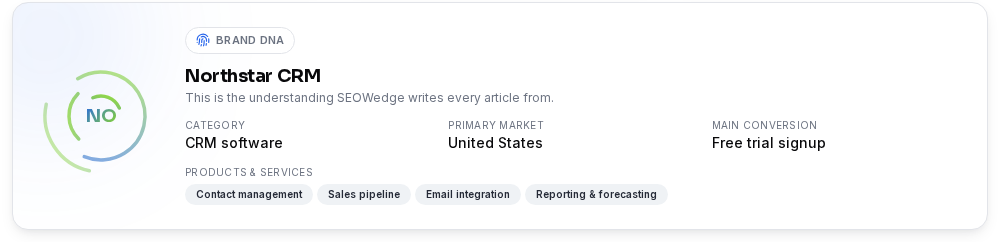
SEOWedge does not ask you to write your own prompts or guess what buyers might ask. Instead, it crawls your site, reads your product and category structure, and builds a Brand DNA profile. This includes your market, product types, and conversion goals. From there, SEOWedge discovers high-intent buyer questions that real people are asking about products like yours—phrased in natural language, not keyword strings.
For example, if you sell specialty cycling shoes, SEOWedge might surface questions like “What are the best cycling shoes for wide feet?” or “Which cycling shoes work with SPD-SL cleats?” These are not generic prompts: they reflect real, niche purchase intent. Each scan discovers up to 25 questions per project, depending on your plan. No manual prompt writing or upkeep is required.
This discovery process is what sets SEOWedge apart from prompt-tracking tools. The question set is fresh for your market and product range, ensuring you are optimizing for what buyers actually type into AI assistants—not just what you imagine they ask.
| Plan | Questions Discovered Per Scan |
|---|---|
| Free | 5 |
| Pro | 12 |
| Agency | 25 |
SEOWedge discovers high-intent buyer questions automatically, no prompt writing required.

What does SEOWedge show about which competitors are cited for these queries?
SEOWedge runs each discovered question through AI assistants—OpenAI GPT on all plans, with Google Gemini added on paid plans. For every question, it records the exact brands and pages cited in the AI answers. You see not just which competitors are named, but the specific URLs that win citations for those niche queries.
This means you can pinpoint which competitor page is being referenced for “best vegan running shoes for flat feet” or “affordable titanium camping cookware,” for example. SEOWedge presents this as a share-of-voice chart and a page-level opportunity list. You see the gap: which queries cite you, which cite competitors, and which cite third-party sources.
This data is not a theoretical ranking—it is a dated sample of what AI assistants actually answered on that day, for those real buyer questions. This is what makes the opportunity list actionable: you know exactly what you are missing and who is being recommended instead.
| Query Example | Cited Brand | Cited Page URL |
|---|---|---|
| Best cycling shoes for wide feet | Competitor A | competitor.com/wide-cycling-shoes |
| Affordable titanium camping cookware | Competitor B | competitor.com/titanium-cookware |
SEOWedge shows which brands and URLs are cited for each niche product question.
How do I turn those findings into pages that win citations?
SEOWedge closes the loop from measurement to action. For every missed citation, it generates an Action Brief. The brief explains the question, why AI answers name someone else, and which page you need to create or update to win the citation.
You do not have to guess what to write. The Content Studio drafts the missing page directly from your Brand DNA profile—your product data, brand tone, and conversion goals. The system scores each draft for Publish Readiness, so you know the page is structured to answer the buyer’s question and be eligible for AI citation.
If you want to see how SEOWedge keeps content on-brand and specific to your offer, see how the Brand DNA system works. Every article is grounded in your actual products and market, not generic AI content. Paid plans let you queue up to 10 articles at once for bulk gap closing.
| Plan | Articles per Month | Bulk Articles at Once |
|---|---|---|
| Free | 1 | 1 |
| Pro | 30 | 3 |
| Agency | 150 | 10 |
SEOWedge generates answer-ready, on-brand articles to fill citation gaps.
What’s the workflow for securing citations in niche product queries?
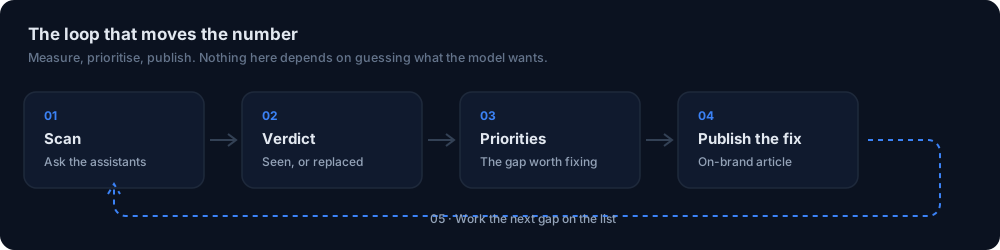
The process is built to be direct and repeatable. You enter your domain, SEOWedge crawls your site and discovers the real buyer questions, then tests those questions across AI assistants. It then shows you which competitor pages are cited for each query, and which questions you are missing out on.
For every gap, you get an Action Brief and can generate a draft page from your Brand DNA. Each draft is scored for Publish Readiness before export. Once published, SEOWedge submits the new URL through IndexNow, so AI assistants are notified of the change as soon as possible. This workflow is designed for GEO (generative engine optimization), AEO (answer engine optimization), and LLM SEO, all in one loop.
You do not need to manage prompts, monitor rankings, or write content from scratch. The loop is: measure, see the gap, generate the fix, and track the outcome. See a detailed breakdown of this loop here.
| Step | What SEOWedge Does |
|---|---|
| 1. Crawl & Brand DNA | Reads site, builds profile |
| 2. Discover Questions | Finds real buyer queries |
| 3. Test AI Answers | Samples AI citations |
| 4. Find Gaps | Shows competitor citations |
| 5. Action Brief | Explains what to fix |
| 6. Generate Page | Drafts answer-ready content |
| 7. Publish & Notify | Scores draft, submits to IndexNow |
SEOWedge workflow: from gap discovery to published, answer-ready page.
How do I know when my brand starts being cited for these queries?
After you publish a new or revised page, SEOWedge lets you run a new scan using the same set of buyer questions. It samples answers from the same AI assistants and records which brands and pages are now cited. If your brand appears in the answer, you see the change in the share-of-voice chart and the opportunity list.
Because SEOWedge stores a dated sample of every answer, you can compare before and after for each query. This is not a moving average or a theoretical score—it is a record of what the AI assistant actually said for that question, on that date. This makes tracking progress concrete and defensible when reporting to stakeholders or clients.
Citations in AI answers do not update instantly. Assistants re-crawl and refresh their sources over days or weeks. SEOWedge is built for this reality: it dates every sampled answer and submits new URLs through IndexNow for faster discovery. For more on how AI answer sampling differs from classic SEO rank tracking, see this explanation of the AI Search Visibility Score.
| Scan Date | Query | Cited Brand/Page |
|---|---|---|
| 2026-08-01 | Best cycling shoes for wide feet | Competitor A |
| 2026-08-20 | Best cycling shoes for wide feet | Your Brand |
SEOWedge records which brand is cited for each question, before and after content changes.
What does SEOWedge offer for free, and when should I upgrade?
The Free plan gives you a real result: one project, one Lite Scan (covering 5 buyer questions), one Action Brief, and one article draft—no credit card needed. This is enough to see your current citation gaps and generate a fix for one high-value niche query. You can test whether SEOWedge’s workflow fits your products and market before spending anything.
Paid plans unlock more scans, more discovered questions (12 or 25 per scan), bulk article generation, and Google Gemini coverage. Pro covers 5 projects and 30 articles/month for $29/month, while Agency supports 25 projects, 150 articles/month, and white-label reporting for $99/month. Paid plans also allow buying credit packs to extend any limit without upgrading the plan. See the pricing page for a full breakdown.
If you want to see a public sample of the output, visit the sample report.
| Plan | Price (monthly) | Projects | Questions/Scan | Articles/Month |
|---|---|---|---|---|
| Free | $0 | 1 | 5 | 1 |
| Pro | $29 | 5 | 12 | 30 |
| Agency | $99 | 25 | 25 | 150 |
SEOWedge plan comparison for niche product citation work.
How does this workflow fit into GEO, AEO, and LLM SEO?
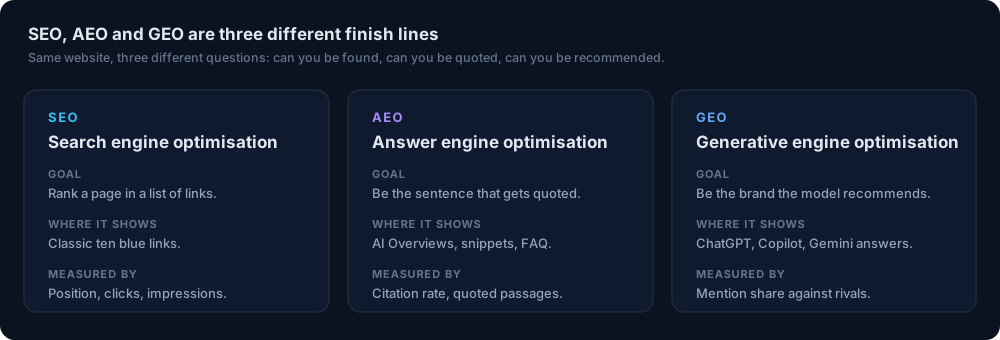
Securing brand citations in AI answers is the core of generative engine optimization (GEO), answer engine optimization (AEO), and LLM SEO. GEO focuses on being named and cited by generative engines like ChatGPT and Gemini. AEO is about structuring your content so that AI assistants can lift and quote it directly. LLM SEO covers the technical layer: ensuring your pages are crawlable and retrievable by large language models.
SEOWedge’s workflow covers all three: it discovers the buyer questions (GEO), shows which competitor pages are cited (AEO), and writes answer-ready content from your Brand DNA (GEO/AEO). Technical checks—like making sure OAI-SearchBot is allowed and pages are discoverable—are part of the scan process. For a technical checklist, see the LLM SEO technical guide.
If you want to understand how GEO, AEO, and classic SEO differ, see the practical definitions and workflow map.
| Discipline | What SEOWedge Does |
|---|---|
| GEO | Finds buyer questions, measures citations |
| AEO | Shows cited passages, writes answer-ready content |
| LLM SEO | Checks crawlability, ensures retrievability |
SEOWedge covers GEO, AEO, and LLM SEO in one workflow.
What’s my next step if I want to secure brand citations for niche queries?
Start with a free scan—no card required. Enter your domain and see which niche buyer questions matter, which competitors are cited, and where your brand is missing. Generate your first answer-ready article from your Brand DNA profile and see how the workflow fits. If you need to cover more questions, projects, or want Google Gemini coverage, upgrade to a paid plan or top up with credits as needed.
For a deeper dive into the mechanics of question discovery and citation measurement, read how SEOWedge finds buyer questions and how citation measurement works.
If you want to see the workflow in action for a specific product or market, browse the resources hub for step-by-step use cases and technical guides.
| Step | Where to Go |
|---|---|
| Run a free scan | /signup |
| See sample output | /sample |
| Compare plans | /pricing |
| Learn about question discovery | /resources/how-does-seowedge-find-buyer-questions-for-my-ecommerce-site |
| See technical checklist | /resources/llm-seo-guide |
Next steps for securing brand citations with SEOWedge.
How this was tested
All facts and workflow steps are based on SEOWedge's documented product process and outputs as of 2026-08-12. Numbers for discovered questions, citations, and article generation are drawn from current plan limits and workflow documentation. Citations and competitor sources are sampled directly from AI assistant answers (OpenAI GPT and Google Gemini, depending on plan) using the same buyer question set per scan. Screenshots and diagrams reflect the SEOWedge interface and process as of this date.
What this page does not cover
This guide covers securing brand citations for niche product queries in AI-generated answers using SEOWedge. It does not cover general SEO, classic rank tracking, or manual prompt tracking. For technical LLM SEO, schema, or broader GEO/AEO definitions, see linked guides. Citations are measured as sampled observations from AI answers, not as persistent rankings, and reflect the state at the time of scan.
Questions buyers ask us
Does SEOWedge require me to write my own prompt list for niche queries?
No. SEOWedge automatically discovers high-intent buyer questions from your site and market. You do not need to write or maintain prompts. Each scan surfaces the questions buyers are actually asking about your products.
How do I know which competitor pages are winning citations for my niche products?
SEOWedge records both the brand and the specific page URL cited by AI assistants for each buyer question. You see exactly which competitor page is being referenced, not just the brand name.
Can SEOWedge generate content that matches my brand’s tone and product specifics?
Yes. SEOWedge uses your Brand DNA profile—built from your site’s content and product data—to generate answer-ready articles. Each draft is scored for Publish Readiness, so it is both on-brand and structured for AI citation.
How soon will my brand appear in AI answers after publishing a new page?
AI assistants re-crawl and update their sources over days or weeks, not instantly. SEOWedge submits new URLs through IndexNow to speed up discovery. You can run a new scan after publishing to check if your brand is now cited for the target queries.
What do I get for free if I just want to test SEOWedge on my niche product queries?
The Free plan covers one project, five discovered buyer questions, one Action Brief, and one article draft. No credit card is required. This is enough to test the workflow and see real citation gaps for your niche products.
How does SEOWedge’s measurement compare to classic SEO rank tracking?
SEOWedge samples actual AI answers for real buyer questions and records which brands and pages are cited. This is different from classic SEO, which tracks rankings for keywords in search results. The method is explained in the AI Search Visibility Score guide.
See what AI assistants say about your site
Enter your domain and SEOWedge runs a free scan: your AI-Visibility score, the buyer questions where a competitor is named instead of you, and the first page to fix. No install, no sales call.