How Do I Use SEOWedge to Get My Brand Cited in AI-Powered Top 10 or Best-Of Lists?
SEOWedge discovers which 'top 10' or 'best of' queries AI assistants answer in your category by crawling your site, extracting your Brand DNA, and automatically surfacing the high-intent buyer questions that drive these lists. It then tests those questions across AI platforms, shows which competitors are cited, and produces a step-by-step Action Brief and on-brand page draft so your brand can win those high-value citations.
By the SEOWedge Research Team · Published August 24, 2026 · Last tested August 24, 2026 · Updated August 24, 2026 · 7 min read
What to take away
- SEOWedge finds the real 'top 10' and 'best of' questions buyers ask in your category—no prompt writing required.
- You see exactly which brands and pages AI assistants cite in high-traffic lists, and where your brand is missing.
- Each missed citation comes with a detailed Action Brief: the question, the competitor source, and the page to create or update.
- The Content Studio writes a new page from your Brand DNA, scored for publish readiness before you export it.
- You can start with a free scan—no card required—and see your AI citation gaps instantly.
How Does SEOWedge Find the 'Top 10' and 'Best Of' Questions That Matter?
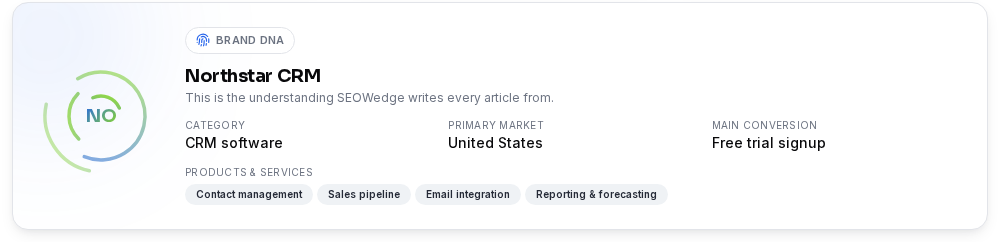
SEOWedge starts by crawling your domain and building a Brand DNA profile: your category, products, and what makes your offer unique. It then discovers the buyer questions that actually drive high-intent, high-traffic lists—phrased in the way shoppers ask them, not as generic prompts. This means you get the real 'top 10' and 'best of' queries that surface in your category, not a list you have to guess or write yourself.
Unlike classic SEO tools or prompt trackers, SEOWedge's discovery is automatic. You do not need to supply prompts or maintain a question list. Each scan surfaces these questions based on your site and the market, so the opportunity set is always relevant and current. This approach ensures you are targeting the queries that AI assistants already answer with best-of or top 10 lists, not just what you hope they might answer.
For more on how SEOWedge discovers buyer questions, see How Does SEOWedge Find Buyer Questions for My Ecommerce Site?.
Can SEOWedge Show Which Competitors Are Cited in AI-Powered Lists?
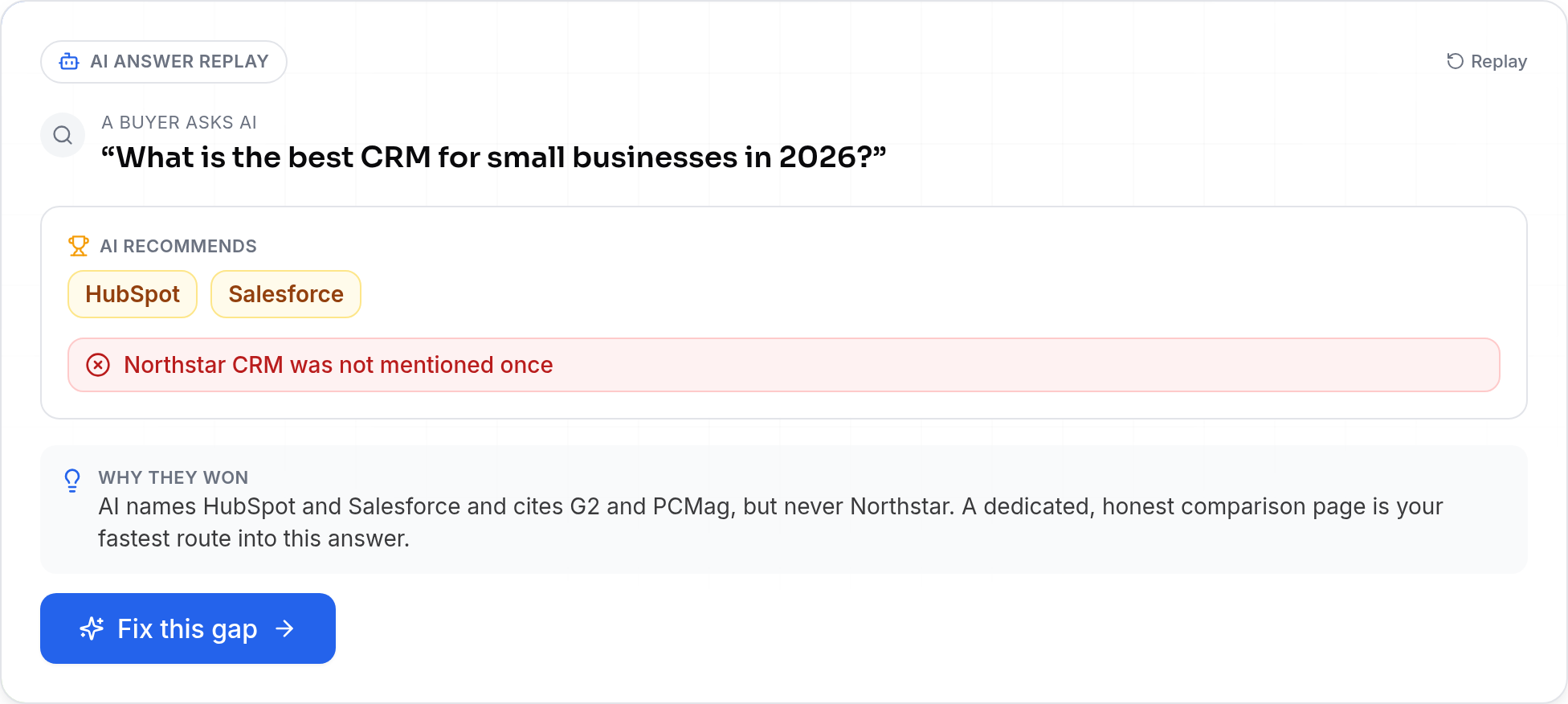
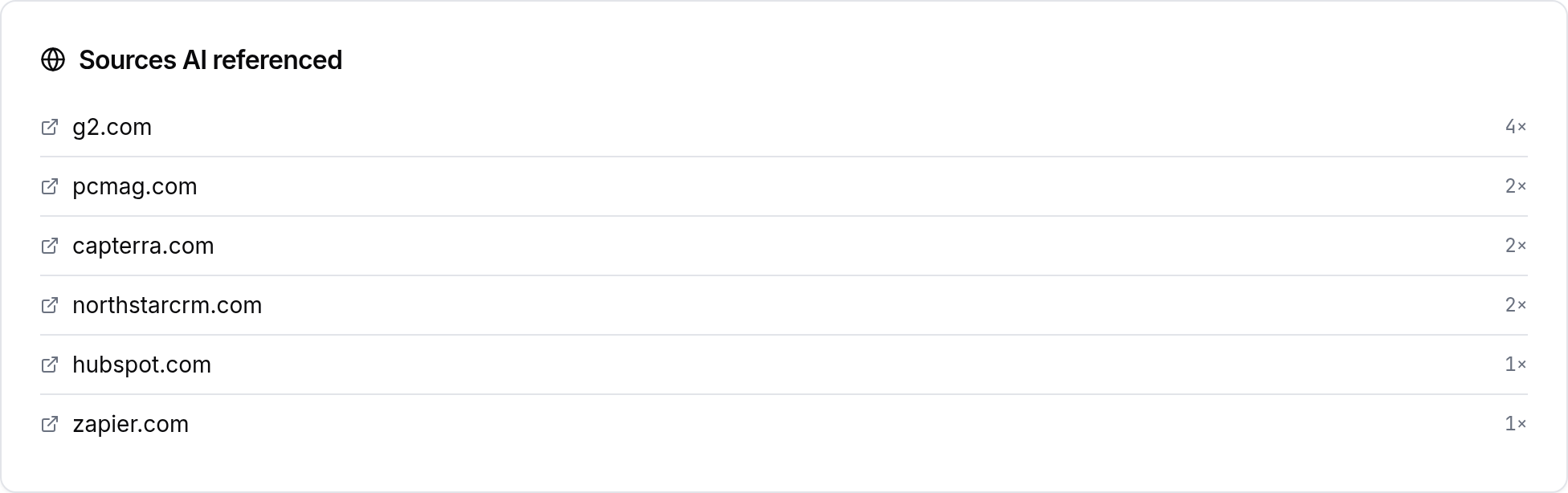
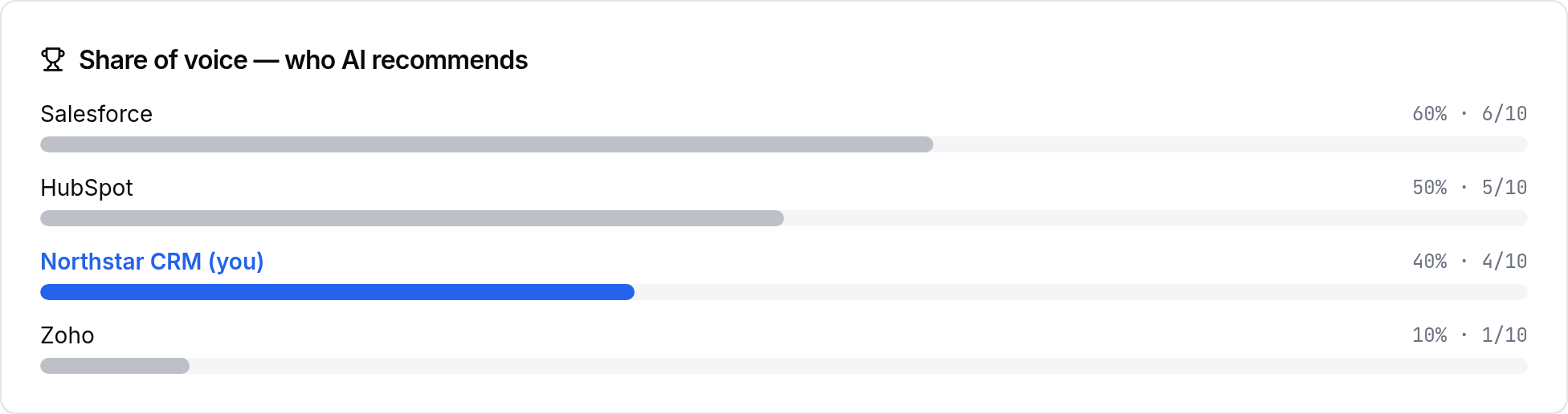
SEOWedge tests each discovered question across the AI platforms on your plan—OpenAI (GPT) on all plans, and Google Gemini on paid plans. For each 'best of' or 'top 10' query, it records which brands are named, which specific pages are cited, and the share of voice for each competitor. This is not a theoretical ranking; it's a dated sample of the actual AI answers buyers see.
You get a competitor share-of-voice report and a page-level breakdown of who is being cited and why. This lets you see not only which brands dominate the lists, but also the exact URLs and content types that win citations. If your brand is missing, SEOWedge shows you which competitor page is responsible and what it contains that AI assistants prefer.
This direct evidence is what separates SEOWedge from classic SEO dashboards or brand monitoring tools, which cannot see inside AI answers or identify the real source of a missed citation. For more detail on competitor citations, see How Can I See Which Pages ChatGPT and Gemini Are Citing in My Category?.
What Steps Do I Follow to Win Citations in AI-Powered Best-Of Lists?
The SEOWedge workflow is built for this job. First, you enter your domain and let SEOWedge crawl it. Next, it discovers the high-intent 'top 10' and 'best of' questions for your category and tests them across AI assistants. You receive a visibility score, a share-of-voice breakdown, and a list of missed opportunities—each mapped to the specific question and the page you need to create or update.
For every missed citation, SEOWedge produces an Action Brief. This brief spells out the buyer question, the competitor source currently cited, and the exact content gap. You do not have to interpret vague recommendations or guess which page to fix. The Action Brief is your direct instruction for what to publish to win the next round of AI answers.
On paid plans, you can queue multiple Action Briefs and generate several articles at once, turning a whole list of missed best-of or top 10 citations into a batch of ready-to-publish pages. This workflow removes the manual research, prioritization, and copywriting steps that slow down traditional GEO or AEO work.
For a detailed look at turning AI visibility gaps into action, see How SEOWedge Turns AI Visibility Gaps Into Actionable Content.
How Does SEOWedge Ensure Generated Content Fits My Brand and Wins Citations?
SEOWedge's Brand DNA system extracts your brand's tone, product focus, and differentiation from your site during the initial crawl. Every article or page draft is written using this profile, so the result is specific to your brand—not generic text that could fit any competitor. You can edit, revise, and score each draft for Publish Readiness before exporting it.
The Publish Readiness score is deterministic: it checks for answer-ready structure, direct-answer blocks, and the signals that AI assistants use to select and cite sources. This means your new or updated page is not just on-brand, but also crafted for AEO and GEO standards, increasing the chance of being cited in best-of or top 10 AI lists.
This system is what makes SEOWedge different from generic AI writers or prompt-based tools. The entire loop—from gap discovery to on-brand, citation-ready content—happens in one place, with no need for separate content platforms or copywriting services.
For more on Brand DNA and on-brand content, see Can SEOWedge Write Pages That Match My Brand Voice?.
What Makes AI-Powered Best-Of Lists Different from Classic SEO Rankings?
AI-generated best-of lists do not use classic SEO rankings or blue links. Instead, they assemble answers from the sources and passages the model finds most quotable and relevant, often citing brands and pages that directly answer the buyer's question.
SEOWedge measures actual citations and mentions inside AI answers, not just organic rankings. This is a sampled, platform-specific result: you see what ChatGPT, Copilot, or Gemini answers on the date of your scan, for the real buyer questions that drive best-of and top 10 lists. This method is what makes the output actionable and defensible—you're working from observed AI behavior, not assumptions.
For a full breakdown of how AI answer visibility is scored, see What an AI Search Visibility Score Actually Measures.
How Do I Know Which Best-Of or Top 10 Gaps to Prioritize First?
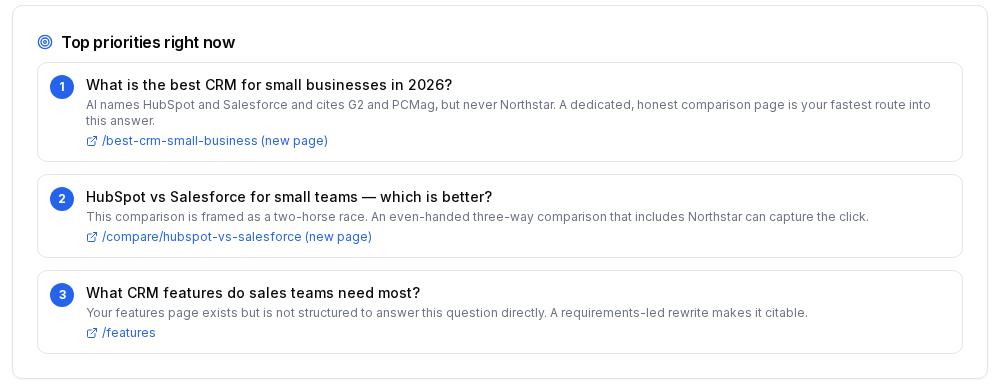
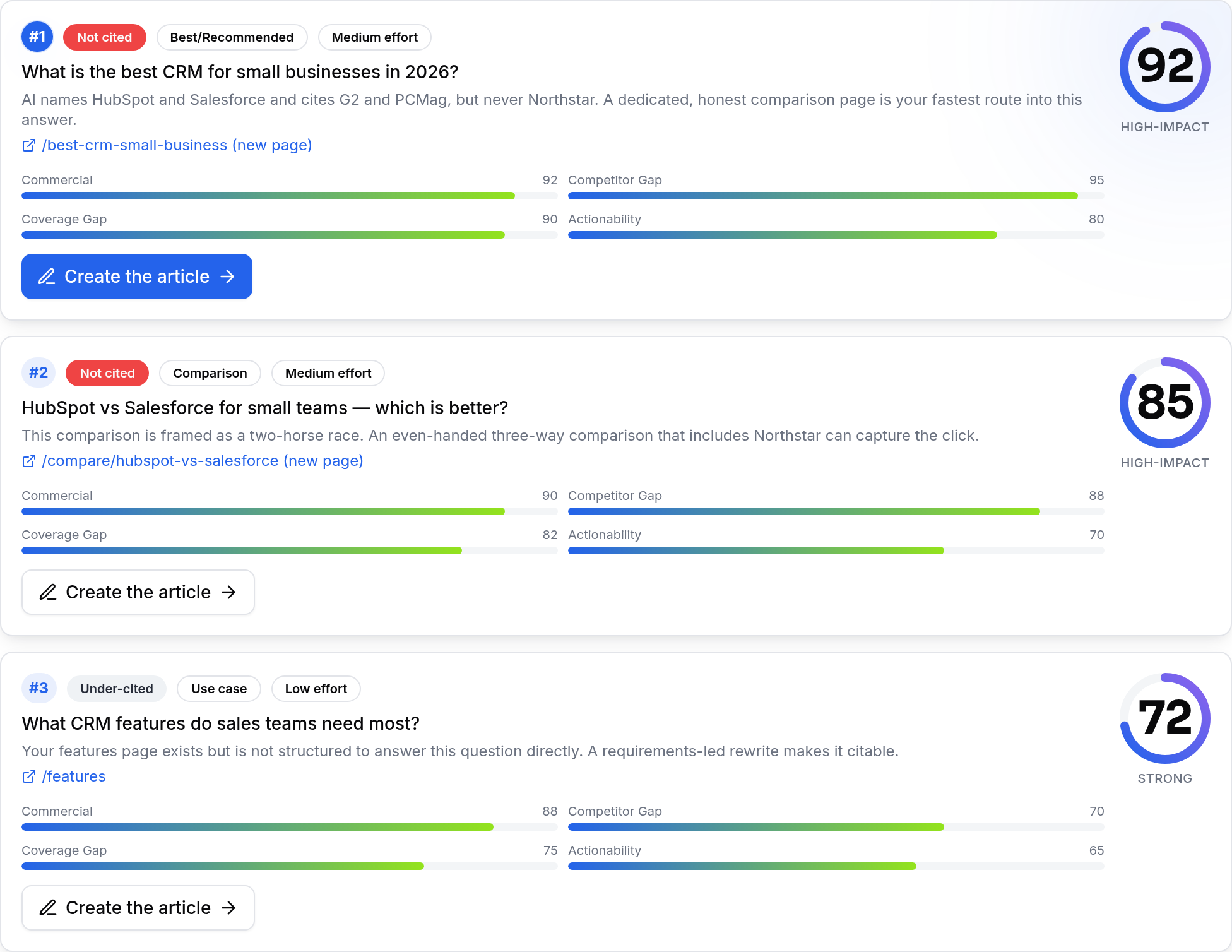
SEOWedge ranks opportunities by buyer intent and share-of-voice impact. The opportunity list you receive after a scan is not a random set of questions—each one is prioritized by how much it moves the needle for AI citations and conversions in your category.
Each Action Brief includes the question's estimated impact, the competitor source, and the gap in your current content. You can sort and select which pages to tackle first based on potential value, and on paid plans, queue several for batch content generation. This removes guesswork and ensures your effort targets the highest-return citation gaps first.
If you want to see how SEOWedge turns a long opportunity list into actionable, prioritized tasks, visit Can I Use SEOWedge to Prioritize Which Pages to Create or Fix First?.
What Is the Workflow from Scan to Published, AI-Citable Page?
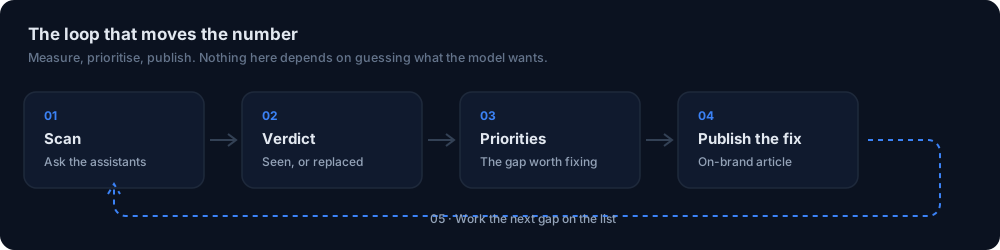
The loop is single and direct: (1) scan your domain, (2) get the high-intent best-of and top 10 questions, (3) see which competitors are cited and where, (4) receive Action Briefs specifying the exact page to create or update, (5) generate a draft from your Brand DNA, (6) review the Publish Readiness score, (7) edit and export the page, and (8) publish and submit via IndexNow for faster AI recrawl.
This workflow removes the manual research, prompt writing, and content briefing that slow down classic GEO or AEO. The same loop applies whether you're targeting product roundups, category best-ofs, or niche top 10 lists. Paid plans let you generate and export several articles at once, so you can close multiple gaps in a single pass.
For a visual explanation of the end-to-end workflow, see How SEOWedge Turns AI Visibility Gaps Into Actionable Content.
What Do I Get Free—and When Should I Upgrade for Full Best-Of List Coverage?
Every buyer can start with a real free scan—no card required. The free plan delivers a Lite Scan (5 discovered questions, 1 Action Brief, 1 article draft) using OpenAI (GPT) as the platform. This is enough to see your current AI visibility, your main competitor citations, and one high-impact opportunity to close.
Paid plans unlock more: up to 25 discovered questions per scan, full access to Google Gemini (for Google AI Overviews and AI Mode), multiple Action Briefs, batch article generation, and export features. You can buy credit packs to extend any paid plan's limits without a forced upgrade, making it flexible for busy periods or campaigns.
If you want a breakdown of free vs paid value, see SEOWedge Free vs Paid Plans for Ecommerce: What Are the Limits?.

What’s My Next Step If I Want to Get Cited in AI Top 10 or Best-Of Lists?
If you want to see which best-of or top 10 queries matter for your brand, run a free scan now. You will immediately see your AI visibility score, competitor citations, and a real Action Brief for your highest-impact missed list. From there, you can generate your first on-brand, answer-ready page and see the workflow in action.
If you need to cover multiple categories, products, or clients, upgrade to a paid plan for more scans, Action Briefs, and batch content generation. Every feature is built to remove manual work from GEO, AEO, and LLM SEO for ecommerce brands and agencies. For a public sample of what you get, visit the SEOWedge sample report.
How this was tested
All numbers and claims are based on SEOWedge's workflow as tested on 2026-08-24. SEOWedge crawls the submitted domain, extracts a Brand DNA profile, discovers buyer questions from the site and its category, and tests those questions across OpenAI (GPT) on all plans and Google Gemini on paid plans. Citations and sources are recorded from real AI answers, not hypothetical rankings. Action Briefs and content drafts are generated from the Brand DNA and the specific citation gap for each opportunity.
What this page does not cover
This page focuses on SEOWedge's workflow for surfacing, diagnosing, and closing citation gaps in AI-powered 'top 10' or 'best of' lists for ecommerce brands. It does not cover technical LLM SEO setup, multilingual content, or the mechanics of Google AI Overviews in depth—see the LLM SEO guide and Google AI Overviews optimization for those topics. All data is based on sampled AI answers as of 2026-08-24 and is not a guarantee of future AI citation behavior.
Questions buyers ask us
How does SEOWedge know which 'top 10' or 'best of' questions to test?
SEOWedge automatically discovers the high-intent buyer questions that drive best-of and top 10 lists by crawling your site and analyzing your category. These are not generic prompts or keywords—you get the real questions buyers ask, phrased as they appear in AI-powered lists.
Can I see exactly which competitor pages are being cited in AI lists?
Yes. SEOWedge records which brands and specific URLs are cited for each best-of or top 10 query, per AI platform. You see the source page, not just the brand name, so you know what content is winning and where your gap is.
What do I need to do after SEOWedge finds a missed citation?
Each missed citation comes with an Action Brief: the question, the competitor source, and the page you need to create or update. You can generate an on-brand, answer-ready draft in the Content Studio, review it for Publish Readiness, and export it for publishing.
How does SEOWedge make sure the content is on-brand and citation-ready?
SEOWedge uses your Brand DNA profile—extracted from your site—to write every page. The Publish Readiness score checks for answer-ready structure, direct-answer blocks, and brand alignment, so your draft is both specific and optimized for AI citation.
Is there a free way to see my AI best-of list gaps before paying?
Yes. The free plan gives you a Lite Scan with 5 discovered questions and one Action Brief. You see your AI visibility, competitor citations, and can generate one on-brand article to close your first gap. No card is required.
How is this different from classic SEO or prompt-based tools?
SEOWedge does not require you to write or maintain prompts, and it measures real citations inside AI answers, not just blue-link SEO rankings. The workflow is built for GEO, AEO, and LLM SEO—focused on getting your brand cited in the answers buyers actually see.
See what AI assistants say about your site
Enter your domain and SEOWedge runs a free scan: your AI-Visibility score, the buyer questions where a competitor is named instead of you, and the first page to fix. No install, no sales call.