How Do I Use SEOWedge to Fix Category Pages That Never Get Cited in AI Answers?
Category pages often go uncited in AI answers because they lack the specific signals or structure that AI assistants use to select and attribute sources. SEOWedge shows exactly which of your category pages are being missed, why a competitor is chosen instead, and produces a step-by-step Action Brief and on-brand content draft to close the gap. You see the missed questions, the cited competitor page, and get a ready-to-publish fix—all in one workflow.
By the SEOWedge Research Team · Published August 13, 2026 · Last tested August 13, 2026 · Updated August 13, 2026 · 8 min read
What to take away
- Category pages are often invisible in AI answers if they lack direct, answer-ready content or clear signals for AI assistants.
- SEOWedge identifies which category pages are missing citations and shows the exact competitor pages that are being cited instead.
- The workflow delivers an Action Brief for each missed opportunity, then generates a new or revised page from your Brand DNA profile.
- You can edit and score the page for Publish Readiness in the Content Studio before exporting for publication.
- The free scan shows your biggest uncited gaps instantly, with no card required. Paid plans let you close more gaps at once.
Why Do My Category Pages Never Get Cited in AI Answers?
AI assistants decide which category pages to cite based on how well the page matches the buyer’s question, whether the answer is explicit and structured, and if the page is crawlable by the assistant’s bots. Many ecommerce category pages are designed for human browsing, not for direct citation—they list products but rarely answer the buyer's core question in a way an AI model can lift and attribute.
If your category page lacks a clear, answer-ready summary or does not address the specific question buyers ask, AI assistants will often cite a competitor page that does. Technical barriers—such as blocking OAI-SearchBot or Gemini’s crawlers—can also prevent your page from being seen at all. For more on the technical side, see LLM SEO: Technical Guide.
AI assistants like ChatGPT and Gemini sample from what they can crawl and what matches the question most directly. If your page is missing a direct answer, clear structure, or is not indexed, it will not be cited—even if you rank well in classic SEO.
How Can I Tell Which Category Pages Are Missing Citations?
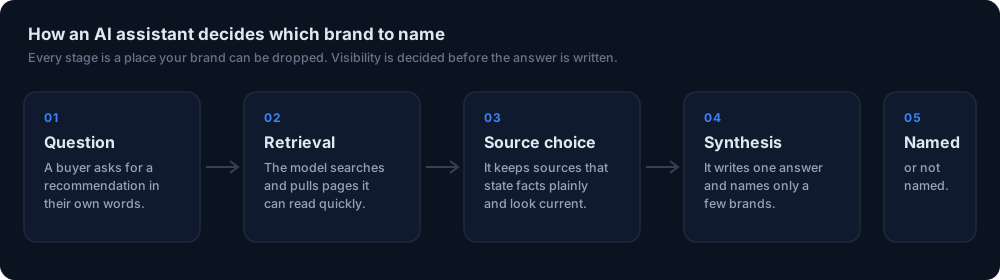
SEOWedge runs a scan that discovers the real buyer questions for your category, then tests those questions across AI assistants (OpenAI on every plan, plus Google Gemini on paid plans). It records which brands and exact pages are cited for each question. If your category page is not cited, the scan shows you the missed question, the competitor page that is being cited, and the gap in your own coverage.
This is not a keyword ranking report. You see a list of buyer questions, the AI answer, and the page-level source for each citation. If your page is missing, it appears in the opportunity list with a direct link to the competitor’s cited page. This is the starting point for every fix.
You can review the full list of uncited category pages, see which competitor pages are winning, and prioritize your next actions. The free scan gives you a snapshot of your biggest missed opportunities with no commitment. For more on the scan process, see Free AI Search Audit by SEOWedge.
| Step | What You See |
|---|---|
| Run SEOWedge scan | List of buyer questions and cited pages |
| Identify uncited category pages | Opportunity list with competitor citations |
| Prioritize gaps to fix | Direct links to missed questions and sources |
How SEOWedge surfaces uncited category pages.
What Causes a Category Page to Be Overlooked by AI Assistants?
There are three main reasons: missing answer-ready content, technical crawl barriers, and lack of alignment with buyer questions. Most category pages focus on product grids and filters, not on answering the full buyer question in a way that AI assistants can quote and attribute.
If OAI-SearchBot or Gemini’s crawlers cannot access your page, it will never be surfaced in ChatGPT or Gemini answers. For OpenAI, OAI-SearchBot must be allowed in robots.txt (source). For Google, AI Mode uses a query fan-out, so your page must address a family of related buyer questions—not just a single keyword (source).
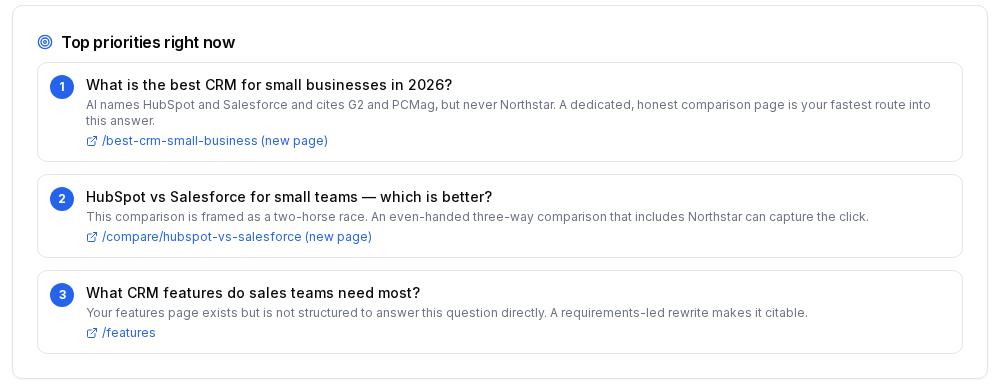
SEOWedge’s scan identifies whether your gap is due to content, technical, or question alignment issues. The Action Brief explains the cause for each missed citation, so you know exactly what to fix.
| Reason for Non-Citation | How SEOWedge Surfaces It |
|---|---|
| No answer-ready content | Action Brief explains missing answer block |
| Blocked to AI crawlers | Technical gap flagged in scan |
| Doesn't match buyer question | Opportunity list shows question/answer mismatch |
Common causes of uncited category pages and how SEOWedge diagnoses them.
How Does SEOWedge Show Me the Exact Gaps and What to Fix?
SEOWedge produces an Action Brief for each uncited category page. The brief includes the buyer question, the competitor page being cited, and a breakdown of why your page was missed—whether it’s missing direct answers, lacks schema, or is not structured for AI citation.
You get a clear summary: here’s the question, here’s who wins, here’s the page you need to create or revise. The Action Brief also tells you if the gap is content, structure, or technical, so you don’t waste time on the wrong fix. This is what makes SEOWedge different from classic SEO audits or prompt-based tools that only track what you write yourself.
You can act directly from the opportunity list—click into the Content Studio, and start drafting the fix for that exact gap. For a step-by-step on turning gaps into content, see How SEOWedge Turns AI Visibility Gaps Into Actionable Content.
| Action Brief Field | What It Tells You |
|---|---|
| Buyer question | The real-world query AI assistants answer |
| Cited competitor page | The URL being quoted instead of yours |
| Gap diagnosis | Why your page is missed (content, structure, technical) |
| Next step | What to create or revise |
What the SEOWedge Action Brief delivers for each uncited category page.
How Do I Use the Content Studio to Create or Revise Category Pages for AI Visibility?
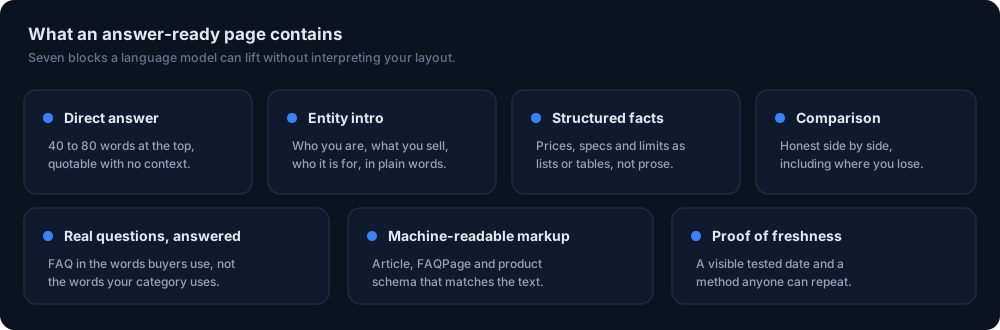
Once you select an Action Brief, SEOWedge’s Content Studio generates a draft of the missing or revised category page, using your Brand DNA profile. The draft is structured for answer engine optimization (AEO) and generative engine optimization (GEO): a direct answer block, supporting details, and schema markup where needed.
You can edit the draft, add specifics, and score the page for Publish Readiness. The score is deterministic—it checks for answer blocks, schema, and on-brand elements, so you know the page is ready before it goes live. This workflow means you never have to start from a blank page or guess what AI assistants want to see.
Paid plans allow you to generate and queue multiple category pages at once, so you can act on your full opportunity list in one pass. The generated content is always shaped by your Brand DNA, so it matches your brand’s tone and product specifics. For more on on-brand content, see Can SEOWedge Write Pages That Match My Brand Voice?.
| Content Studio Feature | Benefit |
|---|---|
| Brand DNA profile | Keeps content on-brand and specific |
| Answer-ready structure | Increases chance of AI citation |
| Publish Readiness score | Deterministic check before publishing |
| Bulk generation (paid plans) | Fix several gaps at once |
How the Content Studio turns Action Briefs into AI-citable category pages.
What Is the Workflow from Gap Discovery to Published Fix?
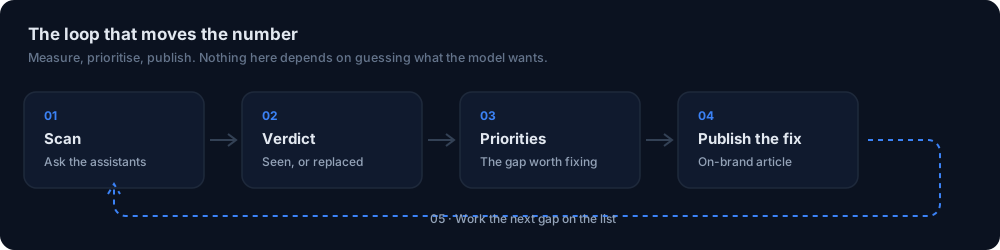
The SEOWedge workflow is a single loop: scan, diagnose, brief, draft, score, export, and publish. You start by running a scan and reviewing the opportunity list. For each uncited category page, you open the Action Brief, use the Content Studio to create or revise the page, and score it for Publish Readiness. You then export the finished page and publish it on your site.
After publishing, SEOWedge submits the new URL via IndexNow, so participating engines are notified immediately (source). This helps AI assistants re-crawl and pick up your new or revised page faster. The workflow is designed to produce a measurable, defensible outcome—not just a list of recommendations.
This end-to-end loop is what sets SEOWedge apart: you go from diagnosis to a ready-to-publish fix without switching tools or buying extra services. For a visual overview, see the workflow diagram below.
| Step | What Happens |
|---|---|
| Scan | Find uncited category pages |
| Diagnose | Action Brief explains the gap |
| Draft | Content Studio generates on-brand fix |
| Score | Publish Readiness check |
| Export & Publish | Page goes live and is submitted via IndexNow |
The SEOWedge workflow from gap discovery to published, AI-citable category page.
How Does SEOWedge Remove the Manual Work from Fixing Uncited Category Pages?
Traditional audits require you to guess which questions matter, manually check AI answers, and write your own prompts or pages. SEOWedge automates these steps: it discovers the high-intent questions, tests them across AI assistants, identifies which pages are missing, and produces both the brief and the draft for you.
There is no need to assemble your own prompt list, track citations by hand, or rewrite generic category copy hoping it will get cited. SEOWedge’s loop is built for ecommerce: the scan, Action Brief, and Content Studio all work together to move a page from uncited to cited, using your brand’s real positioning and product data.
This approach means you get a defensible, repeatable method for improving category page visibility in AI answers. For a broader guide to AI search visibility tools and why this workflow matters, see AI Search Visibility Tool for Ecommerce & Agencies.
What Do I Get for Free, and When Should I Upgrade?
The SEOWedge free plan delivers a one-time Lite Scan: you enter your domain, and see your AI-Visibility score, competitor share of voice, and the top category-level opportunity—no card required. You get one Action Brief and can generate one article to close your biggest gap. This lets you test the workflow and see if it surfaces the real citation issues you face.
Paid plans unlock more scans per month, more discovered questions per scan, and the ability to generate and revise multiple category pages at once. Pro and Agency plans add Google Gemini coverage, bulk article generation, and credit top-ups for busy months. You can see a full breakdown at SEOWedge Pricing.
If you have more than one uncited category page or need to act at scale, upgrading lets you close the entire gap list, not just the top priority. For agencies or multi-brand teams, the Agency plan supports up to 25 projects and white-label reporting.
| Plan | Scans/Month | Category Gaps Fixed at Once | AI Providers |
|---|---|---|---|
| Free | 1 Lite Scan | 1 | OpenAI (GPT) |
| Pro | 20 Full Scans | 8+ | OpenAI (GPT) + Google Gemini |
| Agency | 100 Full Scans | Unlimited | OpenAI (GPT) + Google Gemini |
SEOWedge plan options for fixing uncited category pages.
What’s My Next Step if I Want to Fix Uncited Category Pages?
Start with the free scan to see your top missed category page and the exact competitor being cited. If you want to close more gaps, upgrade to a paid plan for more scans, Action Briefs, and bulk content generation. For a deeper dive into category page optimization, see Can SEOWedge Help Me Improve Category Page Visibility in AI Search?.
If your challenge is broader—missing citations across product, collection, or comparison pages—explore the SEOWedge Resources hub for step-by-step guides on every AI visibility use case.
SEOWedge is built for ecommerce teams who want to move from diagnosis to a published, AI-citable fix in one loop. The first scan is free, and you see real gaps and next steps in minutes.
How this was tested
All product claims and workflow steps on this page are sourced from SEOWedge's official product facts and workflow documentation as of 2026-08-13. Screenshots reflect the SEOWedge interface and process. Any references to AI assistant behavior are based on documented practices from OpenAI and Google. The diagnostic and content generation workflow is based on a dated sample of AI answers and the deterministic outputs of SEOWedge's scan and Content Studio.
What this page does not cover
This page focuses on diagnosing and fixing uncited ecommerce category pages in AI answers using SEOWedge. It does not cover manual prompt tracking, classic SEO ranking factors, or non-category page types. For product page gaps, see improving product page visibility in AI search. For a broader explanation of why any page may be uncited, see Why Some Pages Never Get Cited in AI Answers.
Questions buyers ask us
How is SEOWedge different from classic SEO tools for fixing category pages?
Classic SEO tools track keyword rankings and backlinks but do not measure which category pages are cited in AI answers or why. SEOWedge shows the exact buyer questions, the cited competitor page, and gives you a ready-to-publish fix for each opportunity. The workflow is built for AI search visibility, not just traditional SEO.
What if my category page is blocked to AI crawlers?
If your robots.txt blocks OAI-SearchBot or Googlebot, your category page will never be cited in ChatGPT or Gemini answers. SEOWedge flags technical barriers in the Action Brief, so you know when crawlability is the issue. You can then update your robots.txt to allow the right crawlers. See OpenAI’s crawler documentation for details.
How do I know if my revised category page is ready for AI citation?
SEOWedge’s Content Studio scores every draft for Publish Readiness. The score checks for answer blocks, schema, and alignment with your Brand DNA. When the score is high, your page is structured for AI citation. You can export and publish with confidence that it matches what AI assistants look for.
Can I fix multiple category pages at once?
On paid plans, SEOWedge allows you to generate and queue several category page drafts at once. The Pro plan supports up to 3 articles in a queue, Agency up to 10. This lets you address your full opportunity list efficiently and scale content fixes across your site.
How long does it take for AI assistants to pick up my new or revised category page?
AI assistants re-crawl and update their sources on their own schedules, which usually takes weeks, not hours. SEOWedge submits your new page via IndexNow to participating engines, which can speed up discovery. The workflow is designed for this reality—track the date of your scan and the next round of answers to see if citations move.
Does SEOWedge work for multilingual or international category pages?
SEOWedge’s core workflow is built for English-language ecommerce sites, but some multilingual use is possible. For details and best practices, see Does SEOWedge Work for Multilingual Ecommerce Sites?.
See what AI assistants say about your site
Enter your domain and SEOWedge runs a free scan: your AI-Visibility score, the buyer questions where a competitor is named instead of you, and the first page to fix. No install, no sales call.