How Do I Get My Brand into ChatGPT Product Recommendations?
ChatGPT recommends brands based on the sources it finds, trusts, and can crawl. To get your ecommerce brand named in ChatGPT product recommendations, you need answer-ready, crawlable pages that directly address buyer questions. SEOWedge shows exactly which questions, brands, and pages are being named now—and produces the specific content needed to close the gap.
By the SEOWedge Research Team · Published August 13, 2026 · Last tested August 13, 2026 · Updated August 13, 2026 · 9 min read
What to take away
- ChatGPT recommends brands it can crawl, trust, and cite for buyer questions.
- You need answer-ready, specific product or category pages for your brand to be named.
- SEOWedge reveals which brands and pages ChatGPT currently recommends in your category.
- It gives you a prioritized list of gaps and writes the missing page from your brand profile.
- You can start with a free scan—no card needed—to see your current ChatGPT visibility.
What Makes ChatGPT Include or Exclude Brands in Product Recommendations?
ChatGPT includes brands in product recommendations when it finds answer-ready, crawlable content that matches the buyer's question. It relies on sources it can access via its crawlers, especially OAI-SearchBot for ChatGPT search. If your site blocks this crawler or lacks specific, trustworthy product or category pages, your brand will be skipped—even if you rank well in classic SEO.
ChatGPT's model selects brands and products based on the clarity, specificity, and authority of the content it finds. It tends to cite brands that address buyer questions directly, provide clear product details, and are referenced by other trusted sources. Generic or thin content, missing product pages, or technical blocks (like robots.txt exclusions) will keep your brand out of recommendations.
OpenAI's documentation confirms that OAI-SearchBot must be allowed for ChatGPT to fetch and cite your site in product answers. Allowing GPTBot (training) alone is not enough. See the OpenAI crawler documentation for technical details.
If your brand is missing from ChatGPT answers, it's usually because another brand's page is a better fit for the question, or your page is invisible to the model. For a detailed breakdown of why competitors are named instead, see Why ChatGPT Recommends Your Competitors Instead of You.
| Factor | Effect on ChatGPT Recommendations |
|---|---|
| Crawlability (OAI-SearchBot access) | Required for your brand to be surfaced |
| Answer-ready, specific content | Increases chance of being named |
| External references or reviews | Boosts trust and citation probability |
| Generic or missing pages | Reduces likelihood of recommendation |
Key factors for brand inclusion in ChatGPT product recommendations.
How Can I See Which Brands and Pages ChatGPT Currently Recommends in My Category?
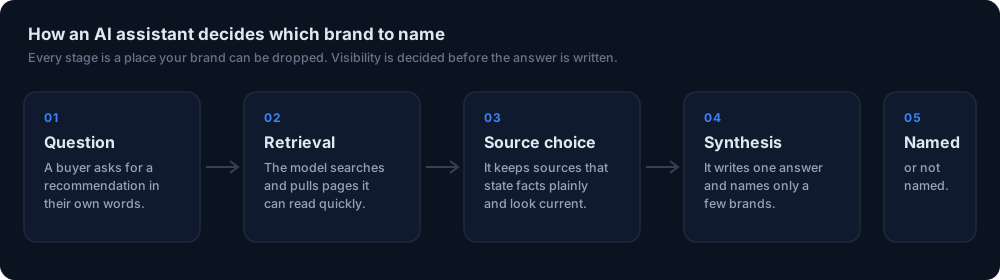
To see which brands and pages ChatGPT recommends, you need to test real buyer questions and record the actual answers. Manual testing is slow and unreliable, as ChatGPT answers can vary by session and prompt phrasing. SEOWedge automates this by discovering high-intent buyer questions for your category, running them through ChatGPT (OpenAI GPT), and capturing which brands and URLs are named or cited in each answer.
The output is a share-of-voice report: you see which brands dominate recommendations, which specific pages are cited, and how your brand compares. This is not a keyword ranking—it's a direct measurement of brand and page mentions inside real AI answers. For a sample of what this looks like, see the public sample report or learn more at ChatGPT Visibility Tracker for Brands and Agencies.
SEOWedge stores each answer with a timestamp, so you can see exactly what ChatGPT said for each question at the time of your scan. This makes the result reproducible and defensible, not just anecdotal.
If you want to understand the difference between being cited, mentioned, or missing, see What an AI Search Visibility Score Actually Measures.
| Buyer Question | Brand Named | Page Cited |
|---|---|---|
| Best running shoes for flat feet | Brand A | brandA.com/products/flat-feet-shoe |
| Eco-friendly phone cases | Brand B | brandB.com/eco-case |
| Affordable standing desks | Brand C | brandC.com/standing-desk-review |
Example: Which brands and pages ChatGPT names for common buyer questions.
What Steps Can I Take to Increase the Chances of My Brand Being Named by ChatGPT?
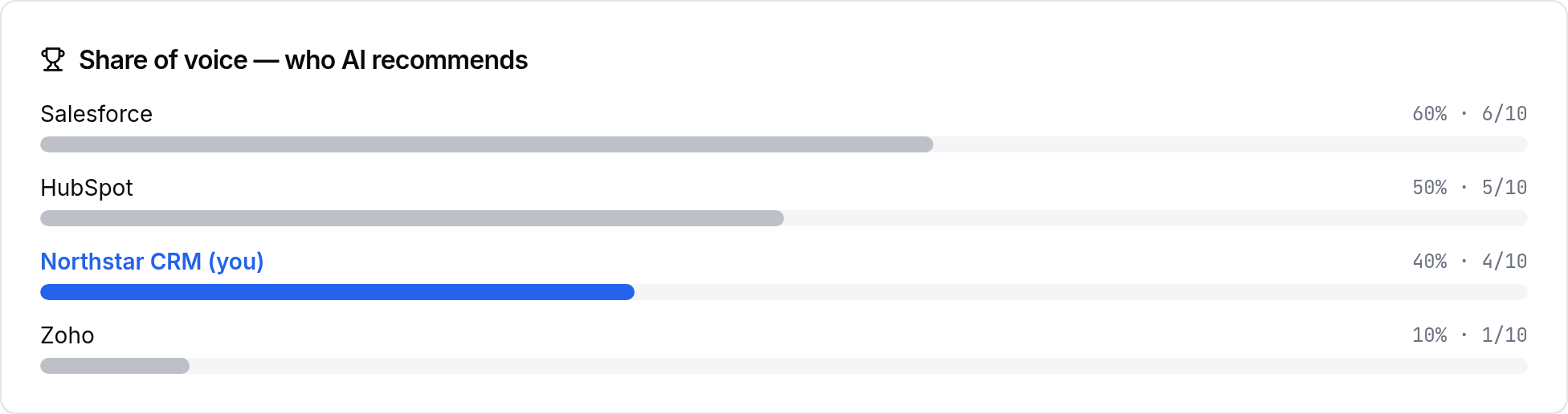
First, confirm your site allows OAI-SearchBot in robots.txt. If blocked, ChatGPT cannot see or cite your pages, regardless of content quality. Next, review your product and category pages: make sure they are specific, answer real buyer questions, and include details that set you apart. Avoid generic content and thin product listings.
ChatGPT looks for content that directly addresses the buyer's intent. This means having pages that answer "Which [product] is best for [use case]?" or "What are the top [category] brands for [problem]?" with clear, cited information. Structured data (like Product or FAQ schema) can help, but only if it matches visible, high-quality content. For schema details, see Structured Data for AI Search: What to Mark Up and What to Skip.
If your brand is missing from ChatGPT recommendations, check which competitor pages are being named. Study their content structure, specificity, and the types of questions they answer. Use this as a benchmark for your own improvements.
SEOWedge automates this diagnosis and tells you exactly which pages and questions are costing you recommendations. For a full step-by-step checklist, see How to Get Your Products Recommended by ChatGPT: Step-by-Step Guide.
| Step | Purpose |
|---|---|
| Allow OAI-SearchBot | Make your site visible to ChatGPT |
| Audit product/category pages | Ensure specificity and buyer focus |
| Add structured data | Support AI understanding (if content matches) |
| Benchmark competitor content | See what wins citations now |
| Fill content gaps | Answer the exact buyer questions ChatGPT tests |
Practical steps to increase ChatGPT product recommendations.
How Does SEOWedge Identify and Fill the Content Gaps That Keep My Brand Out of ChatGPT Answers?
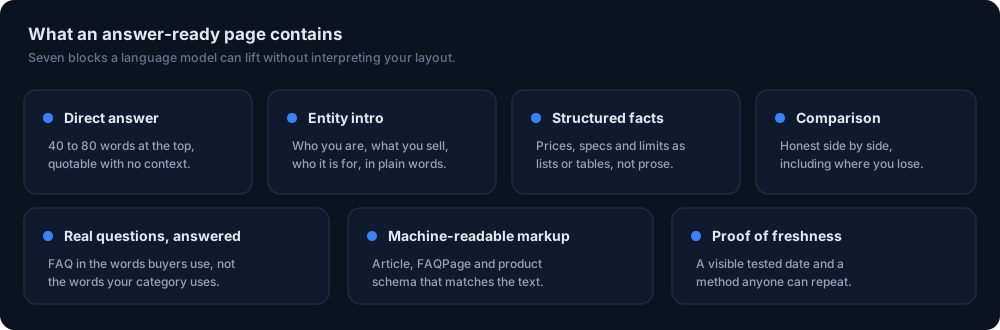
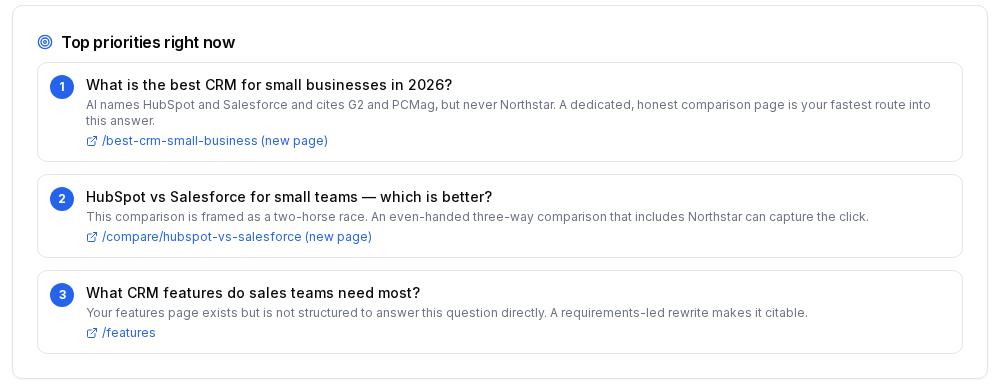
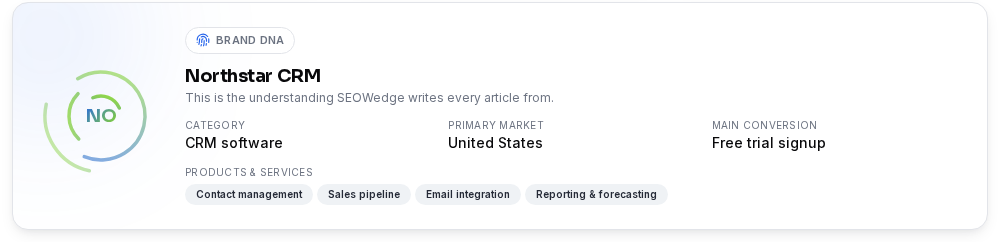
SEOWedge starts by crawling your site and extracting a Brand DNA profile—your category, market, products, and conversion goals. It then discovers the real buyer questions asked in your category, phrased as buyers ask them, not as SEO keywords. Each question is tested live in ChatGPT, and SEOWedge records which brands and pages are named in the answers.
You receive a prioritized list of gaps: for each missed question, SEOWedge shows the exact competitor page that is being cited instead of yours. This is not just a list of missing keywords—it's a map of real, high-impact opportunities where your brand is absent from ChatGPT recommendations.
For each gap, SEOWedge generates an Action Brief. This tells you: the buyer question, why your brand is missing, which competitor is being named, and what type of page or content is needed to close the gap. You do not have to guess what to write or fix.
This workflow removes the manual research and trial-and-error that usually slows down AI search optimization. For more on how gaps become action, see How SEOWedge Turns AI Visibility Gaps Into Actionable Content.
| Gap Question | Competitor Named | Page to Create or Fix |
|---|---|---|
| Best vegan protein powder | Brand X | Create a detailed comparison page |
| Top-rated noise-cancelling headphones | Brand Y | Revise product detail page with expert reviews |
| Affordable ergonomic chairs | Brand Z | Add a buying guide answering value-focused queries |
Sample gaps identified by SEOWedge, with actionable next steps.
What Is the SEOWedge Workflow from Gap Discovery to a Published, Answer-Ready Page?
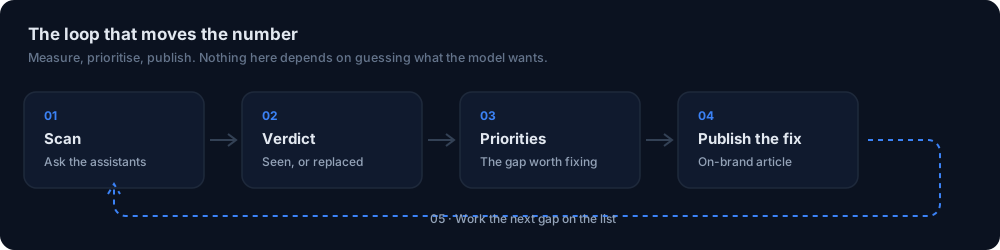
The SEOWedge workflow is built to close the loop from measurement to action in one place. Here’s how it works:
1. Enter your domain. SEOWedge crawls your site and builds your Brand DNA profile automatically—no manual setup required.
2. SEOWedge discovers the high-intent buyer questions for your category, then tests each one in ChatGPT, recording which brands and pages are named.
3. You get an AI-Visibility score, a competitor share-of-voice breakdown, and a ranked list of page-level opportunities. Each opportunity comes with an Action Brief: the buyer question, the competitor page, and the specific fix needed.
4. In the Content Studio, SEOWedge drafts the missing or underperforming page using your Brand DNA profile. You can edit, refine, and score it for Publish Readiness before exporting.
5. On paid plans, you can queue multiple articles at once, moving from gap list to drafted pages in a single session. Once published, SEOWedge supports IndexNow submission so engines see your new URL faster (IndexNow documentation).
This workflow means you do not have to juggle multiple tools or manually rewrite content. SEOWedge is the only tool in this category that measures the answer, names the gap, writes the page, and scores it for publish readiness—all in a single loop.
| Workflow Step | What Happens |
|---|---|
| Enter domain | Crawl and Brand DNA extraction |
| Discover buyer questions | Automatic, category-specific |
| Test in ChatGPT | Record brands/pages cited |
| Get Action Briefs | See exact gaps and fixes |
| Draft and edit page | Brand-aligned, answer-ready |
| Export and publish | Content is ready for ChatGPT citation |
SEOWedge workflow: from gap discovery to published, answer-ready page.
How Does SEOWedge Ensure Content Is On-Brand and Ready for ChatGPT Citation?
SEOWedge generates content directly from your Brand DNA profile, which is built during the initial site crawl. This profile captures your category, product details, tone, and conversion goals. The Content Studio uses this profile to ensure every drafted page matches your brand voice and is specific, not generic.
Each draft is scored for Publish Readiness. This score checks for answer structure, specificity, and brand alignment—key factors that make a page more likely to be cited by ChatGPT. You can revise the draft as needed, with up to 150 revisions per month on Pro and 600 on Agency, before exporting the final version.
This approach means you never get a generic, off-brand AI page. Every exported article is tailored to both the buyer question and your unique brand voice. For more on how Brand DNA works, see Can SEOWedge Write Pages That Match My Brand Voice?.
On paid plans, you can generate up to 10 articles at once, making it practical to address multiple ChatGPT gaps in one workflow.
| Feature | Benefit |
|---|---|
| Brand DNA profile | Keeps content on-brand and specific |
| Publish Readiness score | Ensures answer structure and citation potential |
| Bulk article generation | Fix multiple gaps efficiently |
| Editable drafts | Full control before publishing |
How SEOWedge ensures answer-ready, on-brand content for ChatGPT.
What Is the Fastest Way to See If My Brand Is Being Recommended by ChatGPT—and What Happens Next?
You can start with a free scan on SEOWedge. Enter your domain—no credit card required. The free scan discovers five buyer questions, tests them in ChatGPT, and returns your AI-Visibility score, a competitor share-of-voice chart, and one prioritized Action Brief. You also get one free article draft, scored for Publish Readiness.
This is enough to see if your brand is named in ChatGPT product recommendations for real buyer questions, and to try the workflow for closing a gap. If you want to address more questions, generate more articles, or cover multiple projects, paid plans start at $29/month—the lowest in the category. You can top up credits as needed without changing plans (How Do SEOWedge Credits and Top-Ups Work?).
The result: you get a defensible, actionable answer to "why isn't my brand in ChatGPT recommendations?" and a concrete next step to change it. For a full audit or to compare plan options, see SEOWedge Pricing or Free AI Search Audit by SEOWedge: What You Get, Instantly.
| Plan | Free Scan | Paid Plans |
|---|---|---|
| Buyer questions tested | 5 | 12-25 |
| Action Briefs | 1 | 8 to unlimited |
| Articles per month | 1 (lifetime) | 30-150 |
| Bulk articles at once | 1 | 3-10 |
| Credit top-ups | No | Yes |
SEOWedge free vs paid: what you get for ChatGPT visibility work.

How this was tested
All process details and product claims are current as of 2026-08-13. ChatGPT recommendation data is sampled by SEOWedge using OpenAI's GPT API, recording which brands and URLs are named for each buyer question. SEOWedge's workflow and numbers are based on documented product facts and directly observed outputs. Crawlability requirements are sourced from OpenAI's published documentation. No statistics or claims are invented or extrapolated beyond these sources.
What this page does not cover
This page covers only the process for getting an ecommerce brand named in ChatGPT product recommendations, using SEOWedge's workflow. It does not address Google Gemini, Copilot, or other AI assistants in detail—see dedicated pages for those. All claims are based on SEOWedge's measurement method and OpenAI's documented requirements as of 2026-08-13. For a step-by-step product-level guide, see How to Get Your Products Recommended by ChatGPT.
Questions buyers ask us
Why is my brand missing from ChatGPT product recommendations even though I rank well in Google?
Classic SEO rankings do not guarantee inclusion in ChatGPT answers. ChatGPT relies on what it can crawl and what directly answers the buyer's question. If your pages are not answer-ready, or if OAI-SearchBot is blocked, your brand will be skipped regardless of SEO performance.
How long does it take for ChatGPT to update its recommendations after I publish a new page?
Citations in ChatGPT move when the assistant re-crawls and selects new sources, which typically takes weeks, not hours. SEOWedge supports IndexNow submission to notify engines of new or updated URLs, which can accelerate discovery but does not guarantee instant inclusion.
Can I use SEOWedge if I only want to check ChatGPT, not Google Gemini or Copilot?
Yes, SEOWedge's free plan and Pro plan both include OpenAI GPT (the family behind ChatGPT). You can focus your scans and content work on ChatGPT-specific recommendations. Gemini coverage is available on paid plans if you want to expand later.
Do I need to write my own prompts or buyer questions for SEOWedge to test?
No. SEOWedge automatically discovers high-intent buyer questions for your category. You do not need to supply prompts or maintain a question list. This saves time and ensures you are testing the questions that matter most for recommendations.
What if my products are seasonal or change often? Will SEOWedge still work?
Yes. SEOWedge discovers buyer questions and gaps based on your current site and market, so it adapts to seasonal or changing inventory. You can rerun scans and generate new Action Briefs as your product lineup evolves.
How is SEOWedge different from classic SEO or brand monitoring tools?
SEOWedge is built for generative engine optimization (GEO) and answer engine optimization (AEO)—it measures and closes the gap between your brand and what AI assistants like ChatGPT actually recommend. It does not just monitor mentions or track rankings; it produces the exact page needed to win citations, all in one workflow.
See what AI assistants say about your site
Enter your domain and SEOWedge runs a free scan: your AI-Visibility score, the buyer questions where a competitor is named instead of you, and the first page to fix. No install, no sales call.