
How Can I Use SEOWedge to Improve Visibility for Service or Support Pages?
SEOWedge discovers why your service or support pages are missing from AI answers, identifies the exact questions and competitor pages that win citations, and writes new, on-brand content to close those gaps. The workflow is built to make service and support content as AI-citable as your product pages, with clear measurement of improvement after each update.
By the SEOWedge Research Team · Published August 13, 2026 · Last tested August 13, 2026 · Updated August 13, 2026 · 8 min read
What to take away
- Service and support pages are often missed in AI answers—SEOWedge finds those gaps automatically.
- The scan shows which buyer questions and competitor pages are winning citations for support topics.
- Action Briefs explain what to fix or create for your own service/support content to be cited.
- The Content Studio writes answer-ready, on-brand service pages, not just product content.
- Improvement is measured by re-running the scan and comparing citation results for your updated pages.
How Does SEOWedge Discover Gaps for Service or Support Pages?
SEOWedge starts by crawling your site and extracting your Brand DNA profile. This includes not just products, but also the category, market, and key conversion goals—so support and service sections are mapped from the start. The scan then discovers real buyer questions related to service topics (like warranty, returns, troubleshooting, or how-to support) that are actually being asked in your category.
These questions are sent to AI assistants (OpenAI on every plan, Google Gemini on paid plans) to see which brands and pages are named or cited in live answers. SEOWedge records which competitor or third-party support pages are being surfaced instead of yours, and flags the page-level gaps that cost you visibility.
Unlike classic SEO tools that focus on keywords or product queries, SEOWedge's discovery includes service-specific questions and support intent. This means you see not just if your product is missing, but if your help content is being overlooked in AI answers.
| Step | What SEOWedge Does |
|---|---|
| Crawl site | Maps all sections, including service/support |
| Discover questions | Finds real buyer/service questions for your category |
| Test AI answers | Checks which brands/pages are cited for each question |
| Flag gaps | Identifies missing or underperforming support pages |
How SEOWedge discovers service/support page gaps

What Makes Service and Support Pages Hard to Get Cited in AI Answers?
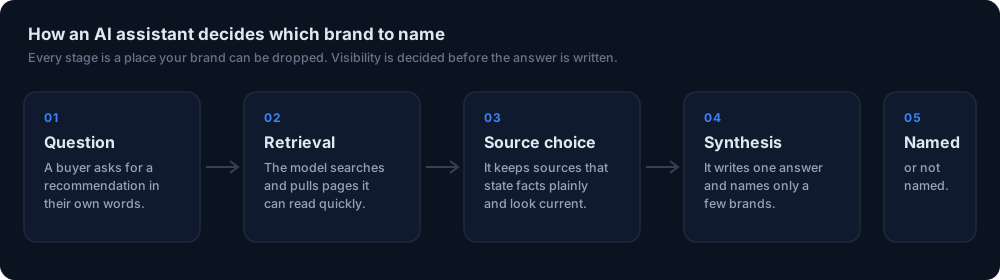
AI assistants choose sources that directly answer the user's question, are easy to retrieve, and look like the authority on that topic. Service and support pages often lose out because they are buried, use generic language, or lack direct-answer structures. Many brands focus their AI search optimization on product and category pages, leaving support content unoptimized for AI citation.
AI models also tend to cite whichever support or help page is most explicit and structured for the question asked. If your warranty or troubleshooting page is vague, or if competitors have clearer, more direct answers, AI assistants will cite them instead. SEOWedge surfaces these issues by showing you the exact competitor page and answer snippet that wins the citation.
For more on how AI models pick sources and what makes a passage quotable, see our AEO guide.
| Common Service Page Issue | Impact on AI Citation |
|---|---|
| Buried in navigation | AI may not find or rank the page |
| Generic or indirect language | Fails to answer the buyer question directly |
| No structured answers or FAQ blocks | Harder for AI to lift a quotable passage |
| Outdated content | AI cites fresher, clearer competitor answers |
Why service/support pages are often missed by AI answers
How Does SEOWedge Turn Service Gaps Into Actionable Tasks?
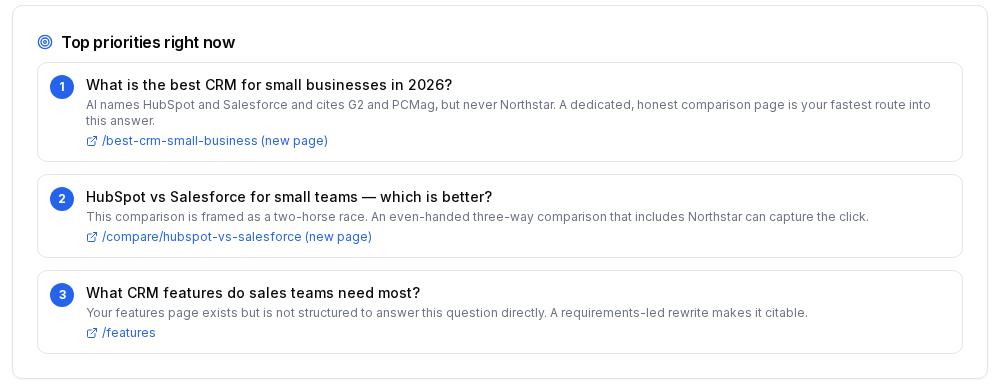
For every missed citation, SEOWedge produces an Action Brief. This brief is specific: it names the buyer question, shows the exact competitor or third-party page getting cited, and explains why AI assistants chose that source. The brief then recommends what to create or change on your own service or support page to win future citations.
This Action Brief is not generic advice. It is tied to the actual AI answer and the real-world gap. For example, if Gemini cites a competitor's warranty FAQ for "How long is the warranty on [product]?", the brief will show their answer and page, and outline what your own warranty page needs to cover to be cited instead.
You do not have to interpret vague metrics or guess what to fix. The Action Brief is the bridge between measurement and action.
| Action Brief Element | What You See |
|---|---|
| Buyer question | Exact wording AI assistants answer |
| Cited competitor page | URL and snippet from the answer |
| Gap explanation | Why your page was missed |
| Recommended fix | What to add or revise on your page |
What a SEOWedge Action Brief includes for service/support gaps
What Steps Make a Service or Support Page AI-Citable?
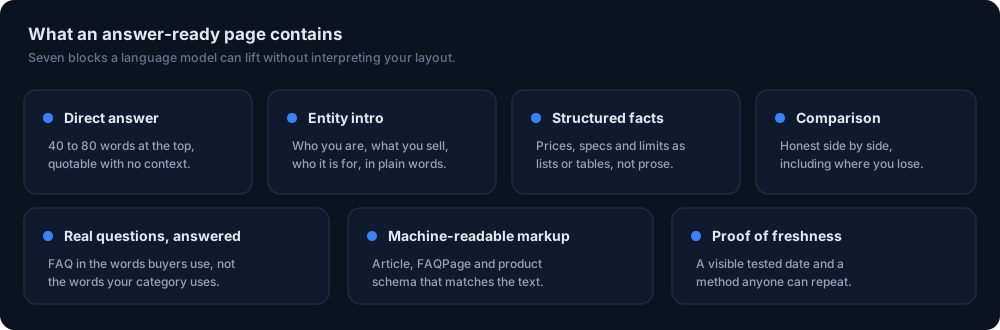
To be cited in AI answers, a service or support page must directly answer the buyer's question, use clear structure (like headings, lists, and FAQ blocks), and be crawlable by AI assistant bots. SEOWedge's workflow ensures every Action Brief leads to a page that meets these criteria.
In the Content Studio, you can generate a draft page based on your Brand DNA profile. This draft will be structured for answer engines—using direct-answer blocks, question headings, and explicit warranty, return, or support details. The Publish Readiness score rates the draft for AI citation potential before you export or publish it.
SEOWedge also recommends submitting new or updated URLs via IndexNow, which notifies participating engines that your page is live and ready for crawling. For more on technical requirements and schema, see our schema markup guide.
| Step | Why It Matters for AI Answers |
|---|---|
| Directly answer the question | AI lifts passages that match the question intent |
| Use headings/FAQ blocks | Makes content quotable and retrievable |
| Keep content updated | AI prefers fresh, authoritative answers |
| Allow AI crawlers (OAI-SearchBot, Gemini) | Ensures page can be indexed and cited |
| Submit via IndexNow | Accelerates discovery by AI engines |
Checklist for making service/support pages AI-citable
How Does the Workflow Differ for Service vs. Product Pages?
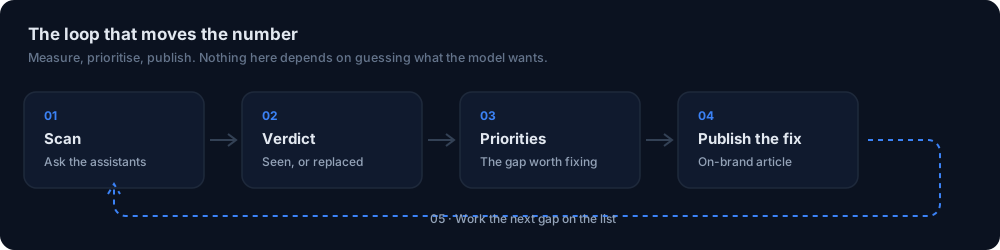
The SEOWedge workflow for service/support pages uses the same loop as for product or category content: scan, discover questions, test AI answers, diagnose gaps, and generate on-brand content. The difference is in the type of questions discovered and the structure of the recommended content.
For service pages, SEOWedge surfaces questions like "How do I file a warranty claim?", "What is your return policy?", or "How do I get technical support?" The Action Briefs and generated drafts focus on clear, policy-driven answers, troubleshooting steps, and support contact details, rather than product features or comparisons.
This means the workflow adapts to the informational and support intent behind these queries. The Content Studio output for a support page will look different from a product page: more FAQ blocks, direct instructions, and policy summaries. But the mechanism—turning a measured gap into a publish-ready, AI-citable page—remains the same.
| Workflow Step | Product Page Example | Service/Support Page Example |
|---|---|---|
| Question discovery | "Which [product] is best for X?" | "How do I return my [product]?" |
| Gap diagnosis | Competitor product page cited | Competitor support FAQ cited |
| Action Brief | Add specs/comparisons | Add direct return instructions |
| Content Studio output | On-brand product guide | On-brand support FAQ or policy |
How the workflow adapts for service/support content
How Do I Measure Improvement After Updating Service Pages?
SEOWedge measures improvement by running the same set of buyer questions against AI assistants after your new or updated service/support pages go live. The scan records which brands and URLs are cited for each question, so you see if your page is now named in place of a competitor or third-party source.
Each scan result is dated and stored, making it possible to compare before-and-after visibility for your support topics. The AI-Visibility score and share-of-voice metrics show whether your brand is gaining ground in service-related answers. This outcome is based on sampled, reproducible AI answers—not just traffic or classic rankings.
The workflow is designed for this reality: citations may take weeks to move as AI assistants re-crawl and re-rank sources. SEOWedge's dated, answer-level record is what makes a shift in citations credible and actionable.
| Metric | What It Shows |
|---|---|
| AI-Visibility score | % of service/support questions where your page is cited |
| Share of voice | How often your brand vs. competitors are named |
| Cited URLs | Which specific pages are named for each service question |
| Date-stamped answers | Proof of improvement over time |
How SEOWedge measures improvement for service/support pages
What Does a Real Example Workflow Look Like?
Suppose your warranty page is missing from AI answers for "How do I claim a warranty on [brand]?" SEOWedge's scan finds that Gemini and ChatGPT are citing a competitor's detailed warranty FAQ. The Action Brief shows the exact question, the cited competitor page, and explains that your page lacks a direct, step-by-step warranty claim process.
In the Content Studio, you generate a new warranty FAQ using your Brand DNA profile. The draft includes clear headings, step-by-step instructions, and direct contact details. The Publish Readiness score confirms the page is structured for AI citation. After publishing, you submit the URL via IndexNow for faster AI crawling.
A follow-up scan (using paid credits or on your monthly plan) will show if your page is now cited for the target question, with a dated answer record for proof.
| Workflow Step | Example Output |
|---|---|
| Scan | Finds competitor warranty FAQ cited |
| Action Brief | Recommends step-by-step claim instructions |
| Content Studio | Drafts on-brand warranty FAQ |
| Publish & Submit | URL submitted via IndexNow |
| Re-scan | Confirms your page is now cited |
End-to-end example: closing a service/support citation gap
How Does SEOWedge Remove the Manual Work for Service and Support Content?
Classic GEO and AEO work for support pages means manually checking AI answers, guessing which questions matter, and hand-writing every page revision. SEOWedge automates this loop: it discovers the real buyer questions, tests them in live AI answers, and produces Action Briefs that name the exact fix needed.
The Content Studio generates answer-ready drafts from your Brand DNA, so your support content is both on-brand and structured for citation. All outputs are scored for Publish Readiness, and you can edit or export as needed. Paid plans allow you to queue multiple articles at once, scaling up for larger support or help centers.
This workflow is what sets SEOWedge apart: one loop from gap discovery to published, on-brand, AI-citable support content, with measurement built in. For more on how this compares to classic SEO or manual AEO, see our comparison guide.
| Manual Step (Classic) | SEOWedge Workflow |
|---|---|
| Hand-check AI answers | Automated, platform-wide scan |
| Guess buyer questions | Questions discovered for you |
| Write from scratch | On-brand drafts generated |
| No measurement of impact | Dated, answer-level citation tracking |
How SEOWedge removes manual work for service/support content
How this was tested
All claims and numbers are based on SEOWedge's workflow and outputs as of 2026-08-13. Scans sample OpenAI (GPT) on all plans and Google Gemini on paid plans. Each scan discovers buyer questions, tests them in live AI answers, records which brands/pages are cited, and generates Action Briefs and on-brand content. Measurement of improvement is by comparing sampled answers and citations before and after content updates, using the same question set and method. No claims are made about other tools unless stated as researched competitor evidence or verified facts.
What this page does not cover
This page focuses on using SEOWedge to improve AI visibility for service or support pages (warranty, returns, customer help, etc.) rather than product or category content. It does not cover agency reporting, B2B-specific workflows, or classic SEO ranking. For product and category page optimization, see our dedicated guide. For agency use cases, see AI Search Reporting for Agencies. All data and workflow steps reflect SEOWedge as of 2026-08-13.
Questions buyers ask us
Will SEOWedge find service/support gaps even if my site is mostly ecommerce?
Yes. SEOWedge scans all site sections, including help, warranty, returns, and support pages. Buyer questions discovered include both product and service topics, so you see missed citations for support content as well as products.
Can SEOWedge write a support or warranty FAQ page for me?
Yes. The Content Studio generates answer-ready drafts for any identified gap, including support, warranty, and returns FAQs. Drafts are based on your Brand DNA, so they reflect your policies and voice, not generic text.
How do I know if my updated service page is now being cited by AI assistants?
After publishing, run a new scan in SEOWedge. The scan tests the same buyer questions and records which brands and URLs are cited in AI answers. You get dated proof if your page is now named instead of a competitor.
Do I need a paid plan to get started with service/support optimization?
No. The free plan gives you a Lite Scan (5 questions, 1 Action Brief, 1 article) with no card required. For more questions, Action Briefs, and multi-page fixes, upgrade to a paid plan or buy credits as needed.
Does SEOWedge support schema markup or technical SEO for service pages?
SEOWedge's Action Briefs and Content Studio drafts include recommended structures (FAQ blocks, headings, answer boxes) that help AI models lift your content. For deeper schema and technical details, see our schema guide.
How long does it take for AI assistants to start citing my updated service page?
AI assistants re-crawl and update their answers on a weekly to monthly cycle. SEOWedge recommends submitting new URLs via IndexNow to accelerate discovery, but citation movement depends on when the assistant refreshes its index.
See what AI assistants say about your site
Enter your domain and SEOWedge runs a free scan: your AI-Visibility score, the buyer questions where a competitor is named instead of you, and the first page to fix. No install, no sales call.