How Can I Use SEOWedge to Get My Brand Featured in AI-Powered Local Product Recommendations?
SEOWedge finds out which brands and pages are named in AI-powered local product recommendations, shows you the exact gaps, and writes location-specific content to close them. It discovers the buyer questions that drive local citations, identifies which competitors are named instead of you, and produces answer-ready, on-brand pages for your target city or region. This lets your ecommerce brand appear in ChatGPT, Gemini, and other AI assistant local product answers.
By the SEOWedge Research Team · Published August 24, 2026 · Last tested August 24, 2026 · Updated August 24, 2026 · 7 min read
What to take away
- SEOWedge discovers the local buyer questions driving AI product recommendations in your city or region.
- You see which competitors are named in local AI answers, and which pages win those citations.
- Each local gap is turned into an Action Brief, showing the exact content you need to create or fix.
- The Content Studio writes on-brand, location-specific pages that match what AI assistants look for.
- You can measure improvement by comparing before-and-after AI answers for your key locations.
How Does SEOWedge Identify Local Product Recommendation Opportunities in AI Answers?
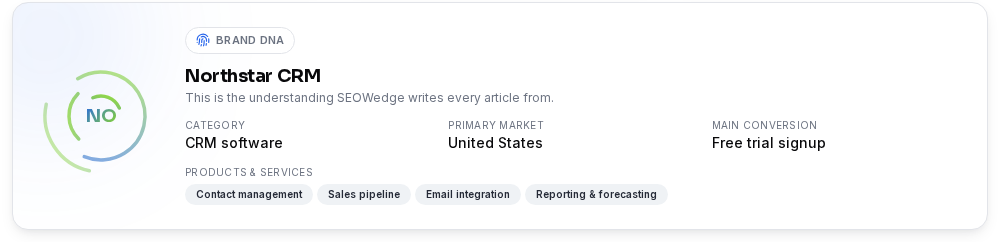
SEOWedge starts by crawling your ecommerce site and building a Brand DNA profile, including your product categories, target markets, and main conversion goals. It then discovers high-intent buyer questions that real shoppers in your city or region actually ask—phrased in natural language, not just keywords. These questions often include local modifiers like "best running shoes in Austin" or "where to buy vegan snacks in Toronto."
Next, SEOWedge sends these location-specific questions to AI assistants (OpenAI GPT on every plan, plus Google Gemini on paid plans) and records which brands and pages each answer names or cites. This is not a guess or a scraped list—it is a dated, reproducible sample of what AI assistants actually recommend to local buyers at the time of the scan. The result is a clear map of which local product queries matter, which brands win them, and where your brand is missing.
Can SEOWedge Show Me Which Local Competitors Are Being Cited Instead of My Brand?
Yes. For every local product recommendation query tested, SEOWedge records not just whether your brand is named, but also which competitors are cited and which specific URLs are referenced. This lets you see, for example, that ChatGPT recommends a rival's city-specific collection page for "best gift shops in Chicago," or that Gemini cites a local review site for "eco-friendly brands in Portland."
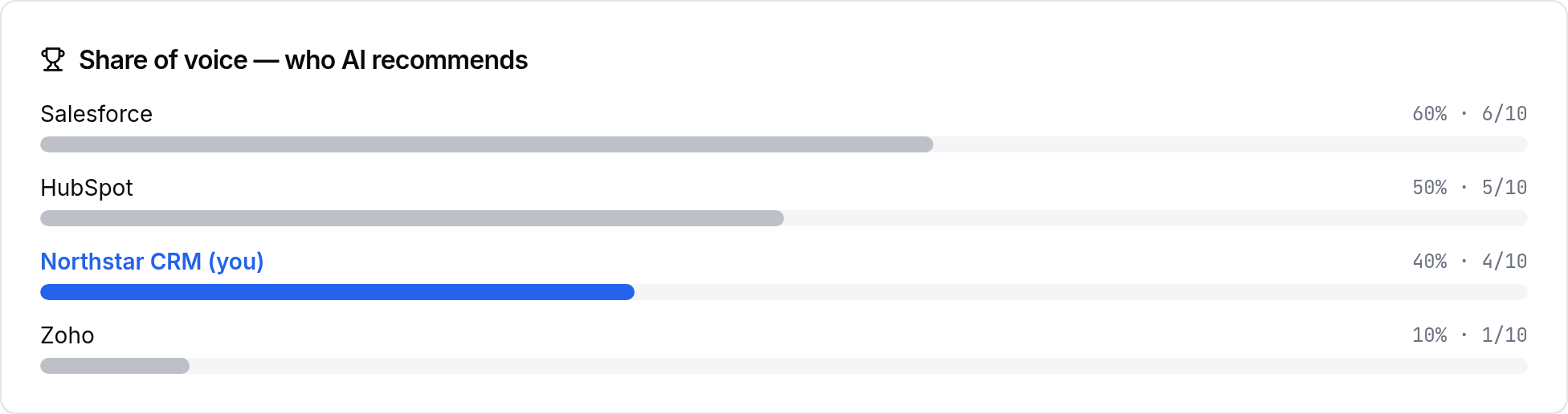
You get a share-of-voice breakdown for each assistant and each location-specific query. The scan output lists the brands and URLs that are winning local citations, so you know exactly who you are up against and which of their pages are being lifted into AI answers. This is not just a brand-level mention—it is page-level, actionable intelligence.
For further detail on how SEOWedge shows cited pages and competitor breakdowns, see How Can I See Which Pages ChatGPT and Gemini Are Citing in My Category?.
What Does the Workflow Look Like for Creating Content That Earns Local AI Citations?
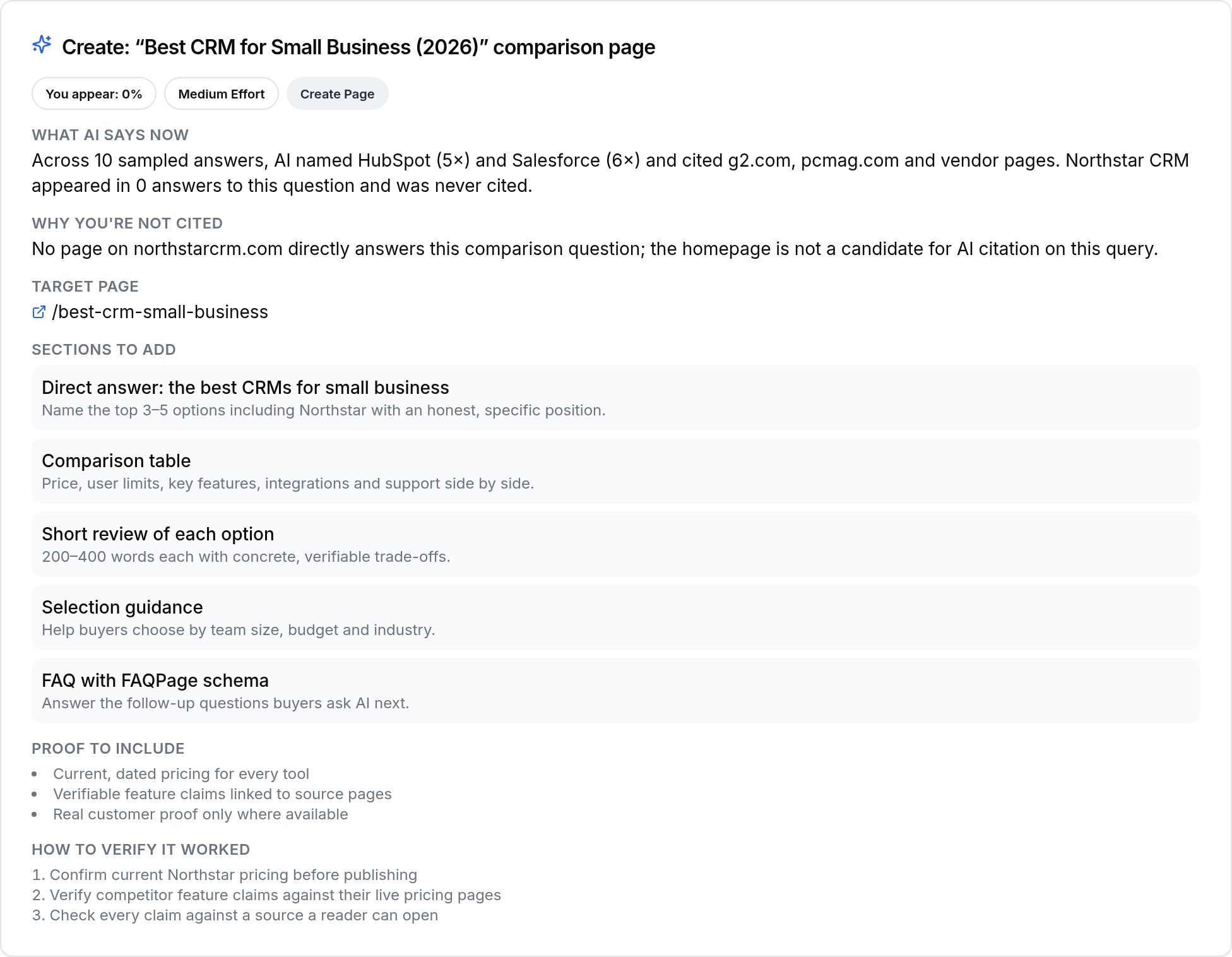
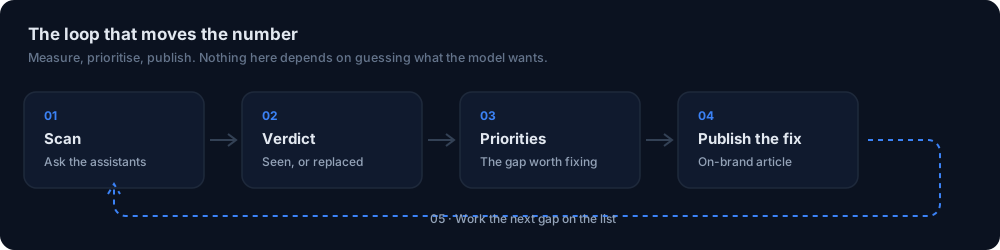
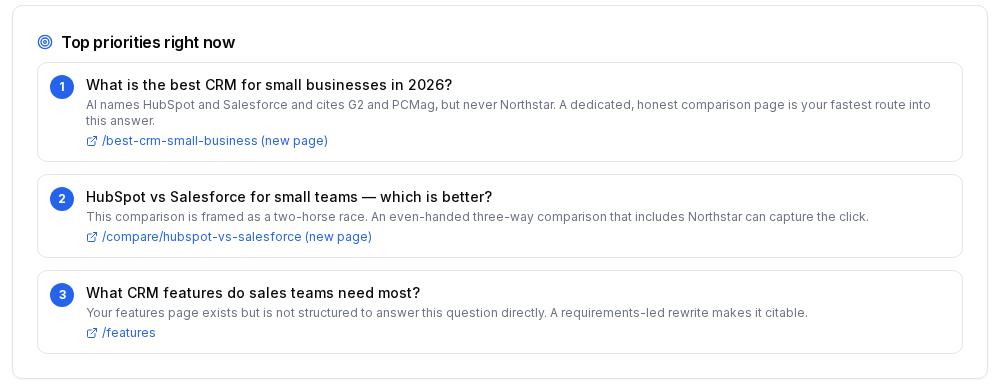
After a scan, SEOWedge presents you with a prioritized list of local AI visibility gaps—each one tied to a real buyer question and a specific competitor page that is currently cited. For each gap, you receive an Action Brief: this includes the exact local question, why another brand is winning, and the type of page you need to create or update (for example, a city-specific collection, a local buying guide, or a store locator with product details).
You can then use the Content Studio to generate a draft page tailored to that city or region. The Content Studio pulls from your Brand DNA profile, so the output is not generic—it reflects your actual products, policies, and local presence. Each draft is scored for Publish Readiness, showing if it meets the structure and specificity AI assistants look for. You can edit, revise, and export the finished page for publishing on your site.
This loop—gap discovery, Action Brief, on-brand draft, and readiness scoring—removes the guesswork from local GEO and AEO. You are not left with a generic template or a prompt to write yourself; you get a complete, location-specific page ready for AI citation.
How Does SEOWedge Ensure My Content Is Genuinely Location-Specific and Answer-Ready for AI Assistants?
SEOWedge's Brand DNA profile includes your location coverage, product types, and unique selling points. When generating content, the Content Studio uses this profile to inject real local details—such as store addresses, delivery areas, or city-specific product selections—directly into the draft. This ensures the output is not a generic "best products" list, but a page that reflects your actual local offer and presence.
The system also checks for answer structure and directness, matching what AI assistants look for when choosing a source to cite. Each page is scored for Publish Readiness, which means it is reviewed for local signals, product specificity, and clear answers to the buyer question. You can review and edit the draft before publishing, so the final page always matches your brand and local strategy.
For more on how SEOWedge keeps every page on-brand and specific, see Can SEOWedge Write Pages That Match My Brand Voice?.
How Do I Measure Improvement After Publishing New Local Pages?
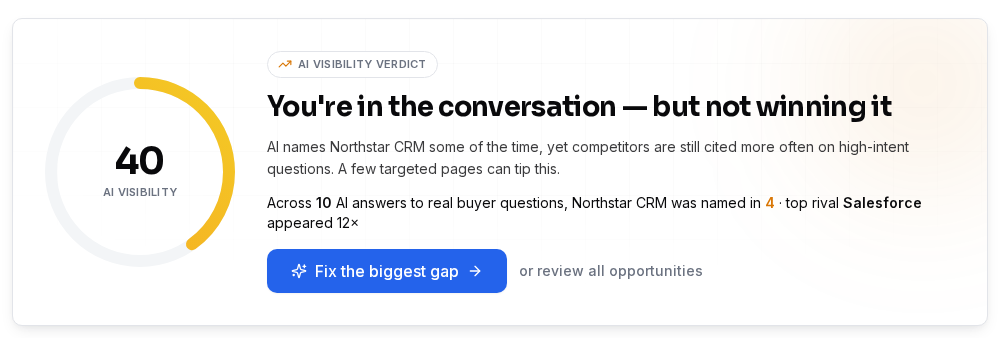
SEOWedge stores the sampled AI answers from your original scan, so you have a dated baseline of which brands and pages were cited for each local query. After you publish new or revised local content, you can run a new scan (on a paid plan) with the same set of buyer questions. This produces a before-and-after comparison, showing whether your brand is now named or cited in the AI answers for those city-specific queries.
Because SEOWedge records the actual assistant outputs and links each citation to a real page, you can see exactly when and where your new content starts to appear in AI recommendations. This is not a vanity score—it is a direct measure of your local AI visibility, and it pairs with your analytics to show whether traffic or conversions move as a result.
For a detailed explanation of what the AI-Visibility score measures and how to interpret it, see What an AI Search Visibility Score Actually Measures.
How Is SEOWedge Different from Manual GEO, AEO, or Prompt-Based Local Optimization?
Manual GEO or AEO work for local recommendations means you have to write your own list of location-specific prompts, test them in each AI assistant, and try to reverse-engineer why a competitor is named. This is slow, subjective, and hard to scale—especially if you want to cover dozens of cities or regions.
SEOWedge automates the discovery of real, high-intent local buyer questions and tests them across multiple AI platforms. You do not have to guess which queries matter or which competitor page is responsible for your absence. The workflow connects measurement, diagnosis, and content creation in a single loop, so you move from gap to answer-ready local page without switching tools or hiring an outside writer.
If you want to see how SEOWedge's workflow compares to other tools or manual methods, visit Best AI Search Visibility Tools for Ecommerce: What to Test and How to Choose.
What Do I Get for Free, and When Should I Upgrade for Full Local Coverage?
The SEOWedge Free plan gives you a one-time Lite Scan for your domain, including five discovered buyer questions (which may include local queries if your site signals strong location intent), one Action Brief, and one on-brand article draft. This is enough to see if your brand is missing from local AI product recommendations and to generate a single answer-ready local page.
Paid plans unlock more: up to 25 discovered questions per scan (Agency plan), coverage of Google Gemini as well as OpenAI GPT, and the ability to generate multiple Action Briefs and articles for different cities or regions at once. You can also buy credit packs to extend limits during busy periods, so you are not forced to upgrade your plan just to cover a seasonal or multi-location campaign.
For a full breakdown of free vs paid features, see SEOWedge Free vs Paid Plans for Ecommerce: What Are the Limits?.
| Plan | Discovered Questions per Scan | AI Providers | Articles per Month |
|---|---|---|---|
| Free | 5 | OpenAI (GPT) | 1 |
| Pro | 12 | OpenAI (GPT) + Google (Gemini) | 30 |
| Agency | 25 | OpenAI (GPT) + Google (Gemini) | 150 |
SEOWedge plan features for local AI product recommendations
What Is the Next Step If I Want to Get My Brand Featured in Local AI Product Recommendations?
Start by running a free scan at SEOWedge signup. Enter your domain and see if your brand appears in local product recommendations on AI assistants. Review the discovered buyer questions, the competitor citations, and the Action Brief for your most valuable local gap. Use the Content Studio to generate your first location-specific, answer-ready page.
If you need to cover multiple cities, regions, or want to track improvement after publishing, consider upgrading to a paid plan or topping up with credits. For a public sample of what a scan and Action Brief look like, see the SEOWedge sample report. If your focus is on location-based product queries, also see Generate Content for Location-Specific Product Queries with SEOWedge for a detailed workflow.
How this was tested
All numbers and claims on this page are based on SEOWedge's measurement and content generation workflow as of 2026-08-24. SEOWedge samples real AI assistant answers (OpenAI GPT and Google Gemini), records which brands and URLs are named for local queries, and produces Action Briefs and answer-ready content for each identified gap. Local opportunity detection and content generation are based on the Brand DNA profile and the buyer questions discovered for each scan. Publish readiness is scored before export. For all method details, see the product facts and workflow above.
What this page does not cover
This page focuses on local and city-specific product recommendation queries in AI assistants, using SEOWedge's workflow. It does not cover manual prompt tracking, classic SEO rankings, or technical site audits unrelated to AI answers. For broader GEO, AEO, or LLM SEO guidance, see the GEO guide or the LLM SEO technical guide. This page relies on SEOWedge's current scan and content generation method, which is shaped for ecommerce and agency use, not for general-purpose enterprise monitoring.
Questions buyers ask us
How does SEOWedge discover which local questions buyers actually ask?
SEOWedge crawls your site and analyzes your category, location signals, and product range. It then discovers high-intent buyer questions that reflect real local search behavior—such as "best [product] in [city]" or "where to buy [product] near me." These are not generic prompts, but location-specific questions that AI assistants are likely to answer with a local recommendation.
Can SEOWedge handle multi-city or region-specific recommendations in one scan?
On paid plans, SEOWedge can discover and act on multiple local buyer questions per scan. You can generate Action Briefs and answer-ready content for several cities or regions at once, making it practical to cover a whole market or franchise footprint. Each Action Brief is tied to a specific location and query.
How does SEOWedge keep my local content on-brand and not generic?
SEOWedge uses your Brand DNA profile, built from your own site, to ensure every generated page includes your real products, policies, and local details. You can edit and review each draft before publishing. The Publish Readiness score checks for both brand voice and local specificity before export.
How long does it take for new local pages to be picked up by AI assistants?
AI assistants update their sources when they re-crawl the web, which can take weeks. SEOWedge submits new URLs via IndexNow to speed up discovery by participating engines, but there is always a lag between publishing and being cited in AI answers. The scan records allow you to measure when your brand starts appearing for each local query.
What if my site is not being crawled by AI assistants?
SEOWedge checks for crawlability issues and flags if your site blocks OpenAI or Google Gemini bots. If your pages are not accessible, AI assistants cannot recommend them. For more on crawlability and technical checks, see the LLM SEO technical guide.
See what AI assistants say about your site
Enter your domain and SEOWedge runs a free scan: your AI-Visibility score, the buyer questions where a competitor is named instead of you, and the first page to fix. No install, no sales call.