How Do I Use SEOWedge to Uncover Product Comparison Opportunities in AI Answers?
SEOWedge shows you exactly which product comparison queries in your category are answered by AI assistants, which brands and pages are named, and where your products are missing. It then produces an Action Brief for each gap, guiding you to create or improve the pages that will win citations in high-intent comparison answers.
By the SEOWedge Research Team · Published August 13, 2026 · Last tested August 13, 2026 · Updated August 13, 2026 · 8 min read
What to take away
- SEOWedge diagnoses where your products are missing in AI-powered product comparisons.
- It discovers high-value comparison queries buyers actually ask in your category.
- You get a concrete Action Brief for each missed citation, naming the exact page to create or fix.
- The Content Studio writes the missing comparison page from your brand profile, ready to export.
- A real free scan shows your first opportunity—no card required.
Can SEOWedge show me if my products are missing from AI-powered comparison answers?
SEOWedge directly tests the real product comparison questions buyers ask in your category by sending them to OpenAI (on all plans) and Google Gemini (on paid plans). It records which brands and pages are named in the AI answers and flags every instance where your products are missing. You see a page-level opportunity list, not just a generic score. Each opportunity is tied to a specific comparison query and AI platform, so you know exactly where you are absent and which competitor is being recommended instead.
This is not a manual prompt tracker. SEOWedge discovers the comparison questions itself, based on your site’s category and market, so you do not need to guess which "vs" or "alternative" queries matter. The scan result includes a share-of-voice chart and a breakdown of the exact pages that are cited for each comparison, making it clear where your products are losing out.
| What SEOWedge Shows | How You Use It |
|---|---|
| Which comparison questions AI assistants answer in your category | See if your products are named or missing |
| Which brands and pages are cited for each query | Identify which competitor wins each comparison |
| Exact page-level gaps for your products | Target the right page to create or improve |
SEOWedge turns AI answer sampling into actionable comparison opportunities.
How can I identify which comparison queries are high-value for my category?
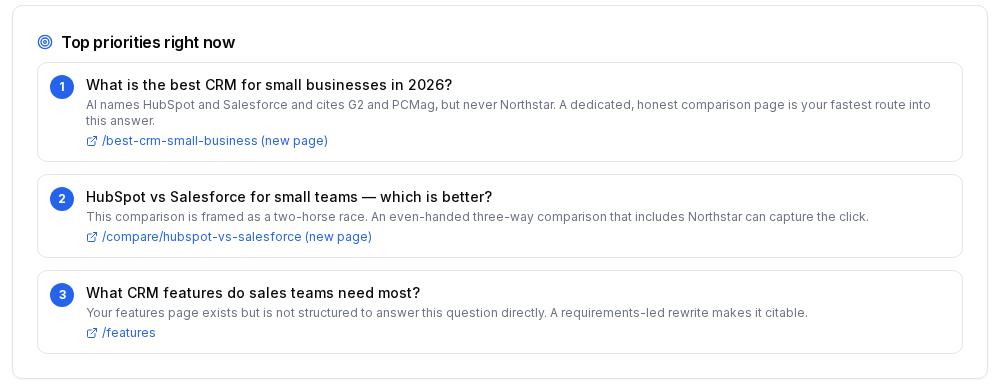
SEOWedge’s discovery process extracts the high-intent buyer questions that drive real product comparisons in your market. This means it does not rely on a fixed keyword list or require you to write prompts. Instead, it crawls your site, analyzes your products and category, and surfaces the most commercially relevant comparison queries—phrased as buyers actually ask them.
Each scan reveals up to 25 discovered questions per project (depending on plan), with a focus on those that signal purchase intent: "best X vs Y", "alternative to Brand Z", "compare [your product] with [competitor]", and similar. These are the queries that AI assistants answer in a way that influences buying decisions. SEOWedge’s scan output shows you which of these high-value questions currently cite your competitors and which are missing your brand.
| Plan | Buyer Questions Discovered Per Scan |
|---|---|
| Free | 5 |
| Pro | 12 |
| Agency | 25 |
Number of high-intent comparison queries discovered per scan, by plan.

What does SEOWedge’s Action Brief tell me about missed comparison citations?
For every comparison query where your product is missing, SEOWedge produces an Action Brief. This is not just a gap alert—it spells out the exact question, which competitor’s page is being cited, and why their answer is preferred by the AI assistant. You see the specific URL and the context of the citation, so you know what needs to be matched or improved.
The Action Brief also explains the content or structure that makes a competitor’s page more likely to be cited. This includes factors like direct answer blocks, product specs, or clear comparison tables. You get a targeted recommendation: create a new comparison page, improve an existing one, or address a missing element that costs you the citation.
| Action Brief Element | What You Learn |
|---|---|
| Comparison question | The exact buyer query that triggers the AI answer |
| Cited competitor page | Which URL is winning the citation |
| Reason for citation | Why the AI assistant prefers that source |
| Recommended fix | What type of page or content to create |
SEOWedge Action Briefs turn missed citations into clear next steps.
How do I create or improve pages for comparison queries using SEOWedge?
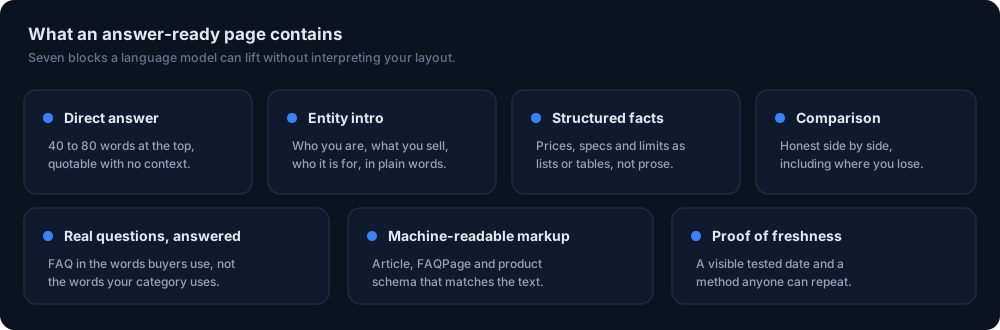
Once you have an Action Brief, SEOWedge’s Content Studio generates the missing comparison page using your Brand DNA profile. This ensures the new content matches your brand’s voice, product specifics, and conversion goals. The page draft is structured for answer engine optimization (AEO) and generative engine optimization (GEO), with direct-answer blocks, comparison tables, and schema markup where needed.
You can edit the draft, adjust product details, and review the Publish Readiness score—a deterministic measure of how likely the page is to win a citation. Once satisfied, export the page and publish it on your site. SEOWedge then provides guidance on submitting the URL via IndexNow, so AI assistants see the new comparison page as soon as possible.
On paid plans, you can queue several Action Briefs and generate multiple comparison pages at once, making it practical to address all major gaps in a single workflow. This is especially valuable for agencies or brands with large product catalogs.
| Workflow Step | What SEOWedge Delivers |
|---|---|
| Action Brief | Clear, page-level recommendation for a missed comparison query |
| Content Studio draft | AI-generated, on-brand comparison page |
| Publish Readiness score | Objective measure of citation-readiness |
| Export and guidance | Instructions for publishing and notifying engines |
From gap to published comparison page with SEOWedge.
How does SEOWedge’s approach differ from prompt-based or classic SEO tools?
SEOWedge does not require you to maintain a list of prompts or keywords. It discovers real buyer questions from your site and market, then tests them against the actual AI assistants buyers use—OpenAI (GPT) and Google Gemini. Other tools ask you to supply prompts and bill by the number tracked, but those are only as good as your guesswork. SEOWedge’s approach means you see the true market landscape, not just what you thought to ask.
Classic SEO tools track rankings for keywords, but AI assistants do not show blue links or classic rankings. Instead, they generate answers that cite sources. SEOWedge measures which brands and pages are named in those answers, so you see the real share of voice for comparison queries. For a full breakdown of how GEO, AEO, and classic SEO differ, see GEO vs AEO vs SEO: The Practical Definitions and When Each Matters.
| SEOWedge | Prompt-Based Tools | Classic SEO Tools |
|---|---|---|
| Discovers buyer questions automatically | You write and maintain prompts | You supply keywords |
| Shows which pages are cited in AI answers | Tracks prompt inclusion | Tracks search rankings |
| Produces on-brand content to close gaps | Requires separate content workflow | Does not address AI answer gaps |
How SEOWedge’s workflow is shaped for AI-powered comparison answers.
How do I prioritize which comparison gaps to fix first?
SEOWedge’s opportunity list is ranked by commercial value and share-of-voice lost. The top opportunities are those comparison queries with the highest buyer intent and the largest gap between your brand and competitors. Each Action Brief includes a priority score, so you can focus on the pages most likely to drive conversions if you win the citation.
On paid plans, you can generate several comparison pages at once, working through the highest-impact gaps first. For a deeper explanation of how SEOWedge turns a long opportunity list into a practical action queue, see Can I Use SEOWedge to Prioritize Which Pages to Create or Fix First?.
| Opportunity Attribute | How It Guides Prioritization |
|---|---|
| Buyer intent | Focus on queries that signal purchase decisions |
| Share-of-voice lost | Target gaps with the biggest lost exposure |
| Competitor cited | See which competitor is winning each query |
| Action Brief priority | Start with the highest-priority fixes |
SEOWedge ranks comparison opportunities by impact and urgency.
What happens after I publish a new comparison page?
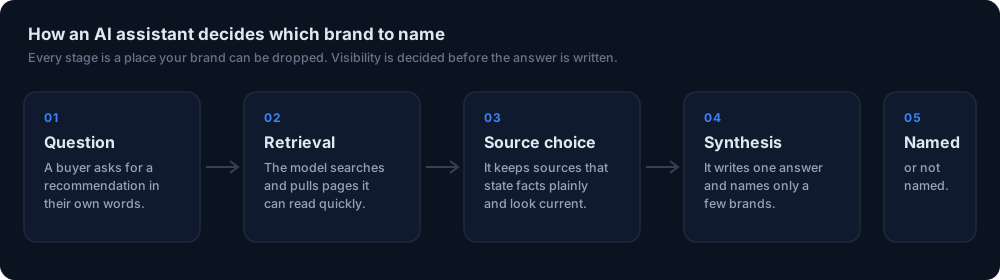
After you publish a new or improved comparison page, SEOWedge guides you to submit the URL through IndexNow, which notifies participating engines of the update. This step helps AI assistants find and re-crawl your page sooner, reducing the lag between publishing and being considered for citation. For background on IndexNow, see IndexNow documentation.
Citations in AI answers move when assistants re-crawl and update their sources. This can take days to weeks, depending on the assistant and the crawl schedule. SEOWedge’s method notes explain that it stores every sampled answer with a date, so you can compare before-and-after states using the same question set and method. For more on how SEOWedge measures and validates these changes, see What an AI Search Visibility Score Actually Measures.
| Step | Why It Matters |
|---|---|
| Publish new page | Makes your product eligible for citation |
| Submit via IndexNow | Accelerates discovery by AI assistants |
| Wait for re-crawl | AI answers update after new content is indexed |
| Re-sample with SEOWedge | See if your citation status has changed |
Steps to move from missing to cited in AI-powered comparison answers.
What is the fastest way to start uncovering product comparison opportunities with SEOWedge?
You can start with a real free scan—no card required. Enter your domain and SEOWedge will crawl your site, extract your Brand DNA, and discover the first set of high-intent buyer questions, including comparison queries. The free scan returns your AI-Visibility score, competitor share of voice, and your first page-level opportunity with a complete Action Brief. You can generate one free article to close that gap, edit it, and export it for publishing.
If you need to cover more queries, run scans for multiple categories, or generate content in bulk, you can upgrade to a paid plan at the lowest entry point in the category ($29/month). Paid plans unlock more discovered questions per scan, more Action Briefs, and bulk article generation. For a detailed breakdown of free vs paid limits, see SEOWedge Free vs Paid Plans for Ecommerce: What Are the Limits?.
| Plan | Free Scan Includes |
|---|---|
| Free | 1 project, 5 questions, 1 Action Brief, 1 article |
| Pro | 5 projects, 12 questions per scan, 8 Action Briefs, 30 articles/month |
| Agency | 25 projects, 25 questions per scan, unlimited Action Briefs, 150 articles/month |
SEOWedge plan options for uncovering and closing comparison gaps.
What’s my next step if I want to win product comparison citations in AI answers?
If you want to see where your products are missing from AI-powered comparison answers, start with a free scan at SEOWedge signup. Review your opportunity list and Action Briefs. Use the Content Studio to generate and edit the missing comparison page. Publish and submit the URL for indexing. If you have more gaps to close, or need to cover multiple products or categories, consider upgrading for bulk coverage and deeper scans.
For further detail on optimizing for comparison and "vs" queries, see Can SEOWedge Help Me Get Cited in AI Answers for Comparison or "vs" Pages? and AEO Checklist for Ecommerce: Product, Category & Comparison Pages. SEOWedge is built for ecommerce and agency buyers who want to turn missed AI citations into conversion-driving content—one actionable loop from measurement to published fix.
How this was tested
All product facts and workflow steps are drawn from SEOWedge’s published documentation and interface as of 2026-08-13. Screenshots illustrate the real platform. Claims about AI answer sampling and citation gaps are based on SEOWedge’s scan process: discovered buyer questions are run through OpenAI (all plans) and Google Gemini (paid plans), with answers stored and scored per provider. Action Briefs and page recommendations are generated from these sampled answers. No feature, number or workflow is claimed beyond what is documented in the product facts and workflow blocks.
What this page does not cover
This page focuses on using SEOWedge to uncover and close product comparison opportunities in AI answers for ecommerce brands and agencies. It does not cover generic SEO tactics, classic keyword rank tracking, or manual prompt-based monitoring. For a full breakdown of GEO, AEO, and LLM SEO definitions, see GEO vs AEO vs SEO: The Practical Definitions and When Each Matters. For details on other page types or non-comparison queries, see the related guides linked throughout this page.
Questions buyers ask us
How does SEOWedge discover comparison queries without me providing a list?
SEOWedge crawls your site, identifies your category and products, and uses its own discovery engine to surface the buyer questions that drive real comparison answers in your market. You do not need to supply prompts or keywords—SEOWedge finds the commercially relevant queries automatically.
Can I see which competitor pages are winning comparison citations in AI answers?
Yes. SEOWedge shows not just which competitor brands are named, but the exact URLs being cited for each comparison query. This lets you see what content or structure is getting them cited, so you can target your own fix.
What if I already have comparison pages but they are not being cited?
SEOWedge’s Action Brief will show you why your page is being overlooked—whether it’s missing a direct answer, lacks a clear comparison table, or is outperformed by a competitor’s structure. You get a specific recommendation for what to add or revise to become the cited source.
How fast can I go from gap discovery to a published comparison page?
You receive the Action Brief and can generate a draft comparison page in minutes using the Content Studio. After editing and publishing, you can submit the URL via IndexNow for faster discovery by AI assistants. The time to citation depends on when the assistants re-crawl, which typically takes days to weeks.
Do I need to upgrade to a paid plan to see comparison opportunities?
The free plan gives you one project, five discovered questions (including comparison queries), one Action Brief, and one article to close your first gap. To unlock more opportunities and bulk generation, upgrade to Pro or Agency.
How is SEOWedge different from classic SEO tools for comparison content?
Classic SEO tools track rankings for keywords, but AI assistants generate answers that cite sources. SEOWedge measures which pages are actually named in those AI answers and produces the content needed to win those citations, closing the loop from measurement to fix.
See what AI assistants say about your site
Enter your domain and SEOWedge runs a free scan: your AI-Visibility score, the buyer questions where a competitor is named instead of you, and the first page to fix. No install, no sales call.