How Do I Use SEOWedge to Improve Visibility for Custom-Configured Products in AI Answers?
SEOWedge discovers the real buyer questions asked about custom-configured or build-to-order products, pinpoints missing or underperforming pages, and generates answer-ready, on-brand content designed to win citations in AI answers. The workflow turns complex product options into clear, citable pages that AI assistants can reference, helping your brand stand out for bespoke product queries.
By the SEOWedge Research Team · Published August 24, 2026 · Last tested August 24, 2026 · Updated August 24, 2026 · 6 min read
What to take away
- SEOWedge surfaces buyer questions unique to custom-configured and build-to-order products—no prompt writing needed.
- It diagnoses which custom product pages are missing or underperforming in AI answers, naming the exact gap.
- You get an Action Brief for each gap: what question to answer, why you’re missing, and which page to create.
- The Content Studio writes new pages from your Brand DNA—on-brand, answer-ready, and scored for AI citation.
- Free scan covers the basics; paid plans unlock more questions, Action Briefs, and bulk content generation.
Can SEOWedge Discover Buyer Questions for Custom-Configured Products?
Yes. SEOWedge does not rely on a fixed prompt list or require you to write queries. When you enter your domain, SEOWedge crawls your site, extracts your category and product structure, and discovers the buyer questions buyers actually ask about custom-configured or build-to-order products. These questions are phrased in the language real customers use—covering configuration options, personalization, lead times, compatibility, and more.
This discovery process is automated and tuned for ecommerce, so it surfaces queries that classic SEO tools or prompt trackers miss. Each scan finds questions specific to your category and product model, not just generic product keywords. For a deeper explanation of this process, see How Does SEOWedge Find Buyer Questions for My Ecommerce Site?.
How Does SEOWedge Identify Missing or Underperforming Pages for Custom Products?
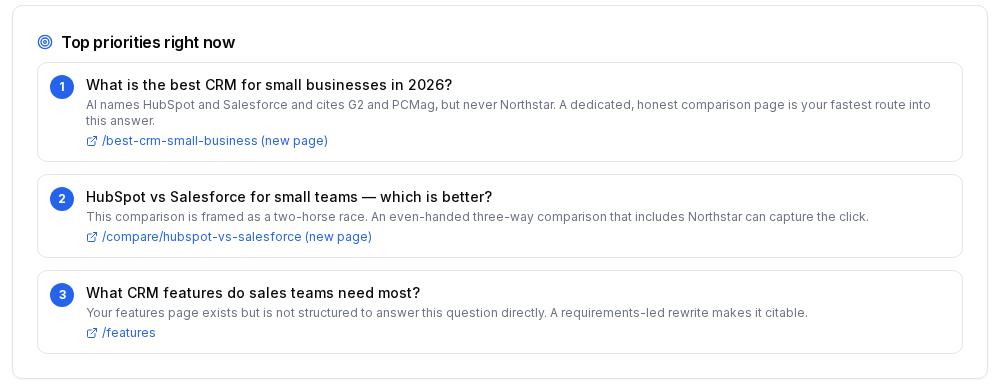
Once SEOWedge has the real buyer questions, it sends them to AI assistants—OpenAI (GPT) on all plans, and Google Gemini on paid plans. Each answer is sampled and scored to see which brands and pages are named or cited for those queries. If your custom-configured product pages are missing or underperforming, SEOWedge records the gap and shows the exact question, the AI assistant’s answer, and which competitor or third-party page is being cited instead.
You see a page-level opportunity list, with each gap tied to a specific buyer question and the page that needs to be created or improved. This is not a guess or a ranking—it is a sampled observation from what AI assistants actually say today. The method is reproducible and gives you a defensible reason for every action.
What Is an Action Brief and How Does It Guide My Next Step?
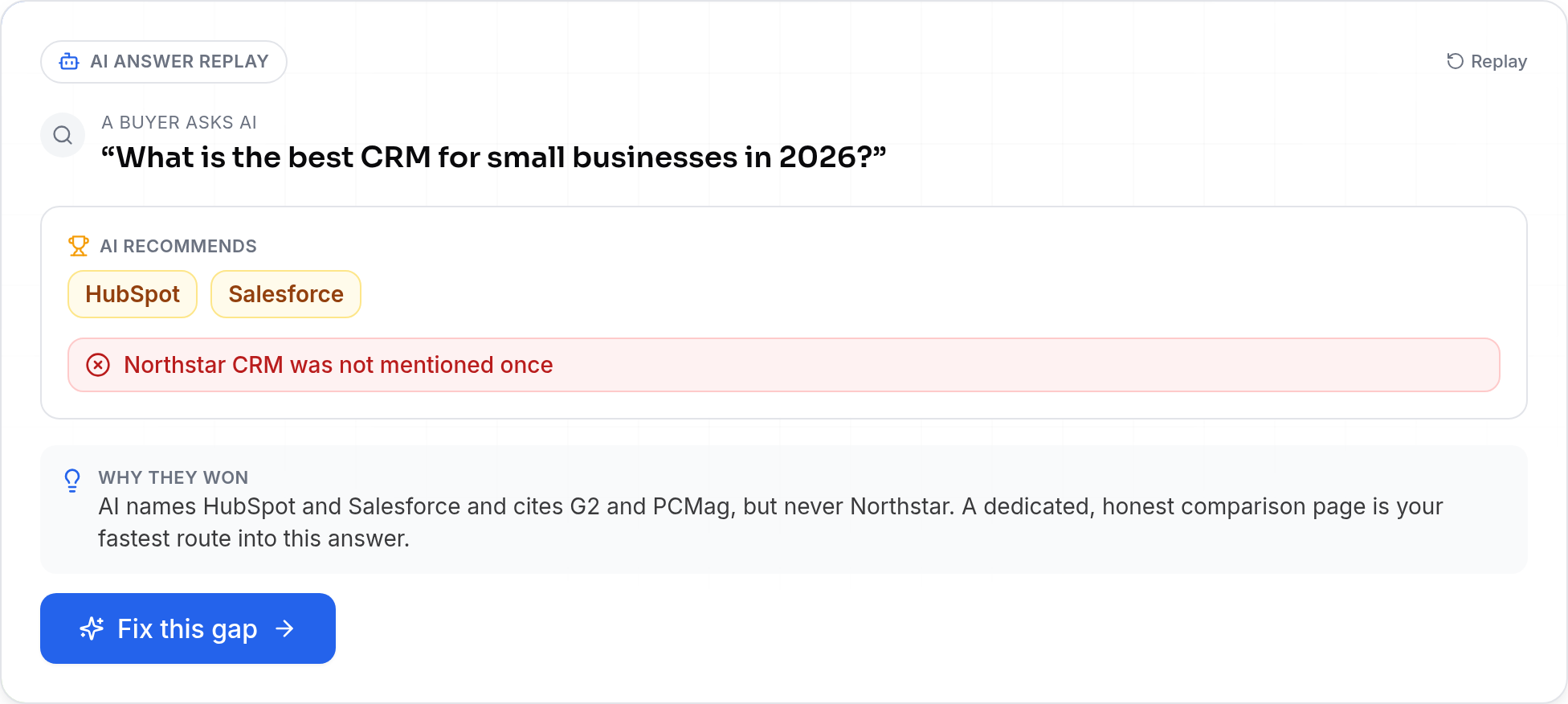
For each gap, SEOWedge produces an Action Brief. This is a one-page summary that tells you: the buyer question, why your brand is not cited, which competitor or source is named, and what page (URL or topic) you need to create or revise. Action Briefs are specific to custom-configured products, reflecting the unique queries buyers ask about configuration, options, and personalization.
The Action Brief removes guesswork. You do not have to interpret vague recommendations or generic keyword lists. You see exactly what is missing and what to build next. This workflow is what makes SEOWedge actionable for ecommerce teams selling complex or bespoke products. For more detail on turning gaps into content, see How SEOWedge Turns AI Visibility Gaps Into Actionable Content.
How Does SEOWedge Generate On-Brand, Answer-Ready Content for Custom Product Queries?
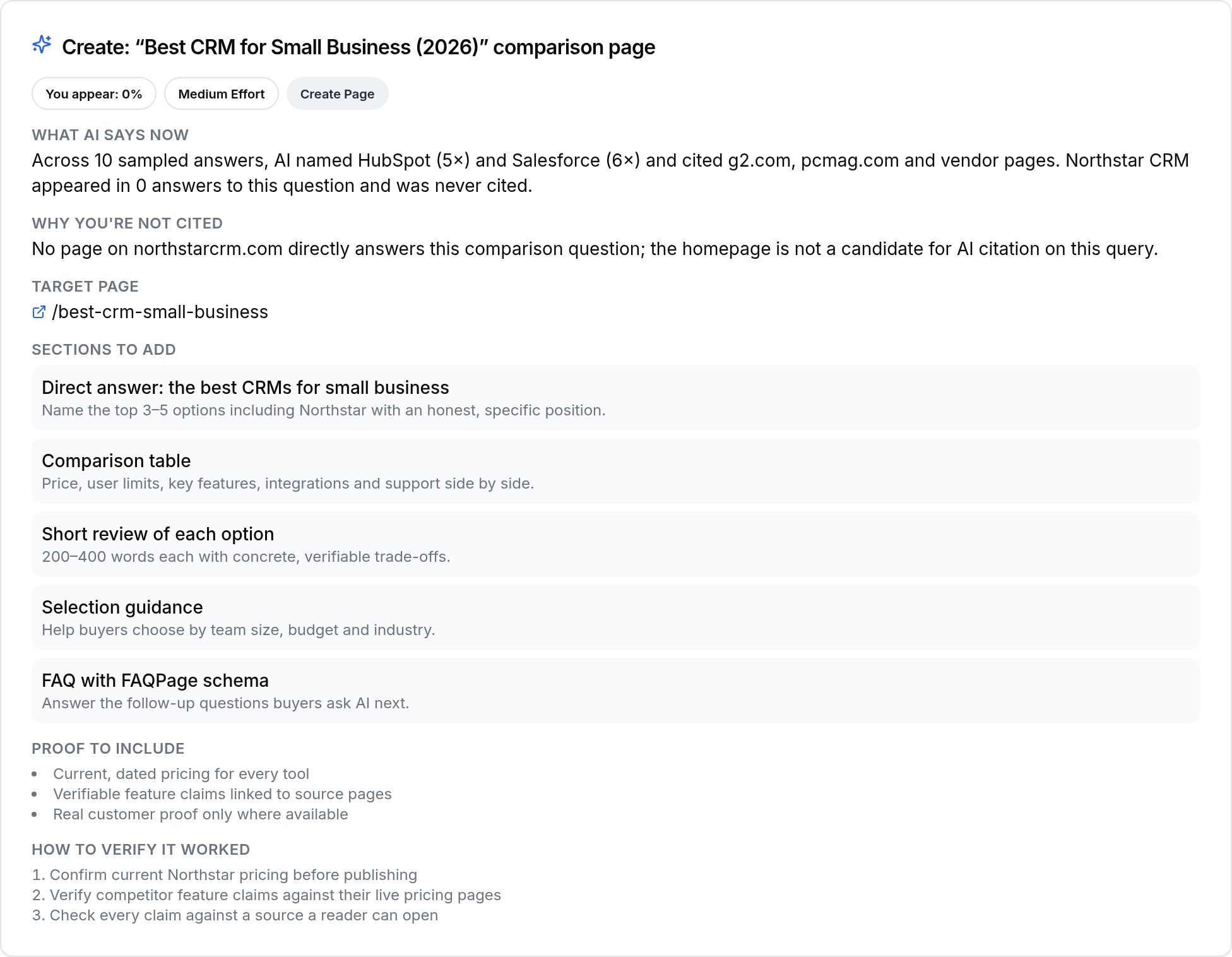
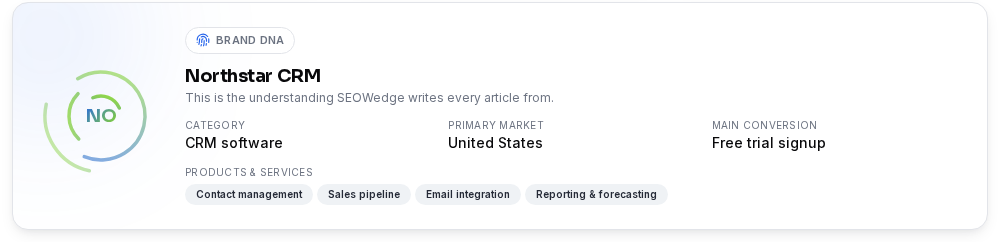
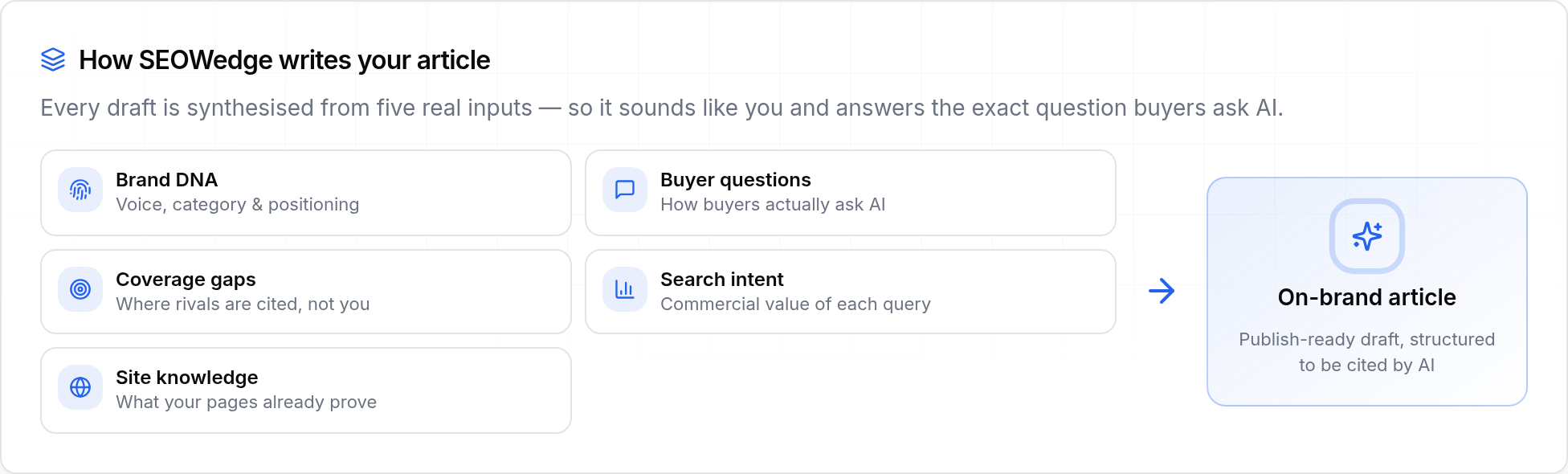
SEOWedge’s Content Studio uses your Brand DNA profile—automatically extracted from your site on the first scan—to generate new pages or revise existing ones. This ensures every page is written in your brand’s voice, covers your unique product options, and answers the specific buyer question surfaced in the Action Brief.
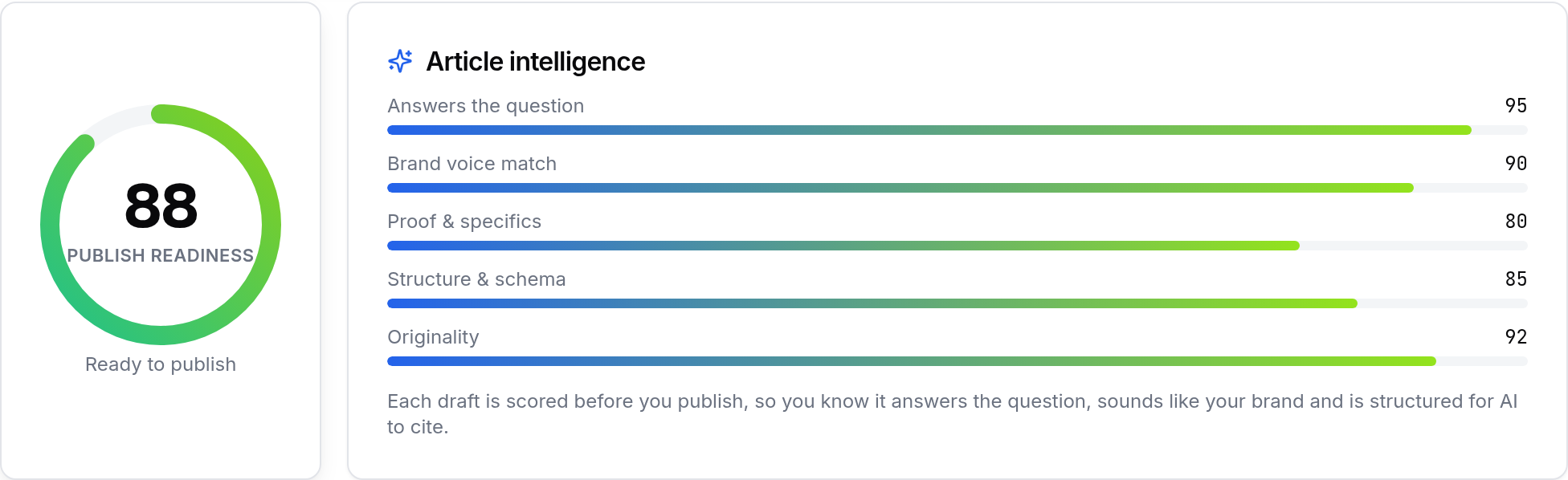
You can review, edit, and score each draft for Publish Readiness before exporting. The Publish Readiness score is deterministic: it checks for direct-answer structure, clarity, and the inclusion of the facts AI assistants need to cite your page. This is not generic AI writing; it is tuned for your brand and your product’s configuration logic.
What Does a Publish-Ready Custom Product Page Look Like for AI Citation?
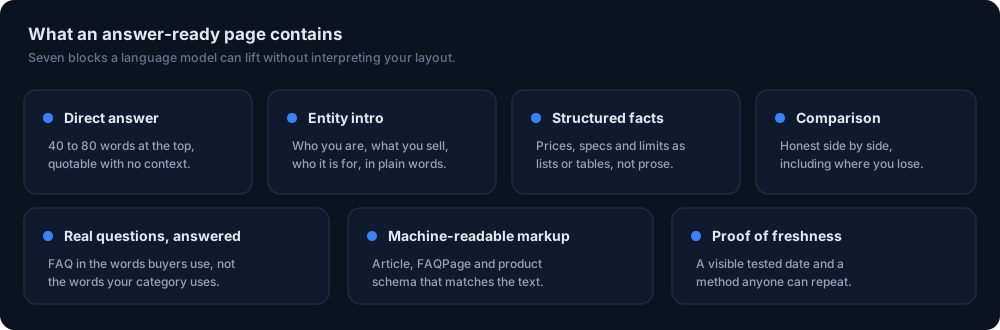
A publish-ready page for a custom-configured product answers the buyer’s question directly, details the configuration process or options, and includes facts that AI assistants can extract and cite. SEOWedge’s Content Studio structures the page for answer engine optimization (AEO) and generative engine optimization (GEO): clear headings, direct-answer blocks, and schema markup that matches the visible content.
The page avoids generic copy. Instead, it reflects your actual product logic—such as step-by-step configuration, compatibility notes, or unique selling points. The Publish Readiness score ensures the page meets the technical and content requirements for AI citation. For examples of answer-ready structure, see Answer Engine Optimization (AEO): How to Become the Quoted Source.
How Does the Workflow Differ for Custom vs Standard Product Pages?
Custom-configured products generate more complex buyer questions than standard SKUs. SEOWedge’s question discovery adapts to this by surfacing queries about build-to-order processes, personalization choices, and compatibility—not just price or stock. The Action Briefs for custom products are more detailed, often specifying which option or configuration is missing from AI answers.
Content generation is also more involved: the Brand DNA profile ensures that every draft page reflects your unique process and product structure. The workflow supports both creating new pages and revising existing ones to meet AI citation criteria. If you want to compare workflows for other product types, see How to Use SEOWedge to Improve Product Page Visibility in AI Search and How Does SEOWedge Handle Collections or Bundles in AI Search Answers.
What Do I Get Free, and What Unlocks on Paid Plans?
The free plan gives you one Lite Scan (five buyer questions discovered, one Action Brief, one free article), so you can test the workflow on your most important custom-configured product or category. No card is required. Paid plans unlock more: up to 25 buyer questions per scan, 8 or unlimited Action Briefs, bulk article generation, and support for Google Gemini as well as OpenAI.
Paid plans also allow you to queue several custom product pages at once, making it practical to close multiple gaps in one session. You can top up credits to extend limits without changing plan. For a detailed comparison, see SEOWedge Free vs Paid Plans for Ecommerce: What Are the Limits?.
| Plan | Buyer Questions per Scan | Action Briefs per Scan | Articles per Month | Bulk Article Generation |
|---|---|---|---|---|
| Free | 5 | 1 | 1 | No |
| Pro | 12 | 8 | 30 | 3 at once |
| Agency | 25 | Unlimited | 150 | 10 at once |
SEOWedge plan features for custom-configured product AI visibility

How Do I Know When My Custom Product Pages Are Ready for AI Citation?
SEOWedge scores every draft page for Publish Readiness. This score checks for direct answers, structured data, on-brand voice, and the inclusion of all configuration details needed by AI assistants. You can see what is missing before publishing, reducing the risk of being overlooked by AI engines.
Once published, SEOWedge submits the URL via IndexNow so search engines and AI assistants are notified of the new or updated page. AI citation is not instant—assistants re-crawl and update sources on their own cycles, which usually takes weeks, not hours. The workflow is designed for this reality, so every step is documented and reproducible.
What Is the Next Step If I Want to Improve AI Visibility for Custom-Configured Products?
Start by running a free scan on your main custom-configured product or category. Review the discovered buyer questions and your first Action Brief. If you see gaps, use the Content Studio to generate a draft page and check its Publish Readiness score. Paid plans let you scale this process across more products, categories, and AI platforms.
If you want to compare the workflow for customization queries, see Create AI-Visible Content for Product Customization Queries with SEOWedge. For broader GEO and AEO guidance, visit the SEOWedge resources hub.
How this was tested
All claims and numbers are based on SEOWedge's workflow and plan facts as of August 24, 2026. Buyer question discovery, gap diagnosis, and content generation steps are documented in SEOWedge's official product facts. Screenshots reflect the current SEOWedge interface. Where process or measurement details are given, they are based on actual sampled AI answers and the Brand DNA-driven content workflow.
What this page does not cover
This page focuses on SEOWedge’s workflow for custom-configured and build-to-order products in ecommerce, not standard SKUs or purely informational content. For product customization queries, see the dedicated guide at Create AI-Visible Content for Product Customization Queries with SEOWedge. Technical LLM SEO, multilingual support, and compliance for regulated products are covered in linked resources. Results reflect the SEOWedge method and do not guarantee instant AI citation, as AI answer updates depend on assistant recrawl cycles.
Questions buyers ask us
Do I have to write my own buyer questions or prompts for custom products?
No. SEOWedge automatically discovers high-intent buyer questions for your custom-configured or build-to-order products. You do not need to write or maintain prompt lists. The scan finds what real buyers ask, based on your site, category, and market.
How does SEOWedge handle complex configuration logic or product options?
SEOWedge’s Brand DNA profile captures your product structure and configuration logic from your site. Generated content reflects these specifics, so answer-ready pages include the details AI assistants need to cite your brand for complex queries.
Can I edit or review the generated content before publishing?
Yes. Every draft page can be reviewed and edited inside the Content Studio. SEOWedge provides a Publish Readiness score, showing what needs to be improved for AI citation. You control the final content before export and publication.
How long does it take for AI assistants to update and cite my new custom product page?
AI assistants update their sources on their own recrawl cycles, which typically take weeks. SEOWedge submits published URLs via IndexNow to notify engines, but AI citation is not instant. The workflow is designed for this lag, and every scan is a dated, reproducible sample.
What’s the difference between optimizing for custom-configured products and standard SKUs in SEOWedge?
Custom-configured products generate more complex, high-intent buyer questions. SEOWedge’s question discovery, Action Briefs, and content generation adapt to these, surfacing configuration-specific gaps and producing answer-ready pages that cover the full buyer journey for bespoke products.
Can I use SEOWedge for both custom and standard products on the same site?
Yes. SEOWedge discovers and surfaces buyer questions for every product type it finds in your ecommerce structure. You can prioritize gaps for custom, standard, or bundled products and generate content for each as needed.
See what AI assistants say about your site
Enter your domain and SEOWedge runs a free scan: your AI-Visibility score, the buyer questions where a competitor is named instead of you, and the first page to fix. No install, no sales call.