How Do I Use SEOWedge to Diagnose Why My Brand Is Missing from AI-Curated Gift Guides?
SEOWedge diagnoses why your brand is missing from AI-curated gift guides by measuring which brands and pages AI assistants cite, showing the exact gaps, and producing action briefs and on-brand content to close them. You see which competitors are named, why, and get a concrete next step to win inclusion in future gift lists.
By the SEOWedge Research Team · Published August 13, 2026 · Last tested August 13, 2026 · Updated August 13, 2026 · 8 min read
What to take away
- Run a free SEOWedge scan to see if your brand is cited in AI gift guides—no card needed.
- Get a page-level breakdown of which competitors are named and which questions cost you citations.
- Action Briefs show exactly what to fix or create to get included in AI-generated gift lists.
- SEOWedge writes the missing page from your brand profile, ready for AI citation.
- See which content signals matter for GEO and AEO—then export and publish the fix.
How Does SEOWedge Identify Missing Citations in AI Gift Guides?
SEOWedge starts by crawling your ecommerce site and extracting key brand, product, and category details. It then discovers the high-intent buyer questions that drive inclusion in AI-curated gift guides—questions like "What are the best gifts for new dads?" or "Which brands are most recommended for eco-friendly gifts?". These are not generic prompts; they are surfaced from real buyer language and market context.
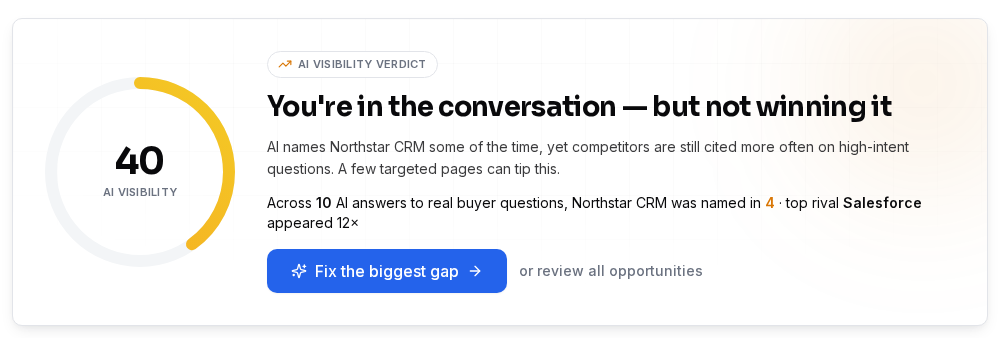
SEOWedge sends these questions to OpenAI (GPT) on all plans, and to Google Gemini on paid plans. It records which brands and exact URLs are cited in each AI answer. If your brand is missing, SEOWedge shows which competitors are named instead and which page earned them the citation. The output is a visibility verdict: you see, for each question, whether your brand is named, which competitor is, and what page is responsible for your absence.
This is not a keyword ranking or a traffic estimate. SEOWedge measures actual named citations in live AI answers, so you know where your brand stands in gift guide recommendations buyers see in ChatGPT, Copilot, and Gemini. Every scan is a dated, reproducible sample, making the diagnosis credible and actionable.
What Are the Common Reasons Brands Get Left Out of AI Gift Lists?
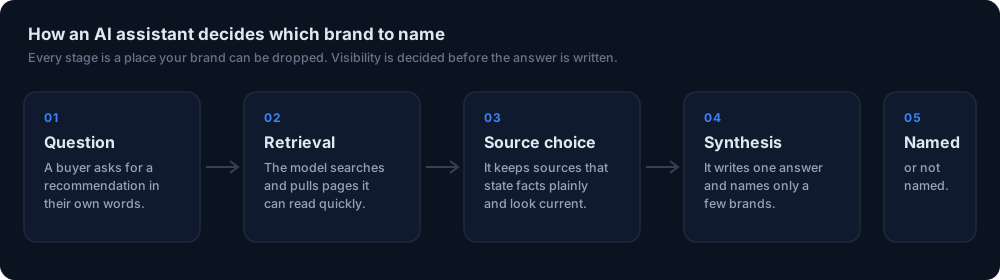
AI assistants build gift guides by selecting brands and products that match the buyer’s intent, pulling from pages they can crawl and understand. The most common reasons brands get left out are:
1. Your pages are not crawlable by AI assistant bots (like OAI-SearchBot or Googlebot). If your robots.txt blocks these, you will not be surfaced. See OpenAI crawler documentation and the LLM SEO guide for technical details.
2. Your content does not match the question’s intent or lacks the signals AI uses to select sources: clear product details, up-to-date offers, and answer-focused structure. AI models favor pages that answer the exact buyer question and provide original, specific recommendations, not just generic lists.
3. Competing brands have published pages that more directly answer the gift guide query, or have been cited more often in third-party reviews and lists. SEOWedge shows which competitor pages are winning and why, so you can see the real gap—not just guess.
4. Your site is new or has few external links, so it is not indexed or trusted by the AI’s underlying search engine. Submitting a sitemap can help, but is not a guarantee (Google sitemap guidance).
How Do I Use SEOWedge to See Exactly Where My Brand Is Missing?
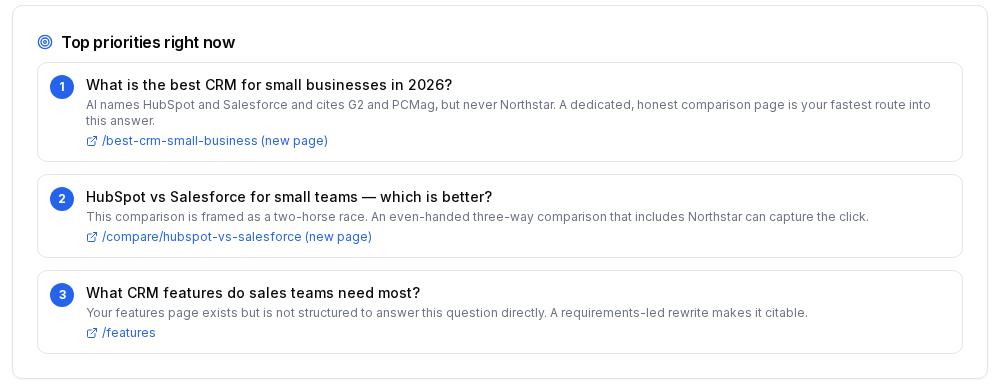
After entering your domain, SEOWedge returns a visibility score and a share-of-voice chart for each AI assistant tested. You see a list of high-intent gift guide questions, with your brand’s citation status for each. For every question where you are missing, SEOWedge shows the competitor and the exact cited page.
This page-level breakdown is what sets SEOWedge apart from classic SEO tools or prompt-based trackers. You do not have to guess which page or competitor is responsible for your absence from AI-curated gift lists. SEOWedge names both the question and the URL that won the citation, so you know exactly what needs to change.
You can export this gap list and use it as a prioritized to-do list. Each gap is tied to a real buyer question and a real AI answer, not just a keyword or a generic prompt. For ecommerce, this means you know which gift guide queries are costing you sales and which competitor pages are blocking you.
What Content Signals Matter Most for AI-Curated Gift Recommendations?
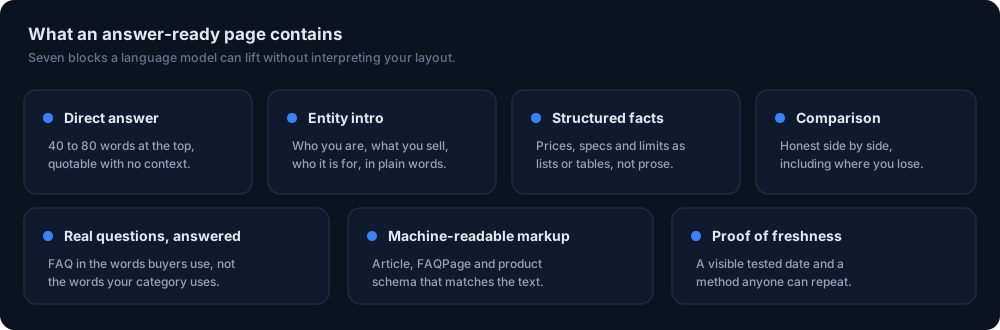
AI assistants select gift guide sources using a mix of retrieval and answer engine optimization (AEO) signals. The most important are:
- Crawlability: Your pages must be accessible to OAI-SearchBot and Googlebot. Blocked bots mean zero citations (OpenAI crawler documentation).
- Direct answer structure: Pages that clearly answer the gift guide question, with specific product recommendations, pricing, and reasons to choose each item, are favored. See the AEO guide for page structure details.
- Originality and specificity: AI models prefer original, first-hand content over generic or scraped lists (Google AI features guide).
- Up-to-date offers: Outdated or out-of-stock products are less likely to be cited. AI models check for freshness and availability.
- Schema markup: While not required, structured data (like Product or ItemList) can help clarify what is being recommended, but only if it matches the visible content (Structured Data for AI Search).
How Does SEOWedge Turn Missing Citations Into Actionable Content?
SEOWedge produces an Action Brief for every missed gift guide citation. Each brief includes the buyer question, which competitor and page won the citation, and a plain-English diagnosis of why your brand was skipped. The Action Brief explains what your page needs to do differently—whether it is a matter of coverage, specificity, freshness, or answer structure.
From the Action Brief, you can generate a draft page directly in the Content Studio. SEOWedge uses your Brand DNA profile—category, product details, and conversion goals—to ensure the generated content fits your brand and is not generic. The draft is scored for Publish Readiness, so you know if it meets the AEO and GEO signals needed for AI citation.
You can edit, revise, and export the page, then publish it to your site. SEOWedge supports IndexNow submission, notifying participating engines that your new page is live (IndexNow documentation). This increases the chance your updated content is picked up in the next crawl and cited in future AI-generated gift guides.
How Fast Can I Go from Diagnosis to a Citation-Ready Gift Guide Page?
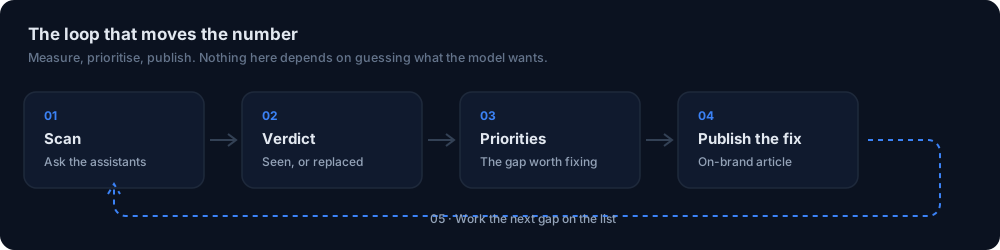
The SEOWedge workflow is designed for speed and action. After your scan, you get a prioritized list of missed gift guide citations and Action Briefs for each. On paid plans, you can queue up to 3 (Pro) or 10 (Agency) articles at once, so a whole list of missing pages can be drafted in one pass. The Content Studio writes each draft from your Brand DNA profile, and you can revise and export immediately.
The Publish Readiness score tells you when a page is ready for AI citation, based on the same signals AI assistants use. Once published, SEOWedge submits your URL via IndexNow, so engines are notified right away. While AI assistants may take days or weeks to update their answers, this workflow removes manual bottlenecks and gets your brand in front of the right queries as fast as the ecosystem allows.
There is no waiting for a monthly cycle or manual prompt writing. Every step, from diagnosis to export, is handled in one loop, with no separate tools or extra purchases required.
How Is This Different from Classic SEO or Manual GEO/AEO Work?
Classic SEO tools measure rankings and traffic, but cannot show which AI-curated gift guides name your brand, or why you are missing. Prompt-based tools ask you to write and maintain a list of questions, then track those prompts. SEOWedge discovers buyer questions automatically, tests them across multiple AI assistants, and names the exact page behind each gap.
Manual GEO or AEO audits require hours of research to find which questions matter, which competitors are cited, and what content is missing. SEOWedge removes that manual work: the scan, Action Brief, and content draft are all produced in one workflow. You do not need to be an AI or SEO expert to act on the result.
For a direct comparison of SEOWedge’s workflow with other tools, see How SEOWedge Turns AI Visibility Gaps Into Actionable Content.
What Do I Get Free, and When Should I Upgrade?
Every ecommerce brand can run a free SEOWedge scan—no card required. The free scan returns a Lite version of the workflow: one project, one scan, five buyer questions, and one Action Brief with a free article draft. You see your AI-Visibility score, competitor share of voice, and the top missed citation opportunity in AI-curated gift guides.
Paid plans unlock more: 20 or 100 Full Scans per month, 12 to 25 buyer questions per scan, multiple Action Briefs, bulk article generation, and Google Gemini coverage. If you need to cover more gift guide queries, more products, or multiple brands, upgrade to Pro or Agency. Paid plans also allow credit top-ups, so you can extend limits during peak gift seasons without changing plans. See SEOWedge pricing and how credits work for details.
You can always start with the free scan to diagnose your biggest missing citation, then decide if the upgrade is worth it for your brand’s seasonal goals.
What’s My Next Step If I Want to Diagnose and Fix Gift Guide Gaps?
Start by running a free scan at SEOWedge signup. You will see instantly if your brand is missing from AI-curated gift guides and which competitor is named instead. Review the Action Brief for your top missed citation, then use the Content Studio to generate and export a citation-ready page.
If you want to see a real example before starting, check the public sample report. For more on the mechanics of GEO, AEO, and AI search visibility, visit the SEOWedge resources hub. Every section there connects the diagnostic workflow to a practical next step for ecommerce brands and agencies.
If you are ready to cover more queries or brands, upgrade to a paid plan and use bulk generation to close multiple gift guide gaps at once. SEOWedge is built to make the process repeatable and credible, so you can act on every missed opportunity before the next gift season.
How this was tested
All claims and workflow steps are based on the SEOWedge platform as tested on 2026-08-13. SEOWedge samples answers from OpenAI (GPT) on all plans and Google Gemini on paid plans. It records which brands and pages are named in AI-curated gift guides by sending high-intent buyer questions to each assistant and logging the full answer. Action Briefs and content generation are produced from the Brand DNA profile extracted from each scanned site. All screenshots and workflow descriptions are drawn from the live product as of this date.
What this page does not cover
This page covers the diagnosis and resolution of missing brand citations in AI-generated gift guides using SEOWedge. It does not cover manual prompt tracking, technical LLM SEO issues, or classic SEO ranking factors—see the LLM SEO guide for technical crawlability and the AEO guide for on-page answer structure. Coverage is focused on ecommerce gift guides, not service or B2B lists.
Questions buyers ask us
How does SEOWedge know which gift guide questions matter for my brand?
SEOWedge discovers high-intent buyer questions automatically by crawling your site and analyzing your category and market. It surfaces the same types of questions buyers actually ask when searching for gift recommendations, not just generic prompts. This ensures the scan targets the queries that drive real AI-curated gift guide citations.
Can SEOWedge show me exactly which competitor pages are winning in AI gift guides?
Yes. For every missed citation, SEOWedge shows the brand, the specific question, and the exact competitor URL that is being cited in AI answers. This lets you see what kind of content is winning and what you need to improve or create to compete.
Does SEOWedge write the missing gift guide page for me, or do I have to do it manually?
SEOWedge generates a draft page for each Action Brief using your Brand DNA profile. You can edit, revise, and export the page directly from the Content Studio. The draft is scored for Publish Readiness, so you know if it is structured for AI citation before publishing.
How quickly can I fix a missing citation and appear in AI gift guides?
You can go from diagnosis to an export-ready page in minutes. Once published, it may take days to weeks for AI assistants to update their answers, depending on when they re-crawl your site. SEOWedge submits your new URL via IndexNow to speed up discovery by participating engines.
What is the difference between GEO, AEO, and classic SEO for gift guide visibility?
GEO (Generative Engine Optimization) and AEO (Answer Engine Optimization) focus on being named and cited in AI-generated answers and gift guides, not just ranking in classic search. Classic SEO measures rankings and traffic, but does not reveal why you are missing from AI-curated lists. SEOWedge is built specifically for GEO and AEO—see GEO vs AEO vs SEO for a full breakdown.
Do I need to upgrade to a paid plan to diagnose my brand’s gift guide gaps?
No. The free scan covers one project, five buyer questions, and one Action Brief with a free article draft. This is enough to see if you are missing from top AI-curated gift guides and to act on your biggest gap. Upgrade to cover more queries, brands, or to use bulk generation and Gemini coverage.
See what AI assistants say about your site
Enter your domain and SEOWedge runs a free scan: your AI-Visibility score, the buyer questions where a competitor is named instead of you, and the first page to fix. No install, no sales call.