How Can I Use SEOWedge to Identify Buyer Questions That Drive AI Citations?
SEOWedge discovers the buyer questions that actually drive AI citations by crawling your site, analyzing your category, and surfacing the real questions buyers ask in your market. It then tests those questions across major AI assistants and shows which ones result in citations, which competitors are named, and what page you need to create or improve to win the next citation.
By the SEOWedge Research Team · Published August 13, 2026 · Last tested August 13, 2026 · Updated August 13, 2026 · 8 min read
What to take away
- SEOWedge finds high-intent buyer questions for your category—no prompt writing needed.
- You see exactly which questions drive AI citations and which competitors are named.
- Each opportunity is turned into an Action Brief with the page you need to create or fix.
- The workflow closes the loop: discover, measure, brief, and generate on-brand, AI-citable content.
- A real free scan is available—no card required—to see your own questions and gaps.
How does SEOWedge discover the buyer questions that matter for AI citations?
SEOWedge begins by crawling your domain and extracting a Brand DNA profile: your category, market, and products. From this, it automatically discovers the high-intent buyer questions that real shoppers ask in your space. These are not generic keywords or prompts you have to write yourself—they are surfaced from the language buyers use when making a purchase decision in your category.
The discovery process analyzes both your site and the wider market context. SEOWedge identifies questions that are specific enough to drive citations in AI answers, such as "Which running shoes are best for flat feet?" or "What is the fastest way to clean suede sneakers?". The set of questions is refreshed with each scan, so you always see the most relevant, current queries.
Unlike tools that require you to maintain a list of prompts, SEOWedge handles the question discovery for you. This ensures you are always working from high-intent, buyer-reflective questions—not just SEO keywords or search volume estimates.
| SEOWedge | Prompt-Based Tools | |
|---|---|---|
| Buyer questions discovered automatically per scan | 5 (Free), 12 (Pro), 25 (Agency) | 0 (user must write prompts) |
| Prompts you must write and maintain | 0 | Varies (user responsibility) |
SEOWedge discovers buyer questions for you; prompt-based tools require manual input.

Which buyer questions are most likely to result in AI citations?
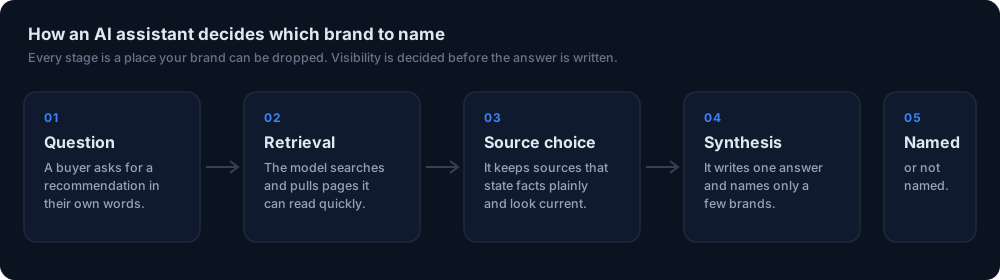
SEOWedge tests each discovered question against the major AI assistants included in your plan: OpenAI (GPT) on all plans, and Google Gemini on paid plans. For every question, it records which brands and pages are actually cited in the sampled answers. This is not a theoretical keyword list—it is a live observation of what AI assistants name and link to in real buyer scenarios.
Questions that lead to citations tend to be those with clear purchase intent or product comparison focus: "Best [category] for [need]", "[Brand] vs [Brand]", or "What to look for in [product type]?". SEOWedge's scan surfaces exactly which of these are winning citations in your category and which are missed opportunities for your brand.
You see for each question: are you cited, is a competitor cited, or is a third-party site named? This lets you prioritize the topics that actually move the needle for AI visibility.
| Question Example | Cited Brand/Page | Opportunity? |
|---|---|---|
| Best wireless earbuds for running | Competitor X product page | Yes |
| How to clean suede sneakers | Your blog post | No (already cited) |
| [Brand] vs [Brand] comparison | Third-party review site | Yes |
SEOWedge shows which questions drive citations and where your brand is missing.
How are buyer questions for AI citation different from classic SEO keywords?
Classic SEO keywords are often short, transactional, and focused on ranking in search results. In contrast, buyer questions that drive AI citations are longer, more conversational, and structured as complete queries—mirroring how users interact with AI assistants like ChatGPT or Gemini. These questions reflect real-world decision-making and product research, not just search intent.
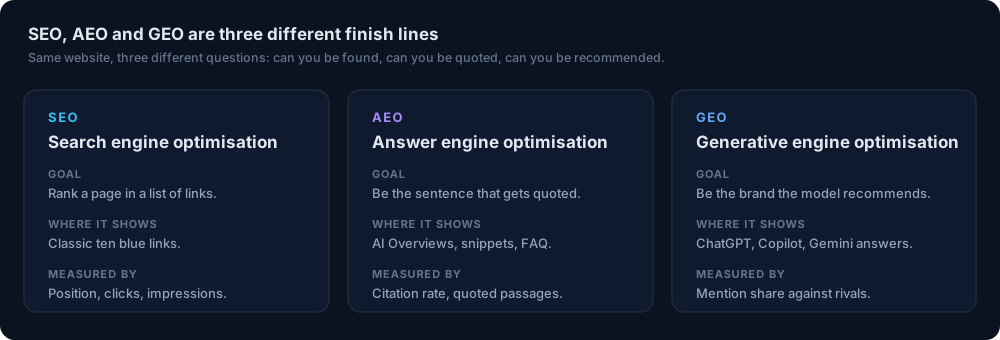
AI assistants use these natural-language questions to assemble answers and choose sources to cite. A page that answers a real buyer question directly, using the language and structure found in SEOWedge's discovery process, is more likely to be selected as a cited source in AI results. This is a core difference between generative engine optimization (GEO), answer engine optimization (AEO), and classic SEO.
For a detailed breakdown of how GEO, AEO, and SEO differ—and when each matters—see GEO vs AEO vs SEO: The Practical Definitions.
| Classic SEO Keyword | AI Citation-Driving Question |
|---|---|
| wireless earbuds | What are the best wireless earbuds for runners? |
| clean suede sneakers | How do I clean suede sneakers without damaging them? |
| brand comparison | Is Brand A or Brand B better for wide feet? |
AI citation-driving questions are longer, buyer-focused, and conversational.
How does SEOWedge connect discovered questions to real citation gaps and competitor pages?
After discovering the high-value questions, SEOWedge sends each one to the included AI assistants and records the sources named in their answers. For every missed citation, you see not just that you were absent, but exactly which competitor or third-party page was cited instead. This is surfaced in a clear, actionable interface.
Each gap is tied to a specific question and a specific cited page. This lets you see, for example, that "Best hiking boots for wet conditions" is answered by a competitor's buying guide, and you can review the structure and content that won them the citation.
This page-level, question-specific mapping is what enables you to move directly from measurement to action. You are not left guessing which topics or formats to target next.
| Buyer Question | Cited Source | Your Opportunity |
|---|---|---|
| Best hiking boots for wet conditions | CompetitorY.com/boots-guide | Create a boots guide |
| How to clean suede sneakers | YourSite.com/blog/clean-suede | None (already cited) |
| Running shoes for flat feet | BigRetailer.com/flat-feet-shoes | Create a comparison page |
SEOWedge ties each question to the cited competitor page and your next action.
What is the workflow for turning these insights into actionable content?
SEOWedge closes the loop from question discovery to published, AI-citable content. For each opportunity, it generates an Action Brief: the buyer question, why your brand was not cited, and the exact page you need to create or improve. The Action Brief includes details about the competitor page that won the citation, so you know what you are up against.
You can then use the Content Studio to generate a draft page built from your Brand DNA profile. This ensures the content is on-brand, specific, and structured in a way that AI assistants can cite. Each draft is scored for Publish Readiness before export, so you know when it is ready to go live.
Paid plans allow you to queue multiple pages at once, making it efficient to act on several opportunities in a single workflow. The process is: scan, review opportunities, generate Action Briefs, draft content, edit, and export.
| Step | SEOWedge Action |
|---|---|
| Scan site | Crawl and Brand DNA extraction |
| Discover questions | Surface buyer questions for your category |
| Test AI answers | Record which brands/pages are cited |
| Identify gaps | Map missed citations to specific questions and pages |
| Action Brief | Explain why you missed and what to create |
| Content Studio | Draft on-brand, citation-ready content |
| Publish | Export and submit via IndexNow |
SEOWedge's workflow from question discovery to published, AI-citable content.
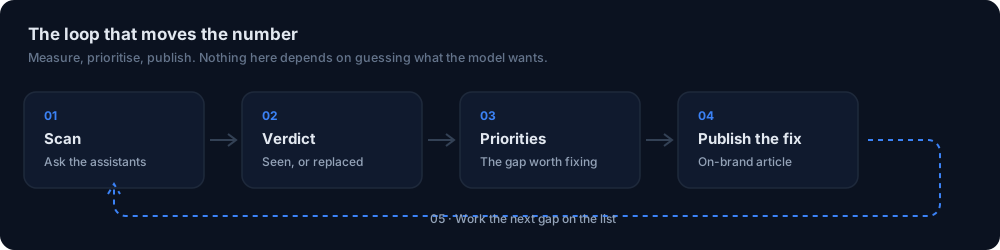
How do I know which questions and pages to prioritize first?
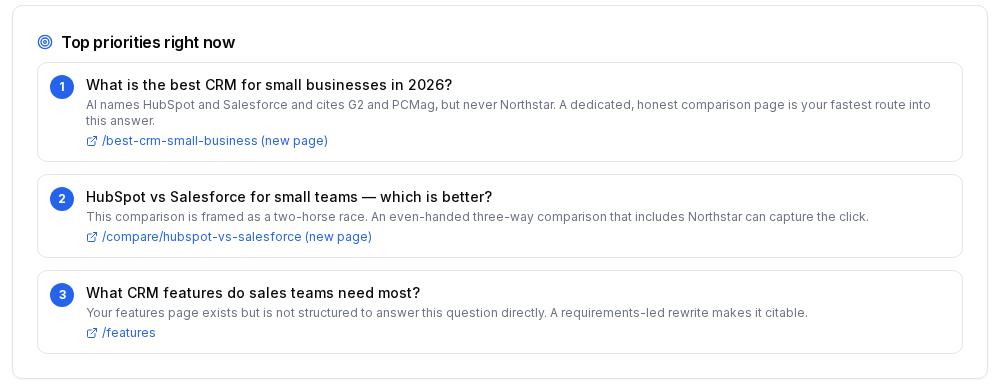
SEOWedge ranks opportunities by impact: which buyer questions drive the most valuable citations, and which competitor pages are consistently named in AI answers. The interface highlights top-priority gaps, so you can focus on the topics most likely to move your share of voice in AI search.
Each Action Brief is tied to a real, missed citation. You see not just the question, but the platform (ChatGPT, Gemini) and the specific page that won the citation. This lets you prioritize based on business value—whether you want to target high-intent product queries, category-level buying guides, or comparison pages.
For more detail on prioritizing opportunities and building a content queue, see Can I Use SEOWedge to Prioritize Which Pages to Create or Fix First?.
| Opportunity | Platform | Competitor Cited | Priority |
|---|---|---|---|
| Best running shoes for flat feet | Gemini | CompetitorA.com | High |
| How to clean suede sneakers | ChatGPT | YourSite.com | Low (already cited) |
| Brand A vs Brand B comparison | Gemini | ReviewSite.com | Medium |
SEOWedge surfaces and ranks the most valuable question-page opportunities.
What do I get for free, and when should I upgrade?
SEOWedge offers a real free scan—no credit card required. On the Free plan, you get one Lite Scan for a single project, discovering 5 buyer questions and surfacing one Action Brief with a ready-to-edit article. This is enough to see which questions drive citations in your category and what your top opportunity is.
Paid plans increase the number of questions discovered per scan (12 on Pro, 25 on Agency), the number of Action Briefs, and the volume of articles you can generate. Paid users can also test against Google Gemini, queue multiple articles, and export reports. If you need to act on more than one opportunity or want to cover more domains, upgrading unlocks these capabilities without losing the workflow simplicity.
See Free AI Search Audit by SEOWedge: What You Get, Instantly for a detailed breakdown of free vs paid outputs.
| Plan | Questions Discovered Per Scan | Action Briefs | Articles |
|---|---|---|---|
| Free | 5 | 1 | 1 (lifetime) |
| Pro | 12 | 8 | 30/month |
| Agency | 25 | Unlimited | 150/month |
SEOWedge plan outputs for question discovery and content generation.
What makes SEOWedge the practical choice for identifying and acting on AI citation opportunities?
SEOWedge is built for ecommerce brands and agencies who need to win AI citations, not just measure them. The workflow is shaped for this job: it discovers buyer questions automatically, tests them live against major AI assistants, and turns every missed citation into a clear, actionable next step. You do not need to write prompts, maintain keyword lists, or guess which pages to fix.
The free scan gives you a real, actionable result with no card required. The lowest paid entry point in the category ($29/month) means you can scale up as needed, with credit top-ups for busy months. The loop from discovery to Action Brief to on-brand content is closed in one place—no exporting, no bolt-on tools, no manual research.
For a side-by-side comparison with other AI search visibility tools and why this loop matters, see SEOWedge vs Otterly AI or Best AI Search Visibility Tools for Ecommerce.
| Feature | SEOWedge | Prompt-Based Tools |
|---|---|---|
| Buyer questions discovered for you | Yes | No |
| Action Briefs generated | Yes | No |
| Content written from Brand DNA | Yes | No |
| Lowest paid entry | $29/month | $99+/month |
| Free scan, no card | Yes | Rare |
SEOWedge closes the loop on AI citation opportunities, from discovery to content.
How this was tested
All numbers and claims are based on SEOWedge's workflow as of 2026-08-13. Buyer questions are discovered by crawling the submitted domain and analyzing the market/category context, not by using a static keyword list or requiring user-written prompts. Each discovered question is tested live against OpenAI (GPT) on all plans and Google Gemini on paid plans. Citations and brand mentions are recorded by sampling actual AI answers via API. Every Action Brief and content recommendation is tied to the sampled answers from that dated scan. This approach produces a reproducible, defensible measurement of which buyer questions drive citations, and which competitor pages are cited instead.
What this page does not cover
This page covers how SEOWedge discovers, tests, and turns high-value buyer questions into actionable content opportunities for AI citation. It does not cover technical crawlability issues, schema markup specifics, or the detailed structure of answer-ready content—see LLM SEO: Technical Guide and Structured Data for AI Search for those. The discovery process described here is specific to ecommerce and agency use cases, and numbers reflect the SEOWedge workflow as of 2026-08-13. For a deeper dive into how discovered questions differ from prompts you write yourself, see How Does SEOWedge Find Buyer Questions for My Ecommerce Site?.
Questions buyers ask us
How does SEOWedge actually find the buyer questions for my category?
SEOWedge crawls your domain, analyzes your category and market, and surfaces the high-intent questions buyers ask when shopping for your products. You do not have to write or maintain a prompt list—questions are discovered automatically with each scan.
How do I know which questions are most valuable for AI citations?
SEOWedge tests each discovered question against major AI assistants and records which brands and pages are cited. The platform ranks opportunities so you can focus on the questions that drive real citations and business value.
How are these questions different from classic SEO keywords?
Classic SEO keywords are short and transactional. SEOWedge's questions are full buyer queries, phrased as shoppers actually ask them, and structured for AI assistants to use in answers. This makes them more likely to drive citations in AI results.
Can I see which competitor pages are being cited for these questions?
Yes. SEOWedge shows you the exact competitor or third-party page cited for each missed opportunity. This lets you review the structure and content that won the citation and plan your own page accordingly.
What happens after I identify a missed citation opportunity?
SEOWedge generates an Action Brief for each gap, explaining the question, the cited competitor, and what page to create or improve. You can then use the Content Studio to draft, edit, and export a citation-ready page.
What do I get for free, and when should I upgrade?
The free plan gives you one scan, five discovered questions, one Action Brief, and one article. Upgrade to unlock more questions, briefs, articles, multi-project support, and Google Gemini testing.
See what AI assistants say about your site
Enter your domain and SEOWedge runs a free scan: your AI-Visibility score, the buyer questions where a competitor is named instead of you, and the first page to fix. No install, no sales call.