Can SEOWedge Help Me Optimize Content for AI Assistant Shoppable Guides?
AI shoppable guides are product recommendation lists generated by AI assistants, now a key conversion path in ecommerce. SEOWedge identifies the buyer questions and content gaps that keep your brand out of these guides, then produces the exact page or update needed to win a citation. It closes the loop from measurement to on-brand, AI-citable content, so your products appear where buyers are ready to act.
By the SEOWedge Research Team · Published August 14, 2026 · Last tested August 14, 2026 · Updated August 14, 2026 · 7 min read
What to take away
- AI shoppable guides are high-intent product lists shown by AI assistants and search engines.
- SEOWedge discovers the buyer questions that drive inclusion in these guides—no prompt writing required.
- You get a clear Action Brief naming the exact page or content type needed to win a spot in a shoppable guide.
- The workflow moves from gap discovery to on-brand, answer-ready content in one loop.
- Start with a free scan—no card required—to see your current AI guide visibility and missed opportunities.
What Are AI Shoppable Guides and Why Do They Matter for Ecommerce Brands?
AI shoppable guides are product recommendation lists created by AI assistants like ChatGPT, Google Gemini, and Copilot. These guides answer buyer questions such as "What are the best backpacks for travel?" or "Which running shoes are recommended for flat feet?" and present a curated set of products, often with direct links to purchase.
For ecommerce brands, being included in these AI-generated guides means showing up at the moment a buyer is ready to compare and purchase. Unlike classic SEO rankings, these guides are built from AI answers that cite specific brands and pages. Missing out means your competitors get the high-conversion clicks and brand exposure.
AI shoppable guides are not just a trend—they are quickly becoming a primary way buyers discover products. Optimizing for these guides requires a different approach than traditional SEO. You need to know which questions trigger a guide, which brands and pages are cited, and how to structure your content to be the source AI assistants choose.
How Does SEOWedge Discover the Buyer Questions That Drive Inclusion in AI Shoppable Guides?
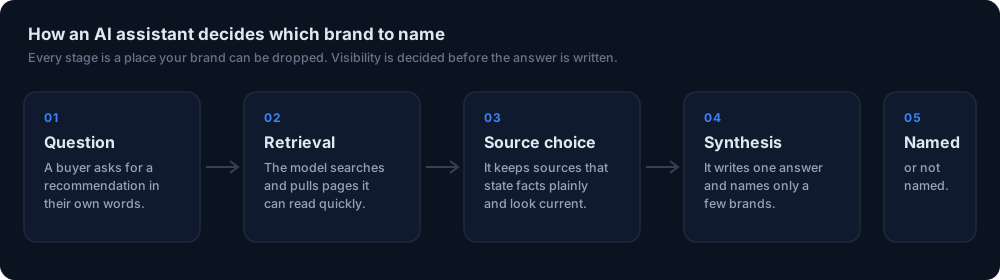
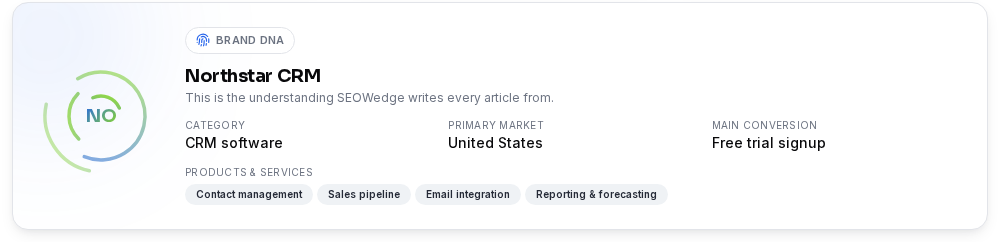
SEOWedge does not require you to write prompts or guess what buyers might ask. Instead, it crawls your ecommerce site, extracts your Brand DNA (category, products, positioning), and analyzes your market to discover the high-intent buyer questions that actually trigger AI shoppable guides in your category.
These questions are phrased exactly as buyers ask them, such as "best eco-friendly kitchen gadgets" or "top-rated noise-cancelling headphones." SEOWedge then tests these questions across supported AI platforms (OpenAI on all plans, Google Gemini on paid plans) to see which brands and pages are cited in real answers.
The discovered questions are not generic—they are tailored to your products and market. This ensures the opportunities surfaced are actionable and relevant for your brand, not just a list of SEO keywords. For a deeper look at SEOWedge's question discovery process, see How Does SEOWedge Find Buyer Questions for My Ecommerce Site?.
What Is the Step-by-Step Workflow to Optimize for AI Shoppable Guides Using SEOWedge?
The workflow is designed for ecommerce teams who want a direct path from measurement to published, AI-citable content. Here’s how it works:
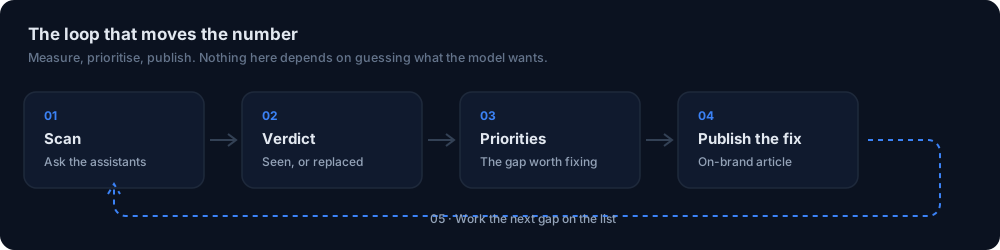
1. Enter your domain. SEOWedge crawls your site and builds a Brand DNA profile, capturing your main categories, products, and conversion goals.
2. SEOWedge discovers the buyer questions that drive shoppable guides in your space—no prompt writing needed.
3. It sends these questions to AI assistants, records which brands and pages are cited in the answers, and scores your current AI visibility.
4. The tool surfaces page-level opportunities: for each missed citation, you get an Action Brief naming the exact question, the reason your brand is missing, and the page or content type you need to create or update.
5. In the Content Studio, you generate the missing page or update, built from your Brand DNA and scored for Publish Readiness.
6. Publish and submit your new URL (SEOWedge supports IndexNow submission), so AI assistants can find and cite your updated content sooner.
On paid plans, you can queue multiple Action Briefs and generate several pages at once, streamlining the process across a whole opportunity list.
Does SEOWedge Identify the Exact Page or Content Type Needed to Win a Citation in an AI Shoppable Guide?
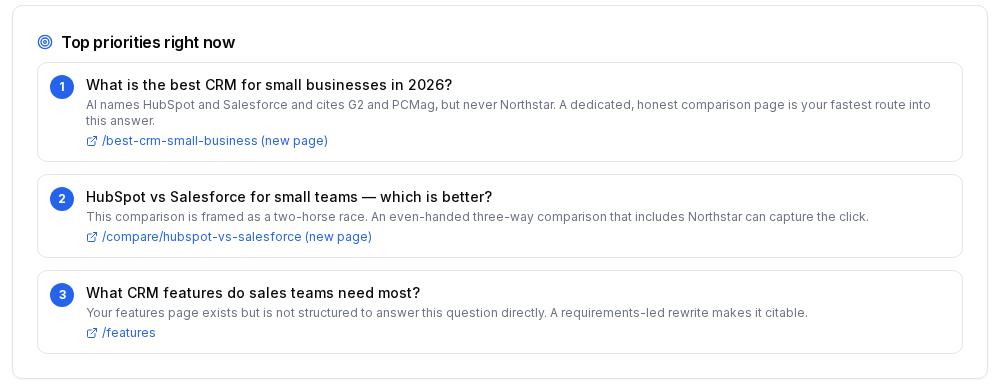
Yes. SEOWedge connects each missed opportunity to a specific Action Brief. Each brief names the buyer question (e.g., "best gifts for new dads"), the AI platforms where your brand is missing, and the exact competitor page or content type that is currently being cited.
You see whether the gap is a product page, a category roundup, a buying guide, or a comparison list. SEOWedge does not just say "you’re missing"—it shows which page wins the citation and what makes it fit for AI answers. This clarity lets you act on the highest-impact gaps first.
If you want to see how SEOWedge surfaces these actionable opportunities, review the public sample report or visit How SEOWedge Turns AI Visibility Gaps Into Actionable Content for a detailed breakdown.
How Does SEOWedge Generate On-Brand, AI-Optimized Content for Shoppable Guides?
Once you select an opportunity, SEOWedge’s Content Studio generates a new page or update using your Brand DNA profile. This profile is built automatically from your site crawl and captures your unique product positioning, tone, and conversion focus.
The content is not generic. SEOWedge writes answer-ready pages that match your brand’s voice and meet the structural needs of AI assistants. Each draft receives a Publish Readiness score, which reflects how closely it matches what AI assistants cite in shoppable guides and product roundups.
You can edit the draft, ensure product details and brand claims are specific, and export the finished page for publishing. For more on on-brand content generation, see Can SEOWedge Write Pages That Match My Brand Voice?.
How Do I Know If My Products or Pages Are Already Included in AI Shoppable Guides?
SEOWedge measures your current AI search visibility by sampling real answers from OpenAI (GPT) and, on paid plans, Google Gemini. The scan checks whether your brand or specific pages are named or cited in shoppable guides for the discovered buyer questions.
You receive an AI-Visibility score, a competitor share-of-voice breakdown, and a list of the exact questions and platforms where you are present or missing. This evidence-based approach removes guesswork and lets you see, in plain language, where your brand stands in AI-generated product recommendations.
If you want to see what a scan delivers, try the Free AI Search Audit—no card required. For a detailed explanation of the score and what it measures, visit What an AI Search Visibility Score Actually Measures.
How Is Optimizing for AI Shoppable Guides Different from Classic SEO or Manual Research?
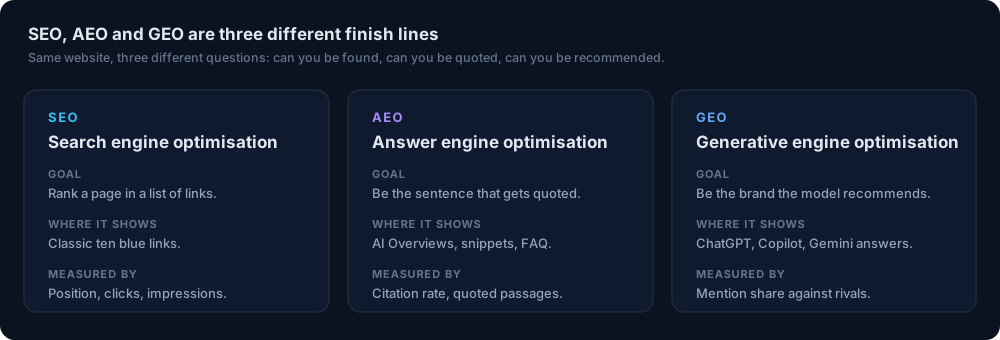
Classic SEO focuses on keyword rankings and organic traffic, but AI shoppable guides are driven by real buyer questions and the specific pages AI assistants choose to cite. You cannot rely on classic rank tracking or general keyword research to win these citations.
Manual research would require you to write dozens of prompts, test them in each AI assistant, and track which brands and pages are cited—then repeat as answers change. SEOWedge automates this: it discovers the real buyer questions, tests them at scale, and returns a prioritized list of actionable gaps with the exact next step for each.
If you want a detailed comparison of GEO, AEO, and classic SEO, see GEO vs AEO vs SEO: The Practical Definitions and When Each Matters. For a workflow-level comparison, visit What Makes SEOWedge Different from Traditional SEO Tools for Ecommerce?.
What Do I Get for Free, and When Should I Upgrade for Full Shoppable Guide Coverage?
The SEOWedge Free plan gives you a one-time Lite Scan for one project. This scan discovers 5 buyer questions, returns a single Action Brief, and generates one article for free—no card required. You see your AI-Visibility score, competitor share of voice, and a real opportunity you can act on.
Paid plans (Pro and Agency) expand coverage: more projects, more buyer questions per scan (up to 25), more Action Briefs, and bulk article generation. Paid plans also add Google Gemini support, so you can optimize for both OpenAI and Google shoppable guides. You can top up credits any time if you need extra scans or articles without changing your plan.
If your goal is to cover a full category, run multiple projects, or queue several shoppable guide pages at once, upgrading to Pro or Agency is the practical next step. For a clear breakdown of plan limits, see SEOWedge Free vs Paid Plans for Ecommerce: What Are the Limits?.
What’s My Next Step If I Want to Optimize for AI Shoppable Guides?
Start with a free scan to see which shoppable guide questions matter in your category and where your brand is missing. Review the Action Brief to see the exact page or content type you need to create. Use the Content Studio to generate or revise the page, then publish and submit it for faster AI discovery.
If you want to see a real example before acting, check the public sample report. For more on how SEOWedge turns gaps into actionable content, see How SEOWedge Turns AI Visibility Gaps Into Actionable Content.
SEOWedge is the only tool in this category that closes the loop: it measures, names the gap, and writes the page in one workflow. That’s what gets your brand cited in AI shoppable guides and product roundups.
How this was tested
All claims on this page are based on SEOWedge’s workflow and product facts as of 2026-08-14. SEOWedge samples AI answers from OpenAI (GPT) on all plans and Google Gemini on paid plans, using real buyer questions discovered from your ecommerce category. It records which brands and pages are cited in dated answer samples, then generates Action Briefs and content recommendations based on observed gaps. Screenshots illustrate actual SEOWedge interface elements or workflow diagrams current as of August 2026.
What this page does not cover
This page explains how SEOWedge helps ecommerce brands optimize for AI-generated shoppable guides and product roundups. It does not cover manual prompt writing, technical SEO setup, or general AI content marketing. For related topics like Google AI Overviews, classic buying guides, or product comparison content, see the linked resources. All workflow and feature claims reflect SEOWedge’s current capabilities and may not apply to other tools or future AI surfaces.
Questions buyers ask us
What is the difference between an AI shoppable guide and a classic buying guide?
AI shoppable guides are generated by AI assistants in response to buyer questions and cite specific brands and pages in real time. Classic buying guides are static editorial content published on websites. Optimizing for AI shoppable guides requires understanding which questions trigger them and which pages are cited by the assistants themselves.
How does SEOWedge know which buyer questions trigger shoppable guides?
SEOWedge discovers high-intent buyer questions by crawling your site, analyzing your market, and extracting questions buyers actually ask in your category. It tests these questions in AI assistants to see which ones produce shoppable guides and which brands or pages are cited in the answers.
Can SEOWedge generate content that matches my brand’s voice and product focus?
Yes. SEOWedge builds a Brand DNA profile from your site and uses it to generate on-brand, product-specific content for each Action Brief. You can edit the draft before publishing to ensure it fits your brand and product details.
Does SEOWedge show me which competitor pages are winning citations in shoppable guides?
Yes. For each missed opportunity, SEOWedge shows the exact competitor page or content type that is being cited in AI answers. This lets you see what’s working for others and target your content updates for maximum impact.
What happens after I publish a new or revised page for a shoppable guide opportunity?
After publishing, SEOWedge supports IndexNow submission so search engines and AI assistants can discover your new page faster. AI citations update when assistants re-crawl and refresh their sources, which typically takes weeks. SEOWedge stores your scan results for comparison after you publish.
See what AI assistants say about your site
Enter your domain and SEOWedge runs a free scan: your AI-Visibility score, the buyer questions where a competitor is named instead of you, and the first page to fix. No install, no sales call.