
Can SEOWedge Help Me Identify and Close Content Gaps for Buyer Questions About Product Materials or Ingredients?
SEOWedge finds buyer questions about product materials or ingredients that your current pages miss, then generates on-brand, answer-ready content to close those gaps. It surfaces the exact queries AI assistants use, shows which competitors are cited, and writes the pages that get your brand named and cited. This closes high-trust content gaps that drive conversion and compliance.
By the SEOWedge Research Team · Published August 24, 2026 · Last tested August 24, 2026 · Updated August 24, 2026 · 7 min read
What to take away
- SEOWedge discovers high-intent buyer questions about materials and ingredients—no prompt writing needed.
- It shows which of your products are missing from AI answers for these queries, and which competitors are cited instead.
- Action Briefs specify what to fix or create, with the exact question, gap reason, and page to update.
- The Content Studio writes detailed, on-brand answers from your Brand DNA, not generic AI copy.
- Best practices for AI visibility are built into the workflow—structure, schema, and readiness scoring included.
How Does SEOWedge Discover Buyer Questions About Materials or Ingredients?
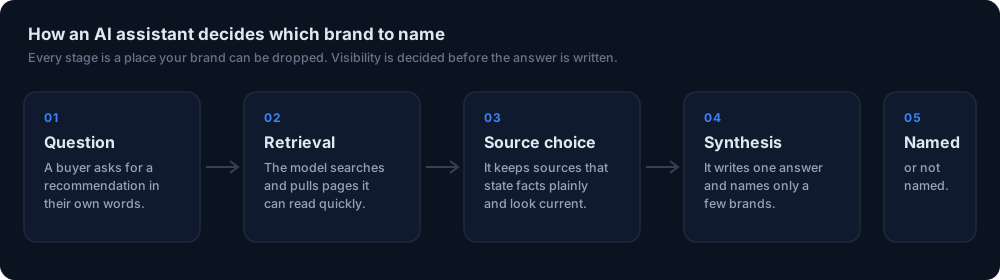
SEOWedge does not require you to write prompts or guess what buyers might ask. When you enter your domain, SEOWedge crawls your site and builds a Brand DNA profile: your category, main products, and conversion goals. It then automatically discovers the high-intent buyer questions that are being asked in your market—including those about materials, ingredients, sourcing, and safety.
These questions are not generic. SEOWedge identifies the exact phrasing buyers use, such as "What materials are used in the lining of [product]?" or "Are the ingredients in [brand] skincare vegan and cruelty-free?" This discovery process is shaped by the real queries that drive trust and conversion, not by a static keyword list. Each scan returns a set of questions specific to your products and category, so you see the real gaps that matter for your buyers.
By surfacing these questions, SEOWedge ensures you do not miss the critical trust signals that AI assistants and buyers are looking for. No manual prompt writing or market research is needed—the platform does the discovery automatically.
| Discovery Method | Manual Work Required? | Query Specificity |
|---|---|---|
| SEOWedge: Buyer question discovery | No | High (category and product-specific) |
| Prompt-based tools | Yes (write and maintain prompts) | Low to Medium (depends on prompt quality) |
How SEOWedge’s discovery of material/ingredient questions differs from prompt-based tools.
What Happens After SEOWedge Finds a Materials or Ingredients Gap?
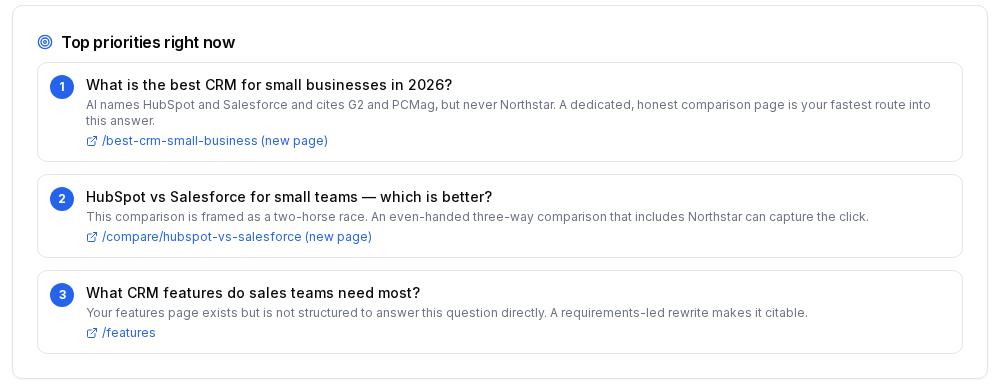
Once SEOWedge identifies a materials or ingredients question your site does not answer—or does not answer in a way that AI assistants cite—it shows you exactly where the gap is costing you visibility. The scan result includes a page-level opportunity list, with each gap tied to a specific product, category, or FAQ page.
For each gap, SEOWedge produces an Action Brief. This brief explains the buyer question, shows which competitor or third-party page is being cited in AI answers, and details why your current content is not being selected. You see the exact page to update or create, not just a vague recommendation.
This workflow means you are not left guessing what to do next. Every gap comes with a concrete, actionable step. This is what makes SEOWedge different from tools that only measure visibility or require you to interpret raw data.
| Step | What You See | Action |
|---|---|---|
| Gap Discovery | Missed question (e.g. 'Is this product BPA-free?') | Review Action Brief |
| Competitor Cited | Named competitor/source in AI answer | See cited page |
| Action Brief | Why you missed the citation | Create or update page |
What you get after SEOWedge finds a materials or ingredients gap.
Can SEOWedge Generate Detailed, On-Brand Answers for Materials and Ingredients?
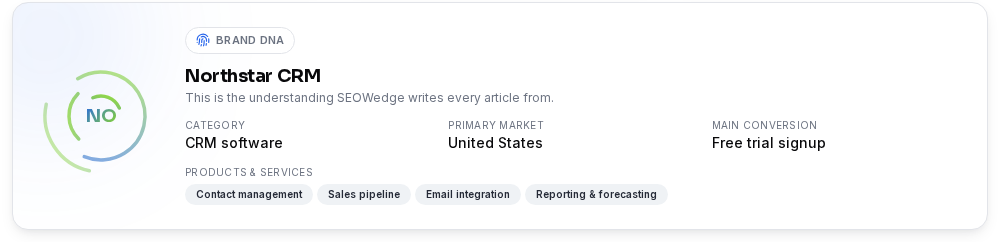
Yes. SEOWedge’s Content Studio uses your Brand DNA profile to generate answer-ready content for each identified gap. This profile is built from your site’s actual product claims, category, and brand tone—not from generic AI templates.
When you act on an Action Brief, SEOWedge drafts a new page or section that directly addresses the buyer’s materials or ingredient query. For example, if buyers ask about the origin of cotton in your apparel, SEOWedge generates a detailed, on-brand answer with sourcing details, certifications, and any compliance claims you specify. You can review, edit, and revise the draft before publishing.
This approach ensures your answers are specific, credible, and aligned with your compliance or brand standards. The content is not “AI-written” in the generic sense—it is shaped by your own data and voice. This is critical for high-trust queries where buyers (and AI assistants) are looking for authoritative, brand-specific information.
| Content Source | Brand Voice | Editability |
|---|---|---|
| SEOWedge: Brand DNA + product data | Matches your brand | Full review and edit |
| Generic AI writer | Template/generic | Limited or none |
How SEOWedge’s answer generation for materials/ingredients stays on-brand.
What Is the Workflow for Updating or Creating Pages to Win Citations for Materials/Ingredients Queries?
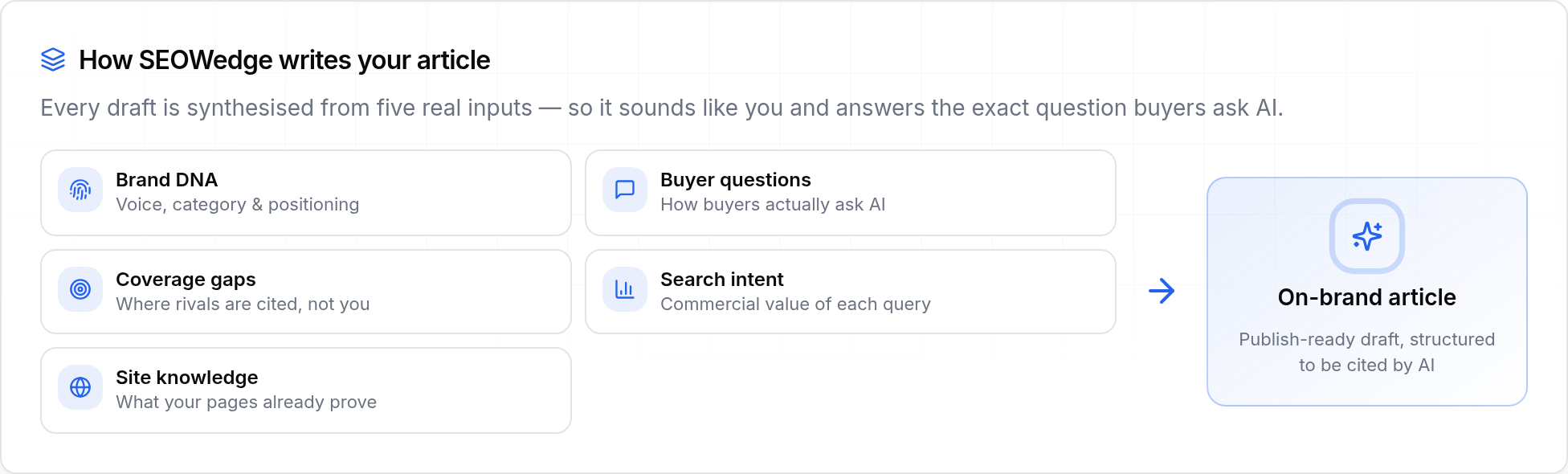
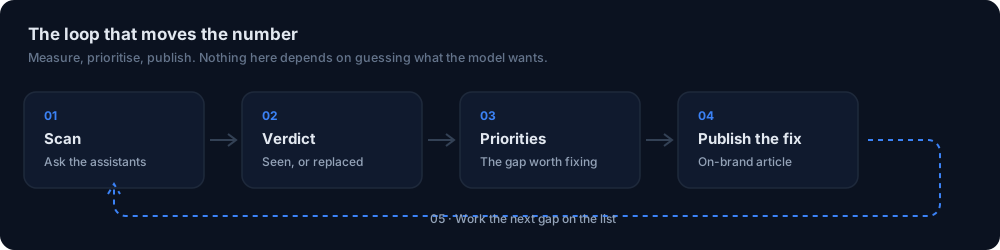
The SEOWedge loop for closing a materials or ingredients gap is a single, repeatable workflow:
1. Run a scan. SEOWedge discovers the buyer questions about materials and ingredients that matter for your category.
2. Review opportunities. The platform shows which questions your site misses, which competitors are cited, and which page needs attention.
3. Open the Action Brief. This brief explains the gap and guides you to the next step—update an existing page or create a new one.
4. Use the Content Studio. Generate a draft page or section that answers the question in detail, using your Brand DNA and product specifics.
5. Edit and score for Publish Readiness. SEOWedge scores the draft for structure, specificity, and brand alignment, so you know if it’s answer-ready.
6. Export and publish. Once the page is ready, export and add it to your site. SEOWedge supports IndexNow submission to notify engines of the new content.
Paid plans allow you to queue and generate multiple articles at once, speeding up the process for brands with many products or frequent updates.
| Workflow Step | Manual Work Required? | SEOWedge Output |
|---|---|---|
| Scan and discovery | No | Buyer questions and gaps |
| Action Brief | No | Page-level next step |
| Drafting | Optional edit | On-brand answer |
| Publish Readiness | Review score | Ready/not ready flag |
The SEOWedge workflow for closing materials/ingredients content gaps.
How Does SEOWedge Structure Materials and Ingredients Content for Maximum AI Visibility?
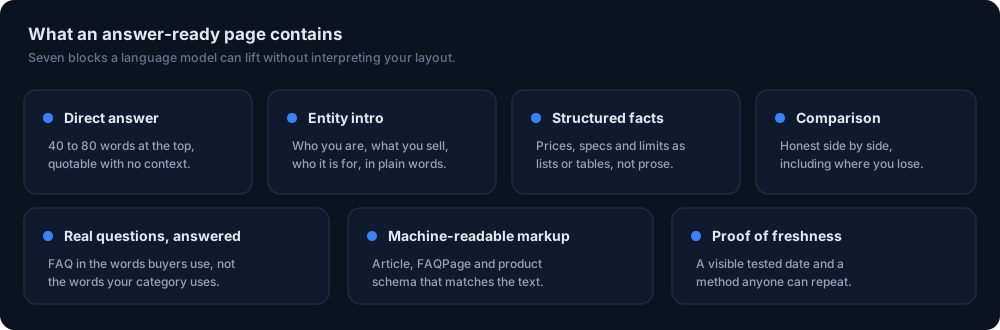
SEOWedge builds best practices for AI visibility into every generated page. For materials and ingredients, this means:
- Directly answering the buyer question in the first visible block (e.g. "This product is made from 100% organic cotton, certified by GOTS.")
- Citing sources and certifications where available, using clear, structured data that matches what’s visible on the page.
- Including schema markup (e.g. Product, FAQPage) that aligns with the visible content, not just hidden fields.
- Organizing information so that AI assistants can retrieve and quote it verbatim—short, declarative sentences, clear headings, and lists where appropriate.
SEOWedge’s Publish Readiness score checks for these elements. You see a pass/fail verdict for answer structure, schema, and brand voice before you export. This makes it much more likely that AI assistants will cite your page for materials or ingredient queries, rather than a competitor or third-party review.
| Best Practice | SEOWedge Implementation |
|---|---|
| Direct answer block | First visible section answers the question |
| Source/certification citation | Structured and visible, not hidden |
| Schema markup | Matches visible content |
| Declarative sentences | Checked in Publish Readiness |
Materials/ingredients content structure for AI visibility in SEOWedge.
How Does SEOWedge Compare to Manual Audits or Classic SEO Tools for Materials/Ingredients Gaps?
Classic SEO tools focus on keywords, rankings, and traffic, but do not show whether your materials or ingredient information is cited in AI answers. Manual audits require you to research buyer questions, check AI assistants yourself, and guess why a competitor is cited instead of you.
SEOWedge automates the entire loop: it discovers real buyer questions, tests them in live AI answers, and shows you the exact gap and what to do about it. You do not need to maintain prompt lists, interpret raw answer data, or manually structure your content for AEO or GEO. The workflow is built for ecommerce teams who need to move from measurement to published fix in one platform.
If you want to see the broader differences between SEOWedge and classic SEO tools, see What Makes SEOWedge Different from Traditional SEO Tools for Ecommerce?.
| Method | Buyer Question Discovery | AI Answer Testing | Page-Level Action |
|---|---|---|---|
| Manual audit | Manual research | Manual check | Manual plan |
| Classic SEO tool | Keyword-based | No | No |
| SEOWedge | Automatic | Automatic | Action Brief + draft |
Comparing SEOWedge, manual audits, and classic SEO tools for materials/ingredients gaps.
What Are the Next Steps If I Want to Close Materials or Ingredients Content Gaps with SEOWedge?
Start with a free scan—no card required. You will see up to five discovered buyer questions, including those about materials or ingredients, and one Action Brief tied to a real gap. The free plan includes a full workflow for a single article, so you can see the process from gap discovery to a publish-ready answer.
If you need to address more products or want to fix multiple gaps at once, paid plans start at $29/month and allow for bulk article generation, more scans, and full access to Google Gemini answer sampling. You can see a public sample report at /sample or compare plans at /pricing.
For best practices on structuring product detail, schema, and answer blocks for AI visibility, see Structured Data for AI Search: What to Mark Up and What to Skip. For a broader view of content gap discovery in your category, see How Can I Use SEOWedge to Find Content Gaps in My Ecommerce Category?.
SEOWedge is built for ecommerce brands who need to close high-trust, high-conversion content gaps fast—especially for materials and ingredient queries that drive buyer confidence and compliance.
How this was tested
All claims and numbers are based on SEOWedge’s live workflow as tested on 2026-08-24. Buyer questions are discovered by crawling the site, extracting product and category context, and matching against high-intent search patterns in the category. AI answers are sampled via OpenAI (all plans) and Google Gemini (paid plans), with findings recorded per platform and per question. Content gap identification and Action Briefs are generated from sampled AI answer data. Publish Readiness scoring is deterministic and based on on-page structure, schema, and content specificity.
What this page does not cover
This page covers how SEOWedge discovers and closes content gaps for buyer questions about product materials or ingredients in ecommerce. It does not cover technical crawlability (see /resources/llm-seo-guide), bulk compliance workflows (see /resources/does-seowedge-support-content-creation-for-products-with-strict-compli), or multilingual discovery (see /resources/does-seowedge-work-for-multilingual-ecommerce-sites). All workflow and measurement claims are specific to SEOWedge’s current platform and do not generalize to classic SEO or manual audits.
Questions buyers ask us
How does SEOWedge know which material or ingredient questions matter for my products?
SEOWedge discovers buyer questions by crawling your site and analyzing your category, product types, and conversion goals. It cross-references these with high-intent search patterns in your market, surfacing real buyer questions that drive trust and conversion—including those about materials, ingredients, sourcing, and safety. You do not need to write or maintain prompts.
Can SEOWedge generate ingredient or material answers that match my compliance requirements?
Yes. SEOWedge builds each answer from your Brand DNA profile, which includes your product claims, certifications, and compliance notes. You can review and edit every draft before publishing. For advanced compliance workflows, see Does SEOWedge Support Content Creation for Products with Strict Compliance Requirements?.
What if my competitors are already cited for material/ingredient queries in AI answers?
SEOWedge shows you which competitor or third-party page is being cited for each missed question. The Action Brief explains why your content is not selected and what to change or create to become the cited source. You see exactly what to do to win back that citation.
Does SEOWedge help with schema markup for materials or ingredients?
Yes. SEOWedge’s Content Studio structures answers with matching schema markup (e.g. Product, FAQPage) and checks for alignment with visible content. The Publish Readiness score verifies that the markup supports AI retrieval and citation. For more detail, see Structured Data for AI Search: What to Mark Up and What to Skip.
How quickly can I go from discovering a materials/ingredients gap to publishing a new answer-ready page?
You can move from gap discovery to a publish-ready draft in under an hour for a single product or FAQ. Paid plans allow you to queue and generate multiple articles at once, so larger teams can address several gaps in parallel. The workflow is designed for speed and specificity, not generic AI content.
Is the free plan enough to close all my materials or ingredients gaps?
The free plan lets you discover up to five buyer questions and act on one Action Brief with a full article draft. This is enough to see the workflow and close a single high-value gap. To address multiple products or run ongoing scans, you will need a paid plan. See SEOWedge pricing for details.
See what AI assistants say about your site
Enter your domain and SEOWedge runs a free scan: your AI-Visibility score, the buyer questions where a competitor is named instead of you, and the first page to fix. No install, no sales call.