
Can I Use SEOWedge to Generate Content for Underperforming Landing Pages?
SEOWedge identifies underperforming landing pages by scanning your site, finding buyer questions where your pages are not cited in AI answers, and showing which competitor’s page is winning the citation. It then generates new or revised content for those specific opportunities, scores each draft for AI-readiness, and guides you from gap discovery to export. This closes the loop from diagnosis to publish-ready content.
By the SEOWedge Research Team · Published August 13, 2026 · Last tested August 13, 2026 · Updated August 13, 2026 · 7 min read
What to take away
- SEOWedge pinpoints which landing pages are missing from AI answers and why.
- It generates new or revised content for each specific gap, using your brand profile.
- You receive an Action Brief for each underperforming page, detailing what to fix or create.
- Every draft is scored for AI-readiness before export, so you know when it’s ready.
- You can start with a free scan—no card required—to see your own page-level gaps.
How does SEOWedge identify underperforming landing pages for AI visibility?
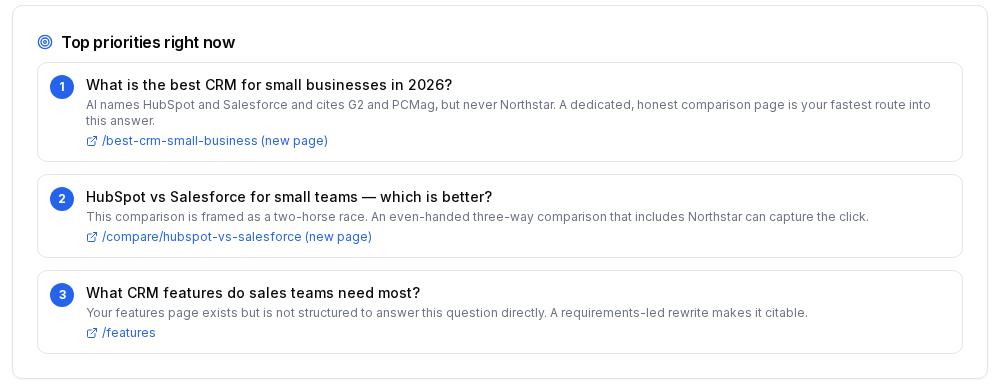
SEOWedge begins by crawling your site and extracting a Brand DNA profile—category, market, products, and your main conversion goal. It then discovers high-intent buyer questions that real customers ask in your category. These questions are sent to AI assistants (OpenAI on all plans, Google Gemini on paid plans) to see which brands and, crucially, which pages are being named or cited in answers.
The scan returns a list of page-level opportunities: for each buyer question, SEOWedge records which competitor’s page is being cited instead of yours. This means you see not just that your brand is missing, but exactly which landing page is winning the mention and what question it answers. The result is a targeted list of underperforming landing pages, each mapped to a real buyer intent.
This approach is different from classic SEO audits or prompt-based trackers. SEOWedge’s workflow is built for ecommerce and agency buyers who need to act on specific, high-value gaps in AI search visibility, not just monitor rankings or generic mentions.
For a deeper look at how SEOWedge finds buyer questions and page-level gaps, see How Does SEOWedge Find Buyer Questions for My Ecommerce Site?.
Can SEOWedge generate new content or rewrite existing landing pages to win AI citations?
Yes. For each underperforming landing page, SEOWedge produces an Action Brief—a one-page summary that explains which buyer question triggered the gap, why AI assistants are citing a competitor’s page, and what your page needs to cover to be considered for citation.
Inside the Content Studio, SEOWedge uses your Brand DNA profile to generate a new page or rewrite the existing one. This ensures the content is specific to your brand, product, and market positioning, not a generic AI output. You can edit or revise the draft up to your plan’s monthly revision limit.
The key difference: SEOWedge does not just suggest a topic or keyword. It writes the full landing page content, structured for AI retrieval and citation. Each draft is scored for Publish Readiness, so you know if it meets the requirements for AI answers to lift and cite it.
For more on how SEOWedge keeps content on-brand and actionable, see Can SEOWedge Write Pages That Match My Brand Voice?.
What is the workflow for generating and publishing new landing page content with SEOWedge?
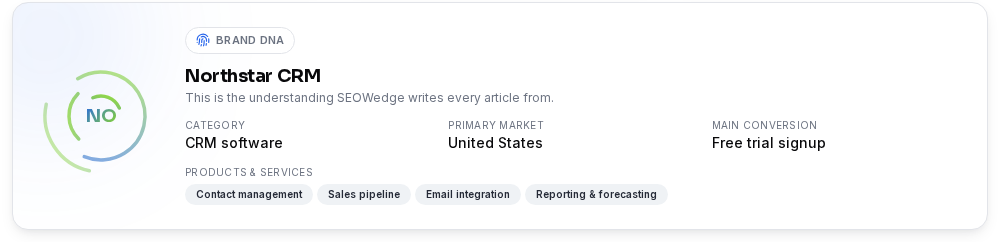
The workflow is structured to move from measurement to action in a single loop:
1. Enter your domain. SEOWedge crawls your site and builds your Brand DNA profile automatically.
2. SEOWedge discovers high-intent buyer questions and tests them across AI assistants, recording which landing pages are cited for each.
3. You receive a prioritized list of opportunities—each one a buyer question and the competitor’s cited page.
4. For each opportunity, SEOWedge produces an Action Brief and offers to generate a new or revised landing page draft based on your Brand DNA.
5. You review, edit, and score the draft in the Content Studio. The Publish Readiness score tells you when it’s ready for export.
6. Export the page and publish it on your site. SEOWedge submits the new URL via IndexNow, so AI assistants are notified of the update.
Paid plans allow you to queue multiple articles (up to 3 at once on Pro, 10 on Agency), so you can address several underperforming landing pages in one session. The workflow is designed for ecommerce and agency teams who need to move quickly from gap discovery to published fix.
For a detailed overview of the end-to-end process, see How SEOWedge Turns AI Visibility Gaps Into Actionable Content.
How does SEOWedge measure when a landing page is 'ready' for AI answers?
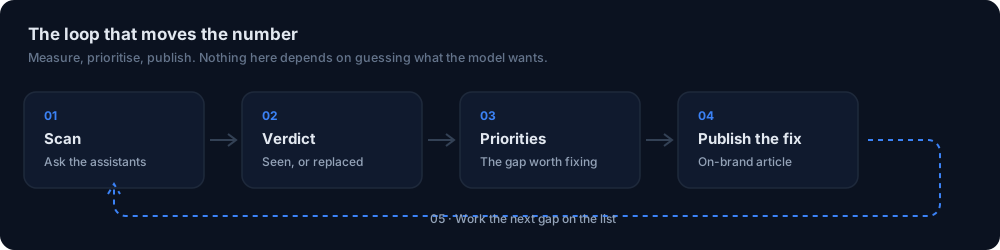
Every draft generated or revised in SEOWedge is scored for Publish Readiness. This is a deterministic, algorithmic score based on the structural and content features that make a page likely to be cited by AI assistants. The score checks for direct-answer blocks, schema markup, coverage of the buyer question, and brand alignment.
You see a clear readiness verdict before exporting the page. This removes guesswork—no need to rely on generic SEO checklists or hope that a change is enough. If the score is low, SEOWedge highlights what to fix, such as missing schema, unclear product details, or lack of a direct answer.
This approach is built for AI search surfaces, where citation is driven by retrieval and answer structure, not just keyword presence. The score is not a guarantee of citation but a practical readiness check based on what AI assistants actually cite in sampled answers.
For more on how the readiness score is determined, see Answer Engine Optimization (AEO): How to Become the Quoted Source.
How do I know which landing pages to prioritize for content generation?
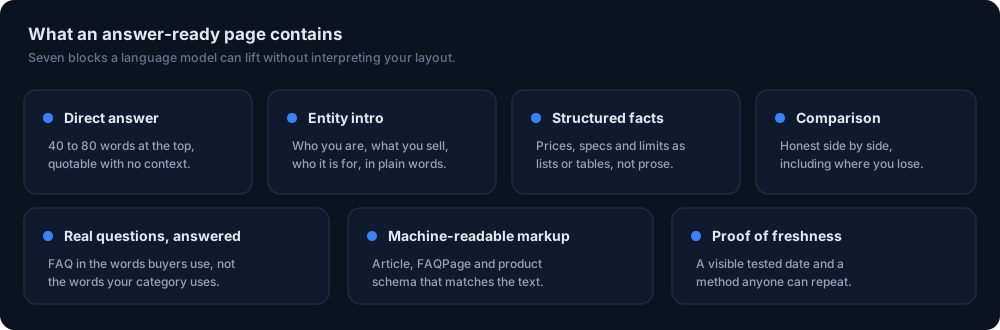
SEOWedge ranks page-level opportunities by the size of the gap and the value of the buyer question. The prioritized list shows you which missed citations are costing you the most visibility, and which competitor pages are winning those mentions.
Each opportunity is linked to a real, high-intent buyer question—no generic keyword lists or prompt tracking. You can filter by product, category, or question type to focus on the landing pages that matter most for conversion.
On paid plans, you can queue multiple Action Briefs and generate several articles in a batch, speeding up the process for larger sites or agency portfolios. This prioritization system is designed for practical, high-impact action, not just reporting.
If you need a deeper breakdown of how SEOWedge turns opportunities into a prioritized action queue, see Can I Use SEOWedge to Prioritize Which Pages to Create or Fix First?.
What does SEOWedge-generated landing page content include?
Each page generated in SEOWedge is built from your Brand DNA profile, so it reflects your actual product, category, and conversion goals. The output includes:
- A direct answer to the buyer question that triggered the gap.
- Structured content blocks designed for AI retrieval and citation, such as FAQs, comparison tables, or feature highlights.
- Schema markup recommendations based on AEO and GEO best practices.
- On-brand tone and details, avoiding generic AI text.
You can edit any section before export, and each revision is scored for readiness. This ensures the published page is both specific to your brand and structured to be cited in AI answers.
For a practical checklist of on-page elements, see AEO Checklist for Ecommerce: Product, Category & Comparison Pages.
How does SEOWedge’s workflow compare to manual GEO or AEO audits?
Manual GEO or AEO audits require you to:
- Manually research which buyer questions are being asked in your category.
- Check AI assistant answers one by one to see if your pages are cited.
- Identify which competitor page is winning each citation.
- Write or brief new content from scratch, hoping it matches what AI assistants want.
SEOWedge automates this loop: it discovers buyer questions, tests them across AI assistants, pinpoints the exact page behind each missed citation, and generates a publish-ready draft for each gap. The result is a closed-loop workflow that moves from measurement to action without manual research or copywriting.
If you want to compare SEOWedge’s workflow and plan fit for agencies or ecommerce teams, see AI Search Visibility Tool for Ecommerce & Agencies.
What do I get for free, and when should I upgrade?
SEOWedge offers a real free scan—no card required. The free plan gives you:
- One Lite Scan for a single project.
- Five buyer questions discovered and tested.
- One Action Brief identifying a missed landing page opportunity.
- One article generated from your Brand DNA profile, with up to five revisions.
- Full access to the Publish Readiness score for that article.
Paid plans unlock more scans, more questions per scan, more Action Briefs, and bulk article generation. You can top up credits to extend limits during busy periods, without upgrading your plan.
If you want to see the free audit in action, visit Free AI Search Audit by SEOWedge: What You Get, Instantly.
How this was tested
All product claims and numbers are drawn from the SEOWedge product facts and workflow documentation as of 2026-08-13. Screenshots illustrate actual product interfaces. Descriptions of how SEOWedge identifies, scores, and generates content for underperforming landing pages are based on the workflow steps and plan features. Where SEOWedge measures AI assistant citations, it does so by sampling real answers from OpenAI (GPT) and Google Gemini (on paid plans), recording which pages are named or cited for each buyer question. Publish Readiness scores are algorithmic and deterministic, ensuring repeatable measurement. No invented features, customer claims, or statistics are used.
What this page does not cover
This page covers the process of using SEOWedge to identify and generate content for underperforming landing pages, with a focus on AI answer citation gaps. It does not cover manual GEO or AEO audits, general SEO ranking, or the technical setup for AI crawlability (see the LLM SEO guide). For product or category page specifics, see the dedicated guides linked within this page. All workflow and plan details are current as of 2026-08-13.
Questions buyers ask us
How does SEOWedge know which landing pages are underperforming for AI search?
SEOWedge tests real buyer questions across AI assistants and records which competitor pages are cited instead of yours. It maps each missed citation to a specific landing page and question, so you see exactly where your site is losing visibility.
Can SEOWedge rewrite an existing landing page, or only create new ones?
SEOWedge can do both. For each opportunity, you can choose to generate a new page or rewrite an existing one. The draft is based on your Brand DNA profile, and you can edit or revise it before publishing.
What does the Publish Readiness score actually measure?
The score checks whether your draft covers the buyer question, includes direct-answer blocks, uses the right schema markup, and matches your brand profile. It is deterministic, so you see exactly what to fix if the score is low.
Do I need to write my own prompts or question lists for SEOWedge to work?
No. SEOWedge discovers high-intent buyer questions for your category automatically with each scan. You do not need to write or maintain prompt lists, unlike some other tools in this space.
How fast can I go from gap discovery to a publish-ready landing page?
You can generate and edit a new landing page draft in minutes after a scan. On paid plans, you can queue several articles at once to address multiple gaps efficiently.
Does SEOWedge guarantee my landing page will be cited in AI answers after publishing?
No tool can guarantee citation, as AI assistants choose sources based on their own retrieval and recrawl cycles. SEOWedge maximizes your chances by structuring content for citation and submitting new URLs via IndexNow, but citation timing depends on assistant behavior.
See what AI assistants say about your site
Enter your domain and SEOWedge runs a free scan: your AI-Visibility score, the buyer questions where a competitor is named instead of you, and the first page to fix. No install, no sales call.