
How Do I Use SEOWedge to Prioritize Content for Peak Shopping Seasons?
SEOWedge identifies which pages and topics will win you citations in AI answers during peak shopping seasons, like Black Friday or holiday sales. It discovers the buyer questions that drive high-intent seasonal searches, shows which competitors are cited, and produces a prioritized list of pages to create or update for maximum AI visibility. This lets you focus effort where it will move revenue, not just rankings.
By the SEOWedge Research Team · Published August 13, 2026 · Last tested August 13, 2026 · Updated August 13, 2026 · 6 min read
What to take away
- SEOWedge discovers high-intent, seasonal buyer questions for your category.
- It shows which pages are missing from AI answers for peak shopping periods.
- You get a prioritized list of content opportunities, not just a score.
- The workflow turns each gap into an Action Brief and an on-brand draft page.
- Free scan covers one campaign; paid plans support multiple events and bulk actions.
Can SEOWedge identify AI search opportunities specific to peak shopping seasons?
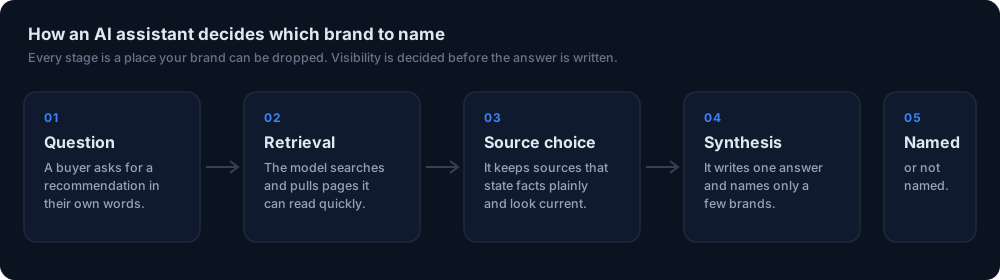
Yes. SEOWedge’s scan process discovers the buyer questions that actually drive traffic and citations during major shopping events. When you run a scan ahead of Black Friday, Cyber Monday, or holiday sales, SEOWedge extracts the high-intent, time-sensitive questions buyers are asking in your category. These are not generic prompts—you see the real, seasonal queries that AI assistants like ChatGPT and Gemini use to recommend brands and products.
The scan then tests those questions across AI platforms and records which brands and pages are named in the answers. If your site is missing, you see exactly which questions and pages are costing you visibility during the event. This is not a theoretical list: it is grounded in sampled AI answers from the models buyers use during peak demand.

How does SEOWedge prioritize which seasonal pages to create or update first?
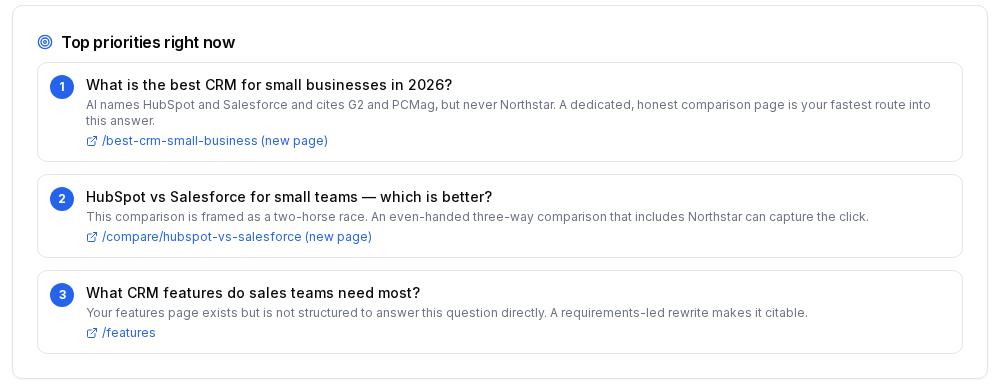
After running a scan, SEOWedge produces an opportunity list ranked by the impact each gap will have on your AI visibility for the season. Each opportunity comes with an Action Brief: it names the buyer question, shows which competitor or page is currently being cited, and explains why your site is being missed. This is not a generic page list—it is prioritized by what will move the needle for AI answers in the weeks leading up to your sale or event.
The Action Brief tells you whether to create a new page (e.g., "best Black Friday deals on running shoes") or update an existing one (e.g., your main holiday gift guide). The workflow is designed for busy ecommerce teams: you focus only on the pages that close real AI citation gaps, not on broad content refreshes that may not matter for the season.
What content strategies increase AI citations during high-traffic periods?
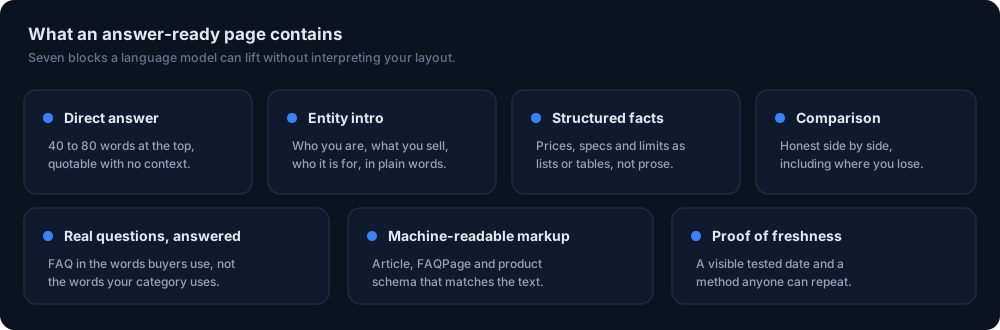
AI assistants cite pages that answer real buyer questions, cover the topic in depth, and match the language used by shoppers during peak events. SEOWedge’s workflow supports this by discovering the exact seasonal questions buyers ask, not just keywords. The Action Brief for each gap includes the phrasing and context needed to make your content the best candidate for citation.
To maximize AI citations, focus on:
- Creating event-specific guides (e.g., "best Black Friday laptop deals 2026") that answer the full scope of the buyer’s problem, not just the product.
- Updating landing pages and collections to reflect current offers, stock, and shipping timelines—AI assistants favor up-to-date, first-hand content.
- Using SEOWedge’s Content Studio to generate drafts that match your brand voice and the structure AI models prefer for citation, including direct-answer blocks and clear, factual details.
How does SEOWedge’s scan adapt to time-sensitive campaigns?
SEOWedge is built for campaign and event-driven work. When you scan your site before a peak shopping season, the buyer questions discovered reflect current search and buying intent. This means you are not relying on stale keyword lists or prompts from last year’s event. The scan output is a snapshot of what matters right now, per AI platform.
Paid plans let you run multiple scans across different campaigns or brands. Each scan generates a fresh opportunity list, so you can prioritize Black Friday, holiday, and other events separately. If you hit your scan or article limit during a busy season, you can buy credit packs to keep producing Action Briefs and articles without changing your plan—see how SEOWedge credits work for details.
The workflow is designed for speed: each Action Brief is actionable, and the Content Studio can generate several on-brand, event-specific pages at once on paid plans.
What is the workflow from gap discovery to published, AI-citable content?
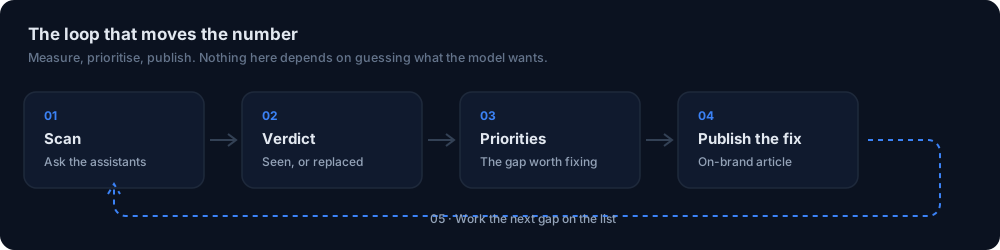
The SEOWedge workflow for peak shopping seasons follows a single loop:
1. Enter your domain and run a scan. SEOWedge crawls your site, builds a Brand DNA profile, and discovers seasonal buyer questions.
2. The scan tests those questions on AI assistants (OpenAI on all plans, plus Gemini on paid), recording which brands and pages are cited.
3. You receive an AI-Visibility score and a prioritized list of page-level gaps, each with an Action Brief.
4. For each Action Brief, the Content Studio generates a draft page or update, using your Brand DNA to keep the content on-brand and event-specific.
5. Each draft is scored for Publish Readiness, so you know it meets AI citation criteria before you export it to your site.
6. Publish the page and submit it through IndexNow (built-in), so AI assistants see the update faster.
Paid plans allow bulk generation of up to 10 articles at once, letting you cover your entire seasonal gap list in one pass.
How does SEOWedge’s approach differ from classic SEO or prompt-based tools?
Classic SEO tools track rankings and keywords, but do not show which pages are cited in AI answers or why. Prompt-based AI tools require you to write and maintain your own list of prompts, which may miss the real, high-intent seasonal questions buyers ask. SEOWedge discovers these questions automatically, tests them across AI assistants, and shows the exact competitor pages that are winning citations you want during peak events.
The output is actionable: you get a list of pages to create or update, not just a score or a chart. The workflow is shaped for ecommerce teams who need to move fast before and during shopping seasons. For a detailed breakdown of how SEOWedge’s prioritization loop compares to manual or prompt-based approaches, see the prioritization guide.
How do I act on the prioritized list and measure results?
Once SEOWedge delivers your prioritized list, you can use the Content Studio to draft and edit each recommended page. The Publish Readiness score tells you when a page is likely to meet AI assistant criteria for citation. After publishing, submit your new URLs through IndexNow (included in the workflow) to notify participating engines immediately. This increases the chance your content is surfaced in AI answers before or during your campaign window.
SEOWedge records which questions and platforms were tested, so you can see whether your brand is cited in the same scenarios after updates. This method is designed for campaign execution: you know which gaps you closed, which pages went live, and where to focus next. For more on how SEOWedge measures and closes AI visibility gaps, see the gap-to-content workflow.
What do I get free, and when should I upgrade for peak season coverage?
The free SEOWedge scan covers one domain and returns a Lite Scan: you get five discovered buyer questions, one Action Brief, and one free article (lifetime). This is enough to test the workflow for a single campaign or product category. If you need to cover multiple events, brands, or want to generate more than one article at a time, the Pro plan ($29/month) supports 20 Full Scans per month, 12 questions per scan, and up to 3 articles at once. Agency plans expand this further for multi-brand or multi-campaign teams.
Paid plans offer credit packs, so you can handle spikes in demand without changing your plan. This is designed for the reality of ecommerce: seasonal peaks require more scans, articles, and updates in a short window. For a detailed breakdown of plan features and upgrade triggers, see the free vs paid plans guide.
How this was tested
All product claims and workflow steps are based on SEOWedge’s documented process as of August 13, 2026. Screenshots illustrate the actual SEOWedge interface. Platform and AI assistant coverage is current to the date of writing. Buyer question discovery, gap detection, and prioritization are performed using SEOWedge’s scan and Action Brief workflow, which samples real AI answers and records results per platform. No features or statistics are claimed beyond those listed in the supplied product facts and workflow.
What this page does not cover
This page addresses only the use of SEOWedge for prioritizing content around peak shopping seasons and time-sensitive ecommerce campaigns. It does not cover classic SEO ranking, manual prompt tracking, or campaign planning for non-ecommerce sites. For broader content planning, see the SEOWedge content calendar guide. For seasonal or sale event content beyond peak shopping, see the dedicated seasonal events page.
Questions buyers ask us
How does SEOWedge find seasonal buyer questions without me writing prompts?
SEOWedge crawls your site and the wider market, extracting real buyer questions that spike during peak shopping periods. You do not have to write or maintain prompts—the tool surfaces high-intent, event-driven queries automatically for each scan.
Will SEOWedge show which competitor pages are winning AI citations for my category?
Yes. For each discovered question, SEOWedge records which brands and specific pages AI assistants cite. You see the exact URLs behind your missed opportunities, so you can target your content updates precisely.
Does SEOWedge work for both product and category pages during sales events?
Yes. The scan identifies opportunities at both the product and category level, depending on which questions are driving AI citations. Action Briefs specify whether to create, update, or optimize product, category, or landing pages for the season.
Can I use SEOWedge to prepare for multiple peak events (e.g., Black Friday and Christmas)?
On paid plans, you can run multiple scans for different campaigns, brands, or product lines. Each scan adapts to the current event or season, producing a fresh list of prioritized opportunities and Action Briefs.
How quickly can I go from scan to published, AI-citable page?
A scan and Action Briefs are delivered in minutes. The Content Studio drafts pages from your Brand DNA, and you can edit and export immediately. On paid plans, bulk generation lets you cover your entire seasonal gap list in one pass.
Does SEOWedge guarantee my page will be cited in AI answers before the event?
No tool can guarantee a citation, as AI assistants update their sources on their own schedule. SEOWedge maximizes your chances by targeting the right questions, structuring content for AI, and submitting new URLs through IndexNow for faster discovery.
See what AI assistants say about your site
Enter your domain and SEOWedge runs a free scan: your AI-Visibility score, the buyer questions where a competitor is named instead of you, and the first page to fix. No install, no sales call.