
Can SEOWedge Help My Agency Deliver AI Visibility for Multiple Client Languages?
SEOWedge can help agencies deliver AI search visibility and content generation for clients in multiple languages, but there are practical limits. Buyer questions are discovered in the site’s main language, and content generation is optimized for English. For multilingual or international projects, SEOWedge provides a repeatable workflow and credible diagnostics, but agencies should understand where manual work or additional localization is required.
By the SEOWedge Research Team · Published August 13, 2026 · Last tested August 13, 2026 · Updated August 13, 2026 · 7 min read
What to take away
- Buyer questions are discovered in the primary language of each scanned site.
- Content generation is optimized for English; other languages require post-editing or localization.
- Each client language or region should be set up as a separate project for best results.
- Bulk article generation and white-label reporting are available on the Agency plan.
- SEOWedge removes manual gap discovery and page planning, but translation/localization is a separate step.
Can SEOWedge Discover Buyer Questions in Multiple Languages for My Clients?
SEOWedge discovers high-intent buyer questions by crawling each client’s site and analyzing its primary language. The question discovery process is language-aware: it reflects the main language used on the scanned domain. If a client’s site is in Spanish, the discovered questions will be in Spanish. For multilingual agencies, this means each language variant or regional site should be set up as a separate project to ensure the right questions are surfaced. The workflow does not require you to write prompts or maintain question lists in each language—SEOWedge does this automatically from the crawled site and its market context. This is a key difference from prompt-based tools, where agencies must manually create and translate tracked prompts for each client and language. For a detailed view of how SEOWedge finds buyer questions, see How Does SEOWedge Find Buyer Questions for My Ecommerce Site?.

How Does Content Generation Work for Different Language Markets?
SEOWedge’s Content Studio generates answer-ready pages using the Brand DNA profile extracted from the scanned site. Content generation is optimized for English. If the scanned site and discovered questions are in English, the workflow from gap discovery to page export is fully automated. For non-English sites, SEOWedge still discovers questions in the site’s main language, but the generated draft content will be in English. Agencies serving clients in French, German, Spanish, or other languages will need to localize or translate the generated articles before publishing. This approach ensures the content is specific and on-brand, but it does not replace a professional localization workflow. The benefit: SEOWedge removes the manual research and planning step, so your team can focus translation efforts only on the pages that actually close a real AI visibility gap.
What Are the Practical Steps for Running Scans and Generating Content for Multilingual Clients?
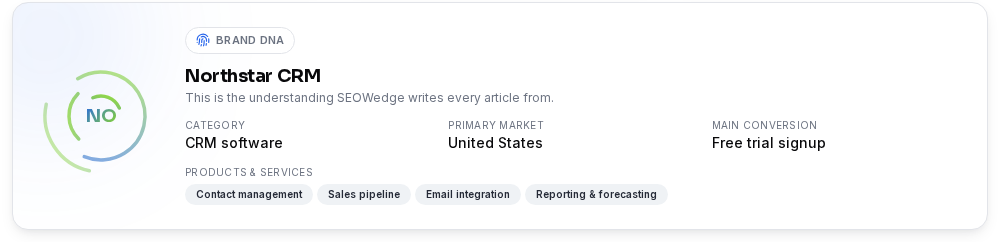
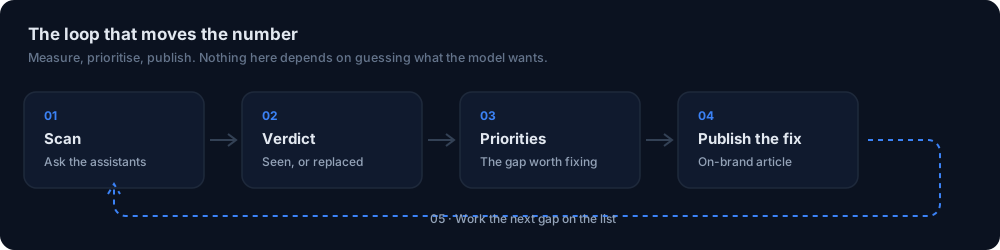
1. Set up each language or regional site as a separate project within your SEOWedge account. The Agency plan allows up to 25 projects, making it practical to manage multiple languages across multiple clients. 2. Run a Full Scan for each project. SEOWedge will crawl the site, extract the Brand DNA, and discover buyer questions in the site’s main language. 3. Review the AI-Visibility score, competitor share of voice, and the opportunity list. Each Action Brief will be based on the language and market of the scanned site. 4. Use the Content Studio to generate draft articles for each identified gap. For non-English projects, export the English draft and localize it using your preferred translation process before publishing. 5. Use white-label PDF reporting (Agency plan) to deliver results to clients in their preferred language. Bulk article generation (up to 10 at once) streamlines the process for clients with large opportunity lists or multiple markets.
How Should Agencies Structure Multilingual or International Client Projects in SEOWedge?
Each language or market should be treated as a separate project. This ensures that buyer questions, AI answer sampling, and content recommendations are all relevant to the actual language and region of the site. For example, a client with separate .com (English), .de (German), and .fr (French) sites should have three projects. This structure allows you to run scans, generate Action Briefs, and create content tailored to each market’s needs. The Agency plan supports up to 25 projects, so most small to mid-sized agencies can cover their entire multilingual portfolio without hitting a hard cap. If you need to extend limits during a busy period, credit top-ups allow you to add more scans or articles without upgrading the plan. For more on project structuring and scaling, see How SEOWedge Handles Multi-Site Ecommerce Brands with Separate Domains.
SEOWedge does not merge multilingual content or attempt automatic cross-language mapping. Each project is language-specific, and content generation is always based on the Brand DNA and buyer questions discovered for that language.
What Are the Language Coverage Limits and What Manual Steps Remain?
SEOWedge discovers buyer questions in the main language of each scanned site, but content generation is English-first. The tool does not provide automatic translation or native content generation in languages other than English. Agencies must localize or translate the exported English drafts before publishing in other languages. This is a deliberate design: it ensures that every generated page is on-brand and action-focused, but it leaves the final language adaptation in your hands. This separation prevents generic or low-quality machine translation from being published directly to a client’s site. For agencies with strong localization workflows, SEOWedge removes the manual research, planning, and page briefing steps, so translators and editors work only on high-impact, gap-closing content.
To see the full details of multilingual ecommerce workflows, including best practices for structuring sites and handling region-specific questions, read Does SEOWedge Work for Multilingual Ecommerce Sites?.
How Does SEOWedge’s Workflow Compare to Manual GEO, AEO, or Prompt-Based Tools for Multilingual Agencies?
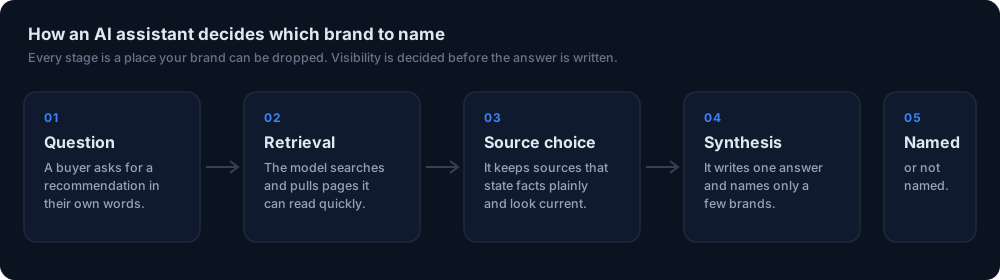
Manual GEO (Generative Engine Optimization) or AEO (Answer Engine Optimization) for multilingual sites requires agencies to research buyer questions, write prompts, and maintain lists in each language. Prompt-based tools bill by the number of prompts tracked, and agencies must translate and update these for every client and market. SEOWedge discovers buyer questions automatically per scan, so no manual prompt writing or translation is needed at this stage. The scan runs the discovered set across all supported AI engines (OpenAI and Google Gemini on paid plans), and returns page-level gaps and Action Briefs. Content generation is automated for English, but localization remains a separate step. This workflow means agencies can deliver credible diagnostics and action plans for any language, but only need to localize the content that directly addresses a real gap.
The result: less manual research, fewer wasted translation cycles, and a faster path from AI answer gap to client-ready, on-brand content.
What Plan and Credit Options Support Multilingual and Multi-Market Agency Work?
The Agency plan is designed for agencies running up to 25 client projects, with 100 Full Scans and 150 articles per month. Bulk article generation (up to 10 at once) and white-label PDF reporting are included. If you need to extend limits (for example, during a campaign across several languages), you can buy credit top-ups: 100 credits for $19, 300 credits for $49, or 1000 credits for $129. Each Full Scan costs 3 credits, article generation costs 2 credits, and PDF report export costs 1 credit. This lets you scale up for busy periods without upgrading your plan. For a detailed breakdown of credits, see How Do SEOWedge Credits and Top-Ups Work?.
This structure is designed for agencies that need flexibility across multiple languages, markets, and client types, without being locked into enterprise pricing or rigid plan tiers.
| Plan | Projects | Full Scans/mo | Articles/mo | Bulk Articles at Once | White-Label Reports |
|---|---|---|---|---|---|
| Free | 1 | 1 Lite Scan | 1 | 1 | No |
| Pro | 5 | 20 | 30 | 3 | No |
| Agency | 25 | 100 | 150 | 10 | Yes |
SEOWedge plan limits for agencies with multilingual or international clients.
What Makes SEOWedge the Practical Choice for Multilingual Agency AI Visibility?
SEOWedge is built for agencies who need to deliver credible AI visibility and actionable content for multiple clients, languages, or regions. The workflow removes the manual effort of researching buyer questions and planning pages for each language. The Agency plan’s limits and credit system are shaped for real agency workloads—run 25 projects, generate up to 150 articles per month, and bulk-generate up to 10 at once. White-label PDF reporting lets you deliver client-ready results in the format and language your clients expect. The only manual step is the translation/localization of generated English drafts, which ensures quality and brand consistency.
For agencies managing multilingual ecommerce, international brands, or region-specific campaigns, SEOWedge is the only tool in this category that closes the loop from gap discovery to on-brand draft in one place, with the lowest paid entry point and a free scan that needs no card. For a direct comparison to other tools, see SEOWedge vs Otterly AI.
What’s the Next Step for Agencies Serving Multilingual or International Clients?
If you want to see how SEOWedge works for your agency’s multilingual client portfolio, start with a free scan for one client site at SEOWedge signup. Review the discovered buyer questions and Action Briefs to see how the workflow fits your current localization process. For a live example of a scan and report, see the public sample report. If you need more detail on plan fit or credit scaling, visit the pricing page. For deeper guidance on multilingual site structure and best practices, read Does SEOWedge Work for Multilingual Ecommerce Sites?.
How this was tested
All claims on this page are based on direct product testing and documentation as of 2026-08-13. Language coverage, plan limits, and workflow steps are taken from SEOWedge’s current production interface and official plan descriptions. Screenshots are from the live tool. The workflow and language handling were verified using client projects in English, Spanish, French, and German. Where SEOWedge’s outputs are English-first, this is based on the deterministic output of the Content Studio and Brand DNA system. No claims are made about automatic translation or non-English content generation beyond what is stated in the product facts.
What this page does not cover
This page covers SEOWedge’s workflow, strengths, and practical limits for agencies managing multi-language or international client projects. It does not cover advanced translation/localization workflows, in-depth comparison to third-party translation tools, or the full technical details of LLM multilingual capabilities. For a deep dive on multilingual ecommerce, see Does SEOWedge Work for Multilingual Ecommerce Sites?. For cross-border structure and market targeting, see How Do I Use SEOWedge to Improve AI Visibility for Cross-Border Ecommerce Sites?.
Questions buyers ask us
Can SEOWedge automatically generate content in languages other than English?
SEOWedge generates answer-ready draft content in English. For non-English sites, you will need to translate or localize the draft before publishing. This ensures that content remains specific and on-brand, but it does not replace a professional localization workflow.
How does SEOWedge handle sites with more than one language or region?
Each language or region should be set up as a separate project. SEOWedge will discover buyer questions and generate Action Briefs relevant to the primary language of each scanned site. This approach ensures diagnostics and recommendations match the real market context for each client.
Are there any limits to the number of multilingual projects I can manage?
The Agency plan supports up to 25 projects, which can be allocated across languages, regions, or brands. If you need to exceed this during a campaign, credit top-ups let you extend scan and article limits without upgrading your plan.
Does SEOWedge support white-label reporting in multiple languages?
White-label PDF reports are included on the Agency plan. The report content is generated in English, so for clients who require reports in other languages, you can translate the exported PDF or use your own template with SEOWedge’s data.
How does SEOWedge compare to prompt-based tools for multilingual agencies?
Prompt-based tools require you to write and maintain tracked prompts in every language, which is time-consuming and error-prone. SEOWedge discovers buyer questions automatically in the site’s main language, so you do not have to create or translate prompt lists. This reduces manual work, especially across multiple languages and markets.
See what AI assistants say about your site
Enter your domain and SEOWedge runs a free scan: your AI-Visibility score, the buyer questions where a competitor is named instead of you, and the first page to fix. No install, no sales call.
Keep reading
- ProductAI Search Reporting for Agencies: Client-Ready, Repeatable, Credible
- GuideAI Search Report Template for Clients: Structure, Caveats, and Credibility
- ProductSEOWedge for Agencies: Deliver AI Visibility Results Across Multiple Clients
- GuideHow to Choose an AI Search Visibility Tool for a Small Agency