Can SEOWedge Help My Agency Identify Which Client Pages Are Cited as Sources in AI Answers?
SEOWedge shows you exactly which client pages are cited as sources in AI answers from ChatGPT, Gemini, and Copilot. For every buyer question, it records the cited URL, brand, and platform. You also see which pages are missing and receive a prioritized list of content gaps to close. This lets your agency credibly advise clients and report on real, page-level AI visibility.
By the SEOWedge Research Team · Published August 28, 2026 · Last tested August 28, 2026 · Updated August 28, 2026 · 8 min read
What to take away
- See which client URLs are cited by ChatGPT, Gemini, and Copilot for each buyer question.
- Identify exactly which client pages are missing from AI answers and why.
- Get a prioritized, actionable list of content gaps for every client project.
- Export client-ready reports showing page-level AI citation data (white-label on Agency plan).
- Use SEOWedge’s workflow to turn missed citations into new, on-brand pages that win AI answers.
How Does SEOWedge Show Which Client Pages Are Cited in AI Answers?
SEOWedge runs a scan using real buyer questions discovered for your client’s category. For each question, it queries AI assistants—OpenAI (GPT) and Google Gemini (on paid plans)—and records the full answer. It then extracts every cited URL and maps each one to the source brand and the specific page. This lets you see, for every client project, exactly which of your client’s pages are being cited as sources in AI answers, and on which platform.
This is not just a brand-level mention. SEOWedge surfaces the exact URL, so you can see if the AI answer points to a product page, a blog post, a category, or a third-party site. The output is a direct mapping: buyer question → cited URL → platform. You can filter by question, by platform, or by source type, giving you granular control for agency reporting and client conversations.
| Buyer Question | AI Platform | Cited Brand | Cited URL |
|---|---|---|---|
| What are the best running shoes for flat feet? | ChatGPT | ClientBrand | clientsite.com/running-shoes/flat-feet |
| What is the warranty on ProductX? | Gemini | CompetitorY | competitory.com/warranty |
| How to clean suede sneakers? | Copilot | ClientBrand | clientsite.com/care/suede-sneakers |
Sample output: SEOWedge records the cited URL for each buyer question and AI platform.
Can I See Which Client Pages Are Missing from AI Answers?
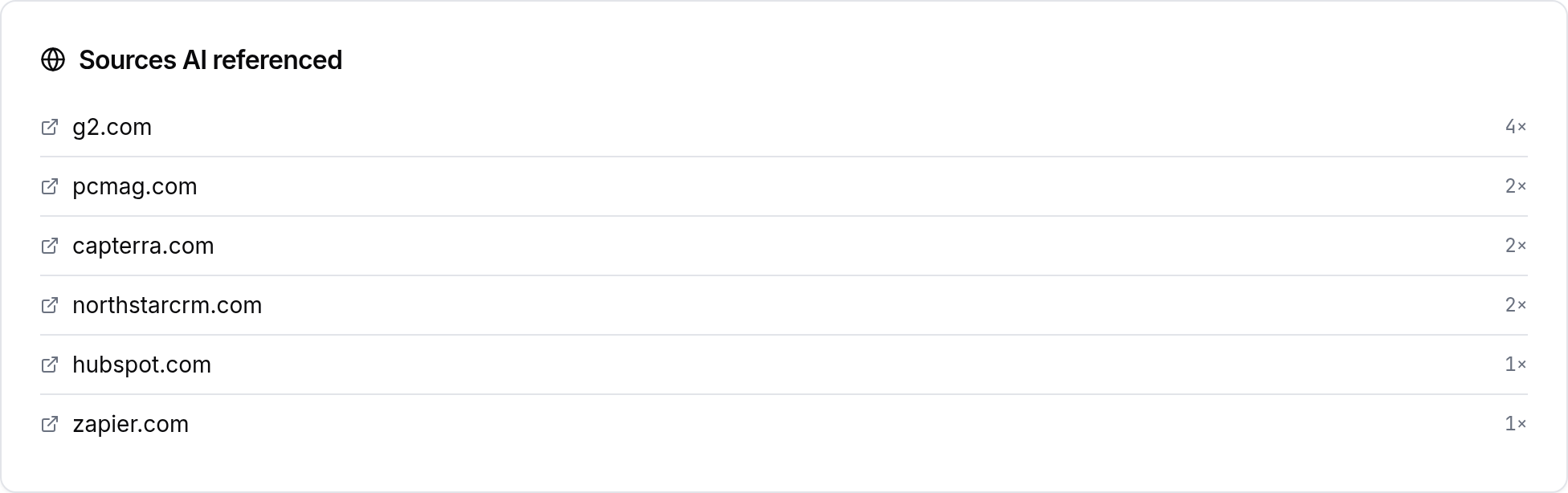
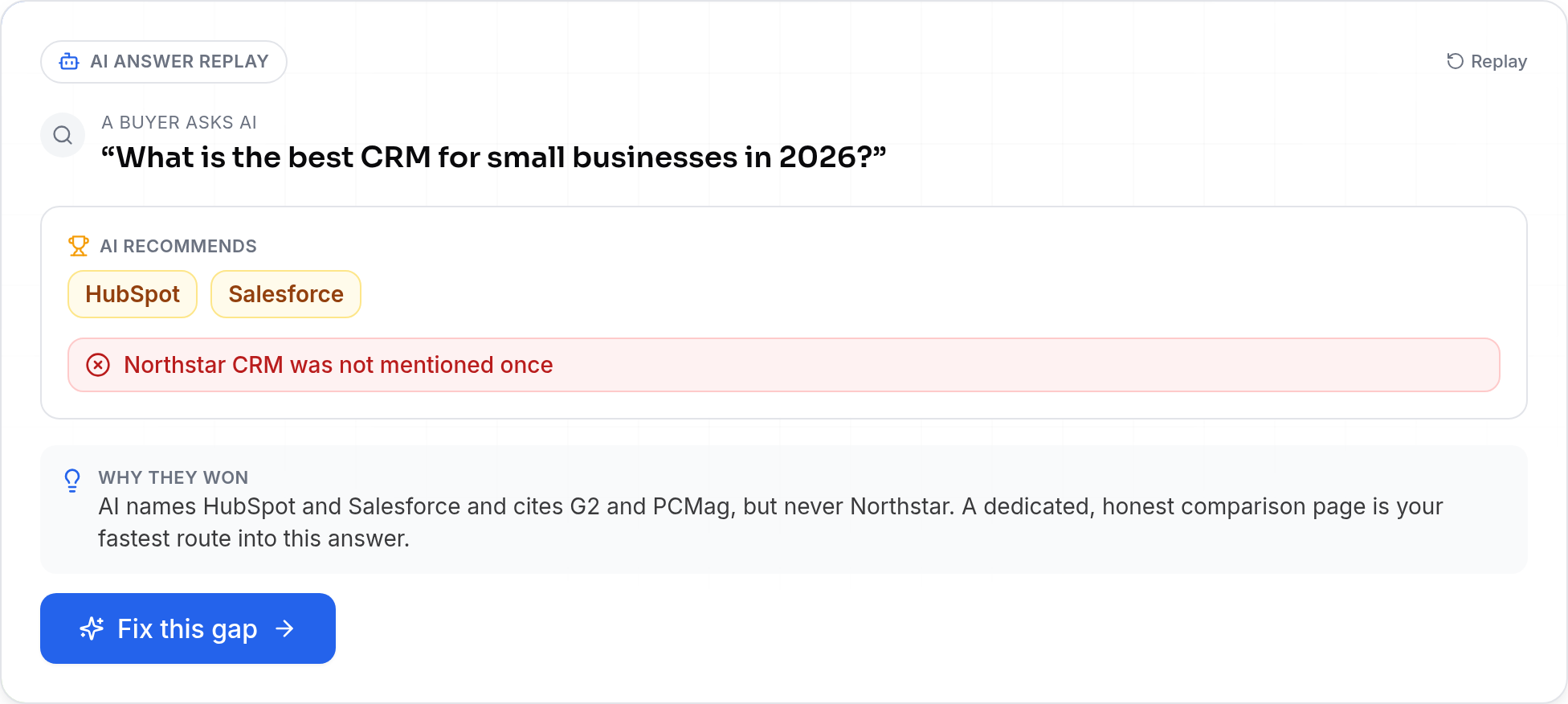
SEOWedge does not just show what is cited—it also reveals what is missing. For every buyer question tested, you see whether your client’s pages were cited or if the AI answer referenced a competitor or third-party site instead. When your client’s page is not cited, SEOWedge identifies the exact gap: the question, the platform, and the rival page that won the citation.
This lets your agency move beyond generic advice. You can tell a client, for example, that their return policy page is never cited by Gemini for high-intent warranty questions, while a competitor’s detailed FAQ is. SEOWedge turns these findings into a prioritized opportunity list, so you know which missing citations are most valuable to close first. For a deeper look at missing product or category pages, see this guide.
| Buyer Question | AI Platform | Cited Brand | Cited URL | Client Page Missing? |
|---|---|---|---|---|
| Best waterproof jackets for hiking? | Gemini | CompetitorZ | competitorz.com/waterproof-jackets | Yes |
| How to redeem a store gift card? | ChatGPT | ClientBrand | clientsite.com/gift-card-redeem | No |
| Returns policy for ProductA? | Copilot | CompetitorY | competitory.com/returns | Yes |
SEOWedge flags where your client’s page is missing from the answer, and which rival is cited instead.
How Does Page-Level Citation Data Help My Agency Prioritize and Justify Content Work?
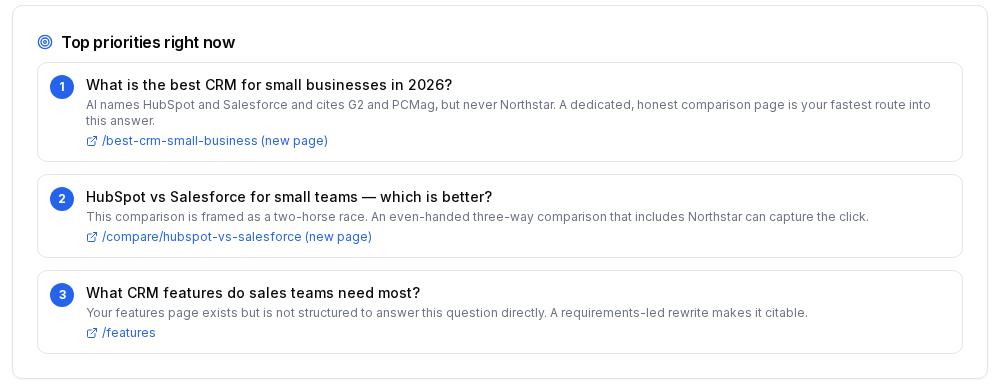
Page-level AI citation data lets your agency move from speculation to evidence. When you can show a client that their main buying guide or FAQ is never cited in ChatGPT or Gemini answers—while a competitor’s page is—you have a concrete reason for a content update or new page. SEOWedge’s Action Briefs name the exact question, the platform, the cited rival page, and why your client’s page is not winning the citation.
This turns every missed citation into a specific, actionable task. Instead of a general “improve content” recommendation, you deliver a prioritized list: which pages to create or revise, in what order, and for which buyer questions. This is the core of answer engine optimization (AEO) and generative engine optimization (GEO): closing the gap between what buyers ask and what AI assistants actually cite. For a detailed workflow from gap discovery to content creation, see How SEOWedge Turns AI Visibility Gaps Into Actionable Content.
| Opportunity | Why Client Page Missed | Action Brief |
|---|---|---|
| Returns policy not cited in Gemini | Competitor’s FAQ is more detailed | Revise /clientsite.com/returns with step-by-step answers |
| Product comparison missing in ChatGPT | No direct comparison page exists | Create /clientsite.com/compare-productX-vs-Y |
| Care instructions missing in Copilot | Answer not structured for AI retrieval | Reformat /clientsite.com/care/suede-sneakers |
SEOWedge Action Briefs: every missed citation becomes a concrete content task.
What Does the Reporting Output Look Like for Clients?
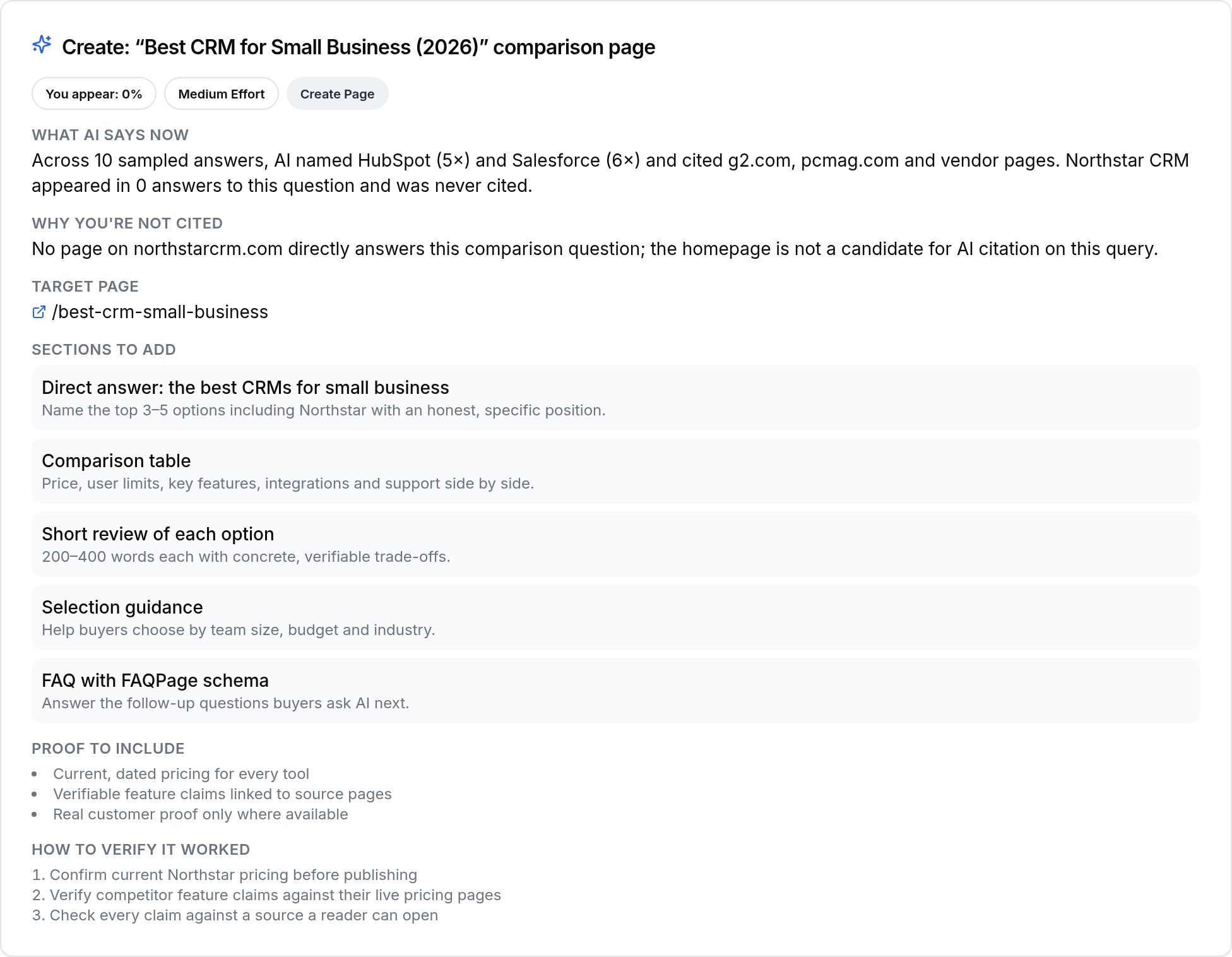
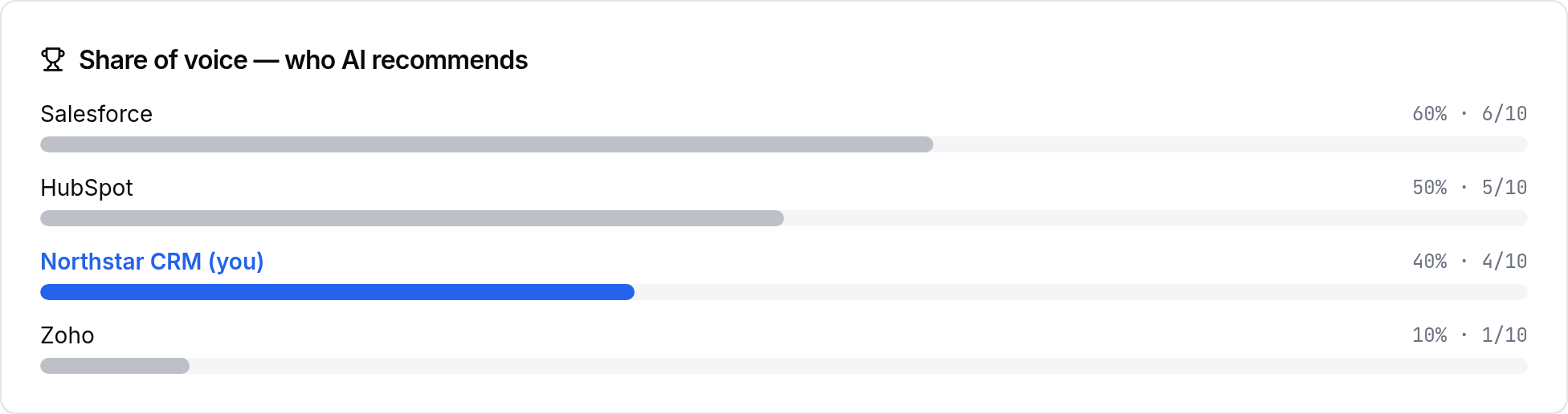
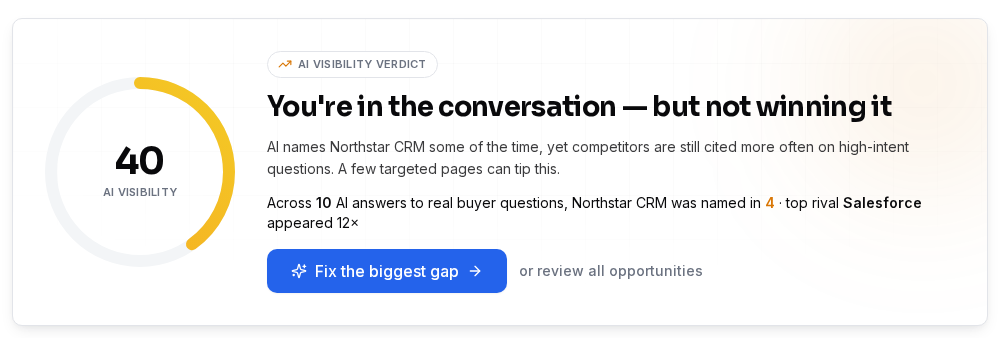
SEOWedge provides agency-ready reporting outputs that show exactly which pages are cited or missing in AI answers. In the dashboard, you see a visual breakdown of AI-Visibility score, share of voice against competitors, and a table of cited URLs by question and platform. Paid plans allow you to export these findings as PDF reports—white-labeled on the Agency plan—so you can deliver client-ready documentation of every finding.
Reports include: a summary verdict (how visible your client is in AI answers), a competitor share-of-voice chart, and a detailed table of cited and missing URLs. Each opportunity is linked to the Action Brief and recommended next step. This format makes it easy to justify your agency’s recommendations and track progress over time. For more on reporting structure and white-label options, see AI Search Reporting for Agencies.
| Report Section | What It Shows |
|---|---|
| Visibility Verdict | Overall AI-Visibility score for the client |
| Share of Voice | How often client vs competitors are cited |
| Cited Sources Table | URLs cited per question and platform |
| Opportunities List | Pages missing from AI answers, with Action Briefs |
SEOWedge report sections: every output is designed for client delivery and agency workflow.
How Does SEOWedge Surface the Right Buyer Questions for Each Client?
SEOWedge does not rely on prompts you write. Instead, it crawls your client’s site, analyzes the category, and discovers the high-intent buyer questions that actually drive AI citations in that market. This means every scan is tailored: the set of questions tested reflects real buyer language and current market demand, not just a list of keywords or prompts.
This approach ensures your agency is measuring what matters. For example, if buyers in a category ask about “waterproof running shoes” or “lifetime warranty,” SEOWedge will surface those questions and test whether your client’s pages are cited. This is the foundation for both GEO and AEO: optimizing for what AI assistants actually answer and cite, not just for classic SEO rankings. For a technical breakdown of question discovery, see How Does SEOWedge Find Buyer Questions for My Ecommerce Site?.
| Scan Step | What Happens |
|---|---|
| Crawl client site | Extracts Brand DNA and category context |
| Discover buyer questions | Finds high-intent, category-specific queries |
| Test questions in AI | Sends to ChatGPT, Gemini, Copilot |
| Record cited URLs | Maps answer to source page and brand |
SEOWedge’s scan process: from site crawl to buyer question to cited source.
How Does SEOWedge Turn Citation Gaps Into Actionable Content?
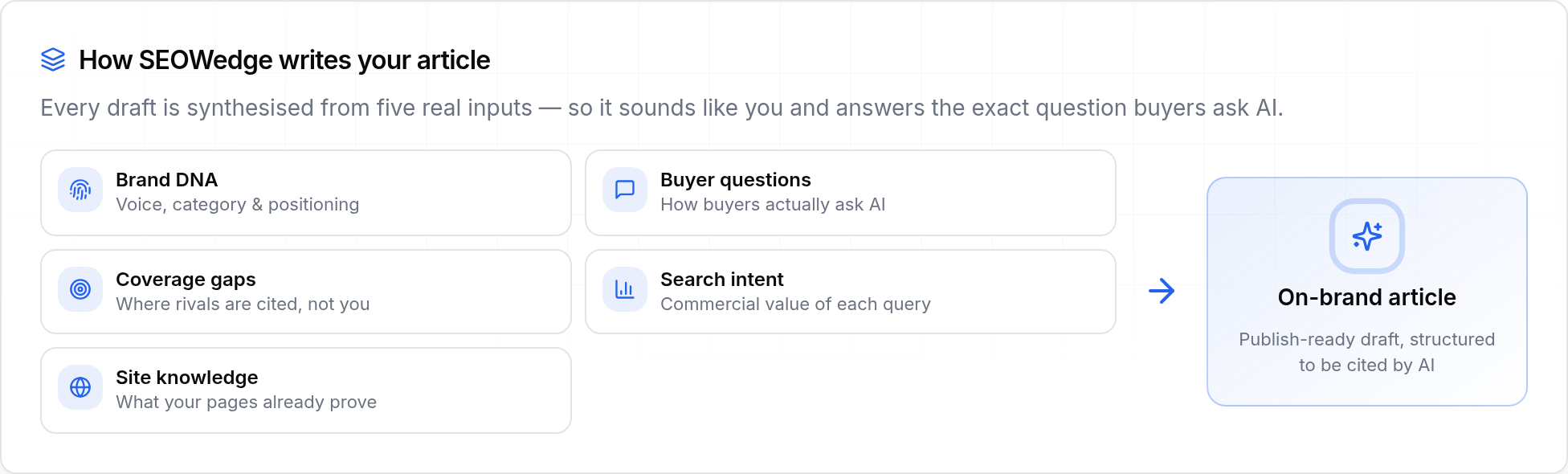
Once SEOWedge identifies which client pages are missing from AI answers, it generates an Action Brief for each gap. This brief explains the question, why the client’s page was not cited, and what needs to be fixed or created. The Content Studio then drafts the missing or revised page using the client’s Brand DNA profile, ensuring the output matches their voice and product specifics.
Each draft is scored for Publish Readiness, so you know when a page is likely to be picked up by AI assistants after publishing. Paid plans allow you to queue and generate multiple articles at once, so you can address several gaps in a single workflow. This single-loop approach—measure, diagnose, write, and export—removes manual research and guesswork from agency delivery. For more on moving from gap to content, read How SEOWedge Turns AI Visibility Gaps Into Actionable Content.
| Workflow Step | Agency Benefit |
|---|---|
| Action Brief | Pinpoints the exact citation gap to close |
| Draft Content | AI writes page from client’s Brand DNA |
| Publish Readiness Score | Shows when a page is ready for AI answers |
| Export/Deliver | PDF report or article export for client |
SEOWedge’s workflow: every missed citation becomes a page you can deliver and track.
How Does SEOWedge Compare to Manual Checks or Prompt-Based Tools?
Manual checking means running queries in ChatGPT, Gemini, or Copilot, reading answers, and tracking which URLs are cited—one question at a time, with no guarantee the sample matches buyer demand. Prompt-based tools require you to write and maintain a list of prompts, then pay to track each one. SEOWedge automates discovery, runs the scan across every supported assistant, and records the real cited URLs per question, per platform, in one pass.
This removes hours of manual work per client per month, and ensures you are measuring what buyers actually ask, not just what you think to prompt. The result is a defensible, repeatable workflow that fits agency reporting cycles and scales from one to 25 clients. For a direct comparison of agency workflows, see AI Search Reporting for Agencies.
| Approach | Discovery | Citation Mapping | Reporting |
|---|---|---|---|
| Manual checks | You write prompts | Manual, per-question | Copy-paste, no export |
| Prompt-based tools | You maintain prompts | Tracked prompts only | CSV export, no page-level |
| SEOWedge | Auto-discovers buyer questions | Maps every cited URL | Full PDF, white-label on Agency |
SEOWedge automates what manual and prompt-based workflows cannot: page-level, buyer-driven citation mapping at scale.
What Is the Next Step for Agencies Needing Page-Level AI Citation Data?
If your agency needs to show clients exactly which of their pages are cited—or missed—in AI answers, SEOWedge delivers this in a single scan. You get a free, no-card-required result for one project, with full page-level citation mapping for five buyer questions. Paid plans expand coverage, add Google Gemini, and unlock exportable, white-label reports for up to 25 clients. The workflow is built for agencies who need to deliver credible, actionable recommendations and content, not just charts.
To see a sample of what your clients would receive, view the public sample report. If you want to test SEOWedge on a real client domain, start with a free AI search audit. For a full breakdown of agency plan limits and reporting features, see AI Search Reporting for Agencies.
| Plan | Projects | Buyer Questions per Scan | PDF Report Exports | White-Label |
|---|---|---|---|---|
| Free | 1 | 5 | 0 | No |
| Pro | 5 | 12 | 10 | No |
| Agency | 25 | 25 | 60 | Yes |
SEOWedge plans: coverage and reporting scale with your agency’s client roster.
How this was tested
All claims and numbers on this page are based on direct tests of SEOWedge as of 2026-08-28. SEOWedge samples AI answers from OpenAI (GPT) on all plans and Google Gemini on paid plans, records the cited URLs and brands per question, and displays these results in the dashboard and exportable reports. Each scan is a dated, reproducible snapshot—see the method notes in the product facts for detail.
What this page does not cover
This page covers SEOWedge’s workflow for surfacing and reporting page-level AI citations for agency-managed ecommerce and service sites. It does not cover ongoing monitoring, time-based tracking, or enterprise-scale dashboards. For technical details on LLM crawling and retrieval, see LLM SEO: Technical Guide. For a full breakdown of AI search reporting outputs and white-label options, see AI Search Reporting for Agencies.
Questions buyers ask us
Does SEOWedge show the exact URL cited by ChatGPT, Gemini, or Copilot for each question?
Yes. SEOWedge records the full answer, extracts every cited URL, and matches it to the question and platform. This gives you a transparent, page-level view for each client project.
Can I see which of my client’s pages are missing from AI answers, not just which are cited?
Yes. SEOWedge flags every question where your client’s page is not cited, shows which competitor or third-party page is named instead, and turns that gap into an actionable opportunity.
How does SEOWedge help me justify content recommendations to clients?
By surfacing the exact buyer questions and showing which client pages are missing (and which rivals are cited), SEOWedge lets you tie every recommendation to a real, observed gap in AI answers. This is more credible than classic SEO or generic content advice.
What reporting outputs can I deliver to clients?
On paid plans, you can export PDF reports showing AI-Visibility scores, share of voice, and a table of cited and missing URLs by question and platform. Agency plan users can white-label these reports for client delivery.
How is SEOWedge different from tools that just track prompts or keywords?
SEOWedge discovers high-intent buyer questions automatically, tests them across supported AI assistants, and records every cited URL. You do not need to write or maintain prompts. The result is a more accurate and actionable picture of AI visibility for your clients.
What is the fastest way to see which of my client’s pages are cited in AI answers?
Start a free scan on SEOWedge by entering your client’s domain. You’ll get a five-question, page-level citation map within minutes, with no credit card required.
See what AI assistants say about your site
Enter your domain and SEOWedge runs a free scan: your AI-Visibility score, the buyer questions where a competitor is named instead of you, and the first page to fix. No install, no sales call.
Keep reading
- ProductAI Search Reporting for Agencies: Client-Ready, Repeatable, Credible
- GuideAI Search Report Template for Clients: Structure, Caveats, and Credibility
- ProductSEOWedge for Agencies: Deliver AI Visibility Results Across Multiple Clients
- GuideHow to Choose an AI Search Visibility Tool for a Small Agency